
Ricgraph Explorer - Exploration for Ricgraph - Research in context graph

Project description














Ricgraph - Research in context graph
What is Ricgraph?
Ricgraph, also known as Research in context graph, enables the exploration of researchers, teams, their results, collaborations, skills, projects, and the relations between these items.
Ricgraph can store many types of items into a single graph. These items can be obtained from various systems and from multiple organizations. Ricgraph facilitates reasoning about these items because it infers new relations between items, relations that are not present in any of the separate source systems. It is flexible and extensible, and can be adapted to new application areas.
Motivation
Ricgraph is software that is about relations between items. These items can be collected from various source systems and from multiple organizations. We explain how Ricgraph works by applying it to the application area research information. We show the insights that can be obtained by combining information from various source systems, insight arising from new relations that are not present in each separate source system.
Research information is about anything related to research: research results, the persons in a research team, their collaborations, their skills, projects in which they have participated, as well as the relations between these entities. Examples of research results are publications, data sets, and software.
The following sections show three use cases that use different types of information (called items): researchers, skills, publications, etc. Most often, these types of information are not stored in one system, so the use cases may be difficult or time-consuming to answer. However, by using Ricgraph, these use cases (and many others) are easy to answer, as will be explained throughout this documentation.
Although this documentation illustrates Ricgraph in the application area research information, the principle “relations between items from various source systems” is general, so Ricgraph can be used in other application areas.
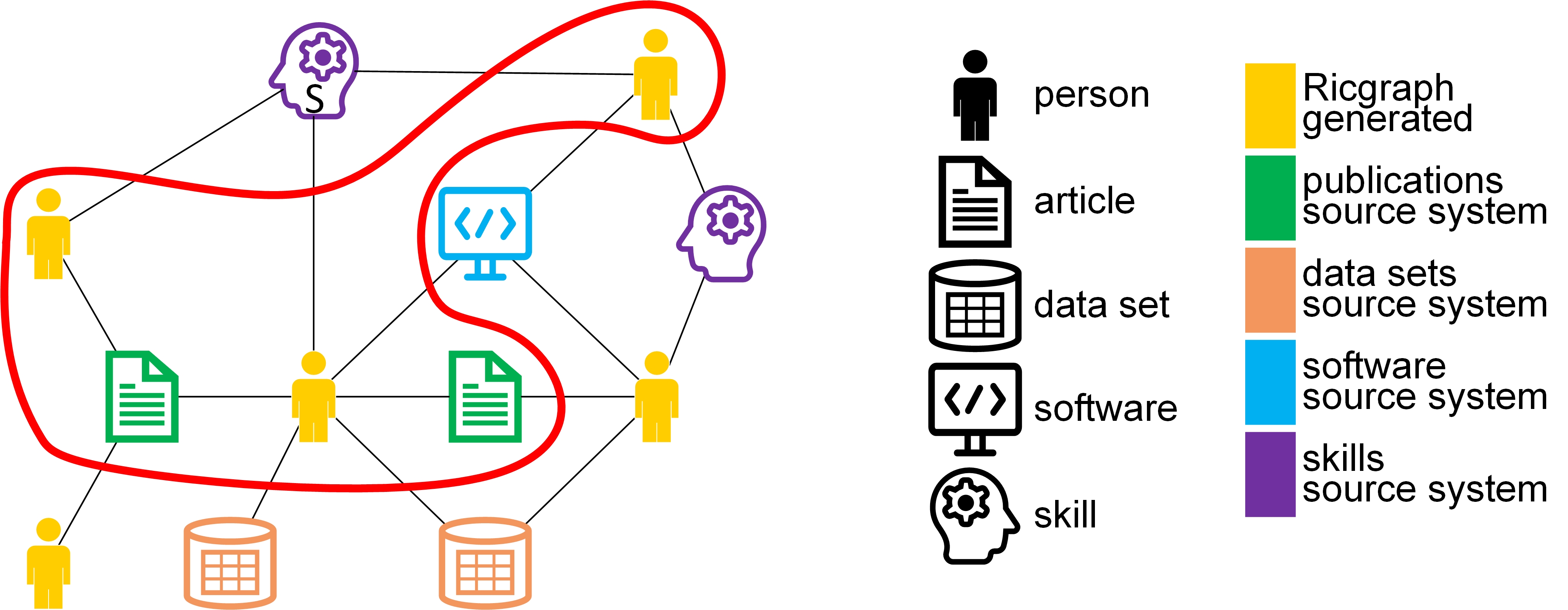
Use case for a journalist
As a journalist, I want to find researchers with a certain skill S and their publications, so that I can interview them for a newspaper article. Example skills can be: climate change or stem cells. The items surrounded by the red line are the solution to this use case.
Use case for a librarian
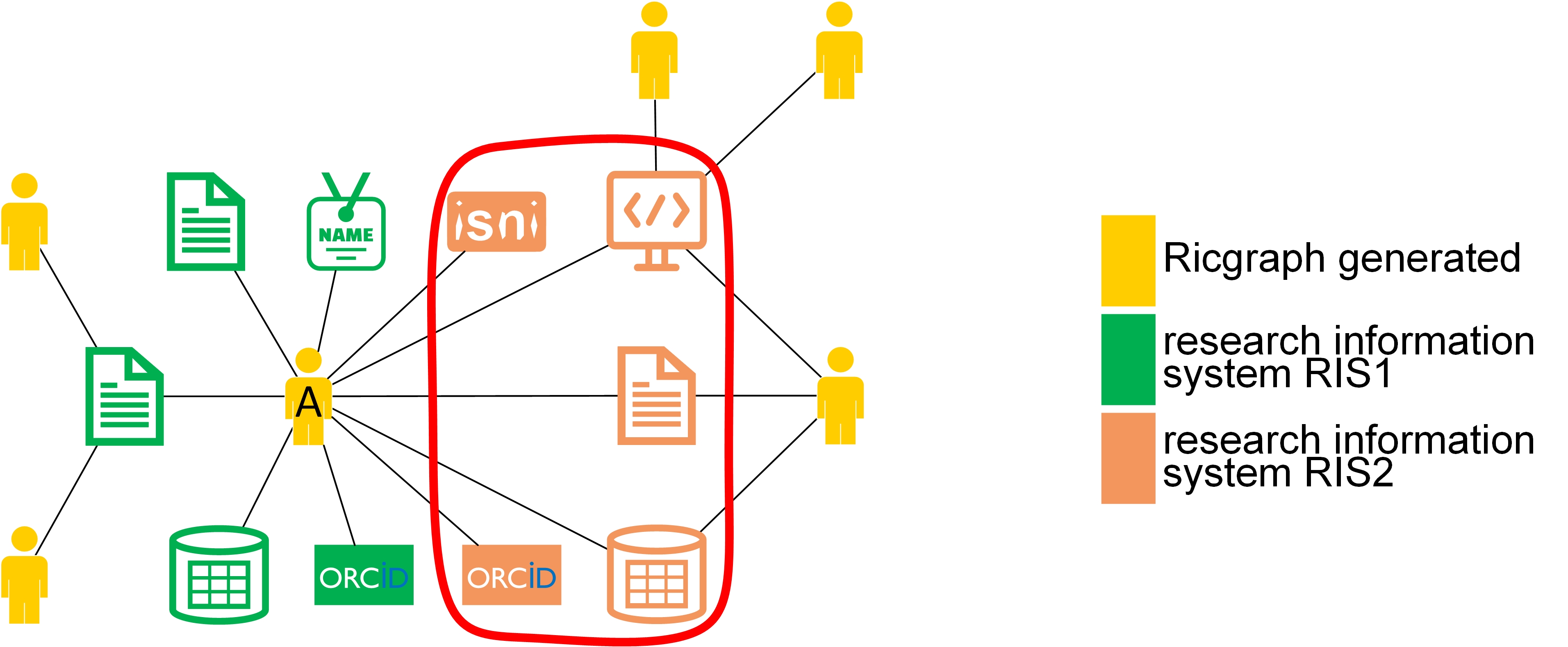
As a librarian, I want to enrich my local research information system with research results from person A that are in other systems (in orange, RIS2) but not in ours (in green, RIS1), so that we have a more complete view of research at our university. The items surrounded by the red line are the solution to this use case.
Use case for a researcher
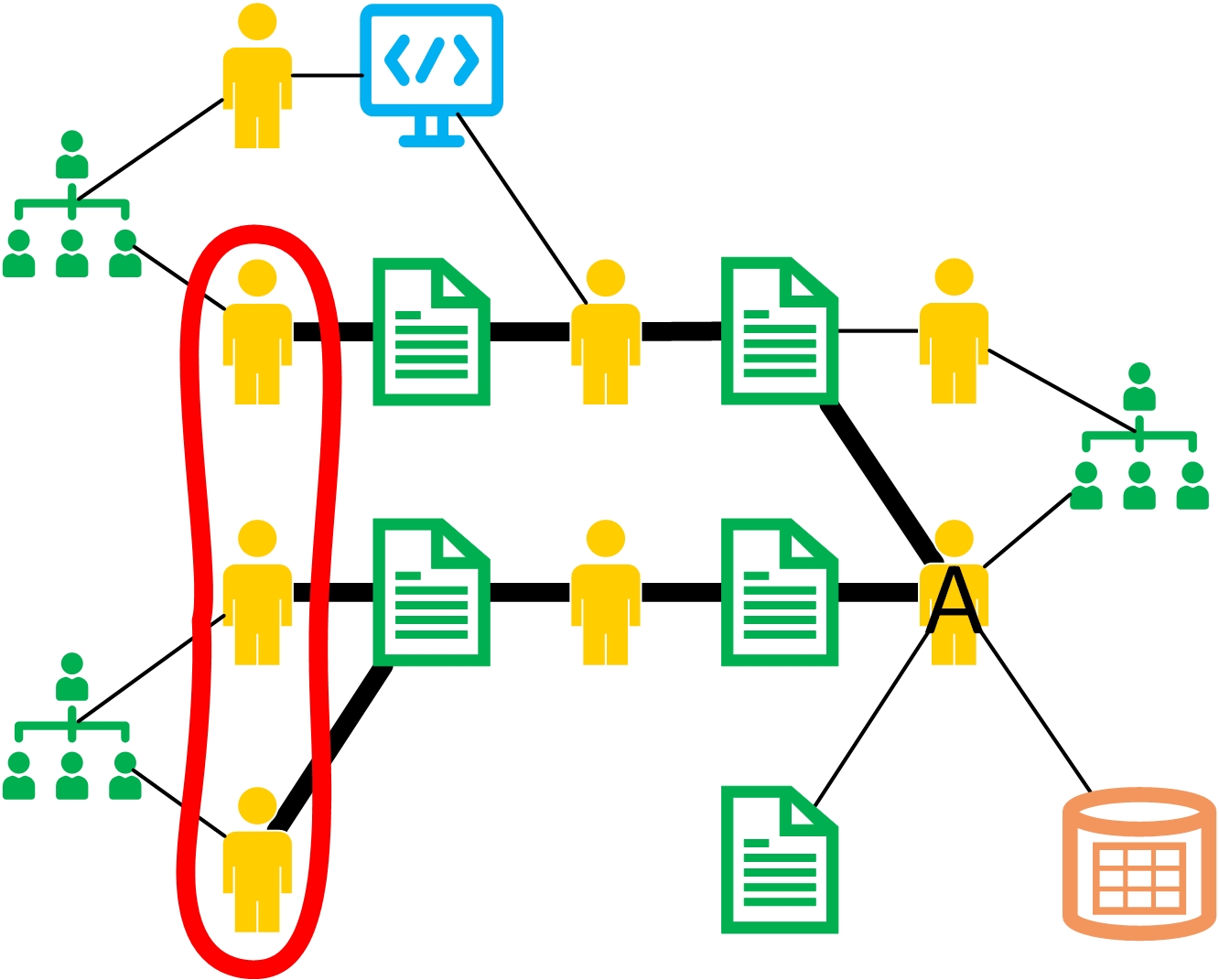
As a researcher A, I want to find researchers from other universities that have co-authored publications written by the co-authors of my own publications, so that I can read their publications to find out if we share common research interests. The items surrounded by the red line are the solution to this use case.
Main contributions of Ricgraph
- Ricgraph can store many types of items in a single graph.
- Ricgraph harvests multiple source systems into a single graph.
- Ricgraph Explorer is the exploration tool for Ricgraph.
- Ricgraph facilitates reasoning about items because it infers new relations between items.
- Ricgraph can be tailored for an application area.
Read more about Ricgraph
For a gentle introduction in Ricgraph, read the reference publication: Rik D.T. Janssen (2024). Ricgraph: A flexible and extensible graph to explore research in context from various systems. SoftwareX, 26(101736). https://doi.org/10.1016/j.softx.2024.101736.
You might also want to read the documentation on https://docs.ricgraph.eu. You can also go to the Ricgraph GitHub repository. To use Ricgraph, installing the Ricgraph package from PyPI is not sufficient. Please read the installation instructions in the Ricgraph GitHub repository.
Contact
Ricgraph has been created and is being maintained by Rik D.T. Janssen from Utrecht University in the Netherlands. You can find contact details at his Utrecht University employee page. He also has an ORCID profile on ORCID 0000-0001-9510-0802.
Release history Release notifications | RSS feed


Download files
Download the file for your platform. If you're not sure which to choose, learn more about installing packages.
Source Distribution
Built Distribution
Filter files by name, interpreter, ABI, and platform.
If you're not sure about the file name format, learn more about wheel file names.
Copy a direct link to the current filters
File details
Details for the file ricgraph_explorer-3.3.tar.gz.
File metadata
- Download URL: ricgraph_explorer-3.3.tar.gz
- Upload date:
- Size: 906.6 kB
- Tags: Source
- Uploaded using Trusted Publishing? No
- Uploaded via: twine/6.2.0 CPython/3.13.11
File hashes
| Algorithm | Hash digest | |
|---|---|---|
| SHA256 |
7f74cb9994ea1955428de750b2e929ecc7a1326732a510856c9de29ffafe604e
|
|
| MD5 |
be243cc5fff650730df081e06e323237
|
|
| BLAKE2b-256 |
dd3596eb5d0b2c5aec9f61c72805b3b8b7fe44169fd5e4a4a5b3601ef98bb783
|
File details
Details for the file ricgraph_explorer-3.3-py3-none-any.whl.
File metadata
- Download URL: ricgraph_explorer-3.3-py3-none-any.whl
- Upload date:
- Size: 913.7 kB
- Tags: Python 3
- Uploaded using Trusted Publishing? No
- Uploaded via: twine/6.2.0 CPython/3.13.11
File hashes
| Algorithm | Hash digest | |
|---|---|---|
| SHA256 |
da3858c81f8c5f0839c789c7a13236ef444377bfa3767b51537c3843bf827104
|
|
| MD5 |
de7345bc62f1ac7d6dba77fa379cc9d6
|
|
| BLAKE2b-256 |
93198473c23ab436f3eedf41e296e20152ef0a7d690c1414ab0dbd321266f636
|






