
A python->Zig CPU rasteriser.


Project description
Riley
Riley is a software rasteriser written in Zig for digital image correlation uncertainty quantification (DIC UQ). It renders deformed speckle pattern images from finite element simulations and supports higher order surface elements including tri3, tri6, quad4, quad8 and quad9. Riley supports nodal, texture and analytic function shaders, including higher order texture sampling and mixed scenes with multiple mesh and shader types.
We chose Zig because it gives us explicit memory control, strong compile-time specialisation and direct SIMD support. Riley uses comptime to generate specialised raster paths for geometry, shader and build-policy combinations so the hot loop avoids runtime dispatch.
Getting Started: Zig
Riley currently targets Zig 0.16.0, available here.
The first check to run is the minimal regression suite:
zig test -O ReleaseSafe ./src/test_min.zig
or with the build system:
zig build test-min -Doptimize=ReleaseSafe
Plain zig run and zig test on files under ./src/ default to the standard Riley configuration:
- precision:
f64 - SIMD:
on - Newton solver:
fast
The build system can override these defaults:
zig build <STEP> -Dprecision=f64 -Dsimd=on -Doptimize=ReleaseSafe
zig build <STEP> -Dprecision=f64 -Dsimd=off -Doptimize=ReleaseSafe
zig build <STEP> -Dprecision=f32 -Dsimd=on -Doptimize=ReleaseSafe
zig build <STEP> -Dnewton-solver=robust -Doptimize=ReleaseSafe
zig build <STEP> -Dsimd-vector-width=8 -Doptimize=ReleaseSafe
Run zig build --help to see the available build steps.
The min suite contains two high-signal cases:
multimesh: two elements of each supported type in one scene, rendered with nodal and texture shadingsphere200: a sphere rendered across shader combinations and element orientations
These are the quickest correctness checks and should be your first stop before running wider gold or benchmark suites.
Only the main production-path min gold is kept in the repository by default, so the min suite is intended primarily for f64 with SIMD enabled. The min suite also requires .simd = .on; the scalar min orchestration is not implemented.
For deeper test, gold generation and benchmark workflows, see dev/README.md.
Getting Started: Python
We provide Python bindings to the Riley C ABI through Cython, and publish a riley-raster package on PyPI.
Install from PyPI with:
pip install riley-raster
This builds Riley from Zig source on your local machine, so installation can take a minute or two depending on hardware.
For local development, clone the repository, create a virtual environment and install from source:
pip install -e .
Python demos live in src/riley/pydemos/ and the Python tests live in src/riley/pytests/.
Run the packaged Python test suite with:
python -m pytest --pyargs riley.pytests -s
or through Riley's module entry point:
python -m riley test
The repo parity test inside riley.pytests compares Python demo output against Zig demo output. It runs when the repository assets are available from the current working directory and skips cleanly otherwise.
Capability Demonstration
We include several demonstration scripts in ./src/ and Python equivalents in ./src/riley/pydemos/.
In Zig:
zig run -O ReleaseFast ./src/demo_<CASE>.zig
or with the build system:
zig build demo-<CASE> -Doptimize=ReleaseFast
where CASE is one of sphere200, rabbits, dicuq, or stereocal. Zig demo output is written to ./out/demo-CASE/.
Zig demo source on GitHub:
In Python:
python -m riley demo_<CASE>
Python demo output is written to Path.cwd() / "out-riley-py" / "demo-CASE".
Python demo source on GitHub:
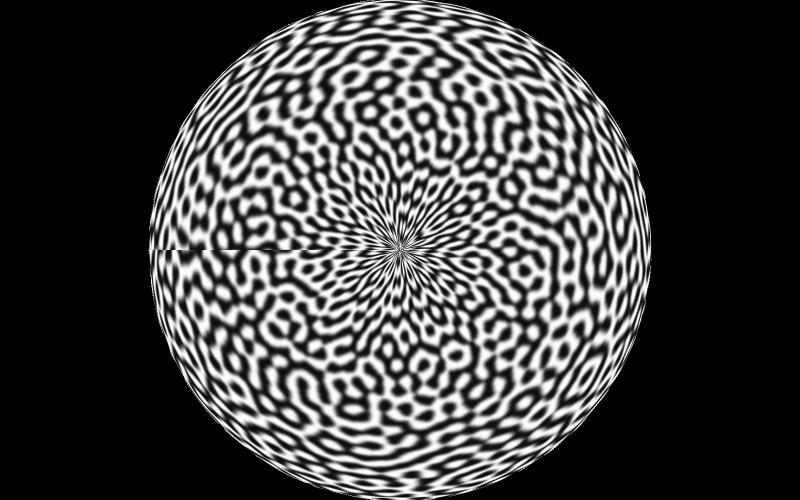
Demo 1: Speckle Sphere
For this demonstration we import a sphere mesh and apply a speckle pattern texture shader. This is a representative single-mesh, single-shader case.
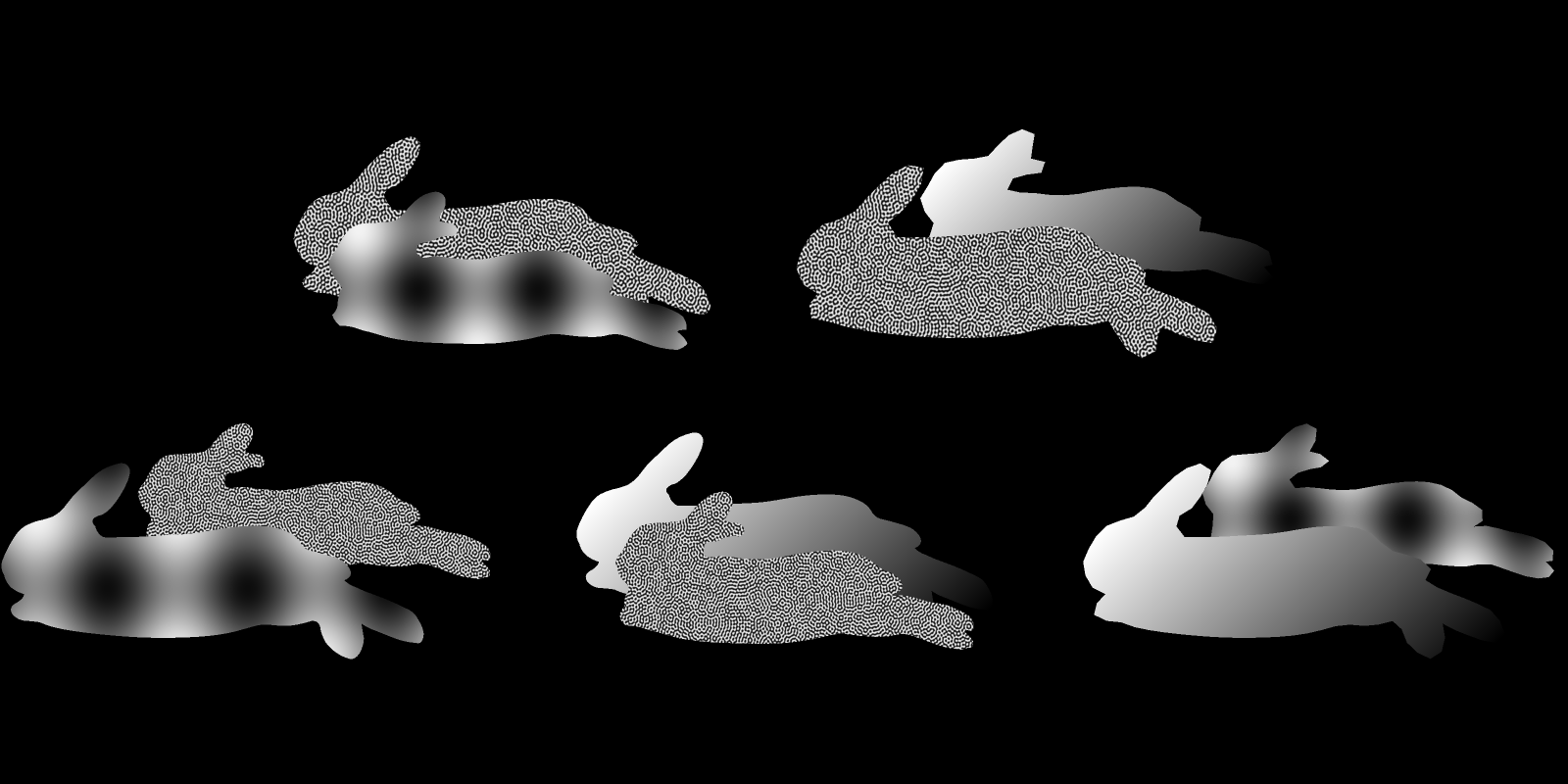
Demo 2: Rendering Rabbits
This demonstration renders rabbit meshes composed of all supported element types: tri3, tri6, quad4, quad8 and quad9. It also exercises the main shader families in one scene.
Demo 3: Digital Image Correlation Uncertainty Quantification
This case demonstrates a representative stereo DIC UQ rendering of a plate with a hole in tension. The input FE model is in ./data/FE/.
| Camera 0 | Camera 1 |
|---|---|
 |
 |
Demo 4: Stereo Calibration
This demonstration uses the stereo setup from the DIC UQ case and renders stereo calibration target images. The input meshes are in ./data/calplate/.
| Camera 0 | Camera 1 |
|---|---|
 |
 |
Project Layout
The main Zig entry point for the rendering pipeline is the raster(...) family in ./src/riley/zig/riley.zig.
Useful top-level locations:
src/: Zig demos, tests, benchmarks and the core Riley sourcesrc/riley/zig/: core Zig implementationsrc/riley/pydemos/: packaged Python demossrc/riley/pytests/: packaged Python testspyscripts/: compatibility wrappers for the packaged Python demo/test entry pointsscripts/: benchmark and performance orchestration scriptsgold/: gold reference rendersout/: Zig render and benchmark outputout-riley-py/: Python render outputdev/README.md: detailed developer testing and benchmark notes
For a mathematical and architectural overview, see the engrXiv preprint: Riley: A computational framework for higher-order finite element image synthesis applied to digital image correlation uncertainty quantification.
C Interface
Riley provides a C-compatible API for use from other languages. The Python bindings use this interface through Cython, but it can also be called from C or from any language with a C FFI.
The public C ABI is intentionally fixed to the production Riley build with: precision=f64, SIMD=on.
This keeps the exported ABI stable for downstream callers. The extern types and functions live in src/riley/zig/c-riley.zig.
Citing Riley
If you have found Riley useful you can cite it using:
Fletcher, L., Hirst, J., and Bielajewa, W. (2026). Riley: A computational framework for higher-order finite element image synthesis applied to digital image correlation uncertainty quantification. engrXiv preprint. https://engrxiv.org/preprint/view/7300
@article{fletcher2026riley,
  title   = {Riley: A computational framework for higher-order finite element image synthesis applied to digital image correlation uncertainty quantification},
  author  = {Fletcher, Lloyd and Hirst, Joel and Bielajewa, Wiera},
  year    = {2026},
  journal = {engrXiv},
  note    = {Preprint},
  url     = {https://engrxiv.org/preprint/view/7300}
}
Contributors
- Lloyd Fletcher (ScepticalRabbit), UK Atomic Energy Authority
- Joel Hirst (JoelPhys), UK Atomic Energy Authority
- Wiera Bielajewa (WieraB), UK Atomic Energy Authority
Dedication
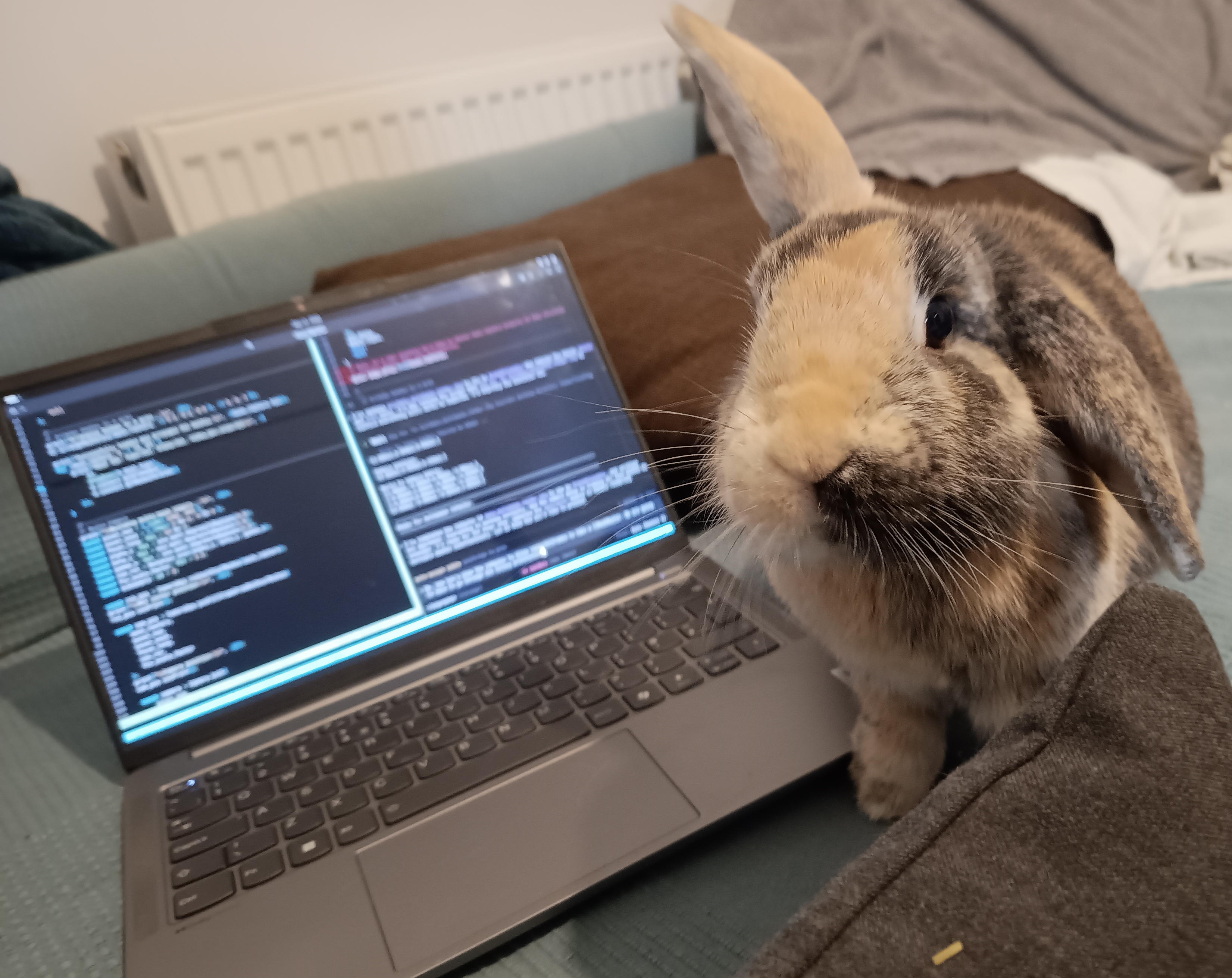
Named in memory of Riley, and for Feebee, her sister and bondmate. Without your love and support, this project would never have happened.


Download files
Download the file for your platform. If you're not sure which to choose, learn more about installing packages.
Source Distribution
File details
Details for the file riley_raster-2026.7.1.tar.gz.
File metadata
- Download URL: riley_raster-2026.7.1.tar.gz
- Upload date:
- Size: 13.7 MB
- Tags: Source
- Uploaded using Trusted Publishing? No
- Uploaded via: twine/6.2.0 CPython/3.13.9
File hashes
| Algorithm | Hash digest | |
|---|---|---|
| SHA256 |
99344ceecf937aafe9debb4873749e9333e277eb7ede0010350dfbecf50f16d6
|
|
| MD5 |
e23b1fb8dc308c2282abfc0724c6f5b7
|
|
| BLAKE2b-256 |
88896aa36e4e97eadd118a163b7fd532fa27acb4b7c246be29a1eec96743327c
|






