
Audit any risk-stratification model for label-choice bias — how much real need it leaves behind

Project description
risk-equity-audit
Auditing label-choice bias in healthcare risk-stratification models.
riskaudit is a Python library that audits any risk-stratification model for label-choice bias — how much real "need" a model leaves behind when it is trained on a convenient proxy (usually healthcare spending) instead of need itself. It works on any model's output: give it the scores a model assigned, an independent need measure, and population weights.



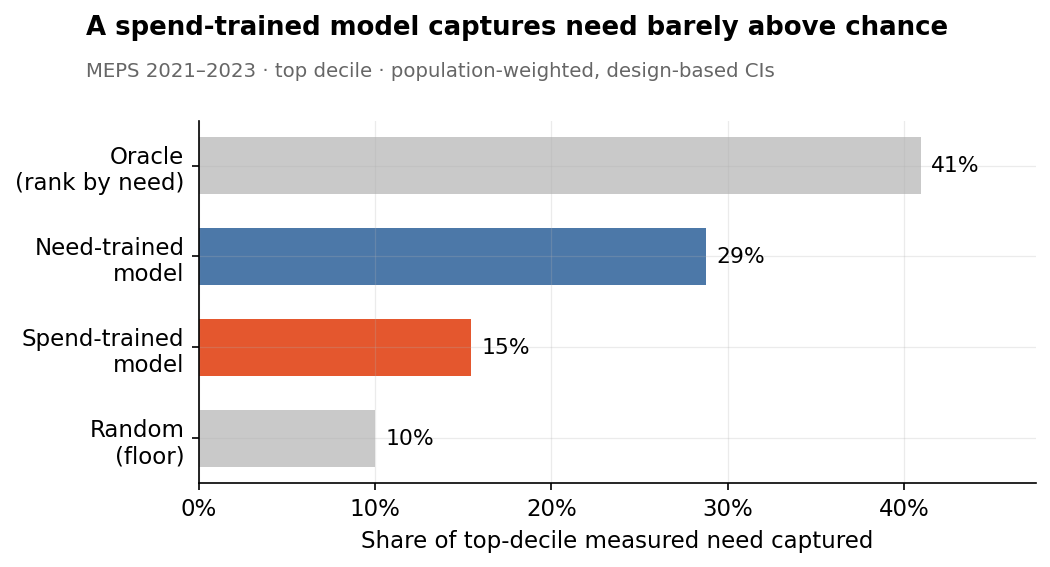
riskaudit's own output on the MEPS example: a deployed spend-trained model captures barely more measured need than a random score — and less than half of what ranking by need would.
(Versión en español más abajo — ir al español.)
Install
pip install riskaudit
Python ≥ 3.11. The core is light (numpy, pandas, scikit-learn, matplotlib); the MEPS example's heavier stack is an extra: pip install "riskaudit[meps]".
Quickstart
Audit your own model's scores in a few lines — no training, no PHI:
import numpy as np
from riskaudit.audit import top_k_capture

rng = np.random.default_rng(2026)
scores  = rng.random(5_000)   # what your risk model output per person
need    = rng.random(5_000)   # an independent measure of real need
weights = rng.random(5_000)   # population / survey weights

c = top_k_capture(scores, need, k=0.10, weights=weights)
print(f"top-decile capture: {c.value:.0%}  (floor {c.baseline:.0%}, oracle {c.oracle:.0%})")
# top-decile capture: 10%  (floor 10%, oracle 19%)   <- a random score sits at the floor
Every result carries a confidence interval (row or design-based) and reads against its floor (a random score) and oracle (ranking by need itself) — a capture number is meaningless without them. audit_report(results, "audit.html") bundles the whole set into a self-contained HTML report.
What this is
Health systems have limited budgets for expensive programs, so a model decides who gets prioritized — usually by predicting who will "spend the most," because spending is recorded for everyone. That choice has a blind spot: someone in psychological distress who does not seek care has near-zero spending, so a spend-trained model calls them low risk and never looks. The need was there; the label never looked for it.
This is label-choice bias — an algorithm trained on cost as a proxy for need under-serves people whose need hasn't turned into spending. riskaudit measures it, on any model, without retraining.
The toolkit
riskaudit does not train models or make predictions. It is an auditor: give it scores and an independent need measure, and it quantifies how much need the model leaves behind — weighted, with a row or design-based (VARSTR/PSU) confidence interval. Because it works purely on scores + need + weights, it is domain- and country-agnostic: the same functions audit a hospital's readmission model, an insurer's cost model, or a ministry's triage algorithm.
| Function | Question it answers |
|---|---|
top_k_capture(scores, need, k, weights) |
Of all real need, what fraction lands in the top-k the model prioritizes — vs. the random floor and the oracle ceiling? |
reclassification(scores_a, scores_b, k, weights) |
If we switch the label from A to B, who enters and leaves the priority list? |
label_choice_curve(scores, need, weights, bins) |
Where do the highest-need people sit on the score? |
ablation(fit_fn, X, y, feature_groups, need, k, weights) |
Cross-fitted: how much does global performance drop vs. how much does capture of need collapse when a feature group is removed? |
incremental_lift(y_t1, y_pred, distress, scores, k, weights) |
The contribution metric: among the deprioritized, do those in need generate more future outcome than predicted? Makes the argument non-circular. |
regression_to_mean(y_t, y_t1, scores_t, k, weights) |
How much of a top-k outcome drop is just regression to the mean? (descriptive) |
label_robustness(scores, need, weights, k) |
How wrong the need label would have to be to explain away the gap. |
audit_report(results, out_html) |
Bundles everything into a self-contained HTML report. |
The MEPS example
A worked example on U.S. MEPS 2021–2023 shows the tool finds real bias — a demonstration, not the point. The figure at the top is its headline; the curve below shows where the highest-need people land on each model's score.
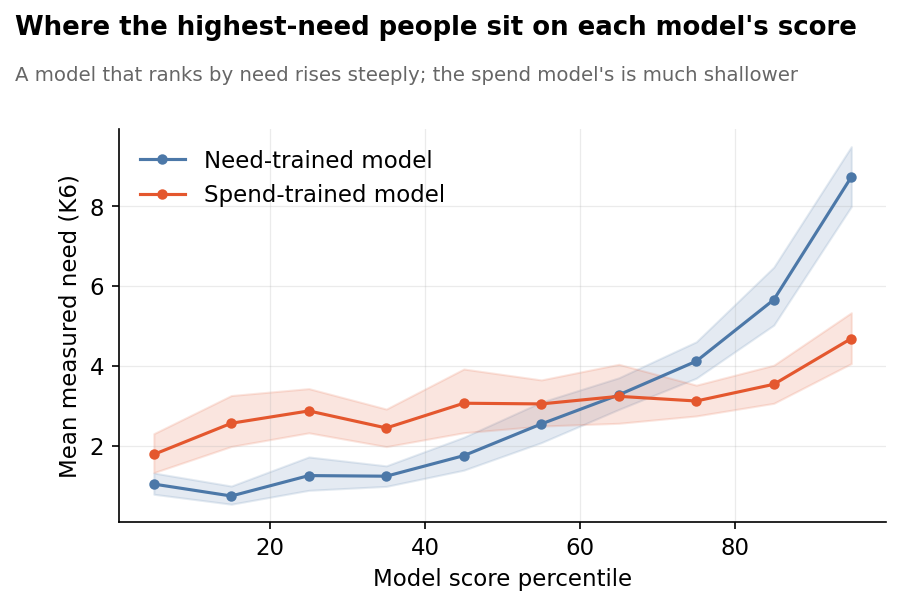
Findings (weighted, design-based CIs): the spend model captures only ~15% of top-decile K6 need — barely above the ~10% random floor, far below the ~41% oracle; a need-trained model reaches ~29%. Among the people the spend model deprioritizes, those in distress run up more total future cost than it predicted (incremental lift +0.8 log-dollars with the mental-health features, +1.0 without — both 95% CIs exclude zero): the bias comes from the label, not from missing information.
Honest limit. That excess does not appear on non-psychiatric utilization (ER + hospitalizations; lift ≈ 0, CI includes zero), so I do not claim the distress surfaces specifically as non-psychiatric spending — the total-spend excess may be partly mental-health spending, and a clean test needs a non-psychiatric spend target (backlog). The severe-untreated subgroup (n ≈ 40) is descriptive only. The figures regenerate from the pipeline with python docs/make_figures.py.
Data sources
No data is stored in this repository. Only download scripts and checksums are versioned; everything under data/ is git-ignored.
- MEPS (AHRQ, U.S.): HC-233/243/251 (FYC 2021–2023), HC-244 (Panel 26 longitudinal), HC-231 (Conditions) and HC-229A (Prescribed Medicines) for the treatment proxy — free, no registration, downloaded with SHA-256 checksums. See
PROTOCOL.md§3. - Synthetic (demo): generated in-script by
demo/run_demo.py— no external data, no real patients.
Limitations
Honesty about limits is a feature of this project, not a footnote:
- The severe untreated subgroup is small (~40 in the analytic sample) — reported descriptively with wide CIs, never modeled. The robust finding is the population-level mechanism, not an anecdote about invisible patients.
- "Need" is a normative choice. Calling a model "biased" asserts which target is legitimate need; that judgment is stated and defended in
docs/methods.md, not assumed.label_robustnessstress-tests it. - Survey design is respected throughout — sample weights and a stratified cluster bootstrap over VARSTR/VARPSU, never unweighted or naïvely filtered.
Roadmap
v0.1.x released (on PyPI, archived on Zenodo). Next (see docs/roadmap-v2.md): validation against Obermeyer et al. 2019 on their public synthetic data, and API expansion — subgroup capture, the label-blend decision frontier, cost-of-blindness, and stability of the priority list. Closed list, one function at a time.
How to cite
Proromant, C. (2026). riskaudit: auditing label-choice bias in healthcare risk-stratification models [Software]. Zenodo. https://doi.org/10.5281/zenodo.21461268
Machine-readable metadata is in CITATION.cff.
License
MIT © Conrado — MD (PUC), MSc(c) Data Science (PUC).
risk-equity-audit (español)
Auditoría del sesgo por elección de etiqueta en modelos de estratificación de riesgo en salud.
riskaudit es una librería en Python que audita cualquier modelo de estratificación de riesgo en busca de sesgo por elección de la etiqueta — cuánta "necesidad" real deja fuera un modelo cuando se entrena con un proxy cómodo (típicamente el gasto sanitario) en lugar de la necesidad misma. Trabaja sobre la salida de cualquier modelo: le das los scores que asignó, una medida independiente de need (necesidad) y weights poblacionales.
Salida de la propia riskaudit sobre el ejemplo MEPS: un modelo desplegado entrenado con gasto captura la necesidad apenas por encima del azar — y menos de la mitad de lo que capturaría rankeando por necesidad.
Instalación
pip install riskaudit
Python ≥ 3.11. El core es liviano; para el ejemplo MEPS: pip install "riskaudit[meps]".
Quickstart
Audita los puntajes de tu propio modelo en pocas líneas — sin entrenar, sin datos sensibles:
import numpy as np
from riskaudit.audit import top_k_capture

rng = np.random.default_rng(2026)
scores, need, weights = rng.random(5_000), rng.random(5_000), rng.random(5_000)
c = top_k_capture(scores, need, k=0.10, weights=weights)
print(f"captura top-decil: {c.value:.0%}  (piso {c.baseline:.0%}, oráculo {c.oracle:.0%})")
Cada resultado trae IC (de filas o de diseño) y se lee contra su piso (score al azar) y su oráculo (rankear por la propia necesidad) — un número de captura no significa nada sin ellos. audit_report(results, "audit.html") empaqueta todo en un informe HTML autocontenido.
Qué es esto
Los sistemas de salud tienen presupuesto limitado, así que un modelo decide a quién se prioriza — normalmente prediciendo quién "va a gastar más", porque el gasto está registrado para todos. Esa elección tiene un punto ciego: alguien con distrés que no consulta tiene gasto casi cero, así que un modelo entrenado con gasto lo etiqueta como bajo riesgo y nunca lo mira. La necesidad estaba; la etiqueta nunca la buscó.
Esto es el sesgo por elección de la etiqueta: un algoritmo entrenado con el costo como proxy de necesidad sub-atiende a quienes su necesidad aún no se tradujo en gasto. riskaudit lo mide, sobre cualquier modelo, sin reentrenar.
La herramienta
riskaudit no entrena modelos ni predice. Es un auditor: le das scores y una medida independiente de necesidad, y cuantifica cuánta necesidad el modelo deja fuera — ponderado, con IC de filas o de diseño (VARSTR/PSU). Como trabaja solo con scores + need + weights, es agnóstico al dominio y al país: las mismas funciones auditan el modelo de reingresos de un hospital, el de gasto de una aseguradora o el algoritmo de priorización de un ministerio.
| Función | Pregunta que responde |
|---|---|
top_k_capture |
De toda la necesidad real, ¿qué fracción cae en el top-k — vs. el piso al azar y el oráculo? |
reclassification |
Si cambio la etiqueta de A a B, ¿quién entra y sale de la lista de prioridad? |
label_choice_curve |
¿Dónde caen las personas de mayor necesidad en el score? |
ablation |
Cross-fitted: ¿cuánto baja el desempeño global vs. cuánto se desploma la captura de necesidad al quitar un grupo de features? |
incremental_lift |
La métrica-contribución: entre los deprioritizados, ¿los que tienen necesidad generan más desenlace futuro del predicho? Hace no-circular el argumento. |
regression_to_mean |
¿Cuánto de una caída del top-k es solo regresión a la media? (descriptivo) |
label_robustness |
¿Cuán equivocada tendría que estar la etiqueta need para explicar la brecha? |
audit_report |
Empaqueta todo en un informe HTML autocontenido. |
El ejemplo MEPS
Un ejemplo sobre MEPS 2021–2023 (EE.UU.) muestra que la herramienta encuentra sesgo real — una demostración, no el objetivo. La figura de arriba es el titular; la curva de abajo muestra dónde caen las personas de mayor necesidad en el score de cada modelo.
Hallazgos (ponderado, IC de diseño): el modelo de gasto captura solo ~15% de la necesidad K6 del top-decil — apenas sobre el ~10% del azar, muy por debajo del ~41% del oráculo; un modelo de K6 llega a ~29%. Entre los deprioritizados por el modelo de gasto, los que están en distrés acumulan más gasto total futuro del predicho (lift +0.8 log-dólares con las features de salud mental, +1.0 sin ellas — ambos IC 95% excluyen el cero): el sesgo viene de la etiqueta, no de falta de información.
Límite honesto. Ese exceso no aparece en la utilización no-psiquiátrica (urgencias + hospitalizaciones; lift ≈ 0, IC incluye el cero), así que no afirmo que el distrés se manifieste específicamente como gasto no psiquiátrico — un test limpio necesita un target de gasto no-psiquiátrico (backlog). El subgrupo severo no tratado (n ≈ 40) es solo descriptivo.
Limitaciones
La honestidad sobre los límites es parte del proyecto, no una nota al pie:
- El subgrupo severo no tratado es pequeño (~40 en la muestra analítica): descriptivo, con IC anchos, nunca se modela. El hallazgo robusto es el mecanismo poblacional, no la anécdota de "los invisibles".
- "Necesidad" es una elección normativa — se declara y defiende en
docs/methods.md;label_robustnessla somete a estrés. - El diseño muestral se respeta siempre: pesos y bootstrap de clúster estratificado sobre VARSTR/VARPSU, nunca sin ponderar.
Licencia
MIT © Conrado — Médico (PUC), MSc(c) Data Science (PUC).


Download files
Download the file for your platform. If you're not sure which to choose, learn more about installing packages.
Source Distribution
Built Distribution
Filter files by name, interpreter, ABI, and platform.
If you're not sure about the file name format, learn more about wheel file names.
Copy a direct link to the current filters
File details
Details for the file riskaudit-0.1.2.tar.gz.
File metadata
- Download URL: riskaudit-0.1.2.tar.gz
- Upload date:
- Size: 200.7 kB
- Tags: Source
- Uploaded using Trusted Publishing? No
- Uploaded via: twine/6.1.0 CPython/3.13.14
File hashes
| Algorithm | Hash digest | |
|---|---|---|
| SHA256 |
d861bd54111458c9e8d5e0dffbe762a25f5e8901bb0455006765c314483e5235
|
|
| MD5 |
2a194607cfe844d38db181ccb52b653e
|
|
| BLAKE2b-256 |
bfe9c8c8b23e0a3dd9d1ee3245e7f3e120149562da0894a8e07a32090a77a981
|
File details
Details for the file riskaudit-0.1.2-py3-none-any.whl.
File metadata
- Download URL: riskaudit-0.1.2-py3-none-any.whl
- Upload date:
- Size: 32.0 kB
- Tags: Python 3
- Uploaded using Trusted Publishing? No
- Uploaded via: twine/6.1.0 CPython/3.13.14
File hashes
| Algorithm | Hash digest | |
|---|---|---|
| SHA256 |
21e24cc6579304cbb18383bca0ab0a79e4f6c4f86d635b6342abd0a1d694de99
|
|
| MD5 |
de3be8320f624f331c3c8a42420699ef
|
|
| BLAKE2b-256 |
f8451d10929a5d5f4b495a7866a03e9acefae1ca9bb50534203b8c11cddbb387
|






