
NEW in version 1.4 (released 2025-06-04):
Use funtion reproject() to reproject all raster datasets to match the DEM. This
may fix issues such as to missing projection in the shielding raster or minor
mismatches in the raster resolutions.
Updated lithological ('quartz') weighing functions.
Use functions get_ages_from_server() and get_erates_from_server() to obtain
point-based exposure ages and erosion rates calculated by the online calculator
from sample data in your Excel spreadsheet and save the results as spreadsheet.
See updated documentation quickstart.ipynb
Catchmentwide erosion rates with riversand
riversand is a python package to calculate catchmentwide erosion rates from
cosmogenic nuclide concentrations in river sand samples. The program computes
the hypsometric statistics of the catchment area from a digital elevation model.
It uses the online erosion rate calculator by Greg Balco
(e.g. http://stoneage.hzdr.de/) to determine predicted
nuclide concentrations $N$ for given erosion rates $E$, and calculates
the erosion rate that corresponds to the measured nuclide concentration from a
polynomial fit $N(E)$.
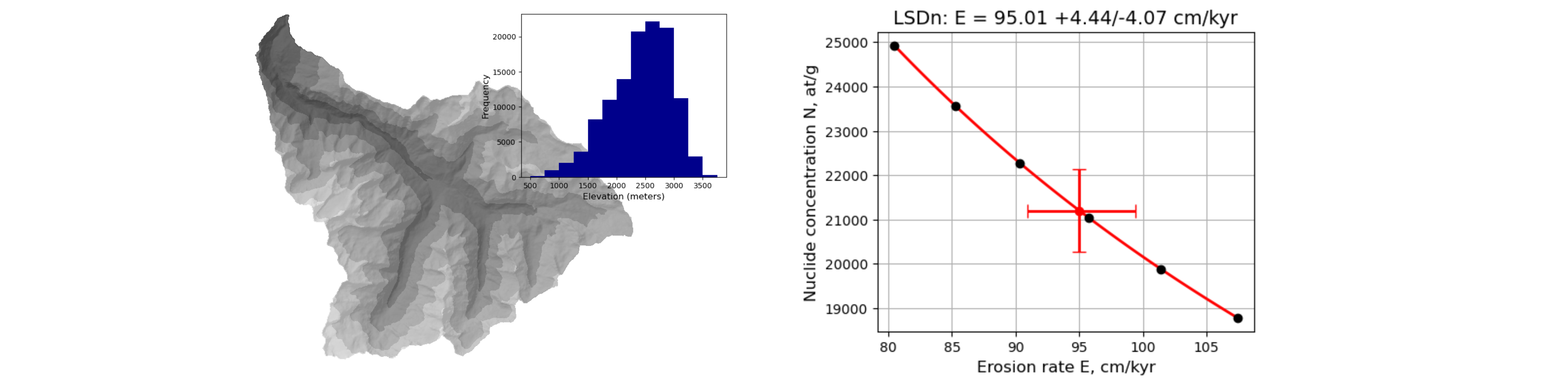
The method works for in situ Be-10 and Al-26 data. It is fast (few seconds for one catchment) for all production scaling methods implemented in the online calculator (St: Lal 1991/Stone 2000; Lm: Lal/Stone with a geomagnetic correction after Nishiizumi et al. 1989; LSDn: Lifton et al. 2014) and independent of the catchment size or the resolution of the digital elevation model. It is considered robust for catchments up to approx. 600 km x 600 km; for larger catchments the effect of latitude on cosmogenic production may become significant.
The approach is described in:
Stübner, K., Balco, G., and Schmeisser, N. (2023). Riversand: a new tool for efficient computation of catchmentwide erosion rates. Radiocarbon. (link).
Definitely check out the documentation of the online calculator (e.g. here or here) and the publication Balco et al. (2008) before using this calculator.
Documentation
quickstart.ipynbstep_by_step.ipynbtest_data/: geotiffs of a 35m-resolution digital elevation model, a topographic shielding raster generated with TopoToolbox and a binary raster indicating quartz-bearing and quartz-free lithologies; shapefiles with catchment outlines; a spreadsheet with sample data.
Installation
Install latest version of riversand by running:
$ pip install riversand==1.4
Requirements
- numpy, scipy, pandas, xarray
- rasterio, fiona, pyproj
- odfpy, openpyxl
- matplotlib
License
1 maintainer

Metadata
1 maintainer
Release files for riversand 1.4
For a detailed explanation of source distributions (sdists) and built distributions (wheels), please see the package formats documentation.
Source distribution (sdist)
| File | Size | Uploaded | Provenance | |
|---|---|---|---|---|
| riversand-1.4.tar.gz | 60.1 kB | Without provenance | Details |
Built distribution (wheel)
| File | Interpreter | ABI | Platform | Reset |
|---|---|---|---|---|
| riversand-1.4-py3-none-any.whl | Python 3 | none | any | Details |
Total release size: 122.3 kB
Release files / riversand-1.4.tar.gz
| Download URL | riversand-1.4.tar.gz |
|---|---|
| Size | 60.1 kB |
| Tags | Source |
|
SHA-256 checksum How to use checksums |
cbad6da19a34b067c6ba26e7503c9a0be7e583bf20f993e4c755cf56cbab8c3b
|
|
BLAKE2b-256 checksum How to use checksums |
0275c69be78608599194d590b7ed4a89bb6ef57979962490df0a77fee0c2b8ce
|
| Upload date | |
|
Uploaded using Trusted Publishing? What is trusted publishing? |
No |
| Uploaded via |
twine/6.1.0 CPython/3.11.12
|
Release files / riversand-1.4-py3-none-any.whl
| Download URL | riversand-1.4-py3-none-any.whl |
|---|---|
| Size | 62.2 kB |
| Tags | Python 3 |
|
SHA-256 checksum How to use checksums |
623ec8a301c0499f41498f684c292ee3ad43eb61b0370ff3ab9cc69f8462ea02
|
|
BLAKE2b-256 checksum How to use checksums |
63ce409b3c66a5e209ed37e4f9d4b465de85d0891bd220f313a309aff4d64f27
|
| Upload date | |
|
Uploaded using Trusted Publishing? What is trusted publishing? |
No |
| Uploaded via |
twine/6.1.0 CPython/3.11.12
|
Security for riversand 1.4
Provenance
Provenance describes where a file came from. On PyPI, provenance is shared via attestations, which provide a verifiable record of the build or publishing details. View details, limitations and caveats.
No provenance found
None of the files in this release were uploaded with provenance metadata.
A note on package security
PyPI is a repository for distributing packages, not a service for auditing them. While third-party security researchers and our staff do their best to detect and remove malicious packages, PyPI cannot guarantee the quality, security or suitability of any given package.
To learn more about protecting yourself from malicious actors, visit our package security documentation.














