
Reinforcement Learning Bridge - connects LLMs to RL environments, automates language-based problem construction, and derives instructions for long-term goals without user supervision

Project description
Reinforcement Learning Bridge (rlbridge)
Reinforcement Learning Bridge connects LLMs to reinforcement learning (RL) agents.
RL agents can be used to automate complex decision making problems. rlbridge is the first attempt at giving LLMs the ability to train RL agents.
LLMs can interact with rl problems directly (e.g. Claude plays Pokemon) but using rlbridge massively reduces token costs and learns to optimize the agent for the problem.
rlbridge streamlines how LLMs construct RL problems for language interaction. This includes: standardized problem specification, novel approach for translating any problem to language, and agent training with auto generated & completed sub-tasks without user supervision.
LLMs interact use rlbridge through an MCP plugin compatible with Claude Code, Claude Desktop, Cursor, Windsurf, Codex CLI and local models through LM Studio and OpenCode.
Architecture
┌──────────────────────────────────────────────────────┐
│  Claude Code                                         │
│                                                      │
│  "Run 100 steps of CartPole with a random policy"    │
│          │                                           │
│   MCP layer (stdio)                                  │
└──────────┼───────────────────────────────────────────┘
           │
┌──────────▼───────────────────────────────────────────┐
│  RL Bridge MCP Plugin  (rlbridge.mcp_plugin)         │
│  FastMCP tools:  rl_create · rl_reset · rl_step      │
│                 rl_render · rl_close · rl_run_episode│
│          │                                           │
│   In-process dispatcher                              │
└──────────┼────────────────────────────┬──────────────┘
           │                            │
           │     ╌╌ OR ╌╌ (rlbridge_SERVER_URL)
           │                            │
┌──────────▼─────────────────┐  ┌──────▼────────────────┐
│  RL Bridge Server          │  │  Live Training        │
│  (HTTP/JSON-RPC 2.0)       │  │  Dashboard            │
│  POST /rpc  ·  GET /docs   │  │(http://localhost:7860)│
└──────────┬─────────────────┘  │  WebSocket/HTTP       │
           │                    │  Real-time reward     │
           │                    │  tracking & policy    │
           │                    │  visualization        │
           │                    └───────────────────────┘
           │
┌──────────▼───────────────────────────────────────────┐
│  Environment Registry + Session Manager              │
│  ┌───────────────┐  ┌───────────────┐                │
│  │ CartPole-v1   │  │ LunarLander   │  + any custom  │
│  │ (Gymnasium)   │  │ (Gymnasium)   │    env …       │
│  └───────────────┘  └───────────────┘                │
└──────────────────────────────────────────────────────┘
Quick Start
1. Install
From PyPI (recommended):
pip install rlbridge

# Classic Gymnasium envs for examples (CartPole, etc.)
pip install "rlbridge[examples]"
With uv:
uv pip install rlbridge
# or, in a uv-managed project:
uv add rlbridge
uv add "rlbridge[examples]"
From source (development):
git clone https://github.com/pdfosborne/RL-IP
cd RL-IP
pip install -e ".[dev,examples]"
# or: uv sync --extra dev --extra examples
2. Add to your AI tool
Run the command for whichever tool(s) you use, then restart the client:
# Claude Code (CLI)  → ~/.claude.json
rlbridge install-claude

# Claude Desktop (GUI app)
#   macOS   → ~/Library/Application Support/Claude/claude_desktop_config.json
#   Windows → %APPDATA%\Claude\claude_desktop_config.json
#   Linux   → ~/.config/Claude/claude_desktop_config.json
rlbridge install-claude-desktop

# LM Studio  → ~/.lmstudio/mcp.json  (Linux)
#              ~/Library/Application Support/LM Studio/mcp.json  (macOS)
#              %APPDATA%\LM Studio\mcp.json  (Windows)
rlbridge install-lmstudio

# Cursor  → ~/.cursor/mcp.json
rlbridge install-cursor

# Windsurf  → ~/.codeium/windsurf/mcp_config.json
rlbridge install-windsurf

# Codex CLI  → ~/.codex/config.toml
rlbridge install-codex

# OpenCode   → ~/.config/opencode/config.json
rlbridge install-opencode
All commands accept --use-script (uses the rlbridge-mcp console script instead
of python -m) and --config-path to override the default config location.
3. Use it
Open Claude Code and ask:
"List the available environments."
Then try running an agent with a problem of your choice, for example:
"Run a blackjack episode with a tabular agent and render the optimal policy."
Claude will call rl_create, rl_reset, rl_step (in a loop), and rl_close automatically.
You can try using Claude directly to make actions in the environment:
"Run a blackjack episode with an llm agent with language translation and show me the token cost."
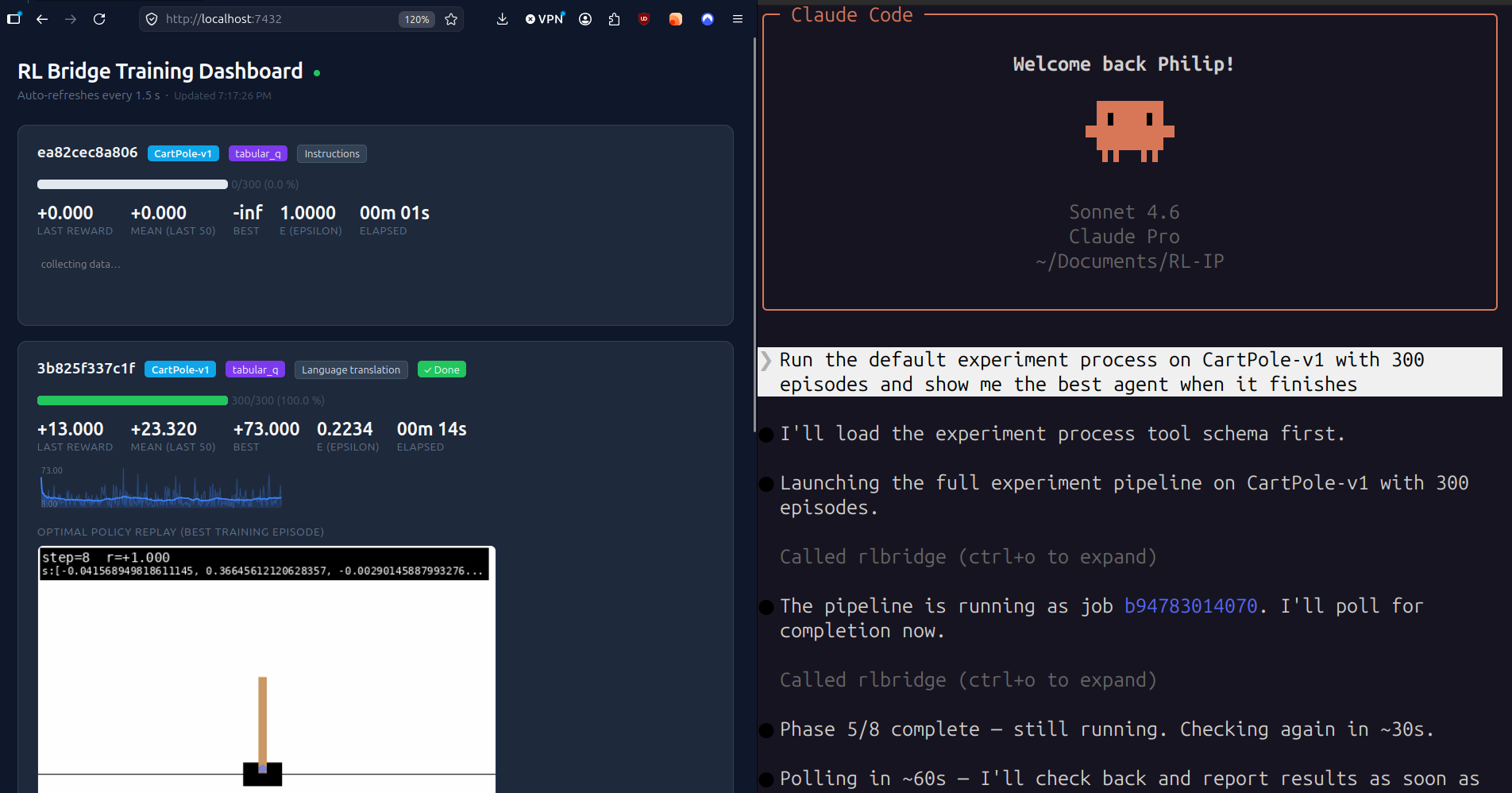
For the default end-to-end training pipeline, ask:
"Run the default experiment process on the easy Sailing environment and show me the best agent when it finishes."
Claude will call rl_experiment_process once, then poll rl_get_training_result(job_id) until completion.
rl_experiment_process runs the full 8-stage workflow in one job:
dashboard, baseline training, language-state training, instruction derivation,
instruction matching, instruction-shaped training, instruction+language training,
and final evaluation/comparison.
The dashboard is viewable at the default localhost url:
Available MCP Tools
Environment control
| Tool | Description |
|---|---|
rl_list_environments |
Browse all registered RL environments |
rl_create |
Create an environment instance |
rl_reset |
Reset an instance, get the initial observation |
rl_step |
Execute one action, get (obs, reward, terminated, truncated, info) |
rl_sample_action |
Sample a random valid action |
rl_spaces |
Inspect observation and action space details |
rl_render |
Render current state (PNG or ASCII) |
rl_close |
Destroy an instance |
rl_list_instances |
List all active instances |
rl_run_episode |
Run a complete episode in one call |
Custom environment builder
Build and register new environments—wrapping any Gymnasium env—with custom metadata, local caching, and language translation.
| Tool | Description |
|---|---|
rl_build_environment |
Wrap a Gymnasium env with custom ID, description, and tags; cache to ~/.rlbridge/envs/ and write to user catalog |
rl_list_cached_environments |
Browse previously built environments stored in the local cache |
rl_load_cached_environments |
Re-register all cached environments at session start |
Example workflow in Claude Code:
"Build me a FrozenLake environment called FrozenLake-Custom-v0 with tags grid and discrete."
rl_build_environment("FrozenLake-Custom-v0", "FrozenLake-v1",
                     description="Custom FrozenLake.", tags="grid,discrete")
Language translation
Map raw environment observations to natural-language descriptions. Required for instruction-following and sub-goal reward shaping.
| Tool | Description |
|---|---|
rl_sample_states_for_translation |
Randomly explore an environment and display raw observed states so a translate() function can be written |
rl_set_translator_code |
Compile, validate, and install a Python translate() function; saves it to ~/.rlbridge/envs/<env_id>/translator.py so it reloads automatically |
rl_translate_state |
Test a single state → natural-language description round-trip |
Example workflow in Claude Code:
"Sample some states from FrozenLake-Custom-v0 so I can write a translator."
rl_sample_states_for_translation("FrozenLake-Custom-v0", n_samples=20)
"Install this translator:"
def translate(state, *, legal_moves=None, action_history=None):
    row, col = divmod(int(state), 4)
    labels = {0: "start", 15: "goal"}
    return f"Agent at row {row}, column {col}. {labels.get(state, '')}"
rl_set_translator_code("FrozenLake-Custom-v0", python_code="...")
rl_translate_state("FrozenLake-Custom-v0", state="15")
The installed translator is automatically used by rl_match_instruction and
rl_train_agent with sub-goal shaping.
Instruction-following
| Tool | Description |
|---|---|
rl_match_instruction |
Explore an environment, translate states to language, and find the state best matching a natural-language goal |
rl_instruction_run_episode |
Run a shaped episode where the matched state provides a bonus reward signal |
For semantic matching with Hugging Face sentence-transformers models:
pip install -e "."[sentence-transformers]
Then choose a model directly in the tool call:
# Uses the default model for sentence-transformers
rl_match_instruction("Sailing-v0", "sail toward the beach", encoder="sentence-transformers")

# Uses a specific Hugging Face model id
rl_match_instruction(
    "Sailing-v0",
    "sail toward the beach",
    encoder="sentence",
    encoder_model="BAAI/bge-small-en-v1.5",
)
RL agent training
| Tool | Description |
|---|---|
rl_list_agents |
See available agent types (tabular_q, dqn, ppo) with guidance on when to use each |
rl_train_agent |
Train an agent; optionally combine with a match_id for instruction-shaped rewards |
rl_run_agent_episode |
Evaluate a trained agent for one greedy episode |
rl_render_policy |
Render the best training episode as an animated GIF |
Local LLM policy agent (Python API)
RL Bridge also includes a direct local_llm policy agent for action selection
without gradient training.
from rlbridge.environments.registry import registry
from rlbridge.language_translation import get_translator
from rlbridge.rl_agents import LocalLLMAgent

env = registry.get("Sailing-v0").create()
translator = get_translator("Sailing-v0")

agent = LocalLLMAgent(base_url="http://localhost:11434/v1", model="llama3.1")

obs = env.reset().observation
obs_text = translator.translate(obs) if translator else str(obs)
action = agent.choose_action(obs_text, action_space=env.action_space)
step = env.step(action)
Use this agent primarily with language-translated observations. Calling a model for every environment action can be expensive in long episodes, so account for per-step latency and token cost.
Full Example: New Environment from Scratch
# 1. Build and cache the environment
rl_build_environment(
    env_id="FrozenLake-Custom-v0",
    gym_env_id="FrozenLake-v1",
    description="4×4 frozen lake grid-world.",
    tags="grid,discrete",
    namespace="custom",
)

# 2. Sample states to understand the observation format
rl_sample_states_for_translation("FrozenLake-Custom-v0", n_samples=16)
# → STATE 1: 0  STATE 2: 1  STATE 3: 5  …

# 3. Install a translator
rl_set_translator_code("FrozenLake-Custom-v0", python_code="""
def translate(state, *, legal_moves=None, action_history=None):
    row, col = divmod(int(state), 4)
    cell = {0: "start (S)", 5: "hole (H)", 10: "hole (H)", 15: "goal (G)"}.get(state, "frozen (F)")
    return f"Agent is at row {row}, column {col} - {cell}."
""")

# 4. Match an instruction to a goal state
rl_match_instruction("FrozenLake-Custom-v0", "reach the goal")
# → match_id: abc123

# 5. Train an agent with sub-goal shaping
rl_train_agent("dqn", "FrozenLake-Custom-v0", n_episodes=500, match_id="abc123")
# → agent_id: def456

# 6. Render the result
rl_render_policy("FrozenLake-Custom-v0", agent_id="def456")
Standalone HTTP Server
Run RL Bridge as a standalone service (useful for multi-process workflows or connecting non-Python agents):
rlbridge server --port 8765
Then send JSON-RPC requests:
curl -X POST http://localhost:8765/rpc \
  -H "Content-Type: application/json" \
  -d '{
    "jsonrpc": "2.0",
    "id": "1",
    "method": "rlbridge/environment/create",
    "params": {"env_id": "CartPole-v1"}
  }'
Browse the auto-generated API docs at http://localhost:8765/docs.
Remote RL Bridge Server from the MCP Plugin
# Point the plugin at a remote server instead of running envs in-process
rlbridge_SERVER_URL=http://my-gpu-machine:8765 rlbridge mcp
Custom Environments (Python API)
For programmatic use, the EnvironmentBuilder Python API mirrors the MCP tools:
from rlbridge.environments.builder import EnvironmentBuilder, load_cached_environments

# Build, cache, and register in one call
built = (
    EnvironmentBuilder("FrozenLake-Custom-v0")
    .from_gymnasium("FrozenLake-v1")
    .with_metadata(description="Custom FrozenLake.", tags=["grid", "discrete"])
    .build()   # auto_register=True, update_catalog=True by default
)

# Attach a hand-written translator
built.translator = ...   # any LanguageTranslator instance
built.register(register_translator=True)

# Reload all cached environments at startup
load_cached_environments()
For a fully custom (non-Gymnasium) environment, subclass the ABCs directly:
from rlbridge.environments.base import rlbridgeEnvironment, rlbridgeEnvironmentFactory
from rlbridge.environments.registry import registry
from rlbridge.protocol.messages import DiscreteSpace, EnvironmentInfo, ResetResult, StepResult, RenderResult

class MyEnv(rlbridgeEnvironment):
    def reset(self, seed=None, options=None) -> ResetResult: ...
    def step(self, action) -> StepResult: ...
    def close(self): ...
    @property
    def observation_space(self): return DiscreteSpace(n=10)
    @property
    def action_space(self): return DiscreteSpace(n=4)
    def render(self) -> RenderResult: ...

class MyFactory(rlbridgeEnvironmentFactory):
    @property
    def env_info(self) -> EnvironmentInfo:
        return EnvironmentInfo(env_id="MyEnv-v0", description="My custom env", namespace="custom")
    def create(self, render_mode=None, **kwargs) -> MyEnv:
        return MyEnv()

registry.register(MyFactory())
Third-Party Environment Plugins
RL Bridge can load additional environments from separately installed pip packages.
Packages register factories via the rlbridge.environments entry-point group and
optional MCP tools via rlbridge.environment_mcp_tools.
Example: Flesh and Blood TCG environments live in the
flesh-and-blood-rlbridge package (not bundled with RL Bridge):
# Install RL Bridge from PyPI
pip install rlbridge

# Then install the FaB plugin from GitHub
pip install git+https://github.com/pdfosborne/flesh-and-blood-rlbridge.git
After installation, environments appear in the registry automatically:
from rlbridge.environments.registry import registry

env = registry.create("FleshAndBlood-Talishar-v0", format="silver_age")
To publish your own plugin, add to pyproject.toml:
[project.entry-points."rlbridge.environments"]
my-env = "my_package:register_environments"

[project.entry-points."rlbridge.environment_mcp_tools"]
my-env = "my_package:register_mcp_tools"
Each callable receives registry= (environments) or
mcp=, registry=, log= (MCP tools) and returns the number of
items registered.
Protocol
See docs/protocol_spec.md for the full JSON-RPC protocol specification, including all method signatures, space encodings, error codes, and the session lifecycle diagram.
Project Layout
src/rlbridge/
├── __init__.py
├── __main__.py              # CLI (rlbridge server / rlbridge install-claude / …)
├── protocol/
│   ├── constants.py         # Method names, error codes
│   └── messages.py          # Pydantic message models
├── environments/
│   ├── base.py              # rlbridgeEnvironment / rlbridgeEnvironmentFactory ABCs
│   ├── builder.py           # EnvironmentBuilder - fluent API for custom envs
│   ├── gymnasium_adapter.py # Gymnasium wrapper
│   ├── registry.py          # EnvironmentRegistry singleton
│   └── utils.py             # NumPy ↔ JSON helpers, space serialisation
├── instruction_matching/
│   ├── base.py              # BaseEncoder ABC
│   ├── tfidf.py             # TFIDFEncoder (default)
│   ├── bm25.py              # BM25Encoder
│   └── sentence_transformer.py  # SentenceEncoder (optional dep)
├── language_translation/
│   ├── base.py              # LanguageTranslator ABC
│   ├── caching.py           # CachingTranslator + translation cache
│   ├── generator.py         # TranslatorGenerator / GeneratedTranslator (LLM)
│   └── sailing.py           # Built-in Sailing translator
├── server/
│   ├── dispatcher.py        # Transport-agnostic JSON-RPC dispatcher
│   ├── rlbridge_server.py       # FastAPI HTTP server
│   ├── session.py           # Session / instance manager
│   └── exceptions.py        # rlbridgeError
├── transport/
│   ├── stdio_transport.py   # Stdio (newline-delimited JSON-RPC)
│   └── http_client.py       # Sync + async HTTP clients
└── mcp_plugin/
    └── plugin.py            # FastMCP MCP plugin for Claude Code
examples/
├── cartpole_http.py         # HTTP client episode example
├── custom_env.py            # Registering a custom environment
└── in_process_usage.py      # Using RL Bridge without a server
docs/
└── protocol_spec.md         # Full JSON-RPC protocol specification
Console scripts
| Command | Entry point | Purpose |
|---|---|---|
rlbridge |
rlbridge.__main__:app |
CLI (server, MCP, install-*, catalog, …) |
rlbridge-mcp |
rlbridge.mcp_plugin.plugin:main |
MCP stdio plugin for AI tools |
rlbridge-server |
rlbridge.__main__:server_app |
Standalone HTTP JSON-RPC server |
Optional dependency extras
| Extra | Install | Use case |
|---|---|---|
examples / envs-classic |
pip install "rlbridge[examples]" |
CartPole and other classic-control envs |
envs-box2d |
pip install "rlbridge[envs-box2d]" |
LunarLander, etc. |
envs-atari |
pip install "rlbridge[envs-atari]" |
Atari games |
envs-mujoco |
pip install "rlbridge[envs-mujoco]" |
MuJoCo envs |
envs-all |
pip install "rlbridge[envs-all]" |
All Gymnasium env groups |
torch |
pip install "rlbridge[torch]" |
DQN / PPO training agents |
sentence-transformers |
pip install "rlbridge[sentence-transformers]" |
Semantic instruction matching |
openai-sdk |
pip install "rlbridge[openai-sdk]" |
Official OpenAI client (optional) |
dev |
pip install "rlbridge[dev]" |
pytest, ruff, mypy, build, twine |
Publishing (maintainers)
Build and upload to PyPI (test first on TestPyPI):
# Install build tools
pip install "rlbridge[dev]"
# or: uv sync --extra dev

# Bump version in pyproject.toml (single source of truth; __version__ reads it at runtime)

# Build sdist + wheel
python -m build
# or: uv build

# Upload (requires PyPI account + API token)
twine upload dist/*
# or: uv publish
User install after release:
pip install rlbridge
uv add rlbridge
Note: The PyPI distribution name is rlbridge. The Python import package and console commands are rlbridge, rlbridge-mcp, and rlbridge-server.
Manual steps before first release: create a PyPI account, generate an API token, and tag releases on GitHub.
License
Apache License 2.0 - see LICENSE.
The framework used in this work is currently patent pending with the US Patent and Trademark Office (18/955718).
Cite
Please use the following to cite this work
@phdthesis{OsborneThesis2024,
  title        = {Improving Real-World Reinforcement Learning by Self Completing Human Instructions on Rule Defined Language},
  author       = {Philip Osborne},
  year         = 2024,
  month        = {August},
  address      = {Manchester, UK},
  note         = {Available at \url{https://research.manchester.ac.uk/en/studentTheses/improving-real-world-reinforcement-learning-by-self-completing-hu}},
  school       = {The University of Manchester},
  type         = {PhD thesis}
}
Release history Release notifications | RSS feed


Download files
Download the file for your platform. If you're not sure which to choose, learn more about installing packages.
Source Distributions
Built Distribution
Filter files by name, interpreter, ABI, and platform.
If you're not sure about the file name format, learn more about wheel file names.
Copy a direct link to the current filters
File details
Details for the file rlbridge-0.1.3-py3-none-any.whl.
File metadata
- Download URL: rlbridge-0.1.3-py3-none-any.whl
- Upload date:
- Size: 314.0 kB
- Tags: Python 3
- Uploaded using Trusted Publishing? No
- Uploaded via: twine/6.2.0 CPython/3.13.11
File hashes
| Algorithm | Hash digest | |
|---|---|---|
| SHA256 |
09af978edb036d4506776aab153ba1f95c6457af884b6a6b169e02a1b9790ff0
|
|
| MD5 |
a8192d4ad7e43cec0494fb5126f3c4e8
|
|
| BLAKE2b-256 |
9c3ea9a909f368a7c35d780eae8945e505eb8a7a07eddf12d20df64de73c7059
|






