
A Python library for robotics education and research
Verified details
These details have been verified by PyPIProject links
GitHub Statistics
Maintainers

Project description
Robotics Toolbox for Python
Note about this fork This repository is a fork of the upstream Robotics Toolbox for Python with the following differences:
- Joint wrapping behavior: joint solutions are only wrapped when doing so helps satisfy joint limits, preventing wrap-induced limit violations.
- Performance: DHRobot now uses LRU caching to speed up repeated computations.
- Optional visualization deps:
spatialgeometryandswift-simare now optional. Core kinematics (FK, Jacobian, IK) work without them. Install withpip install roboticstoolbox-python-source-robotics[viz]if you need Swift visualization or geometry features.- Upstream changes: incorporates updates from the upstream "future" branch.
- Prebuilt wheels: Linux ARM64 (Raspberry Pi 5) wheels are published to PyPI via GitHub Actions. See RELEASING.md for how to trigger a build and verify the wheel.
Upstream project: https://github.com/petercorke/robotics-toolbox-python










 |
A Python implementation of the Robotics Toolbox for MATLAB® |
Contents
- Synopsis
- Getting going
- Tutorials
- Code Examples
- Toolbox Research Applications
- Toolbox ICRA Paper and Citation Info
- Using the Toolbox in your Open Source Code?
- Common Issues and Solutions
Synopsis
This toolbox brings robotics-specific functionality to Python, and leverages Python's advantages of portability, ubiquity and support, and the capability of the open-source ecosystem for linear algebra (numpy, scipy), graphics (matplotlib, three.js, WebGL), interactive development (jupyter, jupyterlab, mybinder.org), and documentation (sphinx).
The Toolbox provides tools for representing the kinematics and dynamics of serial-link manipulators - you can easily create your own in Denavit-Hartenberg form, import a URDF file, or use over 30 supplied models for well-known contemporary robots from Franka-Emika, Kinova, Universal Robotics, Rethink as well as classical robots such as the Puma 560 and the Stanford arm.
The Toolbox contains fast implementations of kinematic operations. The forward kinematics and the manipulator Jacobian can be computed in less than 1 microsecond while numerical inverse kinematics can be solved in as little as 4 microseconds.
The toolbox also supports mobile robots with functions for robot motion models (unicycle, bicycle), path planning algorithms (bug, distance transform, D*, PRM), kinodynamic planning (lattice, RRT), localization (EKF, particle filter), map building (EKF) and simultaneous localization and mapping (EKF).
The Toolbox provides:
- code that is mature and provides a point of comparison for other implementations of the same algorithms;
- routines which are generally written in a straightforward manner which allows for easy understanding, perhaps at the expense of computational efficiency;
- source code which can be read for learning and teaching;
- backward compatability with the Robotics Toolbox for MATLAB
The Toolbox leverages the Spatial Maths Toolbox for Python to provide support for data types such as SO(n) and SE(n) matrices, quaternions, twists and spatial vectors.
Getting going
You will need Python >= 3.10
Using pip
Install a snapshot from PyPI
pip3 install roboticstoolbox-python-source-robotics
If you already have the upstream package installed, uninstall it first because
both distributions provide the same roboticstoolbox import package:
pip3 uninstall roboticstoolbox-python
pip3 install roboticstoolbox-python-source-robotics
Available options are:
collisioninstall collision checking with pybulletvizinstall visualization dependencies (Swift and spatialgeometry)
Put the options in a comma separated list like
pip3 install roboticstoolbox-python-source-robotics[viz,collision]
Note: Core kinematics (FK, Jacobian, IK) work without any optional dependencies.
From GitHub
To install the bleeding-edge version from GitHub
git clone https://github.com/Source-Robotics/robotics-toolbox-python-source-robotics.git
cd robotics-toolbox-python-source-robotics
pip3 install -e .
Tutorials
 |
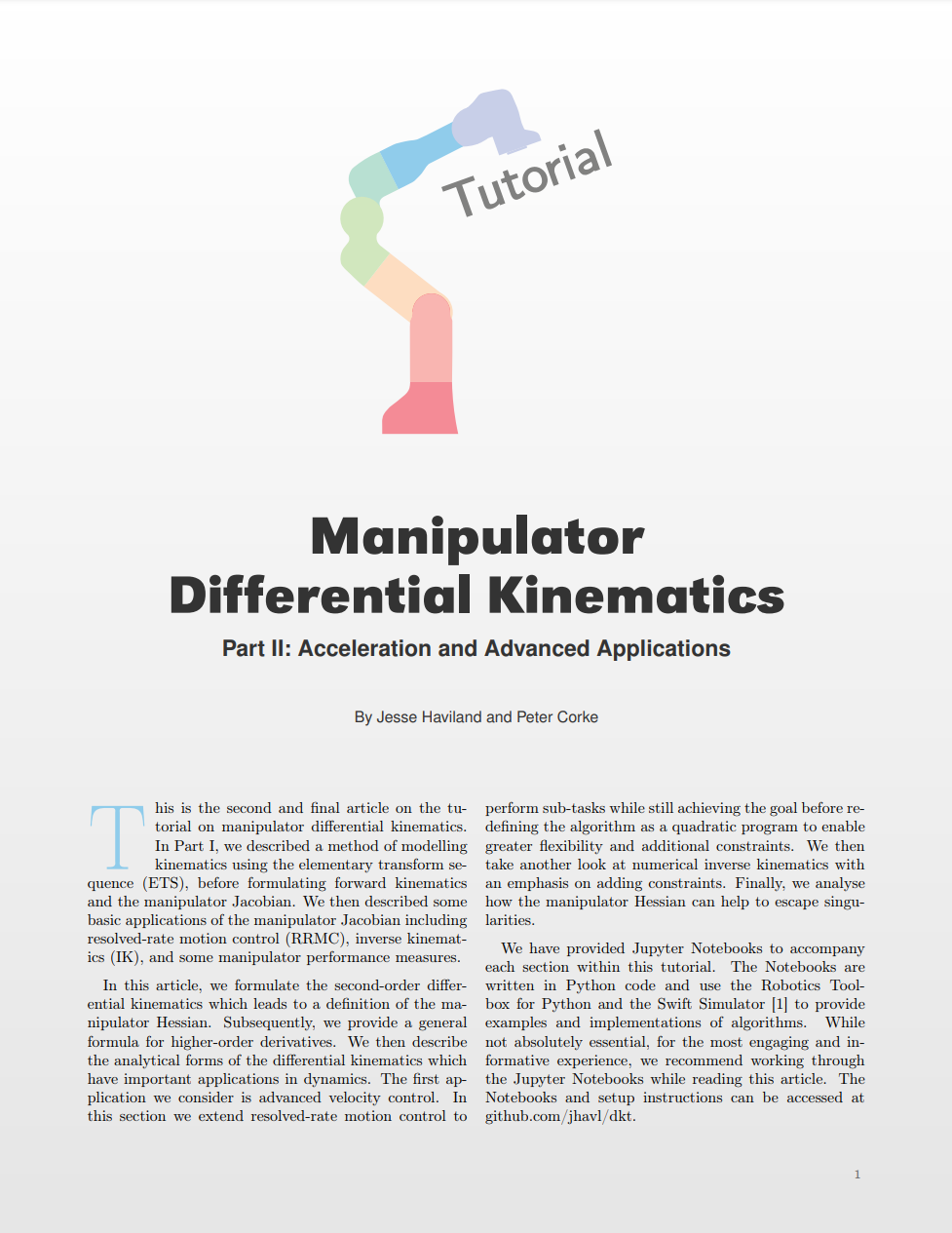 |
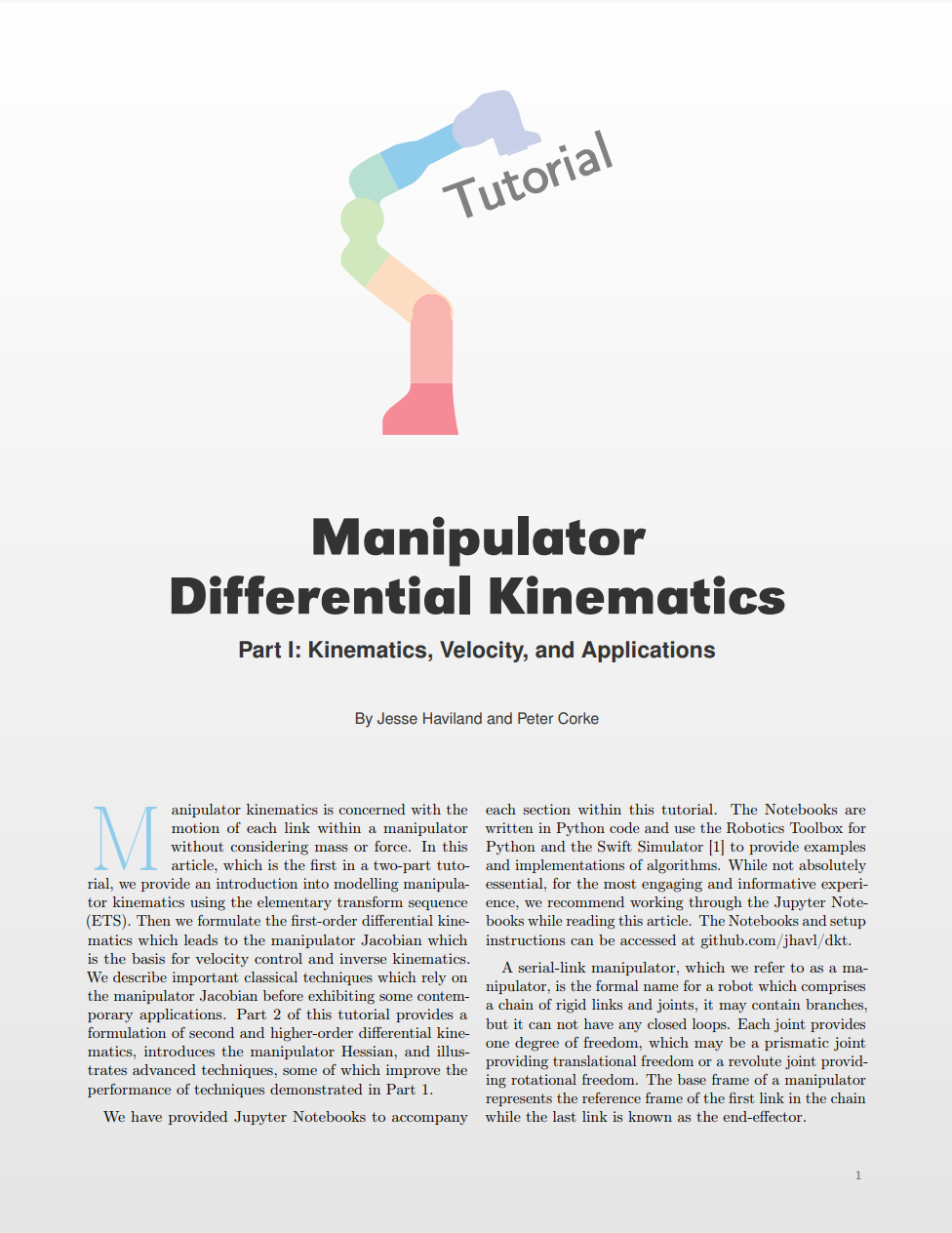
Do you want to learn about manipulator kinematics, differential kinematics, inverse-kinematics and motion control? Have a look at our tutorial. This tutorial comes with two articles to cover the theory and 12 Jupyter Notebooks providing full code implementations and examples. Most of the Notebooks are also Google Colab compatible allowing them to run online. |
Code Examples
We will load a model of the Franka-Emika Panda robot defined by a URDF file
import roboticstoolbox as rtb
robot = rtb.models.Panda()
print(robot)

	ERobot: panda (by Franka Emika), 7 joints (RRRRRRR), 1 gripper, geometry, collision
	┌─────┬──────────────┬───────┬─────────────┬────────────────────────────────────────────────┐
	│link │     link     │ joint │   parent    │              ETS: parent to link               │
	├─────┼──────────────┼───────┼─────────────┼────────────────────────────────────────────────┤
	│   0 │ panda_link0  │       │ BASE        │                                                │
	│   1 │ panda_link1  │     0 │ panda_link0 │ SE3(0, 0, 0.333) ⊕ Rz(q0)                      │
	│   2 │ panda_link2  │     1 │ panda_link1 │ SE3(-90°, -0°, 0°) ⊕ Rz(q1)                    │
	│   3 │ panda_link3  │     2 │ panda_link2 │ SE3(0, -0.316, 0; 90°, -0°, 0°) ⊕ Rz(q2)       │
	│   4 │ panda_link4  │     3 │ panda_link3 │ SE3(0.0825, 0, 0; 90°, -0°, 0°) ⊕ Rz(q3)       │
	│   5 │ panda_link5  │     4 │ panda_link4 │ SE3(-0.0825, 0.384, 0; -90°, -0°, 0°) ⊕ Rz(q4) │
	│   6 │ panda_link6  │     5 │ panda_link5 │ SE3(90°, -0°, 0°) ⊕ Rz(q5)                     │
	│   7 │ panda_link7  │     6 │ panda_link6 │ SE3(0.088, 0, 0; 90°, -0°, 0°) ⊕ Rz(q6)        │
	│   8 │ @panda_link8 │       │ panda_link7 │ SE3(0, 0, 0.107)                               │
	└─────┴──────────────┴───────┴─────────────┴────────────────────────────────────────────────┘

	┌─────┬─────┬────────┬─────┬───────┬─────┬───────┬──────┐
	│name │ q0  │ q1     │ q2  │ q3    │ q4  │ q5    │ q6   │
	├─────┼─────┼────────┼─────┼───────┼─────┼───────┼──────┤
	│  qr │  0° │ -17.2° │  0° │ -126° │  0° │  115° │  45° │
	│  qz │  0° │  0°    │  0° │  0°   │  0° │  0°   │  0°  │
	└─────┴─────┴────────┴─────┴───────┴─────┴───────┴──────┘
The symbol @ indicates the link as an end-effector, a leaf node in the rigid-body
tree (Python prompts are not shown to make it easy to copy+paste the code, console output is indented).
We will compute the forward kinematics next
Te = robot.fkine(robot.qr)  # forward kinematics
print(Te)

	0.995     0         0.09983   0.484
	0        -1         0         0
	0.09983   0        -0.995     0.4126
	0         0         0         1
We can solve inverse kinematics very easily. We first choose an SE(3) pose defined in terms of position and orientation (end-effector z-axis down (A=-Z) and finger orientation parallel to y-axis (O=+Y)).
from spatialmath import SE3

Tep = SE3.Trans(0.6, -0.3, 0.1) * SE3.OA([0, 1, 0], [0, 0, -1])
sol = robot.ik_LM(Tep)         # solve IK
print(sol)

	(array([ 0.20592815,  0.86609481, -0.79473206, -1.68254794,  0.74872915,
			2.21764746, -0.10255606]), 1, 114, 7, 2.890164057230228e-07)

q_pickup = sol[0]
print(robot.fkine(q_pickup))    # FK shows that desired end-effector pose was achieved

	 1         -8.913e-05  -0.0003334  0.5996
	-8.929e-05 -1          -0.0004912 -0.2998
	-0.0003334  0.0004912  -1          0.1001
	 0          0           0          1
We can animate a path from the ready pose qr configuration to this pickup configuration
qt = rtb.jtraj(robot.qr, q_pickup, 50)
robot.plot(qt.q, backend='pyplot', movie='panda1.gif')

where we have specified the matplotlib pyplot backend. Blue arrows show the joint axes and the coloured frame shows the end-effector pose.
We can also plot the trajectory in the Swift simulator (a browser-based 3d-simulation environment built to work with the Toolbox)
robot.plot(qt.q)

We can also experiment with velocity controllers in Swift. Here is a resolved-rate motion control example
import swift
import roboticstoolbox as rtb
import spatialmath as sm
import numpy as np

env = swift.Swift()
env.launch(realtime=True)

panda = rtb.models.Panda()
panda.q = panda.qr

Tep = panda.fkine(panda.q) * sm.SE3.Trans(0.2, 0.2, 0.45)

arrived = False
env.add(panda)

dt = 0.05

while not arrived:

    v, arrived = rtb.p_servo(panda.fkine(panda.q), Tep, 1)
    panda.qd = np.linalg.pinv(panda.jacobe(panda.q)) @ v
    env.step(dt)

# Uncomment to stop the browser tab from closing
# env.hold()

Run some examples
The notebooks folder contains some tutorial Jupyter notebooks which you can browse on GitHub. Additionally, have a look in the examples folder for many ready to run examples.
Toolbox ICRA Paper and Citation Info
Check out our ICRA 2021 paper on IEEE Xplore or get the PDF from Peter's website.
If the toolbox helped you in your research, please cite
@inproceedings{rtb,
  title={Not your grandmother’s toolbox--the Robotics Toolbox reinvented for Python},
  author={Corke, Peter and Haviland, Jesse},
  booktitle={2021 IEEE International Conference on Robotics and Automation (ICRA)},
  pages={11357--11363},
  year={2021},
  organization={IEEE}
}
Using the Toolbox in your Open Source Code?
If you are using the Toolbox in your open source code, feel free to add our badge to your readme!
For the powered by robotics toolbox badge

copy the following
[](https://github.com/petercorke/robotics-toolbox-python)
For the powered by python robotics badge

copy the following
[](https://github.com/petercorke/robotics-toolbox-python)
Common Issues and Solutions
See the common issues with fixes here.
Using the Toolbox with Windows?
Graphical visualisation via swift is currently not supported under Windows. However there is a hotfix, by changing in SwiftRoute.py
self.path[9:] to self.path[10:]
Toolbox Research Applications
The toolbox is incredibly useful for developing and prototyping algorithms for research, thanks to the exhaustive set of well documented and mature robotic functions exposed through clean and painless APIs. Additionally, the ease at which a user can visualize their algorithm supports a rapid prototyping paradigm.
Publication List
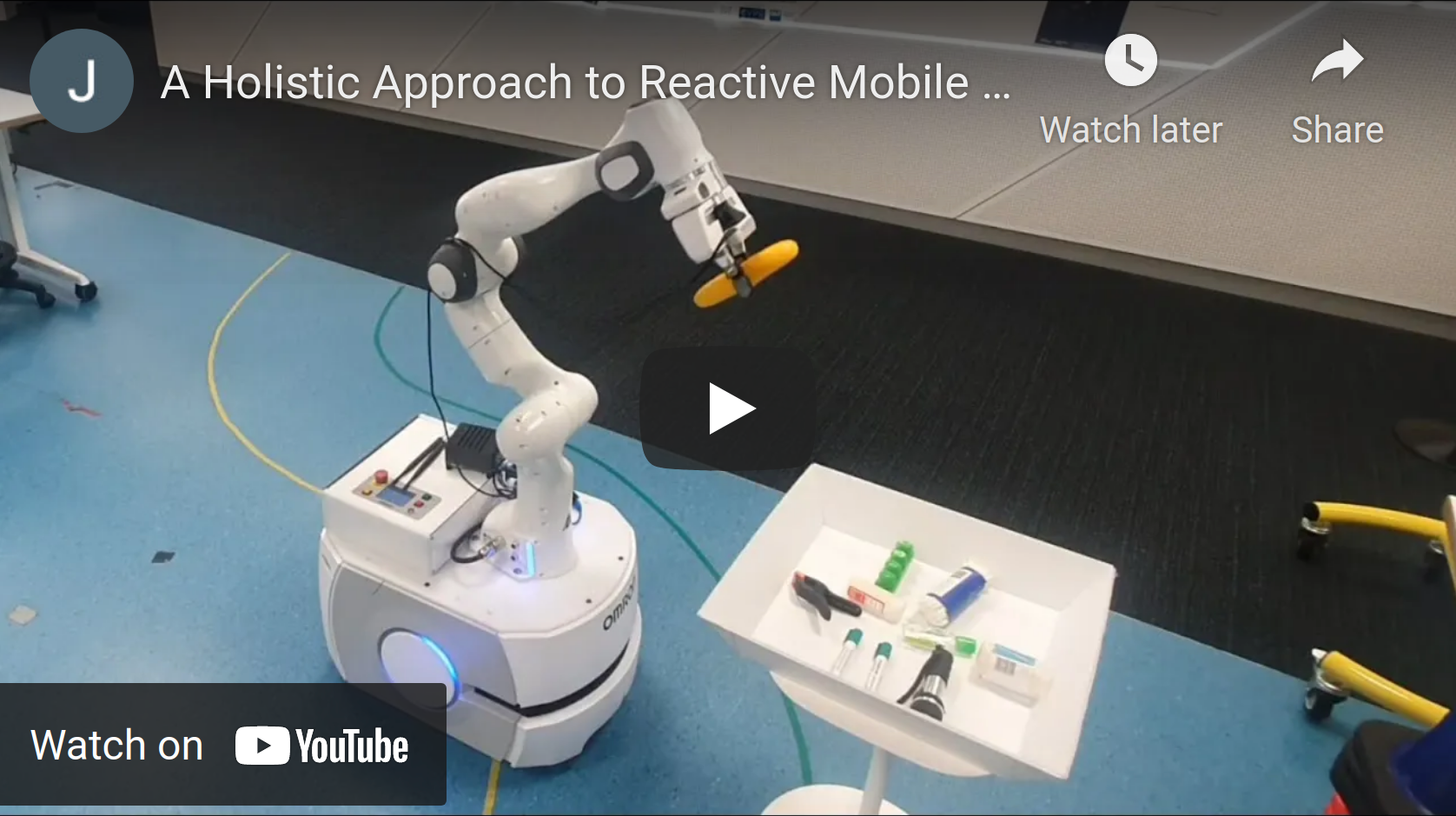
J. Haviland, N. Sünderhauf and P. Corke, "A Holistic Approach to Reactive Mobile Manipulation," in IEEE Robotics and Automation Letters, doi: 10.1109/LRA.2022.3146554. In the video, the robot is controlled using the Robotics toolbox for Python and features a recording from the Swift Simulator.
[Arxiv Paper] [IEEE Xplore] [Project Website] [Video] [Code Example]
J. Haviland and P. Corke, "NEO: A Novel Expeditious Optimisation Algorithm for Reactive Motion Control of Manipulators," in IEEE Robotics and Automation Letters, doi: 10.1109/LRA.2021.3056060. In the video, the robot is controlled using the Robotics toolbox for Python and features a recording from the Swift Simulator.
[Arxiv Paper] [IEEE Xplore] [Project Website] [Video] [Code Example]

K. He, R. Newbury, T. Tran, J. Haviland, B. Burgess-Limerick, D. Kulić, P. Corke, A. Cosgun, "Visibility Maximization Controller for Robotic Manipulation", in IEEE Robotics and Automation Letters, doi: 10.1109/LRA.2022.3188430. In the video, the robot is controlled using the Robotics toolbox for Python and features a recording from the Swift Simulator.
[Arxiv Paper] [IEEE Xplore] [Project Website] [Video] [Code Example]
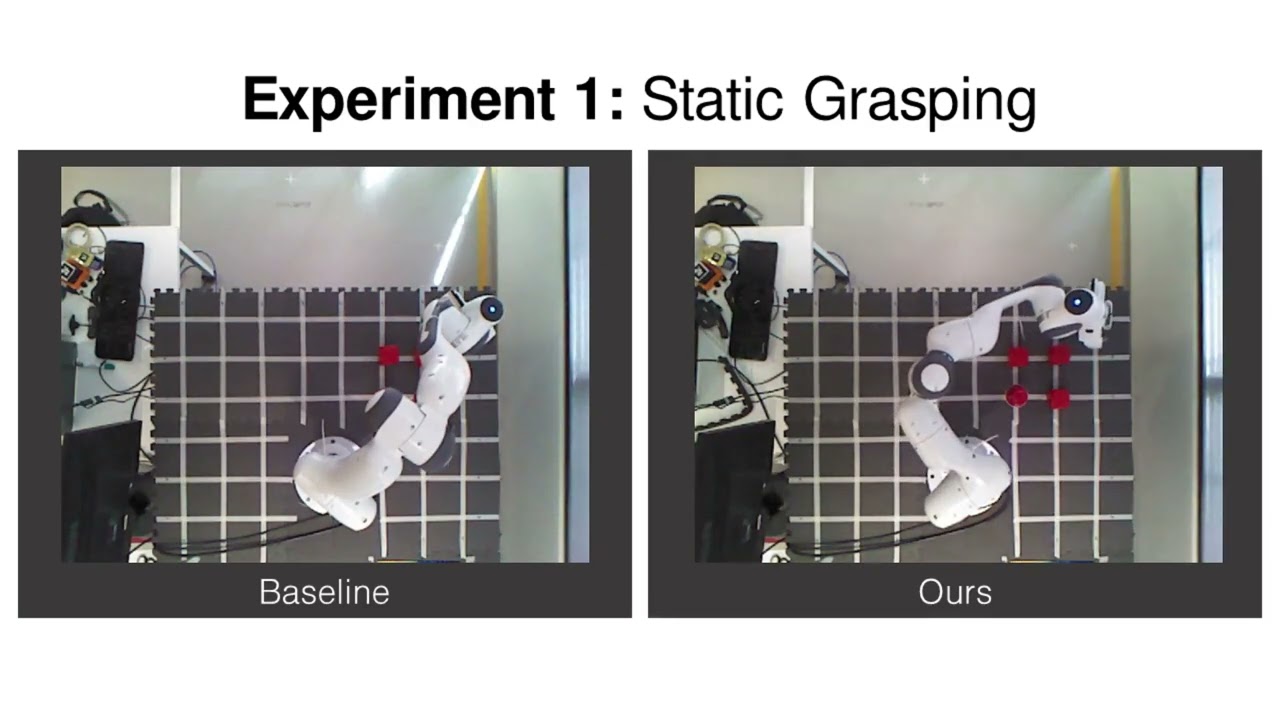
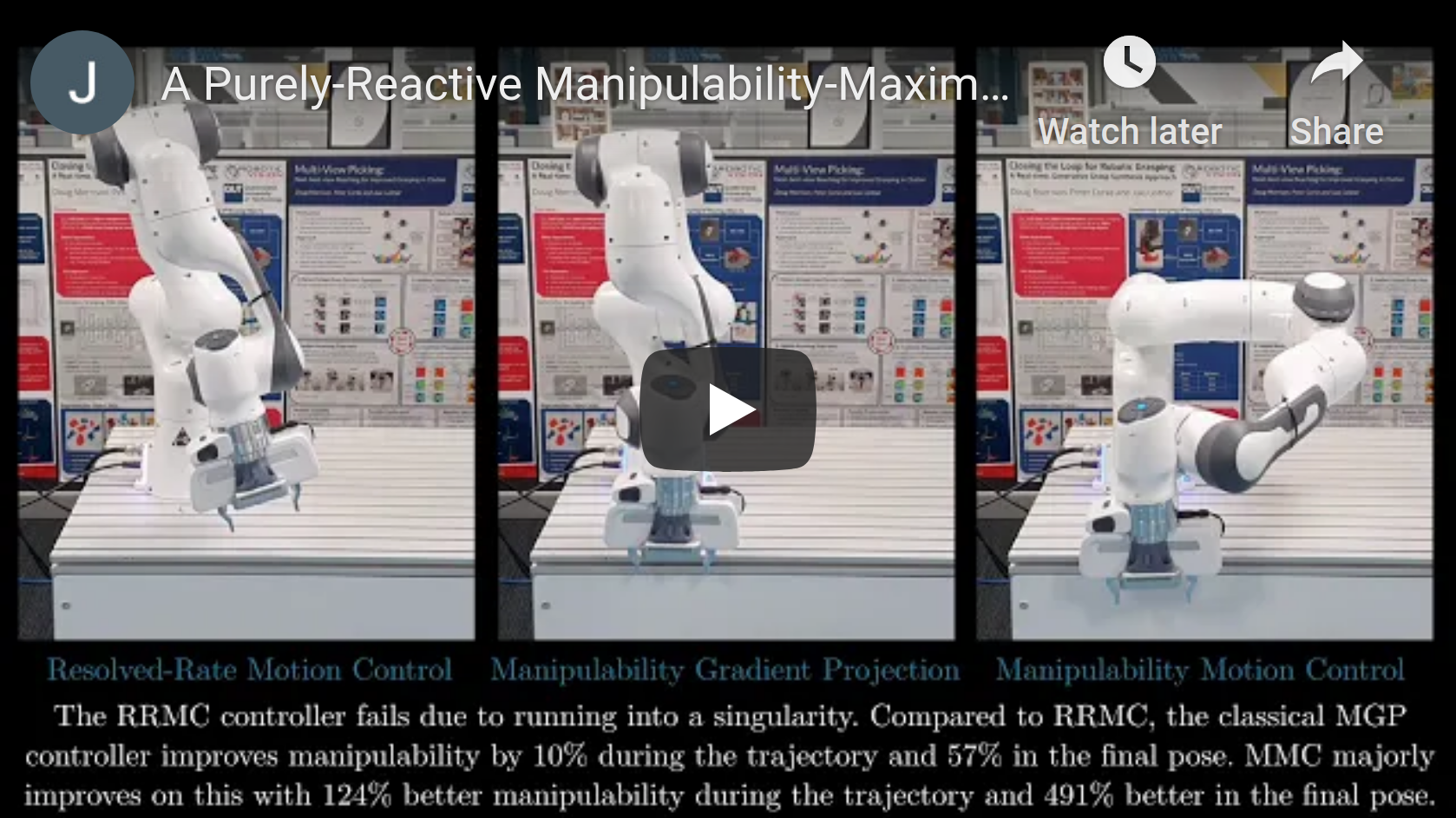
A Purely-Reactive Manipulability-Maximising Motion Controller, J. Haviland and P. Corke. In the video, the robot is controlled using the Robotics toolbox for Python.
[Paper] [Project Website] [Video] [Code Example]
Project details
Verified details
These details have been verified by PyPIProject links
GitHub Statistics
Maintainers
Release history Release notifications | RSS feed


Download files
Download the file for your platform. If you're not sure which to choose, learn more about installing packages.
Source Distribution
Built Distributions
Filter files by name, interpreter, ABI, and platform.
If you're not sure about the file name format, learn more about wheel file names.
Copy a direct link to the current filters
File details
Details for the file roboticstoolbox_python_source_robotics-1.3.0.post2.tar.gz.
File metadata
- Download URL: roboticstoolbox_python_source_robotics-1.3.0.post2.tar.gz
- Upload date:
- Size: 1.4 MB
- Tags: Source
- Uploaded using Trusted Publishing? Yes
- Uploaded via: twine/6.1.0 CPython/3.13.12
File hashes
| Algorithm | Hash digest | |
|---|---|---|
| SHA256 |
8a19ad7760d9a4dac75513315bd77813526cec87ded3ab307acf18b2292a1ef9
|
|
| MD5 |
83d34eaa2537abfa308b9a8634407b75
|
|
| BLAKE2b-256 |
2ff2ce3731e2e856e4c2e481c3469b7e102254d2c3908e93f489bb926e89b73e
|
Provenance
The following attestation bundles were made for roboticstoolbox_python_source_robotics-1.3.0.post2.tar.gz:
Publisher:
cibuildwheel.yml on Source-Robotics/robotics-toolbox-python-source-robotics
-
Statement:
-
Statement type:
https://in-toto.io/Statement/v1 -
Predicate type:
https://docs.pypi.org/attestations/publish/v1 -
Subject name:
roboticstoolbox_python_source_robotics-1.3.0.post2.tar.gz -
Subject digest:
8a19ad7760d9a4dac75513315bd77813526cec87ded3ab307acf18b2292a1ef9 - Sigstore transparency entry: 2023568806
- Sigstore integration time:
-
Permalink:
Source-Robotics/robotics-toolbox-python-source-robotics@d41911b221aade2985a379b7ddafdb39df81abf0 -
Branch / Tag:
refs/tags/v1.3.0.post2 - Owner: https://github.com/Source-Robotics
-
Access:
public
-
Token Issuer:
https://token.actions.githubusercontent.com -
Runner Environment:
github-hosted -
Publication workflow:
cibuildwheel.yml@d41911b221aade2985a379b7ddafdb39df81abf0 -
Trigger Event:
release
-
Statement type:
File details
Details for the file roboticstoolbox_python_source_robotics-1.3.0.post2-cp314-cp314-win_arm64.whl.
File metadata
- Download URL: roboticstoolbox_python_source_robotics-1.3.0.post2-cp314-cp314-win_arm64.whl
- Upload date:
- Size: 1.9 MB
- Tags: CPython 3.14, Windows ARM64
- Uploaded using Trusted Publishing? Yes
- Uploaded via: twine/6.1.0 CPython/3.13.12
File hashes
| Algorithm | Hash digest | |
|---|---|---|
| SHA256 |
172b54ad5a5f87917c1bdd7dfece83a2952ba8657daf27a2c589a351109b26b8
|
|
| MD5 |
74fe8538e3d80f3120a3c5f4328eee59
|
|
| BLAKE2b-256 |
a0a02bae1c9a6ef4b0ba5f30b7739cc33d61fa351d8260edb0fc7be75aade5cb
|
Provenance
The following attestation bundles were made for roboticstoolbox_python_source_robotics-1.3.0.post2-cp314-cp314-win_arm64.whl:
Publisher:
cibuildwheel.yml on Source-Robotics/robotics-toolbox-python-source-robotics
-
Statement:
-
Statement type:
https://in-toto.io/Statement/v1 -
Predicate type:
https://docs.pypi.org/attestations/publish/v1 -
Subject name:
roboticstoolbox_python_source_robotics-1.3.0.post2-cp314-cp314-win_arm64.whl -
Subject digest:
172b54ad5a5f87917c1bdd7dfece83a2952ba8657daf27a2c589a351109b26b8 - Sigstore transparency entry: 2023570295
- Sigstore integration time:
-
Permalink:
Source-Robotics/robotics-toolbox-python-source-robotics@d41911b221aade2985a379b7ddafdb39df81abf0 -
Branch / Tag:
refs/tags/v1.3.0.post2 - Owner: https://github.com/Source-Robotics
-
Access:
public
-
Token Issuer:
https://token.actions.githubusercontent.com -
Runner Environment:
github-hosted -
Publication workflow:
cibuildwheel.yml@d41911b221aade2985a379b7ddafdb39df81abf0 -
Trigger Event:
release
-
Statement type:
File details
Details for the file roboticstoolbox_python_source_robotics-1.3.0.post2-cp314-cp314-win_amd64.whl.
File metadata
- Download URL: roboticstoolbox_python_source_robotics-1.3.0.post2-cp314-cp314-win_amd64.whl
- Upload date:
- Size: 1.9 MB
- Tags: CPython 3.14, Windows x86-64
- Uploaded using Trusted Publishing? Yes
- Uploaded via: twine/6.1.0 CPython/3.13.12
File hashes
| Algorithm | Hash digest | |
|---|---|---|
| SHA256 |
9262f45d053c4d1db37234a20d974dcab95093aa4893a9f70624a6a3b1544848
|
|
| MD5 |
b89a5757abede37c823bfb455a142eeb
|
|
| BLAKE2b-256 |
353e464bfc26e6f7cd868b0c35f5d7abf83e5bc77d6958fe5414509261f57e59
|
Provenance
The following attestation bundles were made for roboticstoolbox_python_source_robotics-1.3.0.post2-cp314-cp314-win_amd64.whl:
Publisher:
cibuildwheel.yml on Source-Robotics/robotics-toolbox-python-source-robotics
-
Statement:
-
Statement type:
https://in-toto.io/Statement/v1 -
Predicate type:
https://docs.pypi.org/attestations/publish/v1 -
Subject name:
roboticstoolbox_python_source_robotics-1.3.0.post2-cp314-cp314-win_amd64.whl -
Subject digest:
9262f45d053c4d1db37234a20d974dcab95093aa4893a9f70624a6a3b1544848 - Sigstore transparency entry: 2023569980
- Sigstore integration time:
-
Permalink:
Source-Robotics/robotics-toolbox-python-source-robotics@d41911b221aade2985a379b7ddafdb39df81abf0 -
Branch / Tag:
refs/tags/v1.3.0.post2 - Owner: https://github.com/Source-Robotics
-
Access:
public
-
Token Issuer:
https://token.actions.githubusercontent.com -
Runner Environment:
github-hosted -
Publication workflow:
cibuildwheel.yml@d41911b221aade2985a379b7ddafdb39df81abf0 -
Trigger Event:
release
-
Statement type:
File details
Details for the file roboticstoolbox_python_source_robotics-1.3.0.post2-cp314-cp314-manylinux2014_x86_64.manylinux_2_17_x86_64.manylinux_2_28_x86_64.whl.
File metadata
- Download URL: roboticstoolbox_python_source_robotics-1.3.0.post2-cp314-cp314-manylinux2014_x86_64.manylinux_2_17_x86_64.manylinux_2_28_x86_64.whl
- Upload date:
- Size: 12.6 MB
- Tags: CPython 3.14, manylinux: glibc 2.17+ x86-64, manylinux: glibc 2.28+ x86-64
- Uploaded using Trusted Publishing? Yes
- Uploaded via: twine/6.1.0 CPython/3.13.12
File hashes
| Algorithm | Hash digest | |
|---|---|---|
| SHA256 |
52f0c27dc7c43b1f696df40d9476f692f5fecaa048cb1167d5019a65142e93ec
|
|
| MD5 |
b496f2e48929c08d1268746364012ca0
|
|
| BLAKE2b-256 |
1994fc191cb8fe83b29938dc4e5d1422eab0d9d35e1fed714ebfa5092117620c
|
Provenance
The following attestation bundles were made for roboticstoolbox_python_source_robotics-1.3.0.post2-cp314-cp314-manylinux2014_x86_64.manylinux_2_17_x86_64.manylinux_2_28_x86_64.whl:
Publisher:
cibuildwheel.yml on Source-Robotics/robotics-toolbox-python-source-robotics
-
Statement:
-
Statement type:
https://in-toto.io/Statement/v1 -
Predicate type:
https://docs.pypi.org/attestations/publish/v1 -
Subject name:
roboticstoolbox_python_source_robotics-1.3.0.post2-cp314-cp314-manylinux2014_x86_64.manylinux_2_17_x86_64.manylinux_2_28_x86_64.whl -
Subject digest:
52f0c27dc7c43b1f696df40d9476f692f5fecaa048cb1167d5019a65142e93ec - Sigstore transparency entry: 2023571718
- Sigstore integration time:
-
Permalink:
Source-Robotics/robotics-toolbox-python-source-robotics@d41911b221aade2985a379b7ddafdb39df81abf0 -
Branch / Tag:
refs/tags/v1.3.0.post2 - Owner: https://github.com/Source-Robotics
-
Access:
public
-
Token Issuer:
https://token.actions.githubusercontent.com -
Runner Environment:
github-hosted -
Publication workflow:
cibuildwheel.yml@d41911b221aade2985a379b7ddafdb39df81abf0 -
Trigger Event:
release
-
Statement type:
File details
Details for the file roboticstoolbox_python_source_robotics-1.3.0.post2-cp314-cp314-manylinux2014_aarch64.manylinux_2_17_aarch64.manylinux_2_28_aarch64.whl.
File metadata
- Download URL: roboticstoolbox_python_source_robotics-1.3.0.post2-cp314-cp314-manylinux2014_aarch64.manylinux_2_17_aarch64.manylinux_2_28_aarch64.whl
- Upload date:
- Size: 12.6 MB
- Tags: CPython 3.14, manylinux: glibc 2.17+ ARM64, manylinux: glibc 2.28+ ARM64
- Uploaded using Trusted Publishing? Yes
- Uploaded via: twine/6.1.0 CPython/3.13.12
File hashes
| Algorithm | Hash digest | |
|---|---|---|
| SHA256 |
c1f342677b581ba19670360d3da60dd11a5cfec57488ee207d9341fea33c1f33
|
|
| MD5 |
4ac5d795fef1eabb8af961847356079d
|
|
| BLAKE2b-256 |
0dff22c1cba4ac897f2367543d71c6f4153692433954be5a047a0d649410c286
|
Provenance
The following attestation bundles were made for roboticstoolbox_python_source_robotics-1.3.0.post2-cp314-cp314-manylinux2014_aarch64.manylinux_2_17_aarch64.manylinux_2_28_aarch64.whl:
Publisher:
cibuildwheel.yml on Source-Robotics/robotics-toolbox-python-source-robotics
-
Statement:
-
Statement type:
https://in-toto.io/Statement/v1 -
Predicate type:
https://docs.pypi.org/attestations/publish/v1 -
Subject name:
roboticstoolbox_python_source_robotics-1.3.0.post2-cp314-cp314-manylinux2014_aarch64.manylinux_2_17_aarch64.manylinux_2_28_aarch64.whl -
Subject digest:
c1f342677b581ba19670360d3da60dd11a5cfec57488ee207d9341fea33c1f33 - Sigstore transparency entry: 2023569422
- Sigstore integration time:
-
Permalink:
Source-Robotics/robotics-toolbox-python-source-robotics@d41911b221aade2985a379b7ddafdb39df81abf0 -
Branch / Tag:
refs/tags/v1.3.0.post2 - Owner: https://github.com/Source-Robotics
-
Access:
public
-
Token Issuer:
https://token.actions.githubusercontent.com -
Runner Environment:
github-hosted -
Publication workflow:
cibuildwheel.yml@d41911b221aade2985a379b7ddafdb39df81abf0 -
Trigger Event:
release
-
Statement type:
File details
Details for the file roboticstoolbox_python_source_robotics-1.3.0.post2-cp314-cp314-macosx_11_0_x86_64.whl.
File metadata
- Download URL: roboticstoolbox_python_source_robotics-1.3.0.post2-cp314-cp314-macosx_11_0_x86_64.whl
- Upload date:
- Size: 1.9 MB
- Tags: CPython 3.14, macOS 11.0+ x86-64
- Uploaded using Trusted Publishing? Yes
- Uploaded via: twine/6.1.0 CPython/3.13.12
File hashes
| Algorithm | Hash digest | |
|---|---|---|
| SHA256 |
809f4d4e96ddcb02ba25c68b96536909f0595ed38bb6ab2c4a4df0d592f042b9
|
|
| MD5 |
d7d470b96cc9b50a64b2cdf6392e388a
|
|
| BLAKE2b-256 |
558800adc2a2700706765e2a8c6da72cd329d1f4b737786c72f7d95115721af0
|
Provenance
The following attestation bundles were made for roboticstoolbox_python_source_robotics-1.3.0.post2-cp314-cp314-macosx_11_0_x86_64.whl:
Publisher:
cibuildwheel.yml on Source-Robotics/robotics-toolbox-python-source-robotics
-
Statement:
-
Statement type:
https://in-toto.io/Statement/v1 -
Predicate type:
https://docs.pypi.org/attestations/publish/v1 -
Subject name:
roboticstoolbox_python_source_robotics-1.3.0.post2-cp314-cp314-macosx_11_0_x86_64.whl -
Subject digest:
809f4d4e96ddcb02ba25c68b96536909f0595ed38bb6ab2c4a4df0d592f042b9 - Sigstore transparency entry: 2023573641
- Sigstore integration time:
-
Permalink:
Source-Robotics/robotics-toolbox-python-source-robotics@d41911b221aade2985a379b7ddafdb39df81abf0 -
Branch / Tag:
refs/tags/v1.3.0.post2 - Owner: https://github.com/Source-Robotics
-
Access:
public
-
Token Issuer:
https://token.actions.githubusercontent.com -
Runner Environment:
github-hosted -
Publication workflow:
cibuildwheel.yml@d41911b221aade2985a379b7ddafdb39df81abf0 -
Trigger Event:
release
-
Statement type:
File details
Details for the file roboticstoolbox_python_source_robotics-1.3.0.post2-cp314-cp314-macosx_11_0_arm64.whl.
File metadata
- Download URL: roboticstoolbox_python_source_robotics-1.3.0.post2-cp314-cp314-macosx_11_0_arm64.whl
- Upload date:
- Size: 1.9 MB
- Tags: CPython 3.14, macOS 11.0+ ARM64
- Uploaded using Trusted Publishing? Yes
- Uploaded via: twine/6.1.0 CPython/3.13.12
File hashes
| Algorithm | Hash digest | |
|---|---|---|
| SHA256 |
ac33d80b2b4885cc980a815023ad3672757f6d6e939679b1ec14cefd43fa4d30
|
|
| MD5 |
b9950178b2aaf26e83ac65c619c53c71
|
|
| BLAKE2b-256 |
a359bfce4e44bb59e5dcd14131a4ea4431ea0c85b6a7c7858a5c0e4e7db0cd16
|
Provenance
The following attestation bundles were made for roboticstoolbox_python_source_robotics-1.3.0.post2-cp314-cp314-macosx_11_0_arm64.whl:
Publisher:
cibuildwheel.yml on Source-Robotics/robotics-toolbox-python-source-robotics
-
Statement:
-
Statement type:
https://in-toto.io/Statement/v1 -
Predicate type:
https://docs.pypi.org/attestations/publish/v1 -
Subject name:
roboticstoolbox_python_source_robotics-1.3.0.post2-cp314-cp314-macosx_11_0_arm64.whl -
Subject digest:
ac33d80b2b4885cc980a815023ad3672757f6d6e939679b1ec14cefd43fa4d30 - Sigstore transparency entry: 2023573478
- Sigstore integration time:
-
Permalink:
Source-Robotics/robotics-toolbox-python-source-robotics@d41911b221aade2985a379b7ddafdb39df81abf0 -
Branch / Tag:
refs/tags/v1.3.0.post2 - Owner: https://github.com/Source-Robotics
-
Access:
public
-
Token Issuer:
https://token.actions.githubusercontent.com -
Runner Environment:
github-hosted -
Publication workflow:
cibuildwheel.yml@d41911b221aade2985a379b7ddafdb39df81abf0 -
Trigger Event:
release
-
Statement type:
File details
Details for the file roboticstoolbox_python_source_robotics-1.3.0.post2-cp313-cp313-win_arm64.whl.
File metadata
- Download URL: roboticstoolbox_python_source_robotics-1.3.0.post2-cp313-cp313-win_arm64.whl
- Upload date:
- Size: 1.9 MB
- Tags: CPython 3.13, Windows ARM64
- Uploaded using Trusted Publishing? Yes
- Uploaded via: twine/6.1.0 CPython/3.13.12
File hashes
| Algorithm | Hash digest | |
|---|---|---|
| SHA256 |
d7fb8ecc41ef3ef6857c0c6b5c740151f3d7bfe7f08c1398969d73ac5b2c2546
|
|
| MD5 |
9a01229559f09ddb35cd03dd6d8414fd
|
|
| BLAKE2b-256 |
a9fc2805c48fda9aeda03e7adfab0359fd15b97d1a493f4558c57332c82f8927
|
Provenance
The following attestation bundles were made for roboticstoolbox_python_source_robotics-1.3.0.post2-cp313-cp313-win_arm64.whl:
Publisher:
cibuildwheel.yml on Source-Robotics/robotics-toolbox-python-source-robotics
-
Statement:
-
Statement type:
https://in-toto.io/Statement/v1 -
Predicate type:
https://docs.pypi.org/attestations/publish/v1 -
Subject name:
roboticstoolbox_python_source_robotics-1.3.0.post2-cp313-cp313-win_arm64.whl -
Subject digest:
d7fb8ecc41ef3ef6857c0c6b5c740151f3d7bfe7f08c1398969d73ac5b2c2546 - Sigstore transparency entry: 2023569803
- Sigstore integration time:
-
Permalink:
Source-Robotics/robotics-toolbox-python-source-robotics@d41911b221aade2985a379b7ddafdb39df81abf0 -
Branch / Tag:
refs/tags/v1.3.0.post2 - Owner: https://github.com/Source-Robotics
-
Access:
public
-
Token Issuer:
https://token.actions.githubusercontent.com -
Runner Environment:
github-hosted -
Publication workflow:
cibuildwheel.yml@d41911b221aade2985a379b7ddafdb39df81abf0 -
Trigger Event:
release
-
Statement type:
File details
Details for the file roboticstoolbox_python_source_robotics-1.3.0.post2-cp313-cp313-win_amd64.whl.
File metadata
- Download URL: roboticstoolbox_python_source_robotics-1.3.0.post2-cp313-cp313-win_amd64.whl
- Upload date:
- Size: 1.9 MB
- Tags: CPython 3.13, Windows x86-64
- Uploaded using Trusted Publishing? Yes
- Uploaded via: twine/6.1.0 CPython/3.13.12
File hashes
| Algorithm | Hash digest | |
|---|---|---|
| SHA256 |
1ee66e8cf4d155fb52b27a12f0ec9ab98d9fd57a3deb160a33b1bfb4d4fd5d6a
|
|
| MD5 |
f698ef47f8cbbb909bfc881adae32af3
|
|
| BLAKE2b-256 |
15d4e4921bcb636fcbca33100acd17f214804e2551911cdee15940d560c1e19e
|
Provenance
The following attestation bundles were made for roboticstoolbox_python_source_robotics-1.3.0.post2-cp313-cp313-win_amd64.whl:
Publisher:
cibuildwheel.yml on Source-Robotics/robotics-toolbox-python-source-robotics
-
Statement:
-
Statement type:
https://in-toto.io/Statement/v1 -
Predicate type:
https://docs.pypi.org/attestations/publish/v1 -
Subject name:
roboticstoolbox_python_source_robotics-1.3.0.post2-cp313-cp313-win_amd64.whl -
Subject digest:
1ee66e8cf4d155fb52b27a12f0ec9ab98d9fd57a3deb160a33b1bfb4d4fd5d6a - Sigstore transparency entry: 2023572993
- Sigstore integration time:
-
Permalink:
Source-Robotics/robotics-toolbox-python-source-robotics@d41911b221aade2985a379b7ddafdb39df81abf0 -
Branch / Tag:
refs/tags/v1.3.0.post2 - Owner: https://github.com/Source-Robotics
-
Access:
public
-
Token Issuer:
https://token.actions.githubusercontent.com -
Runner Environment:
github-hosted -
Publication workflow:
cibuildwheel.yml@d41911b221aade2985a379b7ddafdb39df81abf0 -
Trigger Event:
release
-
Statement type:
File details
Details for the file roboticstoolbox_python_source_robotics-1.3.0.post2-cp313-cp313-manylinux2014_x86_64.manylinux_2_17_x86_64.manylinux_2_28_x86_64.whl.
File metadata
- Download URL: roboticstoolbox_python_source_robotics-1.3.0.post2-cp313-cp313-manylinux2014_x86_64.manylinux_2_17_x86_64.manylinux_2_28_x86_64.whl
- Upload date:
- Size: 12.6 MB
- Tags: CPython 3.13, manylinux: glibc 2.17+ x86-64, manylinux: glibc 2.28+ x86-64
- Uploaded using Trusted Publishing? Yes
- Uploaded via: twine/6.1.0 CPython/3.13.12
File hashes
| Algorithm | Hash digest | |
|---|---|---|
| SHA256 |
34aee1b5691a37fe61027faf1846a588886ea0cbf0a7014f559bf73477382b3e
|
|
| MD5 |
4a107c46608ec8d73e685c6f6c0d92e0
|
|
| BLAKE2b-256 |
3872c1cd8a58ad90c1ce7e10926cc727102a2d1ef3a8873113bd69e851746ab6
|
Provenance
The following attestation bundles were made for roboticstoolbox_python_source_robotics-1.3.0.post2-cp313-cp313-manylinux2014_x86_64.manylinux_2_17_x86_64.manylinux_2_28_x86_64.whl:
Publisher:
cibuildwheel.yml on Source-Robotics/robotics-toolbox-python-source-robotics
-
Statement:
-
Statement type:
https://in-toto.io/Statement/v1 -
Predicate type:
https://docs.pypi.org/attestations/publish/v1 -
Subject name:
roboticstoolbox_python_source_robotics-1.3.0.post2-cp313-cp313-manylinux2014_x86_64.manylinux_2_17_x86_64.manylinux_2_28_x86_64.whl -
Subject digest:
34aee1b5691a37fe61027faf1846a588886ea0cbf0a7014f559bf73477382b3e - Sigstore transparency entry: 2023572319
- Sigstore integration time:
-
Permalink:
Source-Robotics/robotics-toolbox-python-source-robotics@d41911b221aade2985a379b7ddafdb39df81abf0 -
Branch / Tag:
refs/tags/v1.3.0.post2 - Owner: https://github.com/Source-Robotics
-
Access:
public
-
Token Issuer:
https://token.actions.githubusercontent.com -
Runner Environment:
github-hosted -
Publication workflow:
cibuildwheel.yml@d41911b221aade2985a379b7ddafdb39df81abf0 -
Trigger Event:
release
-
Statement type:
File details
Details for the file roboticstoolbox_python_source_robotics-1.3.0.post2-cp313-cp313-manylinux2014_aarch64.manylinux_2_17_aarch64.manylinux_2_28_aarch64.whl.
File metadata
- Download URL: roboticstoolbox_python_source_robotics-1.3.0.post2-cp313-cp313-manylinux2014_aarch64.manylinux_2_17_aarch64.manylinux_2_28_aarch64.whl
- Upload date:
- Size: 12.6 MB
- Tags: CPython 3.13, manylinux: glibc 2.17+ ARM64, manylinux: glibc 2.28+ ARM64
- Uploaded using Trusted Publishing? Yes
- Uploaded via: twine/6.1.0 CPython/3.13.12
File hashes
| Algorithm | Hash digest | |
|---|---|---|
| SHA256 |
04f061367014b94440d6c8647cf4c323dca7bb24c14de8ab96b4d4fe6289a3ff
|
|
| MD5 |
4c329d873c81930dcd9dc184e1831905
|
|
| BLAKE2b-256 |
f0520094928f1ba87973182dda254b9eb6c2c9b4fc90d1073520fa4a83c8a6a8
|
Provenance
The following attestation bundles were made for roboticstoolbox_python_source_robotics-1.3.0.post2-cp313-cp313-manylinux2014_aarch64.manylinux_2_17_aarch64.manylinux_2_28_aarch64.whl:
Publisher:
cibuildwheel.yml on Source-Robotics/robotics-toolbox-python-source-robotics
-
Statement:
-
Statement type:
https://in-toto.io/Statement/v1 -
Predicate type:
https://docs.pypi.org/attestations/publish/v1 -
Subject name:
roboticstoolbox_python_source_robotics-1.3.0.post2-cp313-cp313-manylinux2014_aarch64.manylinux_2_17_aarch64.manylinux_2_28_aarch64.whl -
Subject digest:
04f061367014b94440d6c8647cf4c323dca7bb24c14de8ab96b4d4fe6289a3ff - Sigstore transparency entry: 2023572586
- Sigstore integration time:
-
Permalink:
Source-Robotics/robotics-toolbox-python-source-robotics@d41911b221aade2985a379b7ddafdb39df81abf0 -
Branch / Tag:
refs/tags/v1.3.0.post2 - Owner: https://github.com/Source-Robotics
-
Access:
public
-
Token Issuer:
https://token.actions.githubusercontent.com -
Runner Environment:
github-hosted -
Publication workflow:
cibuildwheel.yml@d41911b221aade2985a379b7ddafdb39df81abf0 -
Trigger Event:
release
-
Statement type:
File details
Details for the file roboticstoolbox_python_source_robotics-1.3.0.post2-cp313-cp313-macosx_11_0_x86_64.whl.
File metadata
- Download URL: roboticstoolbox_python_source_robotics-1.3.0.post2-cp313-cp313-macosx_11_0_x86_64.whl
- Upload date:
- Size: 1.9 MB
- Tags: CPython 3.13, macOS 11.0+ x86-64
- Uploaded using Trusted Publishing? Yes
- Uploaded via: twine/6.1.0 CPython/3.13.12
File hashes
| Algorithm | Hash digest | |
|---|---|---|
| SHA256 |
ba4549f05f619362481ded2acba02402f7630ed43831b21453bc6787e8ae7a38
|
|
| MD5 |
79157e304272ef1fa5340dc3e6135566
|
|
| BLAKE2b-256 |
381b3705642f0e6a8c4b125914e65bcd0cd58d4af25a0800e120cb8d90a1303d
|
Provenance
The following attestation bundles were made for roboticstoolbox_python_source_robotics-1.3.0.post2-cp313-cp313-macosx_11_0_x86_64.whl:
Publisher:
cibuildwheel.yml on Source-Robotics/robotics-toolbox-python-source-robotics
-
Statement:
-
Statement type:
https://in-toto.io/Statement/v1 -
Predicate type:
https://docs.pypi.org/attestations/publish/v1 -
Subject name:
roboticstoolbox_python_source_robotics-1.3.0.post2-cp313-cp313-macosx_11_0_x86_64.whl -
Subject digest:
ba4549f05f619362481ded2acba02402f7630ed43831b21453bc6787e8ae7a38 - Sigstore transparency entry: 2023572146
- Sigstore integration time:
-
Permalink:
Source-Robotics/robotics-toolbox-python-source-robotics@d41911b221aade2985a379b7ddafdb39df81abf0 -
Branch / Tag:
refs/tags/v1.3.0.post2 - Owner: https://github.com/Source-Robotics
-
Access:
public
-
Token Issuer:
https://token.actions.githubusercontent.com -
Runner Environment:
github-hosted -
Publication workflow:
cibuildwheel.yml@d41911b221aade2985a379b7ddafdb39df81abf0 -
Trigger Event:
release
-
Statement type:
File details
Details for the file roboticstoolbox_python_source_robotics-1.3.0.post2-cp313-cp313-macosx_11_0_arm64.whl.
File metadata
- Download URL: roboticstoolbox_python_source_robotics-1.3.0.post2-cp313-cp313-macosx_11_0_arm64.whl
- Upload date:
- Size: 1.9 MB
- Tags: CPython 3.13, macOS 11.0+ ARM64
- Uploaded using Trusted Publishing? Yes
- Uploaded via: twine/6.1.0 CPython/3.13.12
File hashes
| Algorithm | Hash digest | |
|---|---|---|
| SHA256 |
1ebdafc3c7c07c5d5e25622556e2f5dabeee9a338c5ffd9760933444e3a62058
|
|
| MD5 |
e207673bb2737ef352b99a41cf069ad9
|
|
| BLAKE2b-256 |
340dfdb4c6514eb8a8b61fbd5953713023c9892b0d2d7bcc2b6a6e74bd9ab8a8
|
Provenance
The following attestation bundles were made for roboticstoolbox_python_source_robotics-1.3.0.post2-cp313-cp313-macosx_11_0_arm64.whl:
Publisher:
cibuildwheel.yml on Source-Robotics/robotics-toolbox-python-source-robotics
-
Statement:
-
Statement type:
https://in-toto.io/Statement/v1 -
Predicate type:
https://docs.pypi.org/attestations/publish/v1 -
Subject name:
roboticstoolbox_python_source_robotics-1.3.0.post2-cp313-cp313-macosx_11_0_arm64.whl -
Subject digest:
1ebdafc3c7c07c5d5e25622556e2f5dabeee9a338c5ffd9760933444e3a62058 - Sigstore transparency entry: 2023569585
- Sigstore integration time:
-
Permalink:
Source-Robotics/robotics-toolbox-python-source-robotics@d41911b221aade2985a379b7ddafdb39df81abf0 -
Branch / Tag:
refs/tags/v1.3.0.post2 - Owner: https://github.com/Source-Robotics
-
Access:
public
-
Token Issuer:
https://token.actions.githubusercontent.com -
Runner Environment:
github-hosted -
Publication workflow:
cibuildwheel.yml@d41911b221aade2985a379b7ddafdb39df81abf0 -
Trigger Event:
release
-
Statement type:
File details
Details for the file roboticstoolbox_python_source_robotics-1.3.0.post2-cp312-cp312-win_arm64.whl.
File metadata
- Download URL: roboticstoolbox_python_source_robotics-1.3.0.post2-cp312-cp312-win_arm64.whl
- Upload date:
- Size: 1.9 MB
- Tags: CPython 3.12, Windows ARM64
- Uploaded using Trusted Publishing? Yes
- Uploaded via: twine/6.1.0 CPython/3.13.12
File hashes
| Algorithm | Hash digest | |
|---|---|---|
| SHA256 |
e40dc89de7e749852905a4a9267fd9f87cb75d9f6b32432b71799ebf0eb779dd
|
|
| MD5 |
b1c0da3b8638bb24875a14387ba34a75
|
|
| BLAKE2b-256 |
78353a5022eb5f4db05db6f2d80b335ed337d9c7534a11157d2c55ca112f18c1
|
Provenance
The following attestation bundles were made for roboticstoolbox_python_source_robotics-1.3.0.post2-cp312-cp312-win_arm64.whl:
Publisher:
cibuildwheel.yml on Source-Robotics/robotics-toolbox-python-source-robotics
-
Statement:
-
Statement type:
https://in-toto.io/Statement/v1 -
Predicate type:
https://docs.pypi.org/attestations/publish/v1 -
Subject name:
roboticstoolbox_python_source_robotics-1.3.0.post2-cp312-cp312-win_arm64.whl -
Subject digest:
e40dc89de7e749852905a4a9267fd9f87cb75d9f6b32432b71799ebf0eb779dd - Sigstore transparency entry: 2023571312
- Sigstore integration time:
-
Permalink:
Source-Robotics/robotics-toolbox-python-source-robotics@d41911b221aade2985a379b7ddafdb39df81abf0 -
Branch / Tag:
refs/tags/v1.3.0.post2 - Owner: https://github.com/Source-Robotics
-
Access:
public
-
Token Issuer:
https://token.actions.githubusercontent.com -
Runner Environment:
github-hosted -
Publication workflow:
cibuildwheel.yml@d41911b221aade2985a379b7ddafdb39df81abf0 -
Trigger Event:
release
-
Statement type:
File details
Details for the file roboticstoolbox_python_source_robotics-1.3.0.post2-cp312-cp312-win_amd64.whl.
File metadata
- Download URL: roboticstoolbox_python_source_robotics-1.3.0.post2-cp312-cp312-win_amd64.whl
- Upload date:
- Size: 1.9 MB
- Tags: CPython 3.12, Windows x86-64
- Uploaded using Trusted Publishing? Yes
- Uploaded via: twine/6.1.0 CPython/3.13.12
File hashes
| Algorithm | Hash digest | |
|---|---|---|
| SHA256 |
7dc9c95032bc2d1fba35dc5d2488f9d0a6937069ad15c297ce93c34db53e89ed
|
|
| MD5 |
de1e7b150b369b95706ac81619ca56a5
|
|
| BLAKE2b-256 |
6fa9e04ae53c28fe0b7b2f92d43920e3ef0bcd07b05d386957b8224cbae900f4
|
Provenance
The following attestation bundles were made for roboticstoolbox_python_source_robotics-1.3.0.post2-cp312-cp312-win_amd64.whl:
Publisher:
cibuildwheel.yml on Source-Robotics/robotics-toolbox-python-source-robotics
-
Statement:
-
Statement type:
https://in-toto.io/Statement/v1 -
Predicate type:
https://docs.pypi.org/attestations/publish/v1 -
Subject name:
roboticstoolbox_python_source_robotics-1.3.0.post2-cp312-cp312-win_amd64.whl -
Subject digest:
7dc9c95032bc2d1fba35dc5d2488f9d0a6937069ad15c297ce93c34db53e89ed - Sigstore transparency entry: 2023569241
- Sigstore integration time:
-
Permalink:
Source-Robotics/robotics-toolbox-python-source-robotics@d41911b221aade2985a379b7ddafdb39df81abf0 -
Branch / Tag:
refs/tags/v1.3.0.post2 - Owner: https://github.com/Source-Robotics
-
Access:
public
-
Token Issuer:
https://token.actions.githubusercontent.com -
Runner Environment:
github-hosted -
Publication workflow:
cibuildwheel.yml@d41911b221aade2985a379b7ddafdb39df81abf0 -
Trigger Event:
release
-
Statement type:
File details
Details for the file roboticstoolbox_python_source_robotics-1.3.0.post2-cp312-cp312-manylinux2014_x86_64.manylinux_2_17_x86_64.manylinux_2_28_x86_64.whl.
File metadata
- Download URL: roboticstoolbox_python_source_robotics-1.3.0.post2-cp312-cp312-manylinux2014_x86_64.manylinux_2_17_x86_64.manylinux_2_28_x86_64.whl
- Upload date:
- Size: 12.6 MB
- Tags: CPython 3.12, manylinux: glibc 2.17+ x86-64, manylinux: glibc 2.28+ x86-64
- Uploaded using Trusted Publishing? Yes
- Uploaded via: twine/6.1.0 CPython/3.13.12
File hashes
| Algorithm | Hash digest | |
|---|---|---|
| SHA256 |
9838bba366fe92e16e8ac3da7bb4d01a99e725b017f5f7d2f7e802750672046b
|
|
| MD5 |
67ded4385579a716954c558932510fa5
|
|
| BLAKE2b-256 |
683d20601ab80c7408f976c14de3864e287457061ce12ee0a5fdb029e7a9406c
|
Provenance
The following attestation bundles were made for roboticstoolbox_python_source_robotics-1.3.0.post2-cp312-cp312-manylinux2014_x86_64.manylinux_2_17_x86_64.manylinux_2_28_x86_64.whl:
Publisher:
cibuildwheel.yml on Source-Robotics/robotics-toolbox-python-source-robotics
-
Statement:
-
Statement type:
https://in-toto.io/Statement/v1 -
Predicate type:
https://docs.pypi.org/attestations/publish/v1 -
Subject name:
roboticstoolbox_python_source_robotics-1.3.0.post2-cp312-cp312-manylinux2014_x86_64.manylinux_2_17_x86_64.manylinux_2_28_x86_64.whl -
Subject digest:
9838bba366fe92e16e8ac3da7bb4d01a99e725b017f5f7d2f7e802750672046b - Sigstore transparency entry: 2023573815
- Sigstore integration time:
-
Permalink:
Source-Robotics/robotics-toolbox-python-source-robotics@d41911b221aade2985a379b7ddafdb39df81abf0 -
Branch / Tag:
refs/tags/v1.3.0.post2 - Owner: https://github.com/Source-Robotics
-
Access:
public
-
Token Issuer:
https://token.actions.githubusercontent.com -
Runner Environment:
github-hosted -
Publication workflow:
cibuildwheel.yml@d41911b221aade2985a379b7ddafdb39df81abf0 -
Trigger Event:
release
-
Statement type:
File details
Details for the file roboticstoolbox_python_source_robotics-1.3.0.post2-cp312-cp312-manylinux2014_aarch64.manylinux_2_17_aarch64.manylinux_2_28_aarch64.whl.
File metadata
- Download URL: roboticstoolbox_python_source_robotics-1.3.0.post2-cp312-cp312-manylinux2014_aarch64.manylinux_2_17_aarch64.manylinux_2_28_aarch64.whl
- Upload date:
- Size: 12.6 MB
- Tags: CPython 3.12, manylinux: glibc 2.17+ ARM64, manylinux: glibc 2.28+ ARM64
- Uploaded using Trusted Publishing? Yes
- Uploaded via: twine/6.1.0 CPython/3.13.12
File hashes
| Algorithm | Hash digest | |
|---|---|---|
| SHA256 |
2a16477479984dfa98f80678f6100fb508e2dc8826035acbed8db8ee46aeb87c
|
|
| MD5 |
995f24cd2c68d2ef55db1c99650b2bf4
|
|
| BLAKE2b-256 |
0f5672a5d8b4d6ec3afdbc220baef1e3dcd01aa2c3514e94c3547231bfdf44b8
|
Provenance
The following attestation bundles were made for roboticstoolbox_python_source_robotics-1.3.0.post2-cp312-cp312-manylinux2014_aarch64.manylinux_2_17_aarch64.manylinux_2_28_aarch64.whl:
Publisher:
cibuildwheel.yml on Source-Robotics/robotics-toolbox-python-source-robotics
-
Statement:
-
Statement type:
https://in-toto.io/Statement/v1 -
Predicate type:
https://docs.pypi.org/attestations/publish/v1 -
Subject name:
roboticstoolbox_python_source_robotics-1.3.0.post2-cp312-cp312-manylinux2014_aarch64.manylinux_2_17_aarch64.manylinux_2_28_aarch64.whl -
Subject digest:
2a16477479984dfa98f80678f6100fb508e2dc8826035acbed8db8ee46aeb87c - Sigstore transparency entry: 2023571066
- Sigstore integration time:
-
Permalink:
Source-Robotics/robotics-toolbox-python-source-robotics@d41911b221aade2985a379b7ddafdb39df81abf0 -
Branch / Tag:
refs/tags/v1.3.0.post2 - Owner: https://github.com/Source-Robotics
-
Access:
public
-
Token Issuer:
https://token.actions.githubusercontent.com -
Runner Environment:
github-hosted -
Publication workflow:
cibuildwheel.yml@d41911b221aade2985a379b7ddafdb39df81abf0 -
Trigger Event:
release
-
Statement type:
File details
Details for the file roboticstoolbox_python_source_robotics-1.3.0.post2-cp312-cp312-macosx_11_0_x86_64.whl.
File metadata
- Download URL: roboticstoolbox_python_source_robotics-1.3.0.post2-cp312-cp312-macosx_11_0_x86_64.whl
- Upload date:
- Size: 1.9 MB
- Tags: CPython 3.12, macOS 11.0+ x86-64
- Uploaded using Trusted Publishing? Yes
- Uploaded via: twine/6.1.0 CPython/3.13.12
File hashes
| Algorithm | Hash digest | |
|---|---|---|
| SHA256 |
6948fc8d8165ad9d5695740f38bd2cf431ea49a8eb0aa4f7649c3c01a20e4c3b
|
|
| MD5 |
dc6cb0cbd3fff91f8c72cf3d6f1aab7c
|
|
| BLAKE2b-256 |
6ecadede688f02ecfb9b9ad6dbbfaf00625cd1792bdeeb8ac0d011860b18da9f
|
Provenance
The following attestation bundles were made for roboticstoolbox_python_source_robotics-1.3.0.post2-cp312-cp312-macosx_11_0_x86_64.whl:
Publisher:
cibuildwheel.yml on Source-Robotics/robotics-toolbox-python-source-robotics
-
Statement:
-
Statement type:
https://in-toto.io/Statement/v1 -
Predicate type:
https://docs.pypi.org/attestations/publish/v1 -
Subject name:
roboticstoolbox_python_source_robotics-1.3.0.post2-cp312-cp312-macosx_11_0_x86_64.whl -
Subject digest:
6948fc8d8165ad9d5695740f38bd2cf431ea49a8eb0aa4f7649c3c01a20e4c3b - Sigstore transparency entry: 2023572770
- Sigstore integration time:
-
Permalink:
Source-Robotics/robotics-toolbox-python-source-robotics@d41911b221aade2985a379b7ddafdb39df81abf0 -
Branch / Tag:
refs/tags/v1.3.0.post2 - Owner: https://github.com/Source-Robotics
-
Access:
public
-
Token Issuer:
https://token.actions.githubusercontent.com -
Runner Environment:
github-hosted -
Publication workflow:
cibuildwheel.yml@d41911b221aade2985a379b7ddafdb39df81abf0 -
Trigger Event:
release
-
Statement type:
File details
Details for the file roboticstoolbox_python_source_robotics-1.3.0.post2-cp312-cp312-macosx_11_0_arm64.whl.
File metadata
- Download URL: roboticstoolbox_python_source_robotics-1.3.0.post2-cp312-cp312-macosx_11_0_arm64.whl
- Upload date:
- Size: 1.9 MB
- Tags: CPython 3.12, macOS 11.0+ ARM64
- Uploaded using Trusted Publishing? Yes
- Uploaded via: twine/6.1.0 CPython/3.13.12
File hashes
| Algorithm | Hash digest | |
|---|---|---|
| SHA256 |
32759b94aaaf2d523d254a0b35e79bf93b495a7f971ae8eb4a1ace8cc9b577f1
|
|
| MD5 |
93c0345c4fd8164d5167b0f6c2247817
|
|
| BLAKE2b-256 |
c09d125fe768ef4f35f97b45d282e5ff5895e1085f8ac3cefa7ee23871a466c0
|
Provenance
The following attestation bundles were made for roboticstoolbox_python_source_robotics-1.3.0.post2-cp312-cp312-macosx_11_0_arm64.whl:
Publisher:
cibuildwheel.yml on Source-Robotics/robotics-toolbox-python-source-robotics
-
Statement:
-
Statement type:
https://in-toto.io/Statement/v1 -
Predicate type:
https://docs.pypi.org/attestations/publish/v1 -
Subject name:
roboticstoolbox_python_source_robotics-1.3.0.post2-cp312-cp312-macosx_11_0_arm64.whl -
Subject digest:
32759b94aaaf2d523d254a0b35e79bf93b495a7f971ae8eb4a1ace8cc9b577f1 - Sigstore transparency entry: 2023571461
- Sigstore integration time:
-
Permalink:
Source-Robotics/robotics-toolbox-python-source-robotics@d41911b221aade2985a379b7ddafdb39df81abf0 -
Branch / Tag:
refs/tags/v1.3.0.post2 - Owner: https://github.com/Source-Robotics
-
Access:
public
-
Token Issuer:
https://token.actions.githubusercontent.com -
Runner Environment:
github-hosted -
Publication workflow:
cibuildwheel.yml@d41911b221aade2985a379b7ddafdb39df81abf0 -
Trigger Event:
release
-
Statement type:
File details
Details for the file roboticstoolbox_python_source_robotics-1.3.0.post2-cp311-cp311-win_arm64.whl.
File metadata
- Download URL: roboticstoolbox_python_source_robotics-1.3.0.post2-cp311-cp311-win_arm64.whl
- Upload date:
- Size: 1.9 MB
- Tags: CPython 3.11, Windows ARM64
- Uploaded using Trusted Publishing? Yes
- Uploaded via: twine/6.1.0 CPython/3.13.12
File hashes
| Algorithm | Hash digest | |
|---|---|---|
| SHA256 |
d9d9024c56b05bf122efd2992e9c22b20ac0ae6570fd2705d1ff827700161b78
|
|
| MD5 |
b913fccb77492e43e312894d6c135617
|
|
| BLAKE2b-256 |
975cac770bda6d77646e05c98b34e1bc9f5494635e17b4306fd7b6b777401592
|
Provenance
The following attestation bundles were made for roboticstoolbox_python_source_robotics-1.3.0.post2-cp311-cp311-win_arm64.whl:
Publisher:
cibuildwheel.yml on Source-Robotics/robotics-toolbox-python-source-robotics
-
Statement:
-
Statement type:
https://in-toto.io/Statement/v1 -
Predicate type:
https://docs.pypi.org/attestations/publish/v1 -
Subject name:
roboticstoolbox_python_source_robotics-1.3.0.post2-cp311-cp311-win_arm64.whl -
Subject digest:
d9d9024c56b05bf122efd2992e9c22b20ac0ae6570fd2705d1ff827700161b78 - Sigstore transparency entry: 2023573292
- Sigstore integration time:
-
Permalink:
Source-Robotics/robotics-toolbox-python-source-robotics@d41911b221aade2985a379b7ddafdb39df81abf0 -
Branch / Tag:
refs/tags/v1.3.0.post2 - Owner: https://github.com/Source-Robotics
-
Access:
public
-
Token Issuer:
https://token.actions.githubusercontent.com -
Runner Environment:
github-hosted -
Publication workflow:
cibuildwheel.yml@d41911b221aade2985a379b7ddafdb39df81abf0 -
Trigger Event:
release
-
Statement type:
File details
Details for the file roboticstoolbox_python_source_robotics-1.3.0.post2-cp311-cp311-win_amd64.whl.
File metadata
- Download URL: roboticstoolbox_python_source_robotics-1.3.0.post2-cp311-cp311-win_amd64.whl
- Upload date:
- Size: 1.9 MB
- Tags: CPython 3.11, Windows x86-64
- Uploaded using Trusted Publishing? Yes
- Uploaded via: twine/6.1.0 CPython/3.13.12
File hashes
| Algorithm | Hash digest | |
|---|---|---|
| SHA256 |
054d22465a025b859484eceeddefd6b5d0f4ef80f4027a271e39a8b8f302390a
|
|
| MD5 |
b322c72d03a9afa0059519fb8c8e98b4
|
|
| BLAKE2b-256 |
f14dcb5fccd3474a86fecef0a5eb988b15b46c216c0967ffdfc336880d63870e
|
Provenance
The following attestation bundles were made for roboticstoolbox_python_source_robotics-1.3.0.post2-cp311-cp311-win_amd64.whl:
Publisher:
cibuildwheel.yml on Source-Robotics/robotics-toolbox-python-source-robotics
-
Statement:
-
Statement type:
https://in-toto.io/Statement/v1 -
Predicate type:
https://docs.pypi.org/attestations/publish/v1 -
Subject name:
roboticstoolbox_python_source_robotics-1.3.0.post2-cp311-cp311-win_amd64.whl -
Subject digest:
054d22465a025b859484eceeddefd6b5d0f4ef80f4027a271e39a8b8f302390a - Sigstore transparency entry: 2023571941
- Sigstore integration time:
-
Permalink:
Source-Robotics/robotics-toolbox-python-source-robotics@d41911b221aade2985a379b7ddafdb39df81abf0 -
Branch / Tag:
refs/tags/v1.3.0.post2 - Owner: https://github.com/Source-Robotics
-
Access:
public
-
Token Issuer:
https://token.actions.githubusercontent.com -
Runner Environment:
github-hosted -
Publication workflow:
cibuildwheel.yml@d41911b221aade2985a379b7ddafdb39df81abf0 -
Trigger Event:
release
-
Statement type:
File details
Details for the file roboticstoolbox_python_source_robotics-1.3.0.post2-cp311-cp311-manylinux2014_x86_64.manylinux_2_17_x86_64.manylinux_2_28_x86_64.whl.
File metadata
- Download URL: roboticstoolbox_python_source_robotics-1.3.0.post2-cp311-cp311-manylinux2014_x86_64.manylinux_2_17_x86_64.manylinux_2_28_x86_64.whl
- Upload date:
- Size: 12.6 MB
- Tags: CPython 3.11, manylinux: glibc 2.17+ x86-64, manylinux: glibc 2.28+ x86-64
- Uploaded using Trusted Publishing? Yes
- Uploaded via: twine/6.1.0 CPython/3.13.12
File hashes
| Algorithm | Hash digest | |
|---|---|---|
| SHA256 |
53603f92e778bc012d3becc0a582a43698bf533859c6bfd3d55b7f9e3e6265f4
|
|
| MD5 |
da7d185f5f44866449b13a7d92ed4cda
|
|
| BLAKE2b-256 |
3285054488979f749c80619e282ff871f77ed968beb4343b53bf00fa44100dbd
|
Provenance
The following attestation bundles were made for roboticstoolbox_python_source_robotics-1.3.0.post2-cp311-cp311-manylinux2014_x86_64.manylinux_2_17_x86_64.manylinux_2_28_x86_64.whl:
Publisher:
cibuildwheel.yml on Source-Robotics/robotics-toolbox-python-source-robotics
-
Statement:
-
Statement type:
https://in-toto.io/Statement/v1 -
Predicate type:
https://docs.pypi.org/attestations/publish/v1 -
Subject name:
roboticstoolbox_python_source_robotics-1.3.0.post2-cp311-cp311-manylinux2014_x86_64.manylinux_2_17_x86_64.manylinux_2_28_x86_64.whl -
Subject digest:
53603f92e778bc012d3becc0a582a43698bf533859c6bfd3d55b7f9e3e6265f4 - Sigstore transparency entry: 2023570662
- Sigstore integration time:
-
Permalink:
Source-Robotics/robotics-toolbox-python-source-robotics@d41911b221aade2985a379b7ddafdb39df81abf0 -
Branch / Tag:
refs/tags/v1.3.0.post2 - Owner: https://github.com/Source-Robotics
-
Access:
public
-
Token Issuer:
https://token.actions.githubusercontent.com -
Runner Environment:
github-hosted -
Publication workflow:
cibuildwheel.yml@d41911b221aade2985a379b7ddafdb39df81abf0 -
Trigger Event:
release
-
Statement type:
File details
Details for the file roboticstoolbox_python_source_robotics-1.3.0.post2-cp311-cp311-manylinux2014_aarch64.manylinux_2_17_aarch64.manylinux_2_28_aarch64.whl.
File metadata
- Download URL: roboticstoolbox_python_source_robotics-1.3.0.post2-cp311-cp311-manylinux2014_aarch64.manylinux_2_17_aarch64.manylinux_2_28_aarch64.whl
- Upload date:
- Size: 12.6 MB
- Tags: CPython 3.11, manylinux: glibc 2.17+ ARM64, manylinux: glibc 2.28+ ARM64
- Uploaded using Trusted Publishing? Yes
- Uploaded via: twine/6.1.0 CPython/3.13.12
File hashes
| Algorithm | Hash digest | |
|---|---|---|
| SHA256 |
a21a3a0d30983b8f8b2ca5026b97907ecdcfa8c9dadd01aeca4b718d55093fda
|
|
| MD5 |
2e73a8fc5592a6c814ff1e27cc34c042
|
|
| BLAKE2b-256 |
513b3536eec6c5a26bf9ba90b5f09f3d67cda1fab453cd75cf96ff9cf1a56f3e
|
Provenance
The following attestation bundles were made for roboticstoolbox_python_source_robotics-1.3.0.post2-cp311-cp311-manylinux2014_aarch64.manylinux_2_17_aarch64.manylinux_2_28_aarch64.whl:
Publisher:
cibuildwheel.yml on Source-Robotics/robotics-toolbox-python-source-robotics
-
Statement:
-
Statement type:
https://in-toto.io/Statement/v1 -
Predicate type:
https://docs.pypi.org/attestations/publish/v1 -
Subject name:
roboticstoolbox_python_source_robotics-1.3.0.post2-cp311-cp311-manylinux2014_aarch64.manylinux_2_17_aarch64.manylinux_2_28_aarch64.whl -
Subject digest:
a21a3a0d30983b8f8b2ca5026b97907ecdcfa8c9dadd01aeca4b718d55093fda - Sigstore transparency entry: 2023569031
- Sigstore integration time:
-
Permalink:
Source-Robotics/robotics-toolbox-python-source-robotics@d41911b221aade2985a379b7ddafdb39df81abf0 -
Branch / Tag:
refs/tags/v1.3.0.post2 - Owner: https://github.com/Source-Robotics
-
Access:
public
-
Token Issuer:
https://token.actions.githubusercontent.com -
Runner Environment:
github-hosted -
Publication workflow:
cibuildwheel.yml@d41911b221aade2985a379b7ddafdb39df81abf0 -
Trigger Event:
release
-
Statement type:
File details
Details for the file roboticstoolbox_python_source_robotics-1.3.0.post2-cp311-cp311-macosx_11_0_x86_64.whl.
File metadata
- Download URL: roboticstoolbox_python_source_robotics-1.3.0.post2-cp311-cp311-macosx_11_0_x86_64.whl
- Upload date:
- Size: 1.9 MB
- Tags: CPython 3.11, macOS 11.0+ x86-64
- Uploaded using Trusted Publishing? Yes
- Uploaded via: twine/6.1.0 CPython/3.13.12
File hashes
| Algorithm | Hash digest | |
|---|---|---|
| SHA256 |
249b5c69688ffb691ed79b5b0273ecb0f80c7f9984e16d7defda8f2049f3b823
|
|
| MD5 |
a180eb17f66a403f2750a2b987cf838e
|
|
| BLAKE2b-256 |
31758f298b558e0875df7e4f7203672545633abe71cd5b63fd098a1f0a765824
|
Provenance
The following attestation bundles were made for roboticstoolbox_python_source_robotics-1.3.0.post2-cp311-cp311-macosx_11_0_x86_64.whl:
Publisher:
cibuildwheel.yml on Source-Robotics/robotics-toolbox-python-source-robotics
-
Statement:
-
Statement type:
https://in-toto.io/Statement/v1 -
Predicate type:
https://docs.pypi.org/attestations/publish/v1 -
Subject name:
roboticstoolbox_python_source_robotics-1.3.0.post2-cp311-cp311-macosx_11_0_x86_64.whl -
Subject digest:
249b5c69688ffb691ed79b5b0273ecb0f80c7f9984e16d7defda8f2049f3b823 - Sigstore transparency entry: 2023570831
- Sigstore integration time:
-
Permalink:
Source-Robotics/robotics-toolbox-python-source-robotics@d41911b221aade2985a379b7ddafdb39df81abf0 -
Branch / Tag:
refs/tags/v1.3.0.post2 - Owner: https://github.com/Source-Robotics
-
Access:
public
-
Token Issuer:
https://token.actions.githubusercontent.com -
Runner Environment:
github-hosted -
Publication workflow:
cibuildwheel.yml@d41911b221aade2985a379b7ddafdb39df81abf0 -
Trigger Event:
release
-
Statement type:
File details
Details for the file roboticstoolbox_python_source_robotics-1.3.0.post2-cp311-cp311-macosx_11_0_arm64.whl.
File metadata
- Download URL: roboticstoolbox_python_source_robotics-1.3.0.post2-cp311-cp311-macosx_11_0_arm64.whl
- Upload date:
- Size: 1.9 MB
- Tags: CPython 3.11, macOS 11.0+ ARM64
- Uploaded using Trusted Publishing? Yes
- Uploaded via: twine/6.1.0 CPython/3.13.12
File hashes
| Algorithm | Hash digest | |
|---|---|---|
| SHA256 |
798981b093f11a0e90c7266ba65b497a1a3a259a0e9acf1a2efce366d729df04
|
|
| MD5 |
9384ee2ce47caef2a283055e45741fb7
|
|
| BLAKE2b-256 |
1b15a0478438d54b88c102b7ef32510b420d0297294ff8d64f65f32796bdbb8b
|
Provenance
The following attestation bundles were made for roboticstoolbox_python_source_robotics-1.3.0.post2-cp311-cp311-macosx_11_0_arm64.whl:
Publisher:
cibuildwheel.yml on Source-Robotics/robotics-toolbox-python-source-robotics
-
Statement:
-
Statement type:
https://in-toto.io/Statement/v1 -
Predicate type:
https://docs.pypi.org/attestations/publish/v1 -
Subject name:
roboticstoolbox_python_source_robotics-1.3.0.post2-cp311-cp311-macosx_11_0_arm64.whl -
Subject digest:
798981b093f11a0e90c7266ba65b497a1a3a259a0e9acf1a2efce366d729df04 - Sigstore transparency entry: 2023570433
- Sigstore integration time:
-
Permalink:
Source-Robotics/robotics-toolbox-python-source-robotics@d41911b221aade2985a379b7ddafdb39df81abf0 -
Branch / Tag:
refs/tags/v1.3.0.post2 - Owner: https://github.com/Source-Robotics
-
Access:
public
-
Token Issuer:
https://token.actions.githubusercontent.com -
Runner Environment:
github-hosted -
Publication workflow:
cibuildwheel.yml@d41911b221aade2985a379b7ddafdb39df81abf0 -
Trigger Event:
release
-
Statement type:






