
RocketRide Pipeline Python Client SDK

Project description
RocketRide
Python SDK for the RocketRide Engine - build, run, and manage AI pipelines from Python.
Quick Start
pip install rocketride
import asyncio
from rocketride import RocketRideClient

async def main():
    async with RocketRideClient(uri="https://cloud.rocketride.ai", auth="my-key") as client:
        result = await client.use(filepath="pipeline.pipe")
        token = result["token"]
        out = await client.send(token, "Hello, pipeline!", objinfo={"name": "input.txt"}, mimetype="text/plain")
        print(out)
        await client.terminate(token)

asyncio.run(main())
Don't have a pipeline yet? Visit RocketRide on GitHub or download the extension directly in your IDE.

What is RocketRide?
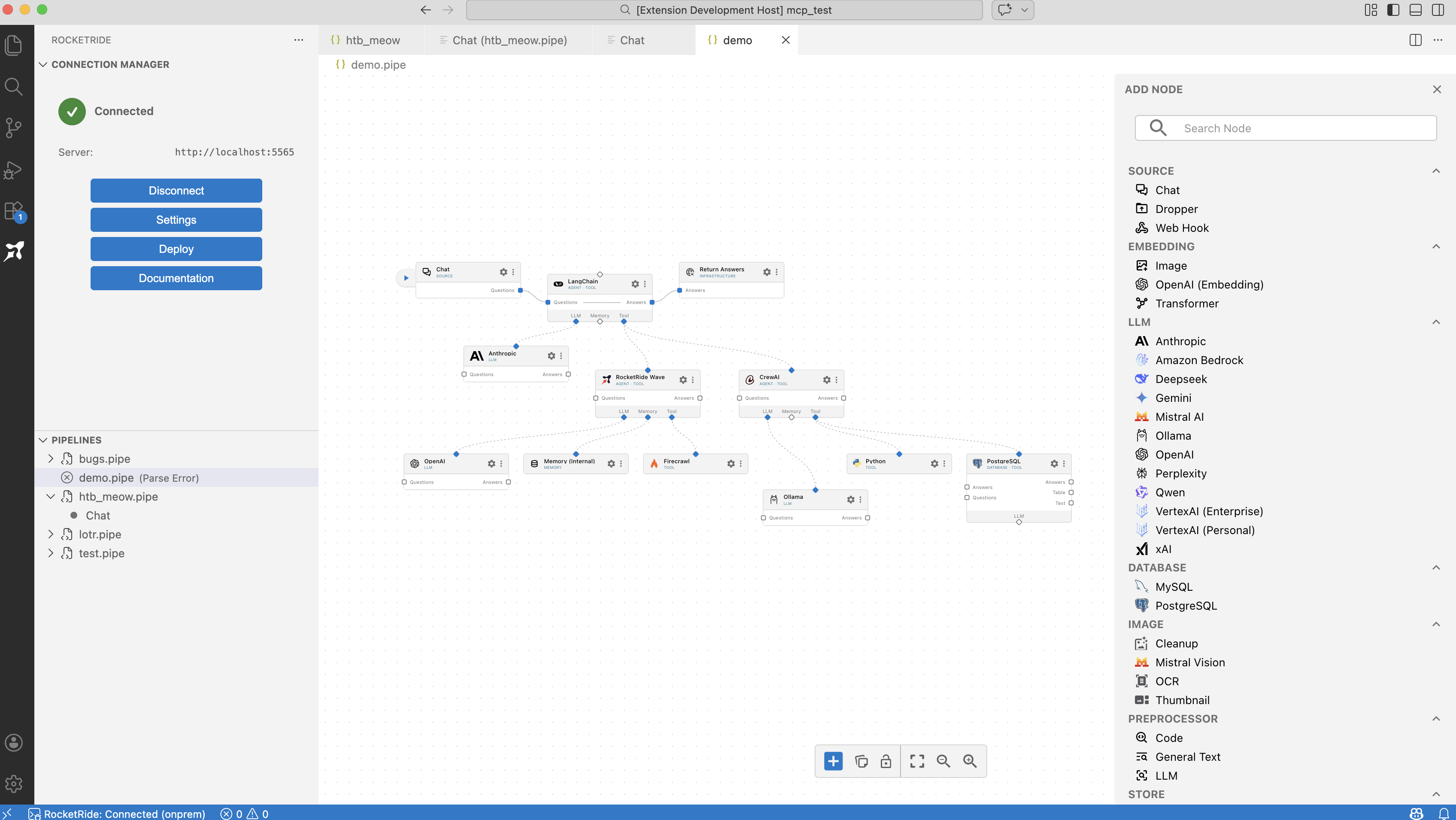
RocketRide is an open-source, developer-native AI pipeline platform. It lets you build, debug, and deploy production AI workflows without leaving your IDE -- using a visual drag-and-drop canvas or code-first with TypeScript and Python SDKs.
- 50+ ready-to-use nodes - 13 LLM providers, 8 vector databases, OCR, NER, PII anonymization, and more
- High-performance C++ engine - production-grade speed and reliability
- Deploy anywhere - locally, on-premises, or self-hosted with Docker
- MIT licensed - fully open-source, OSI-compliant
You build your .pipe - and you run it against the fastest AI runtime available.
Features
- Pipeline execution - Start with
use(), send data viasend(),send_files(), orpipe() - Chat - Conversational AI via
chat()andQuestion - Event streaming - Real-time events via
on_eventandset_events() - File upload -
send_files()with progress; streaming withpipe() - Connection lifecycle - Optional persist mode, reconnection, and callbacks (
on_connected,on_disconnected,on_connect_error) - Async context manager -
async with RocketRideClient(...) as client:for automatic cleanup
RocketRideClient
Constructor
RocketRideClient(
    uri: str = "",
    auth: str = "",
    *,
    env: dict = None,
    module: str = None,
    request_timeout: float = None,
    max_retry_time: float = None,
    persist: bool = False,
    on_event = None,
    on_connected = None,
    on_disconnected = None,
    on_connect_error = None,
    on_protocol_message = None,
    on_debug_message = None,
)
Why the options matter: uri and auth tell the client where and how to authenticate. persist and max_retry_time control what happens when the connection fails or the server is not ready yet: with persist=True the client retries with exponential backoff and calls on_connect_error on each failure, so you can show "Still connecting..." or "Connection failed" without implementing retry logic yourself. Use on_disconnected only for "we were connected and then dropped"; use on_connect_error for "failed to connect" or "gave up after max retry time."
| Argument | Type | Required | Description |
|---|---|---|---|
uri |
str |
Yes* | Server URI. *Can be empty if ROCKETRIDE_URI is set in env/.env. |
auth |
str |
Yes* | API key. *Can be empty if ROCKETRIDE_APIKEY is set. |
env |
dict |
No | Override env; if omitted, .env is loaded. Use when passing config in code instead of env files. |
module |
str |
No | Client name for logging. |
request_timeout |
float |
No | Default timeout in ms for requests. Prevents a single DAP call from hanging. |
max_retry_time |
float |
No | Max time in ms to keep retrying connection. Use (e.g. 300000) so the app can show "gave up" after a bounded time. |
persist |
bool |
No | Enable automatic reconnection. Default: False. Set True for long-lived scripts or UIs. |
on_event |
async callable | No | Called with each server event dict. Use for progress or status updates. |
on_connected |
async callable | No | Called when connection is established. |
on_disconnected |
async callable | No | Called when connection is lost only if connected first; args: reason, has_error. Do not call disconnect() here if you want auto-reconnect. |
on_connect_error |
callable (message: str) |
No | Called on each failed connection attempt. On auth failure the client stops retrying. |
on_protocol_message |
callable (message: str) |
No | Optional; for logging raw DAP messages. Helpful when debugging protocol issues. |
on_debug_message |
callable (message: str) |
No | Optional; for debug output. |
Raises ValueError if both uri and ROCKETRIDE_URI are empty or if auth is missing and not in env.
Example - client with persist and callbacks:
client = RocketRideClient(
    uri="https://cloud.rocketride.ai",
    auth="my-key",
    persist=True,
    max_retry_time=300000,
    on_connect_error=lambda msg: print("Connect error:", msg),
    on_event=handle_event,
)
Context manager
| Method | Signature | Returns | Description |
|---|---|---|---|
__aenter__ |
async def __aenter__(self) |
self |
Enters context; calls connect(). |
__aexit__ |
async def __aexit__(self, exc_type, exc_val, exc_tb) |
- | Exits context; calls disconnect(). |
How to use: Prefer async with RocketRideClient(...) as client: so the connection is always closed when you leave the block, even on exception. No need to call disconnect() manually.
Example:
async with RocketRideClient(uri="wss://cloud.rocketride.ai", auth=os.environ["ROCKETRIDE_APIKEY"]) as client:
    result = await client.use(filepath="pipeline.json")
    token = result["token"]
    await client.send(token, "Hello, pipeline!")
Connection
| Method | Signature | Returns | Description |
|---|---|---|---|
connect |
async def connect(self, uri: str = None, auth: str = None, timeout: float = None) -> None |
- | Opens the WebSocket and performs DAP auth. Optional uri/auth override the constructor values for this connection attempt. Optional timeout (ms) bounds the connect + auth handshake (non-persist only). In persist mode, on failure the client calls on_connect_error and retries; on auth failure it does not retry. |
disconnect |
async def disconnect(self) -> None |
- | Closes the connection and cancels reconnection. Call when the user disconnects or the script is done. |
is_connected |
def is_connected(self) -> bool |
bool |
Whether the client is connected. Check before calling use() or send() if needed. |
set_connection_params |
async def set_connection_params(self, uri: str = None, auth: str = None) -> None |
- | Updates server URI and/or auth at runtime. If currently connected, disconnects and reconnects with the new params (in persist mode, reconnection is scheduled; otherwise reconnects once). Use when the user changes server or credentials without creating a new client. |
get_connection_info |
def get_connection_info(self) -> dict |
dict |
Current connection state and URI. Returns { 'connected': bool, 'transport': str, 'uri': str }. Useful for debugging or displaying "Connected to ..." in the UI. |
get_apikey |
def get_apikey(self) -> Optional[str] |
str | None |
The API key in use. For debugging only; avoid logging in production. |
Low-level DAP
| Method | Signature | Returns | Description |
|---|---|---|---|
build_request |
def build_request(self, command: str, *, token: str = None, arguments: dict = None, data: bytes | str = None) -> dict |
dict |
Builds a DAP request message. Use for custom commands not covered by use(), send(), etc. |
request |
async def request(self, request: dict, timeout: float = None) -> dict |
dict |
Sends the request and returns the response. timeout in ms overrides the default for this call. Use did_fail(response) before trusting body. |
dap_request |
async def dap_request(self, command: str, arguments: dict = None, token: str = None, timeout: float = None) -> dict |
dict |
Shorthand: builds a request and sends it in one call. Equivalent to build_request() + request(). |
did_fail |
def did_fail(self, request: dict) -> bool |
bool |
Returns True when the response indicates failure (success === False). |
Example:
# Two-step (build then request)
req = client.build_request("rrext_monitor", token=token, arguments={"types": ["apaevt_status_upload"]})
res = await client.request(req, timeout=5000)

# One-step with dap_request
res = await client.dap_request("rrext_services", {}, timeout=5000)

if client.did_fail(res):
    raise RuntimeError(res.get("message", "Request failed"))
Pipeline execution
| Method | Signature | Returns | Description |
|---|---|---|---|
use |
async def use(self, *, token: str = None, filepath: str = None, pipeline: dict = None, source: str = None, threads: int = None, use_existing: bool = None, args: list = None, ttl: int = None) -> dict |
dict |
Starts a pipeline. Requires filepath or pipeline. The client substitutes ${ROCKETRIDE_*} from its env. Returns a dict with at least 'token'; use that token for all data and control operations. |
terminate |
async def terminate(self, token: str) -> None |
- | Stops the pipeline and frees server resources. |
get_task_status |
async def get_task_status(self, token: str) -> dict |
dict |
Returns current task status (e.g. completed count, total, state). Poll until completed or use for progress display. |
Why a token: The server runs each pipeline as a separate task. The token identifies that task so send(), send_files(), pipe(), chat(), and get_task_status() target the correct pipeline.
Data
| Method | Signature | Returns | Description |
|---|---|---|---|
pipe |
async def pipe(self, token: str, objinfo: dict = None, mime_type: str = None, provider: str = None) -> DataPipe |
DataPipe |
Creates a streaming pipe: open, then one or more write, then close. Use for large or chunked data. Default MIME: 'application/octet-stream'. |
send |
async def send(self, token: str, data: str | bytes, objinfo: dict = None, mimetype: str = None) -> PIPELINE_RESULT |
PIPELINE_RESULT |
Sends data in one shot (open pipe, write once, close). Use when you have the full payload in memory. |
send_files |
async def send_files(self, files: List[str | Tuple[str, dict] | Tuple[str, dict, str]], token: str) -> List[UPLOAD_RESULT] |
List[UPLOAD_RESULT] |
Uploads files. Each item: path str, or (path, objinfo), or (path, objinfo, mimetype). Progress via on_event as apaevt_status_upload. |
When to use pipe vs send: Use send() for a single string or bytes. Use pipe() when you read a file in chunks, or when data arrives incrementally.
Example - send a string:
result = await client.send(token, "Hello, pipeline!", objinfo={"name": "greeting.txt"}, mimetype="text/plain")
Example - stream with a pipe:
pipe = await client.pipe(token, mime_type="application/json")
await pipe.open()
await pipe.write(b'{"key": "value1"}')
await pipe.write(b'{"key": "value2"}')
result = await pipe.close()
Events
| Method | Signature | Returns | Description |
|---|---|---|---|
set_events |
async def set_events(self, token: str, event_types: List[str]) -> None |
- | Subscribes this task to the given event types. After this, those events are delivered to on_event. Call after use() when you need upload or processing progress. |
Services, validation, and ping
| Method | Signature | Returns | Description |
|---|---|---|---|
get_services |
async def get_services(self) -> dict |
dict |
Returns all service definitions. Use to discover what the server supports. |
get_service |
async def get_service(self, service: str) -> Optional[dict] |
dict | None |
Returns one service by name; None if not found or on error. |
validate |
async def validate(self, pipeline: PipelineConfig, *, source: str = None) -> dict |
dict |
Validates a pipeline configuration without starting it. Returns validation results (e.g. errors, warnings). Use to check pipeline correctness before use(). |
ping |
async def ping(self, token: str = None) -> None |
- | Liveness check; raises on failure. |
Chat
| Method | Signature | Returns | Description |
|---|---|---|---|
chat |
async def chat(self, *, token: str, question: Question) -> PIPELINE_RESULT |
PIPELINE_RESULT |
Sends the Question to the AI for the given token and returns the pipeline result. The answer is in the result body; use the schema's answer helpers if you need to parse JSON from the AI text. |
How it works: The client opens a pipe with the question MIME type, writes the serialized Question, closes the pipe, and returns the server result. The pipeline must support the chat provider.
DataPipe
Returned by await client.pipe(...). One streaming upload: open -> write (one or more) -> close. You can also use it as an async context manager: entering calls open(), exiting calls close().
| Property | Type | Description |
|---|---|---|
is_opened |
bool |
Whether the pipe is open. |
pipe_id |
int | None |
Server-assigned pipe ID after open(). |
| Method | Signature | Returns | Description |
|---|---|---|---|
open |
async def open(self) -> DataPipe |
self |
Opens the pipe; required before write(). |
write |
async def write(self, buffer: bytes) -> None |
- | Writes a chunk. Pipe must be open. |
close |
async def close(self) -> PIPELINE_RESULT |
PIPELINE_RESULT |
Closes the pipe and returns the processing result. |
__aenter__ |
async def __aenter__(self) |
self |
Enters context; calls open(). |
__aexit__ |
async def __aexit__(self, exc_type, exc_val, exc_tb) |
- | Exits context; calls close(). |
Question
From rocketride.schema. Build a question for client.chat(token=..., question=question). Add instructions, examples, context, history, and documents to steer the AI.
Constructor
Question(
    type: QuestionType = QuestionType.QUESTION,
    filter: DocFilter = None,
    expectJson: bool = False,
    role: str = '',
)
QuestionType: QUESTION, SEMANTIC, KEYWORD, GET, PROMPT. Default type is QUESTION. Default filter and expectJson=False, role='' if omitted.
Methods
| Method | Signature | Description |
|---|---|---|
addInstruction |
addInstruction(self, title: str, instruction: str) |
Adds an instruction (e.g. "Use bullet points"). |
addExample |
addExample(self, given: str, result: dict | list | str) |
Adds an example input/output; result can be dict/list (JSON-serialized). |
addContext |
addContext(self, context: str | dict | List[str] | List[dict]) |
Adds context. |
addHistory |
addHistory(self, item: QuestionHistory) |
Adds a history item for multi-turn chat. |
addQuestion |
addQuestion(self, question: str) |
Appends the question text. |
addDocuments |
addDocuments(self, documents: Doc | List[Doc]) |
Adds documents for the AI to reference. |
getPrompt |
getPrompt(self, has_previous_json_failed: bool = False) -> str |
Returns the full prompt (internal). |
Answer
From rocketride.schema. Used to parse chat response content. The client does not attach an Answer instance to the pipeline result; you read the response body and, if needed, use these helpers to extract JSON or code from AI text (which often includes markdown or code fences).
| Method | Signature | Description |
|---|---|---|
getText |
getText(self) -> str |
Get the answer as plain text. |
getJson |
getJson(self) -> Optional[dict] |
Get the answer as parsed JSON; returns None if not valid JSON. |
isJson |
isJson(self) -> bool |
Whether the answer contains valid JSON. |
parseJson |
parseJson(self, value: str) -> Any |
Parses JSON from AI text (strips markdown/code blocks). |
parsePython |
parsePython(self, value: str) -> Any |
Extracts Python code from a code block in the response. |
Types
- PIPELINE_RESULT: TypedDict with
name,path,objectId, optionalresult_types, and dynamic fields. - UPLOAD_RESULT: Per-file result with
action,filepath,error?,result?,upload_time?, etc. - TASK_STATUS: Task status with
completedCount,totalCount,completed,state,exitCode, and many more fields. - DAPMessage: Dict with
type,seq, and optionalcommand,arguments,body,success,message,event,token, etc. - PipelineConfig: Pipeline definition with
name,description,version,components,source,project_id. - QuestionHistory:
{ 'role': str, 'content': str }. - QuestionInstruction:
{ 'subtitle': str, 'instructions': str }. - QuestionExample:
{ 'given': str, 'result': str }.
Exceptions
The exception hierarchy provides fine-grained error handling:
DAPException                    # Base DAP protocol error (has dap_result dict)
└── RocketRideException         # Base for all RocketRide errors
    ├── ConnectionException     # Connection/network issues
    │   └── AuthenticationException  # Bad API key or credentials
    ├── PipeException           # Data pipe errors (open/write/close)
    ├── ExecutionException      # Pipeline start/run failures
    └── ValidationException     # Invalid input/config
All exceptions expose a dap_result dict with detailed server error context.
AuthenticationException is thrown on DAP auth failure. In persist mode the client catches it, calls on_connect_error, and does not retry so the app can fix credentials and call connect() again.
Example:
from rocketride import RocketRideClient, AuthenticationException
from rocketride.core.exceptions import PipeException, ExecutionException

try:
    async with RocketRideClient(uri=uri, auth=auth) as client:
        result = await client.use(filepath="pipeline.json")
        await client.send(result["token"], data)
except AuthenticationException:
    print("Bad credentials")
except ExecutionException as e:
    print(f"Pipeline failed: {e}")
except PipeException as e:
    print(f"Data transfer error: {e}")
Examples (Full API Usage)
1. Minimal: connect, run pipeline from file, send one string, disconnect
import asyncio
from rocketride import RocketRideClient

async def main():
    client = RocketRideClient(uri="https://cloud.rocketride.ai", auth="my-key")
    await client.connect()
    result = await client.use(filepath="pipeline.json")
    token = result["token"]
    out = await client.send(token, "Hello, pipeline!", objinfo={"name": "input.txt"}, mimetype="text/plain")
    print(out)
    await client.terminate(token)
    await client.disconnect()

asyncio.run(main())
2. One-off script with context manager (recommended)
import asyncio
from rocketride import RocketRideClient

async def main():
    async with RocketRideClient(uri="wss://cloud.rocketride.ai", auth="my-key") as client:
        result = await client.use(pipeline={"pipeline": my_pipeline_config})
        token = result["token"]
        await client.send(token, '{"data": 1}')
        status = await client.get_task_status(token)
        print(status)
        await client.terminate(token)

asyncio.run(main())
3. Long-lived app: persist mode, callbacks, and status handling
import asyncio
from rocketride import RocketRideClient

async def main():
    client = RocketRideClient(
        uri="https://cloud.rocketride.ai",
        auth="my-key",
        persist=True,
        max_retry_time=300000,
        on_connected=lambda info: print("Connected:", info),
        on_disconnected=lambda reason, has_error: print("Disconnected:", reason, has_error),
        on_connect_error=lambda msg: print("Connect error:", msg),
        on_event=lambda e: print(e.get("event"), e.get("body")),
    )
    await client.connect()
    # Later: use(), send_files(), etc. If connection drops, client retries; do not call disconnect() in on_disconnected.

asyncio.run(main())
4. Upload multiple files and poll until pipeline completes
import asyncio
from pathlib import Path
from rocketride import RocketRideClient

async def main():
    client = RocketRideClient(uri="https://cloud.rocketride.ai", auth="my-key")
    await client.connect()
    result = await client.use(filepath="vectorize.json")
    token = result["token"]
    await client.set_events(token, ["apaevt_status_upload", "apaevt_status_processing"])

    files = ["doc1.md", "doc2.md", ("doc3.json", {"tag": "export"}, "application/json")]
    upload_results = await client.send_files(files, token)
    for r in upload_results:
        if r["action"] == "complete":
            print("OK", r["filepath"])
        else:
            print("Failed", r["filepath"], r.get("error"))

    while True:
        status = await client.get_task_status(token)
        print(f"Progress: {status.get('completedCount', 0)}/{status.get('totalCount', 0)}")
        if status.get("completed"):
            break
        await asyncio.sleep(2)
    await client.terminate(token)
    await client.disconnect()

asyncio.run(main())
5. Streaming large data with a pipe
import asyncio
from rocketride import RocketRideClient

async def main():
    async with RocketRideClient(uri="https://cloud.rocketride.ai", auth="my-key") as client:
        result = await client.use(filepath="ingest.json")
        token = result["token"]
        pipe = await client.pipe(token, objinfo={"name": "large.csv"}, mime_type="text/csv")
        await pipe.open()
        with open("large.csv", "rb") as f:
            while True:
                chunk = f.read(64 * 1024)
                if not chunk:
                    break
                await pipe.write(chunk)
        result = await pipe.close()
        print(result)
        await client.terminate(token)

asyncio.run(main())
6. Chat: question with instructions and examples, parse JSON answer
import asyncio
from rocketride import RocketRideClient
from rocketride.schema import Question, Answer

async def main():
    async with RocketRideClient(uri="https://cloud.rocketride.ai", auth="my-key") as client:
        result = await client.use(filepath="chat_pipeline.json")
        token = result["token"]
        question = Question(expectJson=True)
        question.addInstruction("Format", "Return a JSON object with keys: summary, keywords.")
        question.addExample("Summarize X", {"summary": "...", "keywords": ["a", "b"]})
        question.addQuestion("Summarize the main points and list keywords.")
        response = await client.chat(token=token, question=question)
        answer_text = response.get("data", {}).get("answer") or (response.get("answers") or [None])[0]
        structured = Answer().parseJson(answer_text) if answer_text else None
        print(structured)
        await client.terminate(token)

asyncio.run(main())
7. Discover services and send a custom DAP request
import asyncio
from rocketride import RocketRideClient

async def main():
    client = RocketRideClient(uri="https://cloud.rocketride.ai", auth="my-key")
    await client.connect()
    services = await client.get_services()
    print("Available:", list(services.keys()))
    ocr = await client.get_service("ocr")
    if ocr:
        print("OCR schema:", ocr.get("schema"))
    req = client.build_request("rrext_ping", token=my_token)
    res = await client.request(req, timeout=5000)
    if client.did_fail(res):
        raise RuntimeError(res.get("message", "Ping failed"))
    await client.disconnect()

asyncio.run(main())
Links
License
MIT - see LICENSE.


Download files
Download the file for your platform. If you're not sure which to choose, learn more about installing packages.
Source Distribution
Built Distribution
Filter files by name, interpreter, ABI, and platform.
If you're not sure about the file name format, learn more about wheel file names.
Copy a direct link to the current filters
File details
Details for the file rocketride-1.0.4.tar.gz.
File metadata
- Download URL: rocketride-1.0.4.tar.gz
- Upload date:
- Size: 148.8 kB
- Tags: Source
- Uploaded using Trusted Publishing? No
- Uploaded via: twine/6.2.0 CPython/3.12.13
File hashes
| Algorithm | Hash digest | |
|---|---|---|
| SHA256 |
0219935ed209c4ac4c8ccae315f32cf9c843d8fd52e2b219a229f1bd97d9dc5b
|
|
| MD5 |
1e1badc761978be3c7feb64468cac4ff
|
|
| BLAKE2b-256 |
4c41511e29c5f7546681b563ab6c603b024baf2dcffce236e0e539a78e28b69a
|
File details
Details for the file rocketride-1.0.4-py3-none-any.whl.
File metadata
- Download URL: rocketride-1.0.4-py3-none-any.whl
- Upload date:
- Size: 198.8 kB
- Tags: Python 3
- Uploaded using Trusted Publishing? No
- Uploaded via: twine/6.2.0 CPython/3.12.13
File hashes
| Algorithm | Hash digest | |
|---|---|---|
| SHA256 |
0368dfc998926077fd9c1bf98f96bff36fc2f4730201779db92dc2be5db377be
|
|
| MD5 |
5d76613bb03bbd37faa441df134e8179
|
|
| BLAKE2b-256 |
2a481470fe986a6e16ad7edd6ed960bf04705131f90e5bf7110ea67c19067ea4
|






