
Roman Wheel Node


An exact-copy gate plus learned, auditable evidence fusion that decides whether a claim can enter an agent's trace. Pure Python (3.9+), standard library only, zero dependencies.
Shipped policy 4.3.0: free, local profiles only, fitted only on SciFact train (commercial-use licences, see
DATA_LICENSES.md). No xAI/Grok or other
hosted-model output is used in any shipped weight, and the package makes no API calls. On held-out SciFact dev the
default profile (local) accepted 58 of 300 claims with 6 false accepts (precision 89.7%) and local-lite accepted 16
with 1 false (93.8%). Neither profile is certified at any error level (10%, 5%, 2% or 1%). These are the only
real-data numbers this release claims; see Policy 4.3.0. To fit a policy
on your own labelled data, see Fit your own policy.
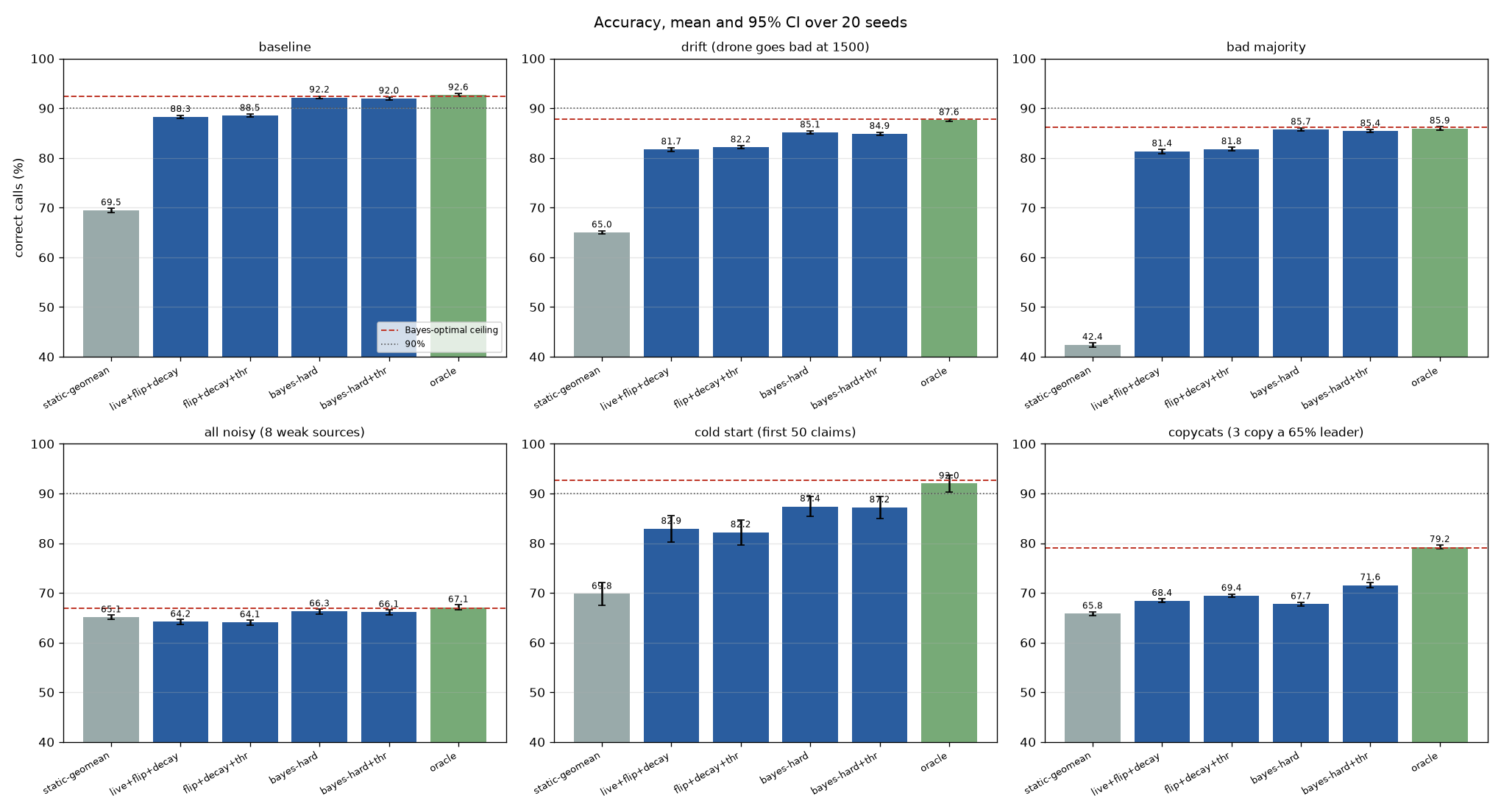
Synthetic benchmark (simulated claim streams, not real data): 92.2% ± 0.3% correct calls on the baseline scenario (20 seeds), against a 92.4% Bayes-optimal ceiling. The other scenarios have ceilings below 90%; see Synthetic benchmark.
Install
pip install roman-wheel-node
roman-wheel-node --version          # or: python -m roman_wheel_node --version
# optional extras for the shadow-mode sources: local-nli (ONNX), local-nli2 (DeBERTa-v3-base, torch)
pip install "roman-wheel-node[local-nli2]"
# for development
git clone https://github.com/SynerGro-AI/roman-wheel-node && cd roman-wheel-node
pip install -e ".[test,bench]" && python -m pytest -q
Design from first principles
1. Gate first, then weigh. Some checks are binary facts (hash match, binary selection,
drawing invariant). Weighing can't make up for a failed fact, so a = 0 BLOCKs before anything
else. A source score of exactly 0 is a veto: it means "this is impossible", not "weak evidence",
so it BLOCKs no matter how much that source is trusted. No scores means no evidence, so that BLOCKs too.
2. Why log-odds (mode="bayes"). We want P(claim true | what the sources said). If the sources
are independent, Bayes' rule says the evidence adds in log-odds space:
logit P(true | s1..sn) = logit(prior) + Σ_k log[ P(s_k | true) / P(s_k | false) ]
If source k is right with probability r_k, its vote is worth ±logit(r_k) = ±log(r_k / (1 − r_k)). This gives three things for free that the geometric mean only handled with patches:
- r > 0.5 counts as positive evidence, r = 0.5 (a coin flip) counts as exactly zero, and r < 0.5 counts as
negative evidence, so a liar is inverted automatically with no
flipflag. - More agreeing sources raise confidence. Product mode does the opposite: more evidence lowers the score.
effis a real probability, so the natural ACCEPT boundary is 0.5 rather than a hand-picked 0.35.
There are three likelihood variants, and all were benchmarked: hard (the source's vote: score > 0.5), soft
(the score treated as P(source says true)) and logit ((2r−1)·logit(score)). hard was the best or tied for best
everywhere, so it is the default. In this data the score's distance from 0.5 carries little information beyond which
side it falls on. Each source's r is capped to [0.01, 0.99], which limits any one source to ±4.6 log-odds.
3. Why append-only ledgers. Every piece of feedback is a new JSONL line. State is a pure function of the ledger, so it can be audited ("why did you trust drone?"), replayed deterministically, and re-run under different settings. Nothing is ever overwritten, which means a bug or a bad setting can't destroy past learning.
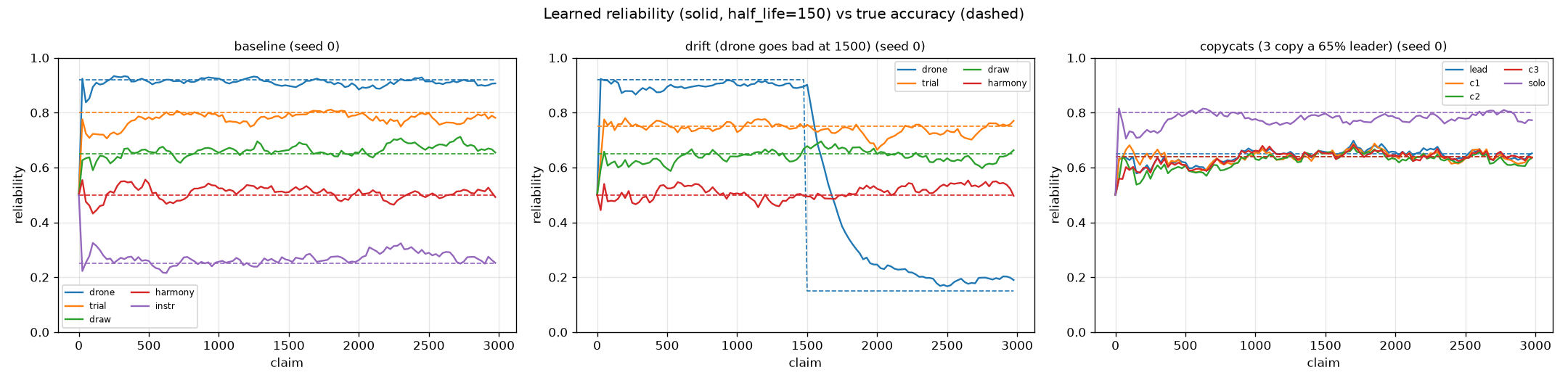
4. Why decay (half-life 150 by default). Sources change. Without forgetting, a source that was right
1,500 times needs hundreds of failures before its trust drops. Decay is applied while replaying, so the
ledger itself stays complete and you can replay with half_life=None at any time.
5. Why a learned threshold. A cut-off is only right if eff is calibrated. When the model's assumptions are
broken (for example, correlated sources), the posterior becomes over-confident. ThresholdLearner keeps an
append-only ledger of (eff, truth) for each mode and picks the cut-off that maximised decayed accuracy over recent
outcomes (half-life 500, 0.001 grid, default until min_obs).
Limits (stated honestly)
- The independence assumption (naive
bayes-hard). Sources that copy each other get counted several times: oncopycats, bayes-hard reaches 67.7% against a 79.1% optimum. Fixed byvariant="ess"with aDependenceLearner, which reaches 79.0% (see Correlation-aware combining). A latent common cause (partial_corr) is only partly captured. - The information ceiling. No fusion rule can beat the Bayes-optimal oracle. Eight independent 58%-accurate sources cap out at about 67% (exact majority-vote value: 67.1%). Reaching 90% would take about 63 such sources.
- Feedback is required. Reliabilities come from right/wrong feedback. With no feedback, the node uses
assumed_reliability(0.75) for bayes mode, or equal trust for geomean. - The simulations are only simulations. The real accuracy of your sources is what sets the ceiling.
API
from roman_wheel_node import roman_wheel_node, LiveWeights, ThresholdLearner, give_feedback

live = LiveWeights("weights_ledger.jsonl")           # half_life=150 by default (None = never forget)
thr  = ThresholdLearner("threshold_ledger.jsonl")    # half_life=500, min_obs=30, default cut-off 0.5

scores = {"drone": 0.95, "trial": 0.81, "instr": 0.12}
eff, op, status = roman_wheel_node(1, scores, live, mode="bayes", threshold=thr)  # variant="hard"
# ... later, when the truth is known:
give_feedback(scores, truth=True, live=live, threshold=thr, eff=eff, mode="bayes")
roman_wheel_node(a, scores, live=None, mode="geomean", log_path=None, flip=False, threshold=None, variant="hard", prior=0.5, assumed_reliability=0.75, cutoff=None) -> (eff, opcode, status)
mode:"geomean"(default, v1/v2),"product", or"bayes"(new).- Opcodes without a learner: geomean/product use the fixed v1 bands (≥0.85
111, ≥0.65110, ≥0.35101,0.05
100HEDGE). Bayes uses cut-off 0.5.cutoff=<float>sets a fixed cut-off, andcutoff="fixed"forces the v1 bands. - Opcodes with a learner: ACCEPT iff
eff ≥ c; the span [c, 1] is split into thirds for101/110/111; HEDGE100covers[c − 0.15, c)but only above 0.05; anything lower is BLOCK. - Backward compatible: every v2 call gives bit-identical results, and the 6 original tests are unchanged
(checked by pytest against a frozen v2 reference,
tests/_v2_reference.py, on 1,600 random claims). - Behaviour change: the
LiveWeightsdefaulthalf_lifeis now 150. Passhalf_life=Noneto get v2 behaviour (benchmarks/train_sim.pypins this so its old results still reproduce).
Gated agent trace (Phase 1): roman_wheel_node.trace
ClaimTrace is the only way a claim can enter an agent's context or become a parent, and every entry goes through roman_wheel_node.
from roman_wheel_node.trace import ClaimTrace, replay

trace = ClaimTrace("audit.jsonl", live=live, mode="bayes")      # allow_hedge=False by default
root = trace.submit("sha matches release", {"drone": 0.95, "trial": 0.9}, a=1)
if root.admitted:
    child = trace.submit("so the build is reproducible", {"trial": 0.8}, a=1, parents=[root.claim])
context = trace.context()        # immutable tuple of admitted Claim objects
replay("audit.jsonl")            # verifies the hash chain and recomputes every decision
trace.verify()                   # also checks the in-memory claims against the log
Invariants (all covered by tests, including property-based tests with hypothesis):
- One entry point.
Claimcan't be constructed outside the trace (private token). Claims are immutable: their slots are frozen,scoresis a read-only mapping, and they can't be pickled into new objects. The trace has no append, insert or remove, andcontext()returns a tuple. - Zero-propagation.
amust be exactly 1.a = 0, BLOCK and any score of exactly 0 never enter. A claim whose parent is not an admitted claim of this trace is evaluated witha = 0. That covers a blocked parent, an unknown or forged one, and one from another trace (checked by object identity). So no descendant of a blocked claim can enter. - Containment. A blocked claim is invisible.
get()treats its id exactly like an id that never existed, andcontext()never shows it. HEDGE is admitted only withallow_hedge=True. - Tamper-evident audit. Every call, admitted or not, appends one JSONL record with the full audit tuple: content,
raw scores,
aand effectivea, parent ids, the reliabilities and cut-off used, mode, eff, opcode, status, admitted/reason, and a timestamp. Each record also storesprevandhash = sha256(prev | canonical record). Passhmac_key=to make it an HMAC chain.replay()rejects edited, deleted, reordered or garbage records, and any record whose decision doesn't recompute from its own inputs. A trace refuses to resume from a log that doesn't verify. - Threat model (honest): this is an API-level guarantee. In-process Python can always reach private state.
Such tampering is caught by
verify()and by the parent identity checks. Withouthmac_key, someone who rewrites the whole log consistently can't be detected unless you anchortrace.head()somewhere else.
Synthetic benchmark (Phase 2): python -m roman_wheel_node.bench --seeds 20
Everything in this section and in Correlation-aware combining is synthetic: simulated sources on simulated claims, not real data. The real-data results are in Policy 4.3.0.
These are synthetic claim streams from roman_wheel_node.bench.generator. The generator is documented and has a CLI
(python -m roman_wheel_node.bench.generator --list prints every scenario spec). Each source makes the right call with
its stated accuracy. Its score is drawn from Beta(8,2) when it says "true" and Beta(2,8) when it says "false", with a
floor of 0.01. Seeds 0–19 are used, so each scenario has 20 independent streams. Every policy sees the same stream,
decides with what it has learned so far, and then receives the truth as feedback.
- Accuracy is the share of right calls. A HEDGE counts as not accepted.
- TA / FB are the true-accept rate (share of true claims accepted) and the false-block rate (share of false claims blocked).
- The ceiling is the Bayes-optimal oracle. It knows the true accuracies, the drift schedule, the copy structure and the noise model, and decides by sign(log-likelihood ratio). Its value is measured on ≥200k claims. Nothing can beat it in expectation.
- Intervals are 95% Student-t intervals over the 20 seeds.
| Scenario | Ceiling | static geomean | v2 best (flip+decay) | bayes-hard | bayes-hard TA / FB | bayes-hard + learned threshold | oracle (same streams) |
|---|---|---|---|---|---|---|---|
| all noisy (8 weak sources) | 66.9 | 65.1 ± 0.5 | 64.2 ± 0.5 | 66.3 ± 0.5 | 67.0 / 65.6 | 66.1 ± 0.5 | 67.1 ± 0.5 |
| bad majority | 86.1 | 42.4 ± 0.4 | 81.4 ± 0.4 | 85.7 ± 0.3 | 85.9 / 85.5 | 85.4 ± 0.3 | 85.9 ± 0.3 |
| baseline | 92.4 | 69.5 ± 0.5 | 88.3 ± 0.3 | 92.2 ± 0.3 | 92.3 / 92.1 | 92.0 ± 0.3 | 92.6 ± 0.3 |
| cold start (first 50 claims) | 92.6 | 69.8 ± 2.3 | 82.9 ± 2.7 | 87.4 ± 2.0 | 86.9 / 87.8 | 87.2 ± 2.2 | 92.0 ± 1.7 |
| copycats (3 copy a 65% leader) | 79.1 | 65.8 ± 0.4 | 68.4 ± 0.3 | 67.7 ± 0.3 | 67.8 / 67.7 | 71.6 ± 0.5 | 79.2 ± 0.4 |
| drift (drone goes bad at 1500) | 87.8 | 65.0 ± 0.3 | 81.7 ± 0.4 | 85.1 ± 0.3 | 85.5 / 84.8 | 84.9 ± 0.3 | 87.6 ± 0.2 |
Where it reaches 90%, and why it doesn't elsewhere. 90% is reached only on the baseline. Every other scenario has a ceiling below 90%, so no method could reach it there. bayes-hard is within 0.6 points of the ceiling on baseline, bad majority and all-noisy. It is 2.7 points short on drift, because it takes time to unlearn the drone after it goes bad. On cold start it is 5.2 points short of the ceiling (4.6 short of the oracle on the same streams): 50 claims are not enough to learn from. On copycats it is 11.4 points short (7.5 with the learned threshold), because the independence assumption counts the leader four times.
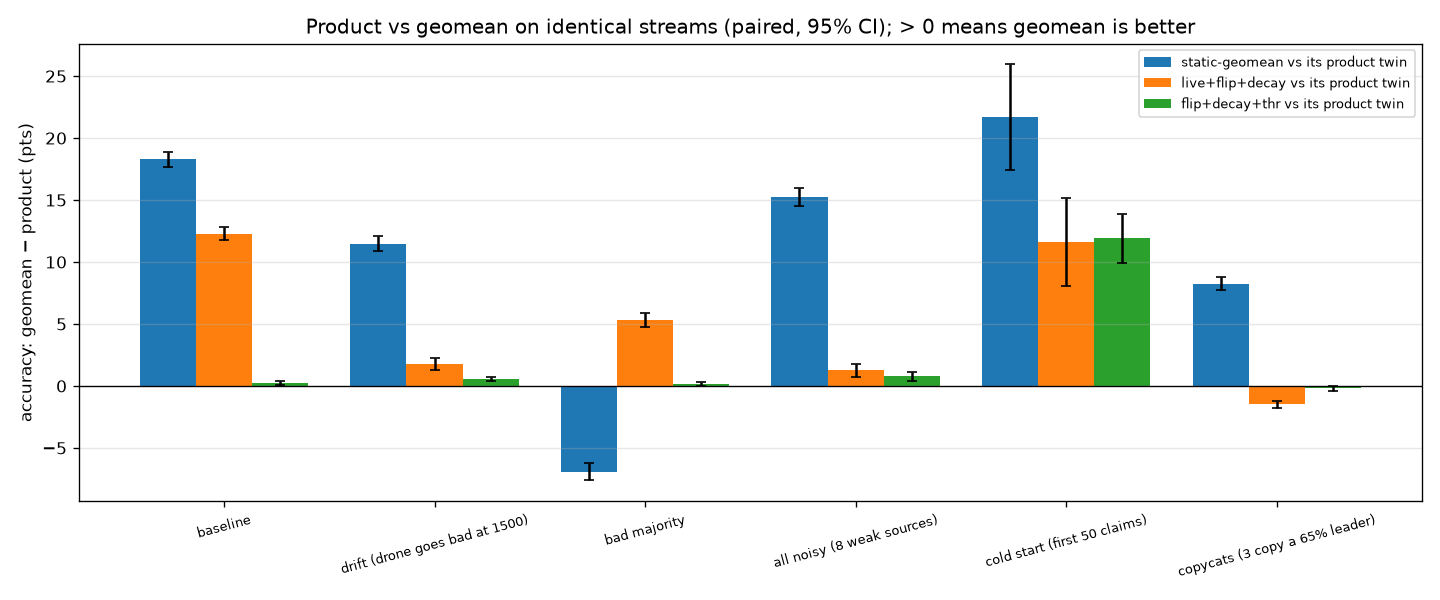
Product vs geomean, head to head on identical streams
The difference is geomean accuracy minus product accuracy in points, paired per seed, with geomean/tie/product wins over 20 seeds.
| Scenario | static | live+flip+decay | flip+decay + learned threshold |
|---|---|---|---|
| all noisy (8 weak sources) | +15.2 ± 0.7 (20/0/0) | +1.3 ± 0.5 (18/0/2) | +0.8 ± 0.3 (17/0/3) |
| bad majority | -6.9 ± 0.7 (0/0/20) | +5.3 ± 0.6 (20/0/0) | +0.2 ± 0.1 (13/1/6) |
| baseline | +18.3 ± 0.6 (20/0/0) | +12.3 ± 0.5 (20/0/0) | +0.2 ± 0.1 (15/1/4) |
| cold start (first 50 claims) | +21.7 ± 4.2 (20/0/0) | +11.6 ± 3.5 (19/0/1) | +11.9 ± 2.0 (20/0/0) |
| copycats (3 copy a 65% leader) | +8.3 ± 0.5 (20/0/0) | -1.5 ± 0.3 (0/0/20) | -0.2 ± 0.2 (6/0/14) |
| drift (drone goes bad at 1500) | +11.5 ± 0.6 (20/0/0) | +1.8 ± 0.5 (19/0/1) | +0.6 ± 0.2 (20/0/0) |
Verdict: with the fixed v1 bands, product mode is broken. It multiplies weights, so its eff shrinks with every
added source and it ends up rejecting almost everything: on baseline it accepts 2.4% of true claims. It only "wins" when
rejecting everything happens to be better than the alternative. That is the case in bad majority with static weights,
where static geomean is worse than a coin flip, and in copycats with live weights.
With a learned threshold the gap mostly closes, because product is close to a monotone transform of geomean once the
reliabilities settle. Even so, geomean is equal or better in 5 of 6 scenarios, and it is far better on cold start
(+11.9 points), where the threshold has too little data. Keep geomean (or bayes) as the default. product stays
available only for backward compatibility.
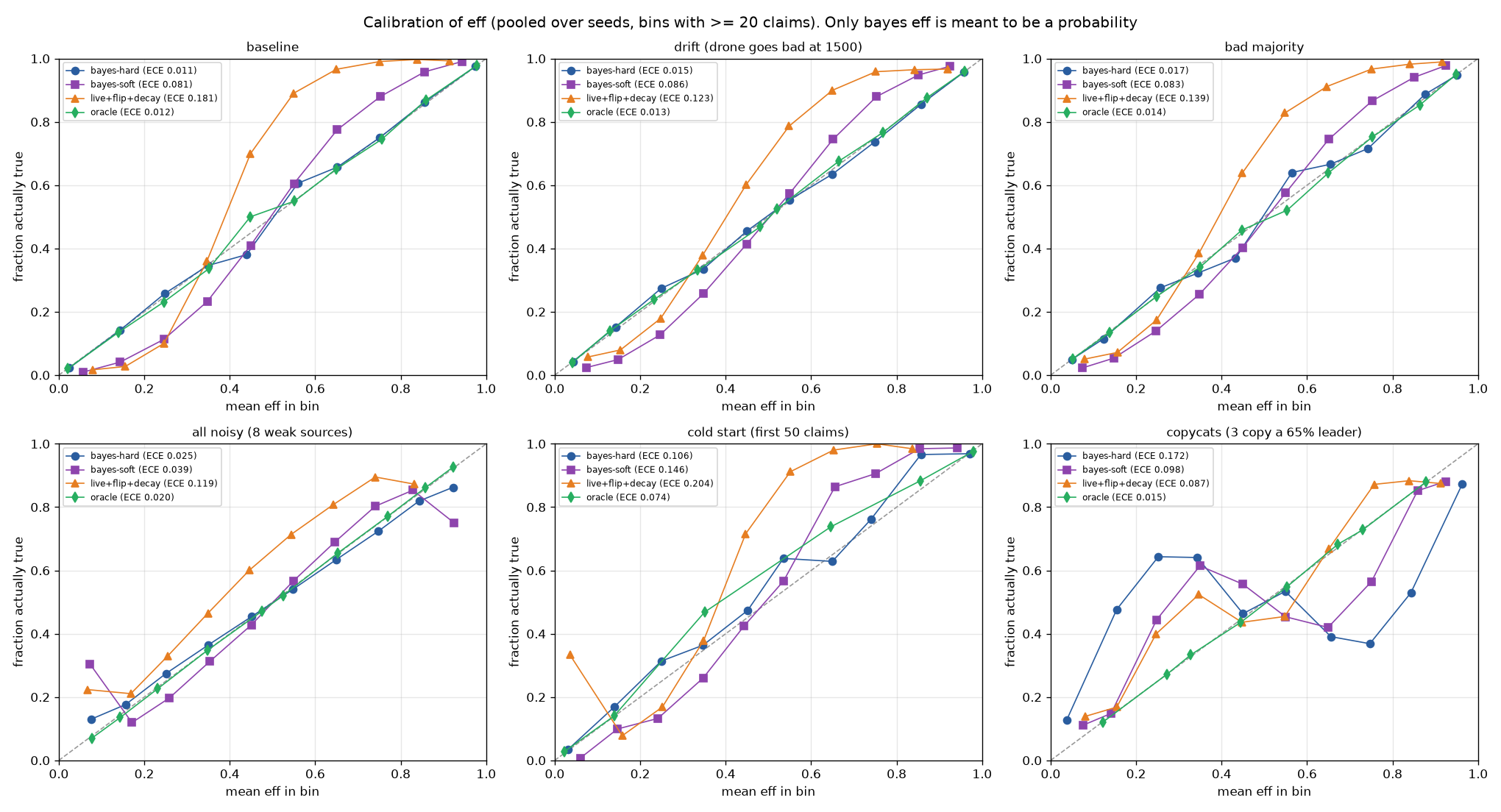
Calibration
- Learned reliability error: mean over sources of |r − true accuracy|, averaged over the run / at the last claim.
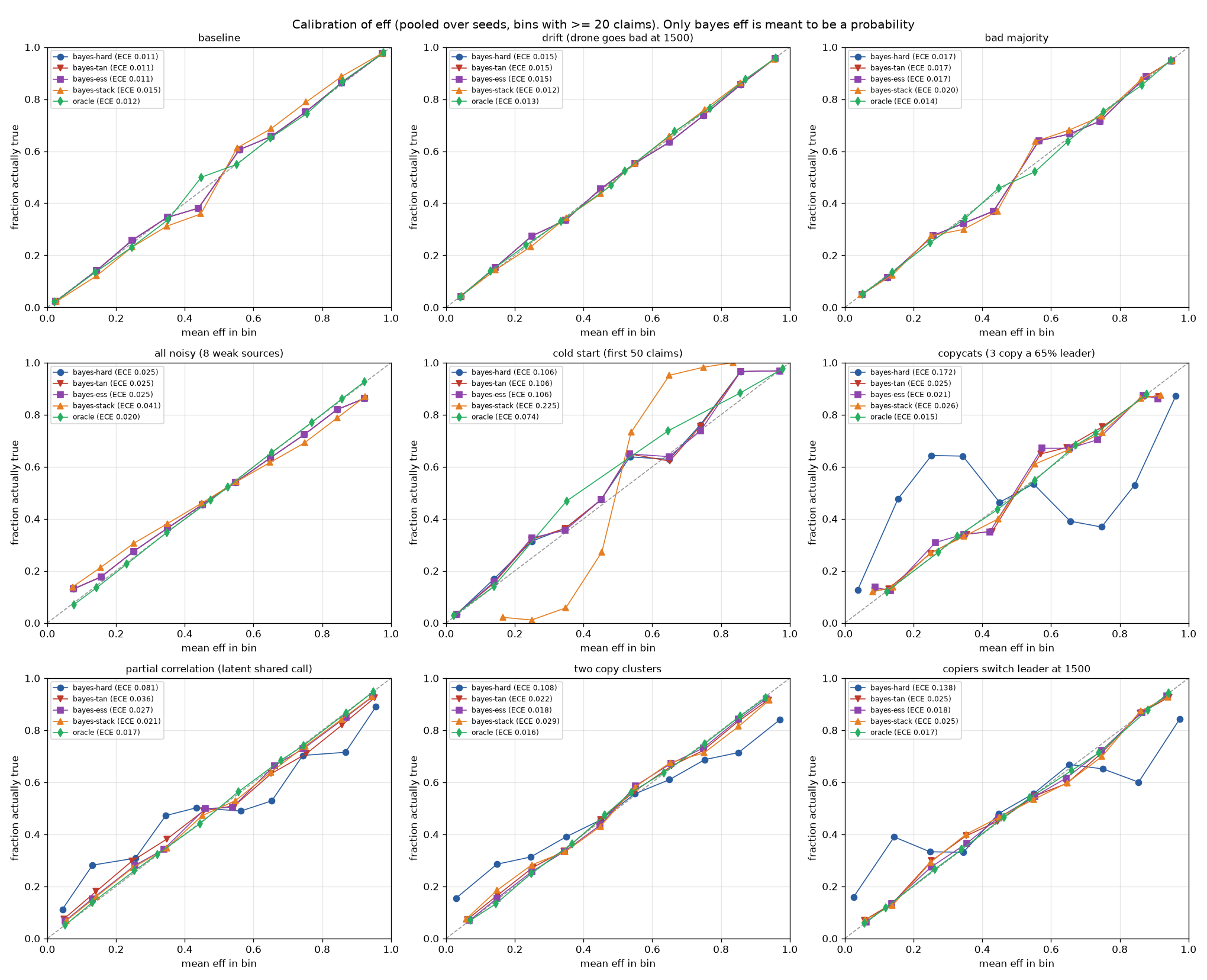
- ECE of eff: expected calibration error over 10 bins, the mean of per-seed values. Only bayes eff is meant to be a probability.
| Scenario | r error, half_life 150 | r error, no decay | ECE bayes-hard | ECE bayes-soft | ECE geomean (flip+decay) | ECE oracle |
|---|---|---|---|---|---|---|
| all noisy (8 weak sources) | 0.021 / 0.018 | 0.014 / 0.008 | 0.025 | 0.039 | 0.119 | 0.020 |
| bad majority | 0.022 / 0.018 | 0.016 / 0.011 | 0.017 | 0.083 | 0.139 | 0.014 |
| baseline | 0.022 / 0.019 | 0.015 / 0.011 | 0.011 | 0.081 | 0.181 | 0.012 |
| cold start (first 50 claims) | 0.075 / 0.046 | 0.074 / 0.045 | 0.106 | 0.146 | 0.204 | 0.074 |
| copycats (3 copy a 65% leader) | 0.021 / 0.016 | 0.014 / 0.009 | 0.172 | 0.098 | 0.087 | 0.015 |
| drift (drone goes bad at 1500) | 0.034 / 0.021 | 0.079 / 0.102 | 0.015 | 0.086 | 0.123 | 0.013 |
Reading the calibration table:
- Stable sources: forgetting costs a little accuracy in the learned reliabilities (0.02 error vs 0.01).
- Drift: forgetting is what makes the reliabilities track the change (0.021 error at the end, vs 0.102 without decay).
- bayes-hard eff is a calibrated probability whenever the sources really are independent (ECE 0.011–0.025, the same as the oracle).
- Copycats: it is badly over-confident (ECE 0.17). This is the double-counting problem, and the learned threshold only partly offsets it.
- Cold start: the ECE figures are inflated by small-sample binning. 50 claims per run gives noisy bins; even the oracle shows 0.074.
- geomean: its eff is a score, not a probability (ECE 0.09–0.20).
Reproduce
pip install -e ".[bench]"
python -m roman_wheel_node.bench --seeds 20                  # writes results/ (~1 min on 8 cores)
python -m roman_wheel_node.bench --seeds 20 --check results  # prints IDENTICAL if byte-for-byte equal
RWN_FULL_BENCH=1 python -m pytest tests/test_bench.py         # the same check as a test
benchmark.json and benchmark.txt are byte-identical across runs and worker counts. This was verified on Python
3.9, 3.12 and 3.13. The charts are not byte-compared, because PNG bytes depend on the matplotlib version.
The default test suite also re-derives a subset of the committed per-seed numbers: all 20 cold-start seeds, baseline seed 0 and copycats seed 7.
Correlation-aware combining: variant="ess" with a DependenceLearner
Naive Bayes assumes sources are independent given the truth. Sources that copy each other then get counted several times
(the copycats scenario lost 11 points to this). roman_wheel_node.dependence.DependenceLearner learns the dependence from
feedback. Like every other learner here, it uses an append-only, replayable ledger with decay applied on replay.
From first principles: if two sources are independent given the truth, whether one is right tells you nothing
about whether the other is right. So the learner tracks, for every pair, the decayed 2×2 table of their correctness
(right/wrong). The G-test (2·N·MI > 6.63, p < 0.01) decides whether a pair is significantly dependent, and
φ (the correlation of correctness) measures how much evidence they duplicate. Three combiners were tried, all on hard votes:
| variant | idea | verdict |
|---|---|---|
ess |
effective-sample-size discount: weight each vote logit(r_k) by 1 / (1 + Σ_j max(0, φ_jk)) over significant partners, so a cluster of near-duplicates counts about once |
chosen: best accuracy and calibration on every dependence scenario |
tan |
tree-augmented naive Bayes: a Chow-Liu forest over significant pairs, with `P(c_k | c_parent)shrunk towardr_k` |
stack |
online logistic regression on signed votes, L2-anchored to naive-Bayes weights | wins only on drift (+0.4); loses 1.0 point on 8 weak sources and is noisier at cold start |
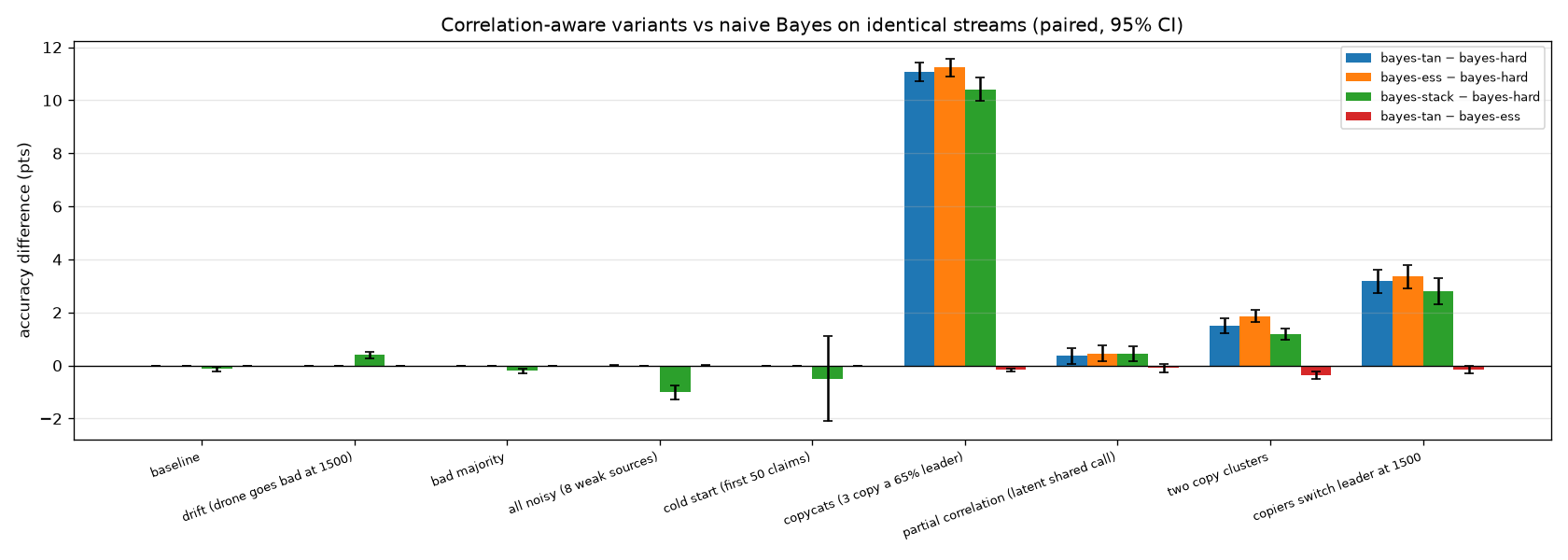
With no significant pairs, ess and tan reduce exactly to variant="hard". That is why they tie bayes-hard on the
independent scenarios: the paired difference is ≤ 0.01 points, with 19–20 of 20 seeds identical.
from roman_wheel_node import DependenceLearner, roman_wheel_node, give_feedback
dep = DependenceLearner("dependence_ledger.jsonl")          # half_life=150 claims by default
eff, op, status = roman_wheel_node(1, scores, mode="bayes", variant="ess", dependence=dep)
give_feedback(scores, truth, dependence=dep)                # once the truth is known
# ClaimTrace(..., mode="bayes", variant="ess", dependence=dep) logs the exact model snapshot, so replay() is exact
Synthetic dependence benchmark: python -m roman_wheel_node.bench --suite dependence --seeds 20
This covers the six standard scenarios (definitions unchanged) plus three new dependence scenarios, each with an oracle that knows the true joint model:
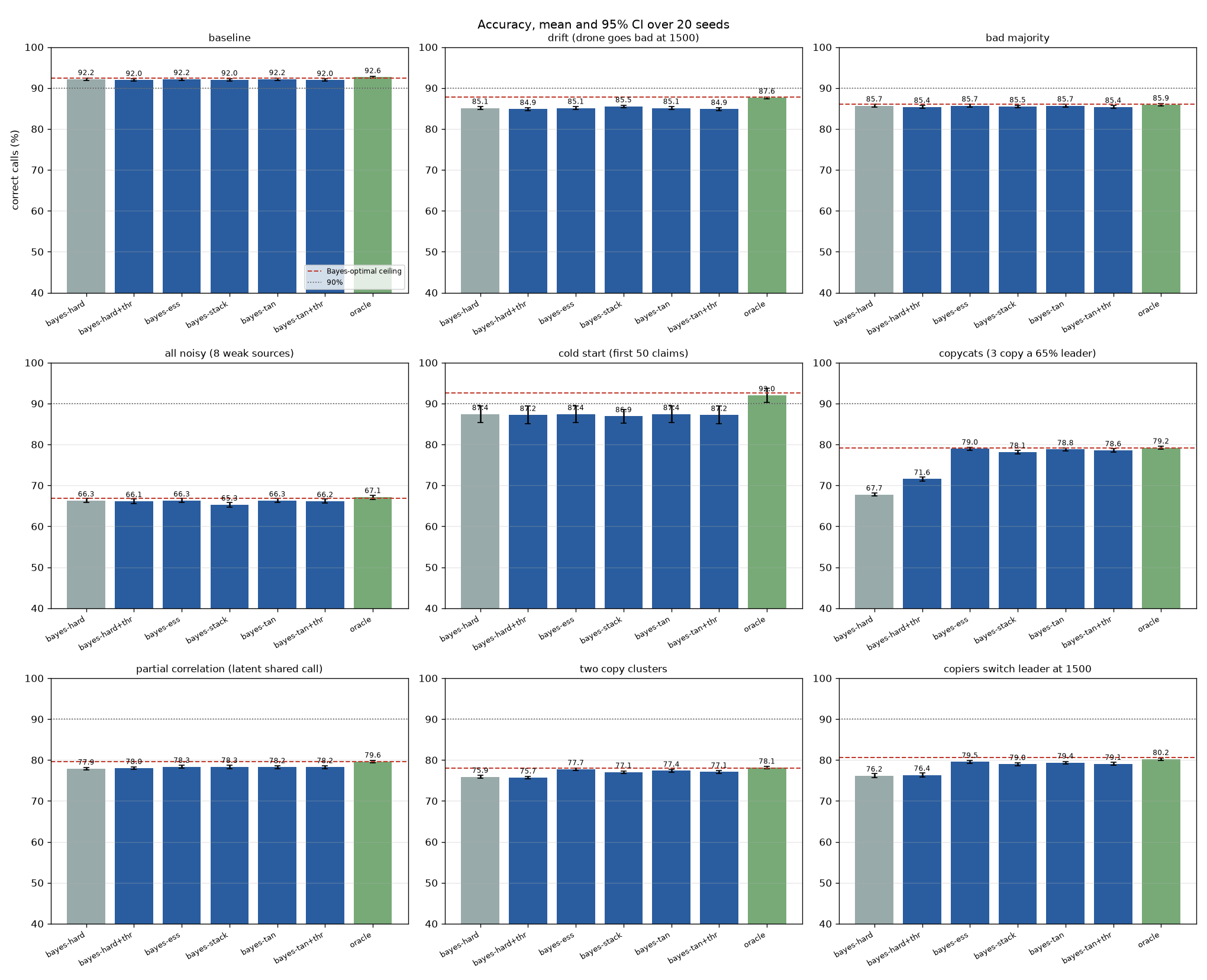
partial_corr: four sources repeat a hidden shared call half the time.two_clusters: two independent leader-plus-two-copier clusters.leader_switch: three copiers switch from a 75% leader to a 60% one at claim 1500.
Each table cell is accuracy, mean ± 95% CI over 20 seeds. TA / FB are the true-accept and false-block rates. The paired column is (ess wins / ties / hard wins) over 20 seeds. ECE is the expected calibration error of eff.
| Scenario | Ceiling | bayes-hard | bayes-ess | ess TA / FB | bayes-tan | bayes-stack | ess − hard, paired | ECE hard → ess |
|---|---|---|---|---|---|---|---|---|
| baseline | 92.4 | 92.2 ± 0.3 | 92.2 ± 0.3 | 92.3 / 92.1 | 92.2 ± 0.3 | 92.0 ± 0.3 | -0.00 ± 0.00 (0/19/1) | 0.011 → 0.011 |
| drift (drone goes bad at 1500) | 87.8 | 85.1 ± 0.3 | 85.1 ± 0.3 | 85.5 / 84.8 | 85.1 ± 0.3 | 85.5 ± 0.3 | +0.00 ± 0.00 (1/19/0) | 0.015 → 0.015 |
| bad majority | 86.1 | 85.7 ± 0.3 | 85.7 ± 0.3 | 85.9 / 85.5 | 85.7 ± 0.3 | 85.5 ± 0.3 | +0.00 ± 0.00 (0/20/0) | 0.017 → 0.017 |
| all noisy (8 weak sources) | 66.9 | 66.3 ± 0.5 | 66.3 ± 0.5 | 67.0 / 65.6 | 66.3 ± 0.5 | 65.3 ± 0.5 | -0.00 ± 0.01 (1/16/3) | 0.025 → 0.025 |
| cold start (first 50 claims) | 92.6 | 87.4 ± 2.0 | 87.4 ± 2.0 | 86.9 / 87.8 | 87.4 ± 2.0 | 86.9 ± 1.6 | +0.00 ± 0.00 (0/20/0) | 0.106 → 0.106 |
| copycats (3 copy a 65% leader) | 79.1 | 67.7 ± 0.3 | 79.0 ± 0.4 | 79.2 / 78.8 | 78.8 ± 0.4 | 78.1 ± 0.5 | +11.23 ± 0.33 (20/0/0) | 0.172 → 0.021 |
| partial correlation (latent shared call) (new) | 79.7 | 77.9 ± 0.3 | 78.3 ± 0.4 | 78.3 / 78.4 | 78.2 ± 0.3 | 78.3 ± 0.4 | +0.46 ± 0.29 (15/1/4) | 0.081 → 0.027 |
| two copy clusters (new) | 78.0 | 75.9 ± 0.4 | 77.7 ± 0.3 | 77.8 / 77.7 | 77.4 ± 0.3 | 77.1 ± 0.3 | +1.87 ± 0.24 (20/0/0) | 0.108 → 0.018 |
| copiers switch leader at 1500 (new) | 80.6 | 76.2 ± 0.6 | 79.5 ± 0.3 | 79.9 / 79.2 | 79.4 ± 0.3 | 79.0 ± 0.3 | +3.35 ± 0.43 (20/0/0) | 0.138 → 0.018 |
- Copycats: the gap to the ceiling went from 11.4 points to 0.1, and ECE went from 0.172 to 0.021.
- leader_switch: the gap went from 4.4 to 1.1 points. Decay lets the learned dependence follow the switch.
- two_clusters: the gap went from 2.1 to 0.3 points.
- partial_corr: the gap only went from 1.8 to 1.4 points. The shared cause is latent, so pairwise statistics capture it only partly. Calibration still improves (0.081 to 0.027).
- Remaining limits: dependence must be learned, so a cluster costs a few hundred claims before it is discounted (cold start can't benefit). Pairwise φ approximates higher-order structure. The combiners use hard votes only.
The standard suite (results/) is frozen and still byte-identical. The dependence suite (results/dependence/)
is byte-reproducible too (--suite dependence --check results/dependence). The dependence code uses
math.fsum, because Python 3.12 changed the builtin float sum(), which made one near-threshold edge differ on 3.9 before the fix.
Phase 3: real claims (SciFact) and safety
Safety guarantees and their limits: see SAFETY.md. It separates what is guaranteed by construction (fail-closed, NOT_SURE never accepted, zero-propagation, non-bypassable gate, hash-chained audit, each mapped to its tests) from what is only measured on data.
The Phase 3 research runs (SciFact-only fits made before the policy 4.x line) do not describe the shipped policy, so
their numbers are not repeated here. The repository keeps them as a research record in results/phase3/.
Phase 4: shadow-mode deployment and fresh-set certification
This is shadow mode: the node watches an agent's claims and changes nothing. A frozen, hash-pinned policy decides every claim and logs the decision. The agent's output is returned untouched. The fresh claims it logs can later earn a certificate on data the node was never tuned on.
from roman_wheel_node.shadow import ShadowRunner
rwn = ShadowRunner("rwn_shadow/", nli2="MoritzLaurer/DeBERTa-v3-base-mnli-fever-anli", corpus=trusted_docs)
respond = rwn.wrap(respond, extract=lambda out: [(c, ev) for c, ev in my_claims(out)])   # same return value
- Policy.
src/roman_wheel_node/policies/rwn-policy-4.3.0.json, loaded byroman_wheel_node.policy.load_policy(). The loader pins its sha256 and refuses an edited or swapped file.- There are three outcomes:
ACCEPT,NOT_SUREandBLOCK. The policy is accept-only, so it never rejects on its posterior. - Anything uncertain or erroring becomes
NOT_SURE: a missing source, a malformed score, the disagreement rule, or a posterior below the margin. - An exact-copy gate failure is
BLOCK. - It has two profiles, both free and local:
local(default): DeBERTa-v3-base NLI + lexical overlap.local-lite: ONNX DeBERTa-v3-small + overlap.
- The loader accepts only the local sources
nli,nli2andoverlap. The package calls no hosted model and reads no API key.
- There are three outcomes:
- Fresh-data pipeline.
python -m roman_wheel_node.fresh prereg | label | certify.- Pre-register one fixed rule before any label.
- Label each claim SUPPORT / NOT / UNSURE.
- Certify with one-sided Clopper-Pearson at 1/2/5% (δ = 0.05). With no search over rules, 299 / 149 / 59 error-free accepts certify 1% / 2% / 5%.
- Honesty. No shipped profile is certified at any level. Treat ACCEPT as "passed a calibrated local check", not as "true".
- Fresh-set run: not yet done for policy 4.3.0. The earlier fresh-set run measured the withdrawn policy 4.0.0 on COVID-Fact and HealthVer claims, which the commercial-use licensing rule now excludes, so none of its numbers apply. A fresh-set run on licensed or owner-labelled data is planned.
- Desktop / GPU runbook: PHASE4_DESKTOP.md, with Windows and PowerShell instructions, the Seraphina hook, and where the logs go.
Policy 4.3.0: local only, fitted on SciFact
Policy 4.3.0 fits both profiles on SciFact train only (799 claims; CC BY 4.0 claims, ODC-By 1.0 abstracts) from the
local models' scores, with the public roman_wheel_node.fit API, then evaluates once on held-out SciFact dev (300
claims). HealthVer, Climate-FEVER and COVID-Fact are not used, and no hosted-model output is used anywhere in the fit.
Script: phase6/refit_policy_43.py; report: results/phase6/refit_43.txt (repository). Licences and attribution:
DATA_LICENSES.md.
| Profile | ACCEPT (of 300) | False accepts | Precision (95% upper bound on false share) | Supported claims accepted | Accuracy, NOT_SURE = reject |
|---|---|---|---|---|---|
| local (default) | 58 (19.3%) | 6 | 89.7% (19.4%) | 41.9% | 74.0% |
| local-lite | 16 (5.3%) | 1 | 93.8% (26.4%) | 12.1% | 63.3% |
- No certificate. Learn-Then-Test (δ = 0.05) on out-of-fold SciFact train posteriors certifies neither profile at
10%, 5%, 2% or 1%, so each profile uses its pre-registered margin (
local: 135 out-of-fold accepts, 21 false;local-lite: 54 accepts, 8 false). - The opt-in structural veto (
roman_wheel_node.structure.FROZEN, chosen on COVID-Fact) is not part of any policy. On thelocalprofile's out-of-fold SciFact train accepts it would catch 1 false accept and drop 3 correct ones (results/phase6/structural_scifact_43.json). - Earlier policies (4.0.0 to 4.2.0) were never published and are withdrawn: 4.0.0 / 4.1.0 used HealthVer, and 4.2.0's paid profile used xAI judge outputs. Their numbers are not repeated here.
Fit your own policy
roman_wheel_node.fit turns your own labelled examples into a frozen policy file, with the same method that produced
4.3.0: per-source isotonic calibration, Beta source reliabilities and a learned cut-off, then an accept-only margin
pre-registered on out-of-fold posteriors, and optionally a Learn-Then-Test certificate. Local sources only, no API
calls, and the same examples in the same order give a byte-identical file.
# one example per line: {"claim": "...", "evidence": ["sentence", ...], "label": "SUPPORT" | "CONTRADICT" | "NEI" | true | false}
python -m roman_wheel_node.fit my_labels.jsonl -o my-policy.json \
    --profile local=nli2,overlap --nli2 MoritzLaurer/DeBERTa-v3-base-mnli-fever-anli \
    --data-licences "my own labels" --alphas 0.10,0.05
from roman_wheel_node.fit import fit_policy, write_policy
from roman_wheel_node.policy import load_policy
from roman_wheel_node.shadow import ShadowRunner
from roman_wheel_node.sources import LocalSources

src = LocalSources(nli2="MoritzLaurer/DeBERTa-v3-base-mnli-fever-anli")
doc = fit_policy("my_labels.jsonl", profiles={"local": ("nli2", "overlap")}, sources=src, alphas=(0.10,))
sha = write_policy(doc, "my-policy.json")                       # returns the file's sha256; pin it
rwn = ShadowRunner("rwn_shadow/", policy=load_policy("my-policy.json", expected_sha256=sha), sources=src)
A line may carry precomputed "scores" ({"nli2": {"S": .., "C": ..}, "overlap": {"S": ..}}) instead of being
scored. The command prints the sha256, each profile's cut-off and margin, and whether a certificate was earned. A
certificate only covers data exchangeable with your examples; with few examples expect none.
Test-only smoke flags (Phase 5)
The Phase 5 scripts have flags that exist only to smoke-test the pipeline on a CPU box. They are test-only, and no reported number comes from them.
phase5/train_pair_checker.py --tiny-randomtrains a tiny, randomly initialised DeBERTa-v2 instead of the real base model.--limit Ntrains on only the first N items. Either flag marks the modelsmokein its metadata, and a smoke model's training record is never written toresults/.phase5/eval_pair_checker.py --smokereplaces the held-out set B with a stand-in made from two disjoint halves of A_dev (B is never read). It writes only tophase5/runs/smoke/, never toresults/, and labels its output "SMOKE ... numbers mean nothing".- Without
--smoke,eval_pair_checker.pyrefuses a smoke model and exits, so a tiny-random model can't produce a real result.
Layout
src/roman_wheel_node/core.py: the node,LiveWeightsandThresholdLearner. The public API is re-exported fromroman_wheel_node.src/roman_wheel_node/dependence.py:DependenceLearner,FrozenDependence, and theess/tan/stackcombiners.src/roman_wheel_node/trace.py:ClaimTrace,Claim,Decision,replay,TamperError(Phase 1).src/roman_wheel_node/policy.py,policies/,shadow.py,sources.py,fresh.py: Phase 4, the frozen policy, shadow runtime, sources, and the label/certify CLI.src/roman_wheel_node/fit.py: fit your own policy from labelled JSONL (python -m roman_wheel_node.fit).phase6/: the 4.3.0 refit and its checks;results/phase6/xai_panel_ledger.mdis a benchmark comparison of the withdrawn xAI judge panel, not used for fitting (repository only, never shipped).phase4/: the policy export, fresh-set builders, the paid fresh-set judge runner andrun_fresh.py(not part of the package).src/roman_wheel_node/bench/:generator.py(the claim-stream generator and its CLI),runner.py(policies, confidence intervals, calibration, head-to-heads),plots.py, and__main__.py(python -m roman_wheel_node.bench).results/: the committed 20-seed standard suite (frozen).results/dependence/: the 20-seed dependence suite.phase3/: the Phase 3 SciFact research pipeline (retrieval, NLI, xAI judges, evaluation, reports; not part of the package, and nothing shipped is fitted on its judge outputs).SAFETY.md: guarantees by construction (with tests) vs measured guarantees.RELEASING.md: how a release is built and published (tag onmain, reviewedpypienvironment).phase5/: the Phase 5 pair-checker pipeline (split, bundle, train, evaluate; not part of the package). Its--tiny-random,--limitand--smokeflags are test-only (see Test-only smoke flags).tests/: 250 tests. In the repository 248 pass and 2 slow full-benchmark tests skip unlessRWN_FULL_BENCH=1is set (then all 250 pass). The suite also passes underpytest -W error. From an unpacked sdist against the installed wheel, 206 pass and 14 skip, each with a stated reason (repo-only research folders, committed results and the local SciFact feature cache are not shipped).tests/test_no_xai_in_package.pyfails if anything xAI-derived reaches the installed package;tests/test_fit.pyfits, loads and runs a policy from deterministic synthetic data.benchmarks/train_sim.pyandbenchmarks/results_v1.0.0.*: the original demo and the 1.0.0 five-seed results, kept for history.
Support development (planned)
Roman Wheel Node is built in the open by SynerGro AI Corp, a for-profit company. Sponsorship is planned: once a sponsor account is set up, sponsorships will go to SynerGro AI Corp and fund maintenance, benchmarks and new releases. There is no sponsor account yet, so there is nothing to pay into today.
For commercial support or a custom integration, open an issue at github.com/SynerGro-AI/roman-wheel-node/issues.
Next steps
- A larger calibration set (and reviewed labels) so a ≤ 1% decided-error band can actually be certified.
- Learned score calibration per source: histogram P(truth | score bin) from the ledger, replacing the fixed soft/hard models.
1 maintainer

Metadata
1 maintainer
Release files for roman-wheel-node 1.2.0
For a detailed explanation of source distributions (sdists) and built distributions (wheels), please see the package formats documentation.
Source distribution (sdist)
| File | Size | Uploaded | Provenance | |
|---|---|---|---|---|
| roman_wheel_node-1.2.0.tar.gz | 148.0 kB | Without provenance | Details |
Built distribution (wheel)
| File | Interpreter | ABI | Platform | Reset |
|---|---|---|---|---|
| roman_wheel_node-1.2.0-py3-none-any.whl | Python 3 | none | any | Details |
Total release size: 236.5 kB
Release files / roman_wheel_node-1.2.0.tar.gz
| Download URL | roman_wheel_node-1.2.0.tar.gz |
|---|---|
| Size | 148.0 kB |
| Tags | Source |
|
SHA-256 checksum How to use checksums |
11a2c54bbd9e362ad2331304f8729e55d2a6452bec7b10b577ccaf0048eb0a08
|
|
BLAKE2b-256 checksum How to use checksums |
2d9695cf6db649265eb29f7c1526e16f1290e38345913700f45187a8b8a0b778
|
| Upload date | |
|
Uploaded using Trusted Publishing? What is trusted publishing? |
No |
| Uploaded via |
twine/7.0.0 CPython/3.13.5
|
Release files / roman_wheel_node-1.2.0-py3-none-any.whl
| Download URL | roman_wheel_node-1.2.0-py3-none-any.whl |
|---|---|
| Size | 88.5 kB |
| Tags | Python 3 |
|
SHA-256 checksum How to use checksums |
e33166b9793c9f8d1dec183f194afa0ffeb449edf4c80adb32c9bf879d967ff0
|
|
BLAKE2b-256 checksum How to use checksums |
93ab6bebb44acc6ad272e011d65fab2bd710c32a478c8cbead5d5ee5875da202
|
| Upload date | |
|
Uploaded using Trusted Publishing? What is trusted publishing? |
No |
| Uploaded via |
twine/7.0.0 CPython/3.13.5
|
Security for roman-wheel-node 1.2.0
Provenance
Provenance describes where a file came from. On PyPI, provenance is shared via attestations, which provide a verifiable record of the build or publishing details. View details, limitations and caveats.
No provenance found
None of the files in this release were uploaded with provenance metadata.
A note on package security
PyPI is a repository for distributing packages, not a service for auditing them. While third-party security researchers and our staff do their best to detect and remove malicious packages, PyPI cannot guarantee the quality, security or suitability of any given package.
To learn more about protecting yourself from malicious actors, visit our package security documentation.













