ROSA as Differentiable Sparse Retrieval with an Exact Suffix Automaton
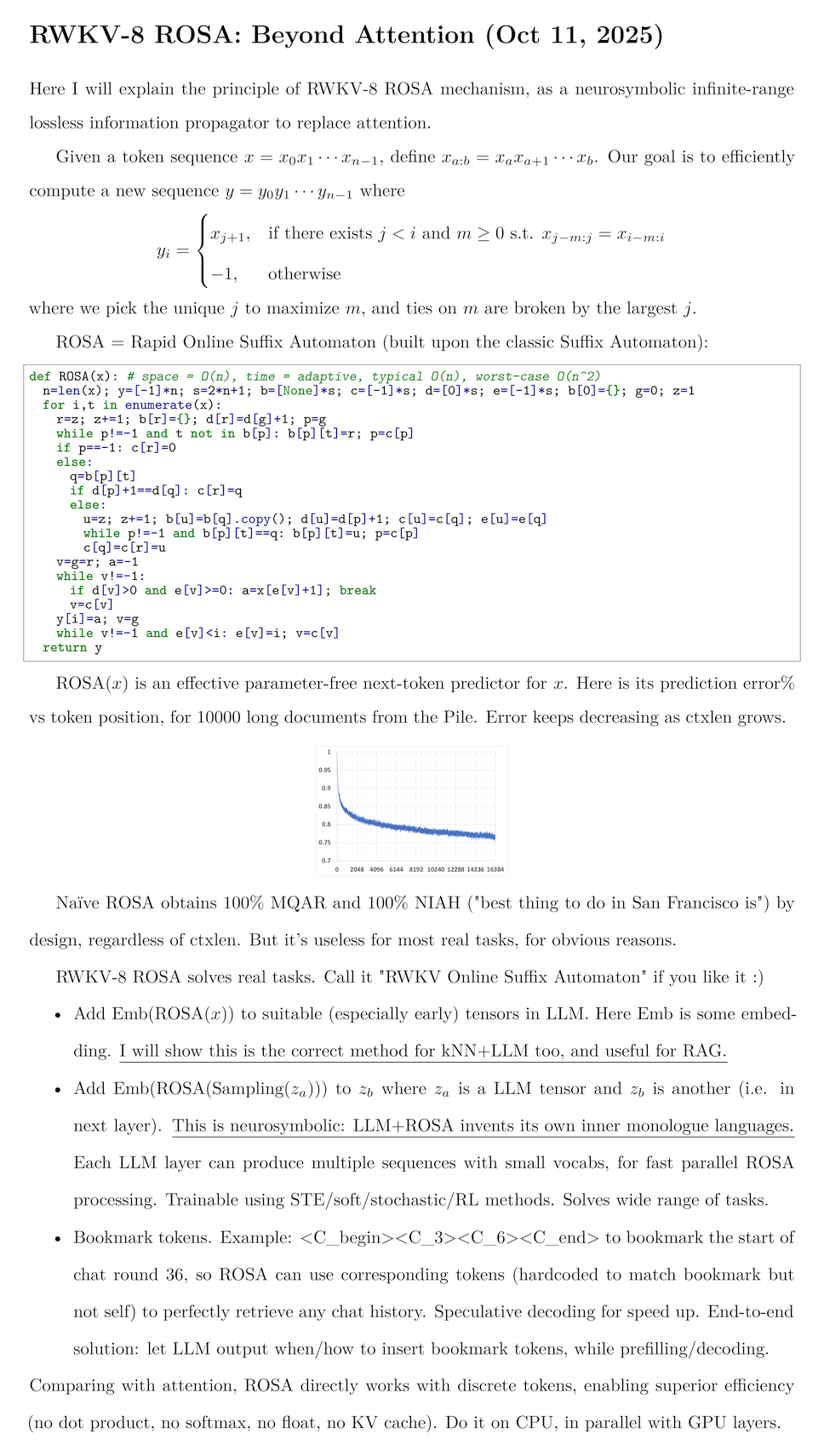
This repository is an independent PyTorch implementation and differentiable extension of RWKV-8 ROSA (Rapid Online Suffix Automaton), described by Bo Peng (BlinkDL) in RWKV-8 ROSA: Beyond Attention on rwkv.com.
The implementation provides long-range associative retrieval over an internal discrete code stream. It uses an exact online suffix automaton as a sparse candidate generator, while keeping tokenization, candidate ranking, and value retrieval differentiable.
The design avoids a trainable dense automaton transition tensor and avoids dense all-pairs attention over sequence positions. The discrete suffix-automaton structure remains exact; learning is concentrated on how symbols are produced and how a small causal candidate set is ranked and read.
Highlights
- Exact online suffix-automaton backbone.
- Factorized straight-through discrete codebook.
- Top-K suffix-state candidate generation.
- Bounded multi-occurrence history per suffix state.
- Differentiable soft verification of candidate suffix matches.
- Causal sparse virtual candidates for learned non-suffix associations.
- Explicit NULL candidate when retrieval should be skipped.
- Hard top-1 forward selection with soft straight-through backward gradients.
- Symbolic retrieval with an optional gated neural value residual.
- Learned read gate before the retrieved value is added to the target stream.
- Exact ROSA prior plus a learned residual candidate score.
- Auxiliary losses for ROSA distillation, hard/soft consistency, codebook balance, and virtual-candidate usage.
- 100% statement and branch coverage for the
rosapackage.
Core scoring rule
Candidate ranking is deliberately residual around standard ROSA behavior:
candidate_score = rosa_prior + learned_residual_scale * learned_score
With learned_residual_scale=0, exact suffix candidates are ranked by match length with recency tie-breaking, reproducing standard ROSA selection. Increasing the scale allows the neural selector to override that prior when doing so improves the task loss.
The virtual-candidate branch and neural value residual have independent curriculum scales, so the module can start from strict ROSA behavior and gradually enable additional capacity.
Requirements
- Python 3.10+
- PyTorch
coverage, Ruff, and Pyright for development
Install the published package from PyPI:
uv add rosa-torch
Install the package and its locked development dependencies with uv:
uv sync --locked --all-groups
The PyPI distribution is named rosa-torch; the Python import remains
from rosa import ROSA.
For a runtime-only installation from a built wheel, install the wheel with any PEP 517-compatible Python package manager.
Repository layout
.
├── pyproject.toml
├── README.md
├── src
│   └── rosa
│       └── __init__.py
└── tests
    ├── __init__.py
    ├── run_coverage.py
    └── test_rosa.py
The implementation is distributed as an installable rosa package while
remaining in one source module to keep the exact suffix-automaton and neural
retrieval paths easy to inspect together.
Quick start
import torch

from rosa import ROSA

batch_size = 2
sequence_length = 128
d_model = 256

model = ROSA(
    d_model=d_model,
    codebook_sizes=(16, 16),
    suffix_k=16,
    occurrences_r=4,
    soft_verify_window=32,
    virtual_candidates=4,
    virtual_pool_size=64,
    selector_dim=128,
    learned_residual_scale=0.0,
    virtual_scale=0.0,
    neural_value_scale=0.0,
)

z_a = torch.randn(batch_size, sequence_length, d_model, requires_grad=True)
z_b = torch.randn_like(z_a)

out = model(z_a, z_b=z_b)
loss = out.updated.square().mean()
loss.backward()

print(out.updated.shape)  # [B, N, D]
print(out.chosen_source_index.shape)  # [B, N]
print(out.hard_rosa_match_length.shape)  # [B, N]
z_a is used to derive the internal symbolic stream and retrieval decisions. z_b is the stream receiving the gated retrieval residual. If z_b is omitted, z_a is used as the target stream as well.
External code logits
If another module already produces the two factorized codebook logits, pass them directly:
code_logits_1 = torch.randn(batch_size, sequence_length, 16, requires_grad=True)
code_logits_2 = torch.randn(batch_size, sequence_length, 16, requires_grad=True)

out = model(
    z_a,
    z_b=z_b,
    code_logits=(code_logits_1, code_logits_2),
)
The hard forward symbols are obtained with argmax; the backward path follows the corresponding softmax distributions through a straight-through estimator.
Curriculum controls
The three runtime scales are registered buffers and are included in state_dict:
# Start close to strict ROSA.
model.set_learned_residual_scale(0.0)
model.set_virtual_scale(0.0)
model.set_neural_value_scale(0.0)

# Gradually enable learned ranking and additional memory capacity.
model.set_learned_residual_scale(0.25)
model.set_virtual_scale(0.10)
model.set_neural_value_scale(0.10)

# Fully learned residual behavior if desired.
model.set_learned_residual_scale(1.0)
model.set_virtual_scale(1.0)
model.set_neural_value_scale(1.0)
A typical training schedule can anneal these values independently rather than changing architectures during training.
Auxiliary losses
The forward result exposes:
out.aux_losses
with the keys:
rosa_distillation: encourages the soft selector to retain the exact ROSA choice.hard_soft_consistency: aligns the soft distribution with the hard top-1 forward choice.code_balance: discourages collapse of either factorized codebook.virtual_usage: provides an explicit regularizer for the virtual-candidate branch.
They can be combined with the task loss using:
total_loss = model.combine_losses(
    lm_loss,
    out.aux_losses,
    rosa_weight=0.10,
    consistency_weight=0.10,
    balance_weight=0.01,
    virtual_weight=0.01,
)
Output fields
ROSA.forward returns a ROSAOutput dataclass. The most commonly useful fields are:
updated: target stream after the gated retrieval residual.retrieved: selected retrieval value before the output projection and read gate.hard_tokens: hard internal symbolic token IDs.chosen_source_index: selected historical source end-position, or-1for NULL.chosen_token: continuation token associated with the selected source, or-1for NULL.chosen_match_length: exact suffix length for exact suffix candidates.chosen_is_virtual: whether the selected candidate came from the virtual branch.hard_rosa_source_index: source selected by standard hard ROSA.hard_rosa_predicted_tokens: standard hard ROSA continuation token.soft_match_score: differentiable truncated common-suffix score for each candidate.soft_weights/hard_weights: soft selector distribution and hard top-1 decision.read_gate/value_gate: learned gates controlling residual injection and neural values.aux_losses: auxiliary training losses described above.
Exact reference implementation
reference_rosa implements the ROSA definition directly in quadratic time and is intended for tests and diagnostics:
from rosa import reference_rosa

predicted, source, match_length = reference_rosa(tokens)
build_hard_candidates uses the online suffix automaton and is tested against this brute-force definition over randomized sequences.
Testing
Run linting, formatting checks, and static type checking:
uv run ruff check .
uv run ruff format --check .
uv run pyright
Run the unit tests against the installed development package:
uv run python -m unittest discover -s tests -v
Run the strict coverage gate:
uv run python tests/run_coverage.py
The coverage command exits non-zero unless both the test suite passes and the
rosa package reaches exactly 100% statement and branch coverage.
Build the wheel and source distribution:
uv build
Complexity and implementation notes
The neural retrieval side operates on a bounded candidate set rather than all prior positions. For fixed suffix_k, occurrences_r, verification window, and virtual-pool size, its work per token is bounded independently of context length.
The exact suffix-automaton control path intentionally runs on CPU, following the RWKV-8 ROSA proposal. Hard token IDs are copied to CPU, the dynamic suffix-automaton reads and writes happen there, and the bounded candidate tensors are returned to the original PyTorch device. Accelerator backends such as TileLang or Triton should optimize only the differentiable tensor path around the automaton.
The current implementation performs this CPU work synchronously and rebuilds the automaton for each full-sequence call. Production autoregressive inference can improve throughput with a stateful CPU worker whose automaton updates are pipelined alongside GPU layers, while preserving the same exact candidate semantics and PyTorch fallback.
Design guarantees
- Reads happen before the current position is written into occurrence history, preventing self-retrieval.
- Virtual candidate pools contain only earlier positions.
- Disabling the learned residual restores exact ROSA ranking among suffix candidates.
- Disabling virtual candidates does not affect the exact suffix branch or NULL candidate.
- No dense trainable state-to-token-to-state transition tensor is used.
Attribution
ROSA is an algorithm described by Bo Peng for RWKV-8. This package implements and extends that algorithm; it does not claim authorship of ROSA itself. For the original definition, pseudocode, and design notes, see RWKV-8 ROSA: Beyond Attention on rwkv.com.
The implementation in this repository is independently maintained and is not an official RWKV distribution. The RWKV community can be found on the official RWKV Discord server.
1 maintainer

Download files
Download the file for your platform. If you're not sure which to choose, learn more about installing packages.
Source Distribution
Built Distribution
Filter files by name, interpreter, ABI, and platform.
If you're not sure about the file name format, learn more about wheel file names.
Copy a direct link to the current filters
File details
Details for the file rosa_torch-0.1.1.tar.gz.
File metadata
- Download URL: rosa_torch-0.1.1.tar.gz
- Upload date:
- Size: 13.7 kB
- Tags: Source
- Uploaded using Trusted Publishing? Yes
- Uploaded via: twine/7.0.0 CPython/3.13.14
File hashes
| Algorithm | Hash digest | |
|---|---|---|
| SHA256 |
53fa5d0a8f68ffe9c8116ba0dceff58976ff46a50036a873b43bfd0e2f721903
|
|
| MD5 |
0f062751bdf95c45e49b6aba9df95ac7
|
|
| BLAKE2b-256 |
1ebbc2070f3cc1bcfea7389610b90d424afbf7ebcaaa5f771038ce110f60b64c
|
Provenance
The following attestation bundles were made for rosa_torch-0.1.1.tar.gz:
Publisher:
publish.yml on aabbdev/rosa
-
Statement:
-
Statement type:
https://in-toto.io/Statement/v1 -
Predicate type:
https://docs.pypi.org/attestations/publish/v1 -
Subject name:
rosa_torch-0.1.1.tar.gz -
Subject digest:
53fa5d0a8f68ffe9c8116ba0dceff58976ff46a50036a873b43bfd0e2f721903 - Sigstore transparency entry: 2411471349
- Sigstore integration time:
-
Permalink:
aabbdev/rosa@ed1902c7c5f20cadfef6033a20ac775f6765a68f -
Branch / Tag:
refs/tags/v0.1.1 - Owner: https://github.com/aabbdev
-
Access:
public
-
Token Issuer:
https://token.actions.githubusercontent.com -
Runner Environment:
github-hosted -
Publication workflow:
publish.yml@ed1902c7c5f20cadfef6033a20ac775f6765a68f -
Trigger Event:
release
-
Statement type:
File details
Details for the file rosa_torch-0.1.1-py3-none-any.whl.
File metadata
- Download URL: rosa_torch-0.1.1-py3-none-any.whl
- Upload date:
- Size: 14.8 kB
- Tags: Python 3
- Uploaded using Trusted Publishing? Yes
- Uploaded via: twine/7.0.0 CPython/3.13.14
File hashes
| Algorithm | Hash digest | |
|---|---|---|
| SHA256 |
e56e1005c549974a597b6e7633044276ad4e62cb2f84a3a34500241b37119b9b
|
|
| MD5 |
bc3289f04ffcf2ac58581cac0e6b4081
|
|
| BLAKE2b-256 |
e3c3b0de8499cdb30ba402b243fbafed99a51352210dccf6452e8b6756d7b750
|
Provenance
The following attestation bundles were made for rosa_torch-0.1.1-py3-none-any.whl:
Publisher:
publish.yml on aabbdev/rosa
-
Statement:
-
Statement type:
https://in-toto.io/Statement/v1 -
Predicate type:
https://docs.pypi.org/attestations/publish/v1 -
Subject name:
rosa_torch-0.1.1-py3-none-any.whl -
Subject digest:
e56e1005c549974a597b6e7633044276ad4e62cb2f84a3a34500241b37119b9b - Sigstore transparency entry: 2411471690
- Sigstore integration time:
-
Permalink:
aabbdev/rosa@ed1902c7c5f20cadfef6033a20ac775f6765a68f -
Branch / Tag:
refs/tags/v0.1.1 - Owner: https://github.com/aabbdev
-
Access:
public
-
Token Issuer:
https://token.actions.githubusercontent.com -
Runner Environment:
github-hosted -
Publication workflow:
publish.yml@ed1902c7c5f20cadfef6033a20ac775f6765a68f -
Trigger Event:
release
-
Statement type: