
This release is a pre-release and may not be stable for production use.









Welcome to the future of urban routing.
Multi-agent reinforcement learning framework for modeling and simulating the collective route choices of humans and autonomous vehicles.
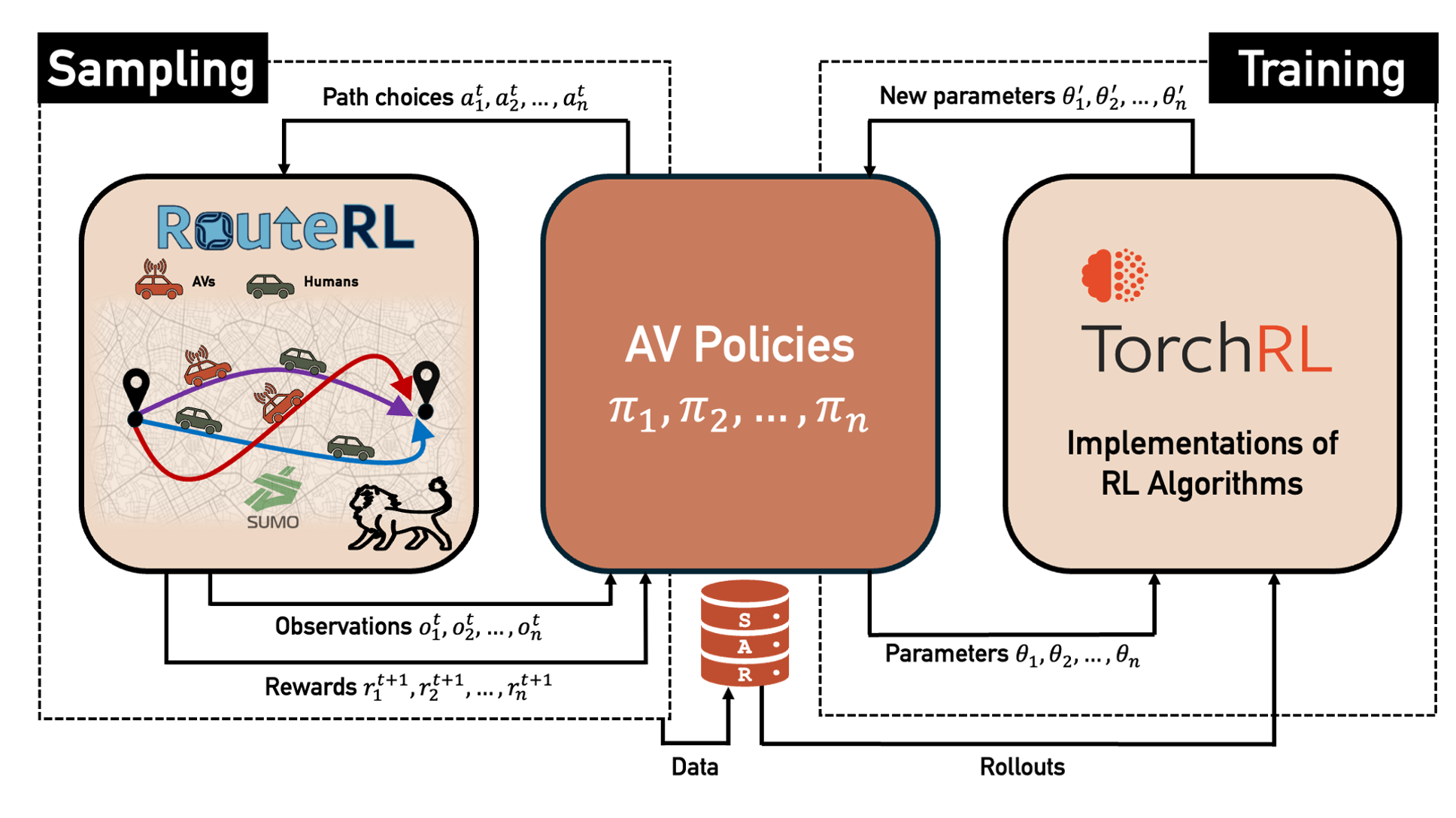
RouteRL is a multi-agent reinforcement learning framework that integrates RL-based collective route choice with a microscopic traffic simulation, SUMO, facilitating the testing and development of efficient route choice strategies. The proposed framework simulates the daily route choices of driver agents in a city, including two types:
- human drivers, emulated using discrete choice models,
- and AVs, modeled as MARL agents optimizing their policies for a predefined objective.
RouteRL aims to advance research in MARL, traffic assignment problems, social reinforcement learning, and human-AI interaction for transportation applications.
- The main class is TrafficEnvironment and is a PettingZoo AEC API environment.
- There are two types of agents in the environment and are both represented by the BaseAgent class.
- Human drivers are simulated using human route-choice behavior from transportation research.
- Automated vehicles (AVs) are the RL agents that aim to optimize their routes and learn the most efficient paths.
- RouteRL is compatible with popular RL libraries such as TorchRL.
For overview see the paper and for more details, check the documentation online.
RouteRL usage and functionalities at a glance
The following is a simplified code of a possible standard MARL algorithm implementation via TorchRL.
env = TrafficEnvironment(seed=42, **env_params) # initialize the traffic environment

env.start() # start the connection with SUMO

for episode in range(human_learning_episodes): # human learning
    env.step()

env.mutation() # some human agents transition to AV agents

collector = SyncDataCollector(env, policy, ...)  # collects experience by running the policy in the environment (TorchRL)

# training of the autonomous vehicles; human agents follow fixed decisions learned in their learning phase
for tensordict_data in collector:

    # update the policies of the learning agents
    for _ in range(num_epochs):
      subdata = replay_buffer.sample()
      loss_vals = loss_module(subdata)

      optimizer.step()
    collector.update_policy_weights_()

policy.eval() # set the policy into evaluation mode

# testing phase using the already trained policy
num_episodes = 100
for episode in range(num_episodes):
    env.rollout(len(env.machine_agents), policy=policy)

env.plot_results() # plot the results
env.stop_simulation() # stop the connection with SUMO
Documentation
Installation
- Prerequisite: Make sure you have SUMO installed in your system. This procedure should be carried out separately, by following the instructions provided here.
- Option 1: Install the latest stable version from PyPI:
pip install routerl - Option 2: Clone this repository for latest version, and manually install its dependencies:
  git clone https://github.com/COeXISTENCE-PROJECT/RouteRL.git
  cd RouteRL
  pip install -r requirements.txt
Reproducibility capsule
We have an experiment script encapsulated in a CodeOcean capsule. This capsule allows demonstrating RouteRL's capabilities without the need for SUMO installation or dependency management.
- Visit the capsule link.
- Create a free CodeOcean account (if you don’t have one).
- Click Reproducible Run to execute the code in a controlled and reproducible environment.
Citation
If you use RouteRL in your research, please cite the following paper:
@article{routerl,
  title = {RouteRL: Multi-agent reinforcement learning framework for urban route choice with autonomous vehicles},
  journal = {SoftwareX},
  volume = {31},
  pages = {102279},
  year = {2025},
  issn = {2352-7110},
  doi = {https://doi.org/10.1016/j.softx.2025.102279},
  url = {https://www.sciencedirect.com/science/article/pii/S2352711025002468},
  author = {Ahmet Onur Akman and Anastasia Psarou and Łukasz Gorczyca and Zoltán György Varga and Grzegorz Jamróz and Rafał Kucharski}
}
Credits
RouteRL is part of COeXISTENCE (ERC Starting Grant, grant agreement No 101075838) and is a team work at Jagiellonian University in Kraków, Poland by: Ahmet Onur Akman and Anastasia Psarou (main contributors) supported by Grzegorz Jamroz, Zoltán Varga, Łukasz Gorczyca, Michał Hoffmann, Błażej Torbus, Mikołaj Rams and others, within the research group of Rafał Kucharski.

1 maintainer

Release files for routerl-nightly 2.0.0.dev260922125057
For a detailed explanation of source distributions (sdists) and built distributions (wheels), please see the package formats documentation.
Source distribution (sdist)
| File | Size | Uploaded | |
|---|---|---|---|
| routerl_nightly-2.0.0.dev260922125057.tar.gz | 2.3 MB | Details |
Built distribution (wheel)
| File | Interpreter | ABI | Platform | Reset |
|---|---|---|---|---|
| routerl_nightly-2.0.0.dev260922125057-py3-none-any.whl | Python 3 | none | any | Details |
Total release size: 4.6 MB
Release files / routerl_nightly-2.0.0.dev260922125057.tar.gz
| Download URL | routerl_nightly-2.0.0.dev260922125057.tar.gz |
|---|---|
| Size | 2.3 MB |
| Tags | Source |
|
SHA-256 checksum How to use checksums |
89377b624861a63ca84fc5425d1c28226b1b33a5909a103dbcab09018fbdfbb5
|
|
BLAKE2b-256 checksum How to use checksums |
eea0def43de524b6d4556f171bf7403161984107406ed2c8273867dc46007ef2
|
| Upload date | |
|
Uploaded using Trusted Publishing? What is trusted publishing? |
Yes |
| Uploaded via |
twine/7.0.0 CPython/3.13.14
|
Provenance
Provenance describes where a file came from. On PyPI, provenance is shared via attestations, which provide a verifiable record of the build or publishing details. View details, limitations and caveats.


PyPI Publish Attestation
PyPI verified that this artifact, at this checksum, originated from the publisher listed below.
Signed by GitHub Actions, verified by PyPI on Sep 22, 2026.
Transparency logRelease files / routerl_nightly-2.0.0.dev260922125057-py3-none-any.whl
| Download URL | routerl_nightly-2.0.0.dev260922125057-py3-none-any.whl |
|---|---|
| Size | 2.4 MB |
| Tags | Python 3 |
|
SHA-256 checksum How to use checksums |
d37f93150cc1d2c8d62c41886f938419370c8b1bc316f93cdf386b64cb10c223
|
|
BLAKE2b-256 checksum How to use checksums |
4345405eaf83823a925e114b2ca51f646d6ba32e89581ee6f485c253a5e8d623
|
| Upload date | |
|
Uploaded using Trusted Publishing? What is trusted publishing? |
Yes |
| Uploaded via |
twine/7.0.0 CPython/3.13.14
|
Provenance
Provenance describes where a file came from. On PyPI, provenance is shared via attestations, which provide a verifiable record of the build or publishing details. View details, limitations and caveats.
PyPI Publish Attestation
PyPI verified that this artifact, at this checksum, originated from the publisher listed below.
Signed by GitHub Actions, verified by PyPI on Sep 22, 2026.
Transparency log













