
RouteSmith
Host-aware auto-routing for coding agents






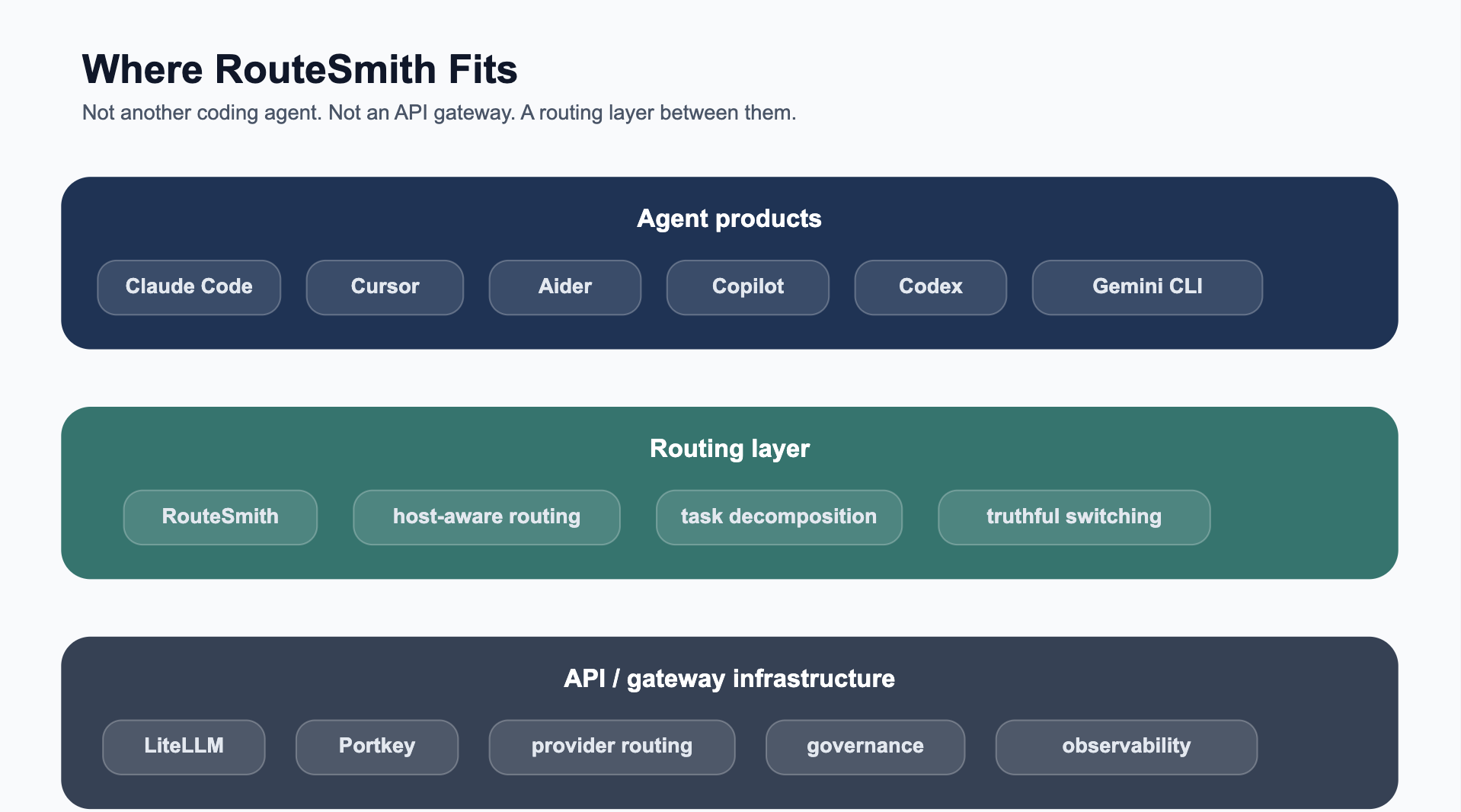
routesmith automatically routes coding agent tasks to the best available model in your IDE — no manual model picking, no cross-provider hacks.
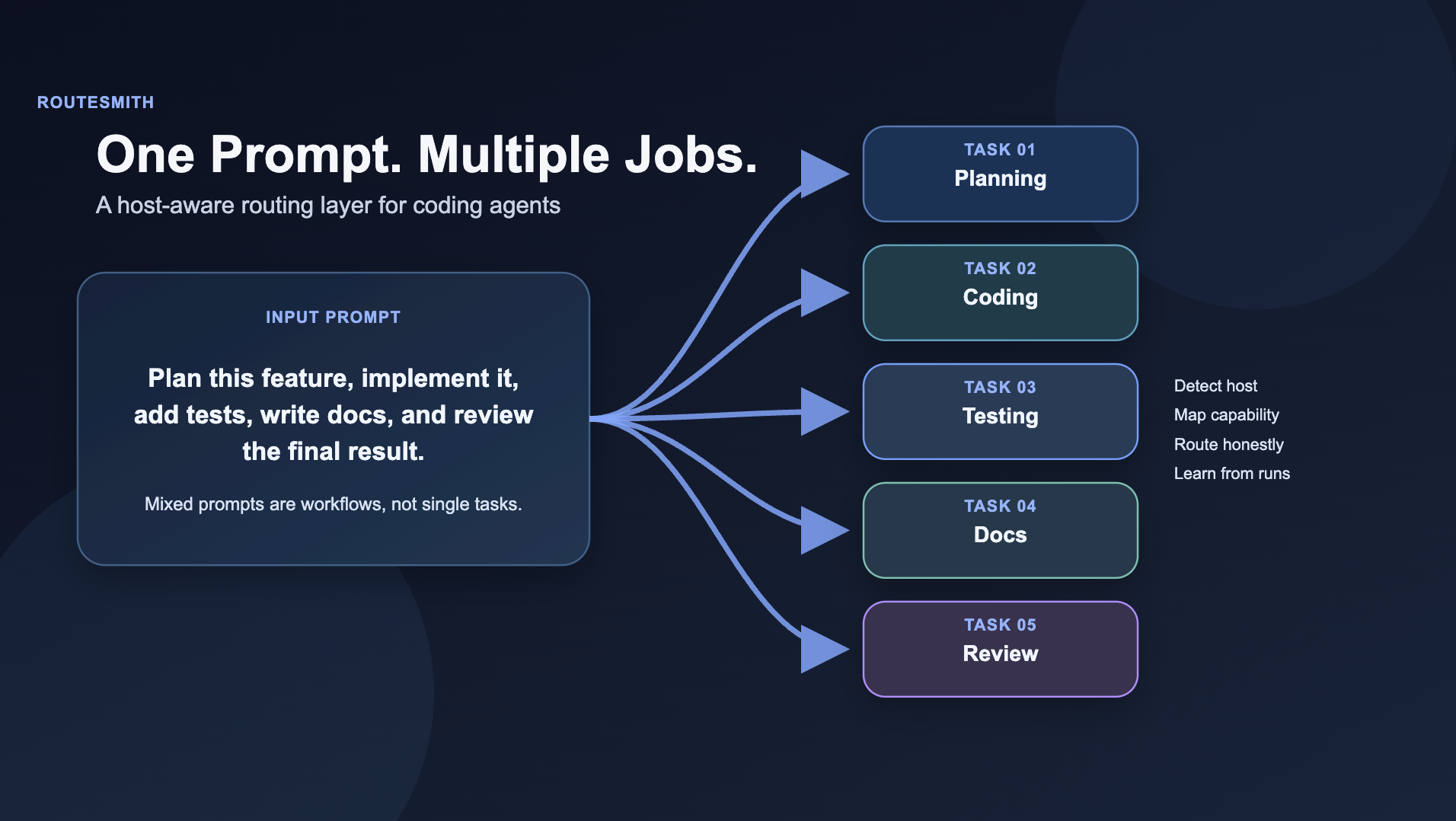
Give it a mixed prompt like "Plan this feature, implement it, add tests, write docs" and it decomposes, routes each step to the right capability class, and executes using your host's native model switching.
Why?
Most coding agents are stuck on one model. Mixed tasks (plan -> code -> test -> document) benefit from different model strengths. But each IDE host (Claude Code, Codex, Gemini CLI, Copilot, Cursor, Aider) has different model families and switching capabilities.
routesmith solves this by being host-aware:
| Host | Models | Strategy |
|---|---|---|
| Claude Code | Claude Opus 4.7 / Sonnet 4.6 / Haiku 4.5 | Dynamic model switching |
| Codex | GPT-5.5 / GPT-5.4 / GPT-5.3-Codex | Dynamic model switching |
| Gemini CLI | Gemini 3.1 Pro / Flash / Flash-Lite | Dynamic model switching |
| Copilot | Claude 4.7 / GPT-5.5 / Gemini 3.1 Pro (plan-dependent) | Prompt optimization |
| Cursor | Claude 4.7 / GPT-5.5 / GPT-5.3-Codex / Gemini 3.1 Pro | Prompt optimization |
| Aider | Claude 4.7 / GPT-5.5 / Gemini 3.1 Pro | Dynamic model switching |
Quickstart
Install from PyPI with pip install routesmith.
If PyPI is unavailable or you want to install from the GitHub-hosted release artifacts instead, use the latest release source archive:
Use pip install https://github.com/sidrat2612/routesmith/releases/latest/download/routesmith-latest.tar.gz.
Direct downloads:
Core Python entry points:
routesmith.run(...)auto-detects the host, decomposes the prompt, and executes the route.routesmith.explain_route(...)shows the route plan without execution.routesmith.detect_host()androutesmith.get_host_capabilities()expose the detected environment.
CLI
Common CLI commands:
- Route a mixed task prompt with
routesmith run "Plan this feature, implement it, add tests, and write docs". - Preview the route plan with
routesmith explain "Refactor auth module and add integration tests". - Inspect the environment with
routesmith detect-host,routesmith capabilities, androutesmith doctor. - View performance stats with
routesmith stats, filter with--host,--capability,--source, or export with--format json. - Show top/bottom performers with
routesmith stats --top 5 --bottom 3. - Prune old telemetry with
routesmith stats --prune --max-age-days 30.
How It Works
routesmith is an advisory routing layer — it plans and recommends, it does not replace your host's execution engine.
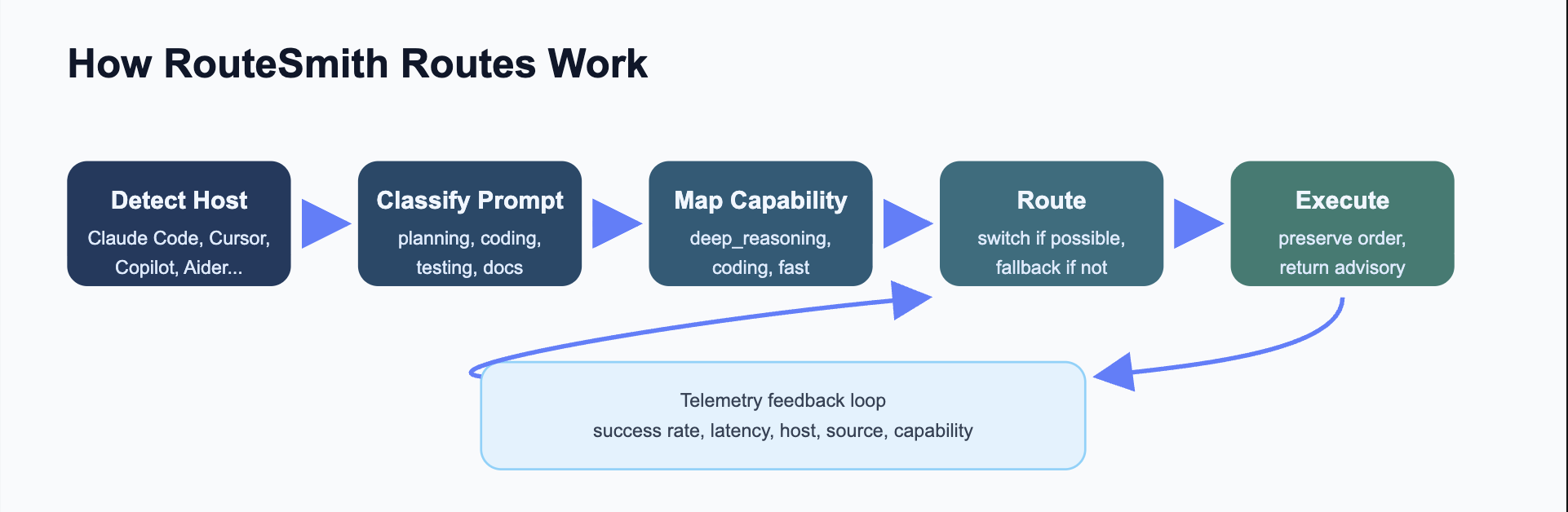
Execution flow:
- Detect the active host, such as Claude Code or Copilot.
- Decompose the prompt into typed subtasks.
- Map each task to a capability class.
- Resolve those capabilities to host-native models.
- Switch models when possible, or optimize prompts when not.
- Report metrics, advisory messages, and effectiveness.
What it does
- Decomposes mixed prompts into discrete, typed subtasks
- Routes each subtask to the best capability class (
deep_reasoning,coding,balanced,fast) - Switches models when the host supports it (Claude Code, Codex, Gemini CLI, Aider)
- Applies routing preferences such as
costorqualityon the same router path - Runs Python policy plugins when you need logic beyond static remaps
- Falls back to prompt optimization when the host controls model selection
- Reports timing, token estimates, effectiveness scores
What it does NOT do
- Does not make LLM API calls — the host handles execution
- Does not bypass host constraints — works within your IDE's limits
- Does not fake model switches — tells you honestly what happened
Design Philosophy
Coding agents run inside a host that owns the LLM connection. routesmith sits alongside the host as a skill layer that makes smarter routing decisions. It's the routing brain, not the execution muscle.
Capability Classes
Instead of hardcoding model names, routesmith uses abstract capability classes:
| Class | Use Case | Example Models |
|---|---|---|
deep_reasoning |
Planning, architecture, review | Claude Opus 4.7, GPT-5.5 |
coding |
Implementation, testing, refactoring | Claude Sonnet 4.6, GPT-5.3-Codex |
balanced |
Documentation, general tasks | Claude Sonnet 4.6, GPT-5.4 |
fast |
Formatting, simple transforms | Claude Haiku 4.5, GPT-5.4-mini |
Each host adapter maps these to actual available models.
Task Types
routesmith classifies prompts into: planning, analysis, coding, testing, refactor, documentation, formatting, review
Dependencies are resolved automatically — tests wait for code, docs wait for implementation.
Configuration
Environment Variables
| Variable | Description | Default |
|---|---|---|
ROUTESMITH_DEFAULT_MODE |
Execution mode | auto |
ROUTESMITH_ALLOW_MODEL_SWITCH |
Allow model switching | true |
ROUTESMITH_FORCE_HOST |
Force a specific host | — |
ROUTESMITH_DEBUG |
Enable debug output | false |
ROUTESMITH_PERFORMANCE_ROUTING |
Enable performance-aware model selection | true |
ROUTESMITH_PERFORMANCE_FILE |
Performance telemetry store path | .routesmith/performance.json |
ROUTESMITH_PERFORMANCE_MAX_RECORDS |
Max stored telemetry records | 500 |
ROUTESMITH_PERFORMANCE_MAX_AGE_DAYS |
Optional age-based pruning window | — |
ROUTESMITH_CONTEXT_WINDOW_LIMIT |
Prefer leaner context defaults for supported hosts | true |
ROUTESMITH_AUTOCOMPACT_THRESHOLD |
Auto-compaction threshold percentage for supported hosts | 80 |
ROUTESMITH_MAX_SPAWN_DEPTH |
Advisory max subagent nesting depth written into host configs | 2 |
Config File
Create .routesmith.toml in your project root:
Example:
[routesmith]
default_mode = "auto"
allow_model_switch = true
routing_preference = "cost"

# Performance-aware routing
performance_routing_enabled = true
performance_store_file = ".routesmith/performance.json"
performance_max_records = 500
performance_max_age_days = 30

# Token-efficiency knobs
context_window_limit = true
autocompact_threshold = 80
max_spawn_depth = 2

# Optional Python hooks
policy_plugins = [
  "my_project.routing:plugin",
  "my_project.routing:CustomPlugin",
]

[routesmith.policy_overrides]
planning = "balanced"
documentation = "fast"
What the new knobs do:
context_window_limit = truetells install adapters to prefer leaner context defaults when the host exposes a real setting. Today this produces concrete settings for Claude Code and advisory guidance for the other hosts.autocompact_threshold = 80lowers the context usage percentage at which auto-compaction should kick in for hosts that support it. Today Claude Code uses this to writeCLAUDE_AUTOCOMPACT_PCT_OVERRIDE.max_spawn_depth = 2controls the advisory spawn-depth limit written into generated host instruction files so subagents do not recurse into wasteful coordination trees.
Recommended config shape:
- Add a
[routesmith]section with values such asdefault_mode = "auto",allow_model_switch = true, androuting_preference = "cost"when you want cheaper model selection. - Add token-efficiency settings such as
context_window_limit,autocompact_threshold, andmax_spawn_depthwhen you want generated host configs to bias toward smaller contexts and shallower delegation. - Add a
[routesmith.policy_overrides]section when you want static remaps such asplanning = "balanced"ordocumentation = "fast". - Add a
policy_pluginslist when you want importable Python hooks such asmy_project.routing:pluginormy_project.routing:CustomPluginto participate in route resolution. - Add performance settings such as
performance_routing_enabled = true,performance_store_file = ".routesmith/performance.json",performance_max_records = 500, andperformance_max_age_days = 30when you want tighter telemetry control.
Built-in routing preferences are balanced, cost, and quality. policy_overrides handles static remaps, while policy_plugins lets you run real Python logic that can adjust capability classes, force explicit models, and attach advisory messages.
MCP / Stdio Server
routesmith exposes an MCP-compatible JSON-RPC 2.0 server for tool integration:
Start it with routesmith serve-stdio.
This lets IDE extensions and agents call routesmith as a tool.
The MCP surface now includes routesmith.performance, which returns filtered performance summaries for CLI and agent consumers.
Performance Tracking
routesmith records per-model task outcomes across runs, including duration, success or failure, capability class, host, and telemetry source. Data is stored in .routesmith/performance.json, uses schema versioning with migration support, and separates runtime telemetry from synthetic test data.
Performance-aware routing now promotes tracker data from passive advisory to an active routing signal. When a default model shows weak success or latency for a capability and a better host-available alternative has enough evidence, routesmith will switch to the stronger performer.
View stats with routesmith stats. You can filter by model, host, capability, and telemetry source; show top and bottom performers; export JSON summaries; and prune old records with max-record or max-age controls.
When a model's historical success rate drops below 70% or average latency exceeds 5 seconds, routesmith still injects performance advisory messages into run results automatically.
Install Configs for Hosts
Generate host-specific configuration files:
routesmith install claudewritesCLAUDE.mdand merges token-saving settings into.claude/settings.json.routesmith install codexwritesAGENTS.md.routesmith install geminiwritesGEMINI.md.routesmith install copilotwrites.github/copilot-instructions.md.routesmith install cursorwrites.cursorules.routesmith install aiderwrites.aider.conf.yml, or.aider.routesmith.ymlif an existing Aider config is already present.
Auto Mode (Default)
Auto mode is the default. For a single mixed prompt, routesmith:
- Detects the host environment
- Classifies the prompt into task types
- Splits into ordered subtasks with dependency resolution
- Chooses the best host-compatible model per subtask
- Executes (or recommends) the route
- Returns metrics and advisory messages
Truthful Switching
- If the host supports dynamic switching → routesmith switches
- If the host does NOT support switching → routesmith uses prompt strategy
- The result always tells you exactly what happened — no black boxes
Contributing
Contributions are welcome! See CONTRIBUTING.md for guidelines.
Development setup:
- Clone the repository from
https://github.com/sidrat2612/routesmith.git. - Change into the
routesmithdirectory. - Create and activate a virtual environment with
python -m venv .venvandsource .venv/bin/activate. - Install dev dependencies with
pip install -e ".[dev]". - Run the test suite with
pytest.
Roadmap
- Host detection and capability mapping
- Weighted task decomposition planner
- Dependency-aware execution loop
- Persistent route state
- MCP stdio server
- Structured observability
- Config-driven policy overrides
- Cost-aware routing
- Python policy plugins
- Gemini CLI host adapter
- Real-time model performance tracking
- Performance-aware routing (active model switching based on tracked data)
- Expanded stats UX (host/capability/source filters, JSON export, ranked performers)
- Data store hardening (schema v2, migration, source-aware pruning)
- Release workflow hardening (concurrency, idempotent publish)
- Additional host adapters
License
MIT — use it anywhere.
Built for the multi-model future of coding agents.
1 maintainer

Metadata
1 maintainer
Release files for routesmith 0.1.8
For a detailed explanation of source distributions (sdists) and built distributions (wheels), please see the package formats documentation.
Source distribution (sdist)
| File | Size | Uploaded | |
|---|---|---|---|
| routesmith-0.1.8.tar.gz | 989.5 kB | Details |
Built distribution (wheel)
| File | Interpreter | ABI | Platform | Reset |
|---|---|---|---|---|
| routesmith-0.1.8-py3-none-any.whl | Python 3 | none | any | Details |
Total release size: 1.1 MB
Release files / routesmith-0.1.8.tar.gz
| Download URL | routesmith-0.1.8.tar.gz |
|---|---|
| Size | 989.5 kB |
| Tags | Source |
|
SHA-256 checksum How to use checksums |
88ea75b51d8a9b1c0ca95e885a6500b09f494a91de9a3d933a5046827e4a3a55
|
|
BLAKE2b-256 checksum How to use checksums |
08afb2834462fca051c8895c028ac701dc0509f2f78d06f3a918cec7f1f5737e
|
| Upload date | |
|
Uploaded using Trusted Publishing? What is trusted publishing? |
Yes |
| Uploaded via |
twine/6.1.0 CPython/3.13.13
|
Provenance
Provenance describes where a file came from. On PyPI, provenance is shared via attestations, which provide a verifiable record of the build or publishing details. View details, limitations and caveats.


PyPI Publish Attestation
PyPI verified that this artifact, at this checksum, originated from the publisher listed below.
Signed by GitHub Actions, verified by PyPI on May 9, 2026.
Transparency logRelease files / routesmith-0.1.8-py3-none-any.whl
| Download URL | routesmith-0.1.8-py3-none-any.whl |
|---|---|
| Size | 72.9 kB |
| Tags | Python 3 |
|
SHA-256 checksum How to use checksums |
ffe34f8d1918028b8a0203c6c6350c068b0d474ff5f1c1d1a8ac9281cc856b85
|
|
BLAKE2b-256 checksum How to use checksums |
13b0f217b9a260179a3db76163034293a095f492201335e6bb60b9c88c5c851d
|
| Upload date | |
|
Uploaded using Trusted Publishing? What is trusted publishing? |
Yes |
| Uploaded via |
twine/6.1.0 CPython/3.13.13
|
Provenance
Provenance describes where a file came from. On PyPI, provenance is shared via attestations, which provide a verifiable record of the build or publishing details. View details, limitations and caveats.
PyPI Publish Attestation
PyPI verified that this artifact, at this checksum, originated from the publisher listed below.
Signed by GitHub Actions, verified by PyPI on May 9, 2026.
Transparency log













