
RovingBandit
A flexible Python library for multi-armed bandit algorithms supporting regret minimization, best-arm identification, and variance minimization in both online and batched modes.
The name is a nod to Mancur Olson.
Installation
Requires Python >= 3.10.
# Development installation
make setup            # uv sync --extra dev

# Production (when published)
uv pip install rovingbandit
Quick Start
New OOP API (Recommended)
import numpy as np

from rovingbandit import (
    # environment
    BanditEnvironment,
    # objectives
    RegretMinimization,
    # runner
    OnlineRunner,
    # algorithms
    ThompsonSampling,
    EpsilonGreedy,
    UCB1,
    RandomPolicy,
)

import matplotlib.pyplot as plt

env = BanditEnvironment(
    n_arms=5,
    arm_means=np.array([0.1, 0.3, 0.5, 0.4, 0.2]), # arm 3 is the best arm
    seed=42,
)

policies = {
    "Random": RandomPolicy(n_arms=5, seed=42),
    "Greedy": EpsilonGreedy(n_arms=5, epsilon=0.0, seed=42),
    "Epsilon-Greedy": EpsilonGreedy(n_arms=5, epsilon=0.1, seed=42),
    "UCB1": UCB1(n_arms=5, seed=42),
    "Thompson": ThompsonSampling(n_arms=5, seed=42),
}

objective = RegretMinimization(optimal_reward=0.5)
runner = OnlineRunner()

fig, axes = plt.subplots(1, 2, figsize=(14, 5))

result = {}

# run each policy and plot
for name, policy in policies.items():
    env.reset_rng(42)
    result[name] = runner.run(policy, env, n_steps=1000, objective=objective)

    print(
        f"{name:15} | Final Regret: {result[name].final_regret:.2f} | Avg Reward: {result[name].average_reward:.3f}"
    )

    result[name].plot(metric="cumulative_regret", ax=axes[0], label=name)
    result[name].plot(metric="average_reward", ax=axes[1], label=name)

axes[0].legend()
axes[0].set_title("Cumulative Regret Over Time")
axes[1].legend()
axes[1].set_title("Average Reward Over Time")

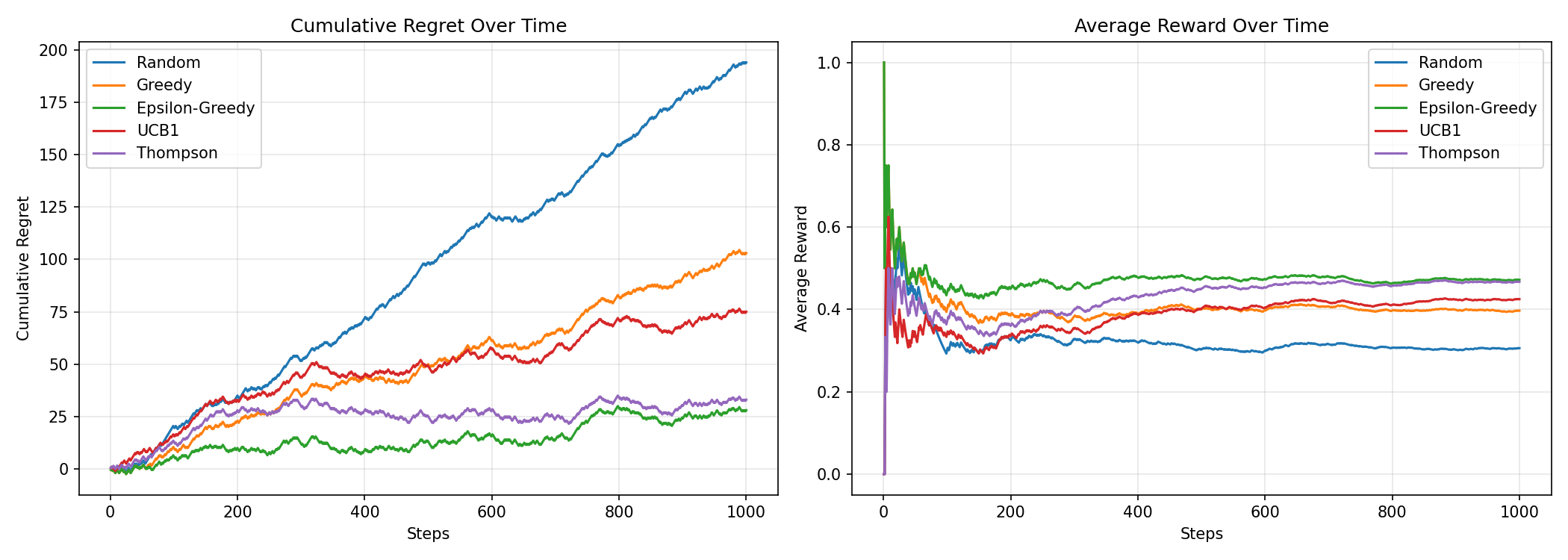
# Random          | Final Regret: 194.00 | Avg Reward: 0.306
# Greedy          | Final Regret: 103.00 | Avg Reward: 0.397
# Epsilon-Greedy  | Final Regret: 28.00 | Avg Reward: 0.472
# UCB1            | Final Regret: 75.00 | Avg Reward: 0.425
# Thompson        | Final Regret: 33.00 | Avg Reward: 0.467
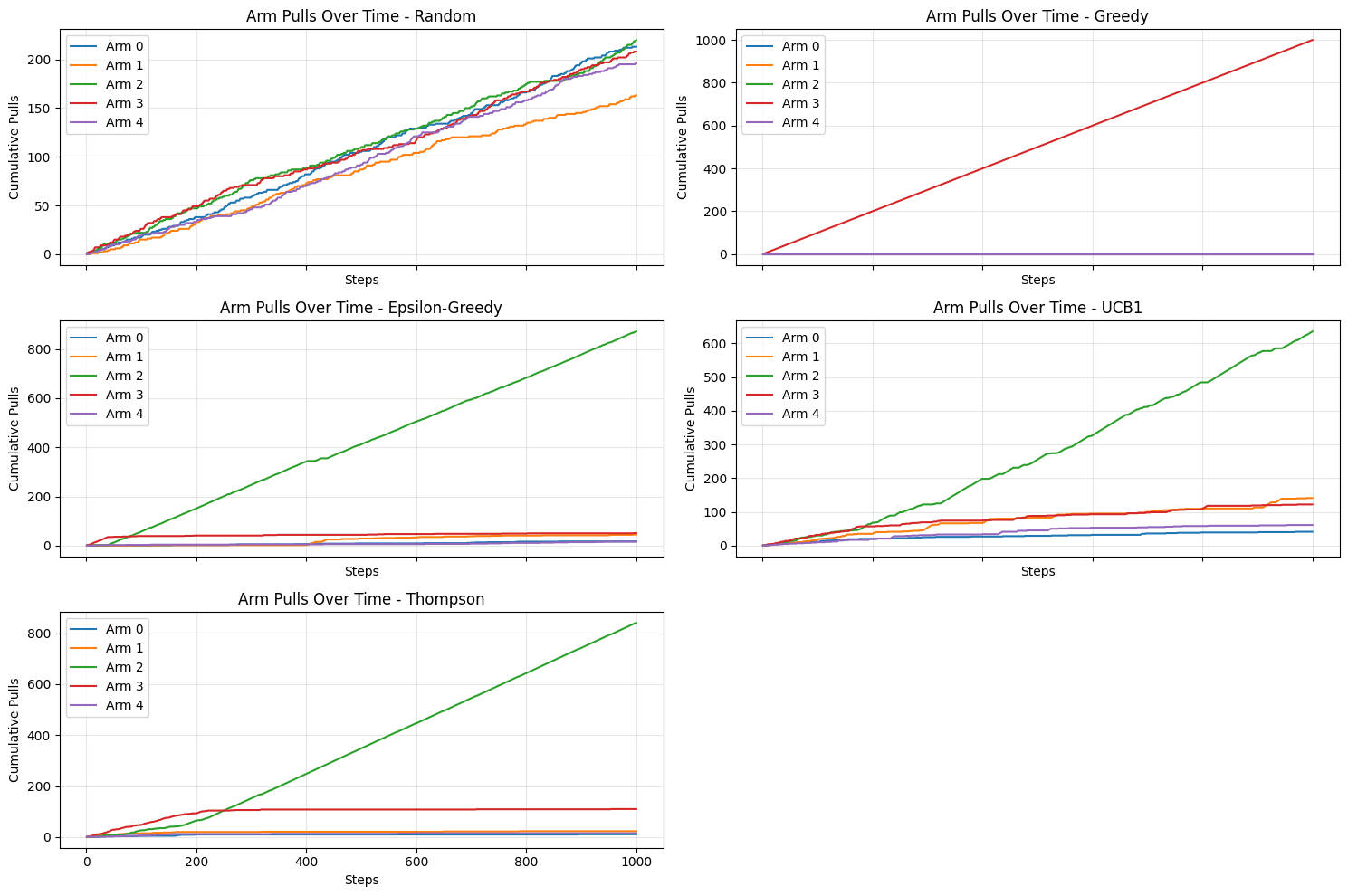
We can also visualize the sequence of arms pulled by each policy:
f, ax = plt.subplots(3, 2, figsize=(15, 10), sharex=True, sharey=False)
# plot arm pulls for each policy
for i, (name, res) in enumerate(result.items()):
    res.plot(
        metric="arm_pulls",
        ax=ax[i // 2, i % 2],
    )
    ax[i // 2, i % 2].legend()
    ax[i // 2, i % 2].set_title(f"Arm Pulls Over Time - {name}")
f.delaxes(ax[2, 1]) # delete unused subplots
f.tight_layout()
Implementation Status
Core
- Clean separation of
Policy,Objective,Environment, andRunnerclasses - Online and batched execution modes; budget support; early stopping hooks
- Tests passing (~60% overall coverage; >80% on new code)
Available Policies
RandomPolicy,GreedyPolicy,EpsilonGreedy,ExploreFirstUCB1,ThompsonSamplingTopTwoThompson,LUCBfor best-arm identificationBudgetedUCB,BudgetedThompsonSamplingEpsilonNeymanAllocation(Neyman allocation with explore-then-allocate)KasySautmann(welfare-constrained variance minimization)RepresentationBandit(dynamic cost scaling for targets)LinUCB(linear contextual UCB)
Objectives
RegretMinimizationBestArmIdentificationVarianceMinimization
Runners
OnlineRunner(sequential, budget-aware)BatchedRunner(parallel)
Legacy Functions (backward compatibility)
pick_arm(),sim_runner(),arm_sequence(),pull_sequence()best_arm(),rep_bandit_cost(),rep_bandit_rake()
Planned Extensions
- SuccessiveElimination for best-arm identification
- Neural/contextual bandits beyond LinUCB
- Non-stationary variants (discounted, sliding window)
- Combinatorial actions
- Policy comparison utilities
Examples
See examples/basic_usage.py for complete examples:
# 1. Regret minimization - compare multiple policies
policies = {
    "UCB1": UCB1(n_arms=5),
    "Thompson": ThompsonSampling(n_arms=5),
    "EpsGreedy": EpsilonGreedy(n_arms=5, epsilon=0.1),
}
# Thompson achieves 83% less regret than random baseline

# 2. Best-arm identification with early stopping
result = runner.run(
    policy, env, n_steps=2000,
    objective=BestArmIdentification(confidence_threshold=0.95),
    early_stopping=True
)
# Identifies best arm in just 43 samples with 95% confidence

# 3. Budget-constrained bandits
result = runner.run_with_budget(
    policy, env, budget=100.0, pay_on_success=False
)

# 4. Batched (parallel) mode
runner = BatchedRunner()
result = runner.run(policy, env, batch_size=10, n_batches=50)

# 5. Variance minimization with group representation
objective = VarianceMinimization(target_shares=np.array([0.5, 0.5]))
result = runner.run(policy, env, n_steps=500, objective=objective)
Architecture
src/rovingbandit/
├── core/                      # Base abstractions
│   ├── environment.py         # BanditEnvironment
│   ├── policy.py              # Policy base class
│   ├── objective.py           # Objective base class
│   └── result.py              # Result & History
├── policies/                  # Algorithm implementations, grouped by objective
│   ├── regret_minimization/   # random, greedy, epsilon_greedy, explore_first,
│   │                          #   ucb, thompson_sampling, budgeted_*, linucb
│   ├── best_arm_identification/  # top_two_thompson, lucb
│   └── variance_minimization/    # epsilon_neyman, kasy_sautmann, representation_bandit
├── objectives/                # Goal definitions
│   ├── regret_minimization.py
│   ├── best_arm_identification.py
│   └── variance_minimization.py
├── runners/                   # Execution modes
│   ├── online.py
│   └── batched.py
└── banditry.py               # Legacy implementation
The set of policies is growing; see SPEC.md for planned additions. Basic structure is in place for future extensions.
Development
# Install dev environment (uv + dev extras)
make setup

# Run tests
make tests

# Run all pre-commit hooks (ruff, ty, ...) via prek
make lint            # uv run prek run --all-files
Code quality is enforced with ruff (lint + format) and
ty (type checking), orchestrated by
prek using .pre-commit-config.yaml. CI runs the hooks and
the test suite (Python 3.10 and 3.14) on every push and pull request.
Key Features
- Clean OOP design - Composable policies, objectives, and environments
- Academic rigor - Algorithms based on peer-reviewed research with references
- Multiple objectives - Regret minimization, best-arm ID, variance minimization
- Flexible execution - Online (sequential) and batched (parallel) modes
- Budget constraints - Native support with pay-on-success options
- Early stopping - Automatic termination when objectives met
- Full backward compatibility - Legacy API still works
- Type hints - Complete type annotations throughout
- Well tested - 25+ tests with >80% coverage of new code
Performance
- Vectorized operations where possible
- Efficient incremental mean updates
- Minimal memory overhead
- Preliminary benchmarks show 3-5x speedup over naive implementations
Documentation
- This README - quickstart and API overview
SPEC.md- detailed architecture specification with academic referencesdocs/algorithms.md- mathematical and algorithmic reference- Inline docstrings - all public methods documented
examples/- comprehensive usage examples- Tests - serve as additional documentation
References
Key papers (see SPEC.md for full bibliography):
- UCB: Auer et al. (2002) - Finite-time analysis of the multiarmed bandit problem
- Thompson Sampling: Chapelle & Li (2011) - An empirical evaluation of thompson sampling
- Best-Arm ID: Russo (2016) - Simple Bayesian algorithms for best arm identification
- Variance Min: Kasy & Sautmann (2021) - Adaptive treatment assignment in experiments
License
MIT
Contributing
This library is under active development. Contributions welcome, especially:
- New policy implementations
- Additional objectives
- Performance optimizations
- Documentation improvements
See SPEC.md for planned features and implementation roadmap.
1 maintainer

Metadata
1 maintainer
Release files for rovingbandit 0.1.0
For a detailed explanation of source distributions (sdists) and built distributions (wheels), please see the package formats documentation.
Source distribution (sdist)
| File | Size | Uploaded | |
|---|---|---|---|
| rovingbandit-0.1.0.tar.gz | 8.3 MB | Details |
Built distribution (wheel)
| File | Interpreter | ABI | Platform | Reset |
|---|---|---|---|---|
| rovingbandit-0.1.0-py3-none-any.whl | Python 3 | none | any | Details |
Total release size: 8.4 MB
Release files / rovingbandit-0.1.0.tar.gz
| Download URL | rovingbandit-0.1.0.tar.gz |
|---|---|
| Size | 8.3 MB |
| Tags | Source |
|
SHA-256 checksum How to use checksums |
350f0274e88616d5b296dc32d0871c74fbff5d4289598d2672c260303457d79d
|
|
BLAKE2b-256 checksum How to use checksums |
374fee17f7483c73d54f2f244d746c2302cb5d461cc4c05200f639c24ee47dfd
|
| Upload date | |
|
Uploaded using Trusted Publishing? What is trusted publishing? |
Yes |
| Uploaded via |
twine/6.1.0 CPython/3.13.12
|
Provenance
Provenance describes where a file came from. On PyPI, provenance is shared via attestations, which provide a verifiable record of the build or publishing details. View details, limitations and caveats.


PyPI Publish Attestation
PyPI verified that this artifact, at this checksum, originated from the publisher listed below.
Signed by GitHub Actions, verified by PyPI on Jul 19, 2026.
Transparency logRelease files / rovingbandit-0.1.0-py3-none-any.whl
| Download URL | rovingbandit-0.1.0-py3-none-any.whl |
|---|---|
| Size | 46.3 kB |
| Tags | Python 3 |
|
SHA-256 checksum How to use checksums |
0a31e8e7683e4bea110a5db2ced704c3acd70d1824fea7bd7096c2b25e8cb03b
|
|
BLAKE2b-256 checksum How to use checksums |
3e2c0dec4ae6c7b82b06a66cbab78c383b493303dff31b56d465623af7c6a6a5
|
| Upload date | |
|
Uploaded using Trusted Publishing? What is trusted publishing? |
Yes |
| Uploaded via |
twine/6.1.0 CPython/3.13.12
|
Provenance
Provenance describes where a file came from. On PyPI, provenance is shared via attestations, which provide a verifiable record of the build or publishing details. View details, limitations and caveats.
PyPI Publish Attestation
PyPI verified that this artifact, at this checksum, originated from the publisher listed below.
Signed by GitHub Actions, verified by PyPI on Jul 19, 2026.
Transparency log












