
Audit Log Retention Lint (PCI DSS, CERT-In)
Runs the same checker as our npm package on a Node.js runtime that pip installs for you (
nodejs-wheel-binaries) - no system Node.js needed. Your files are checked locally.
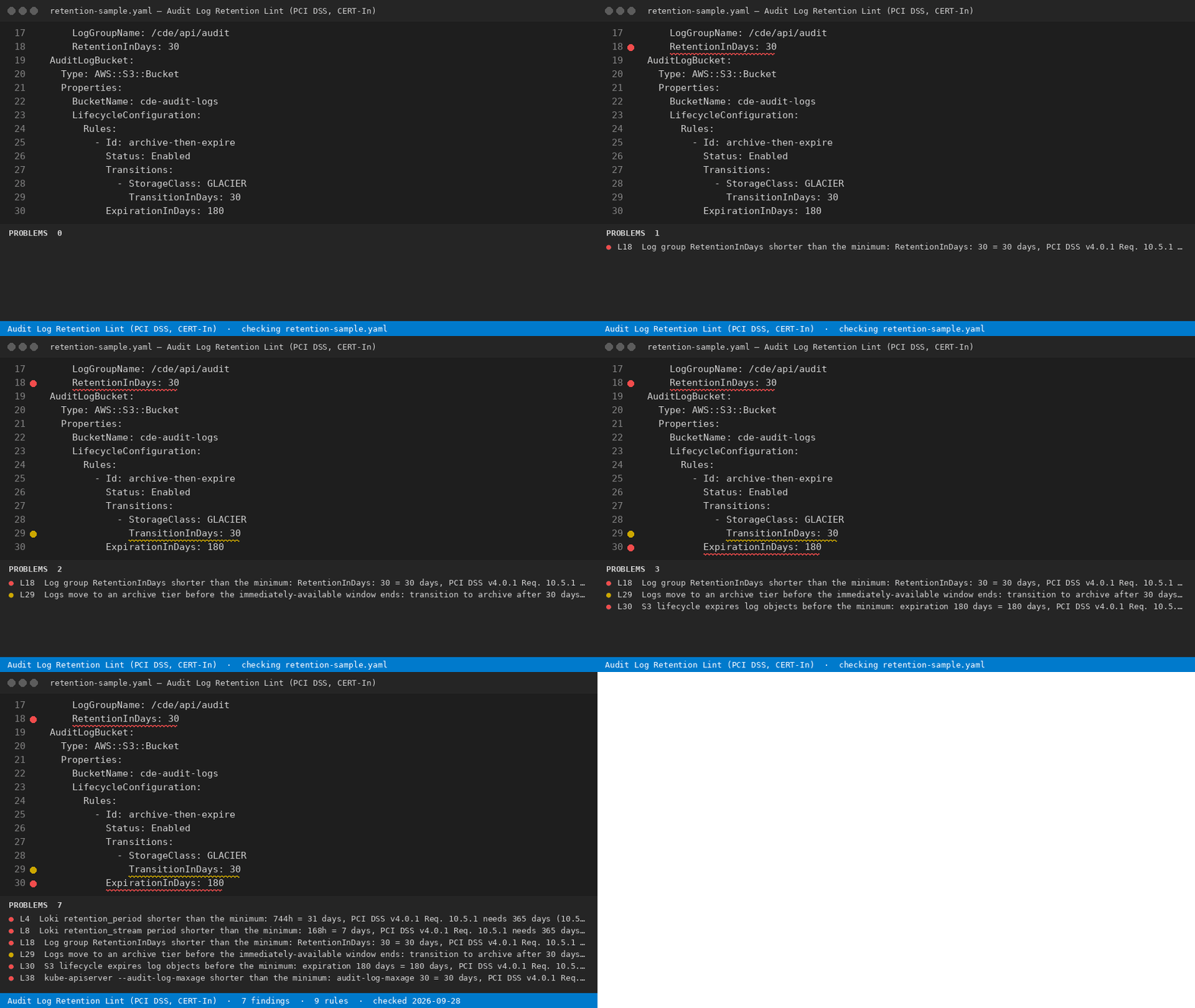
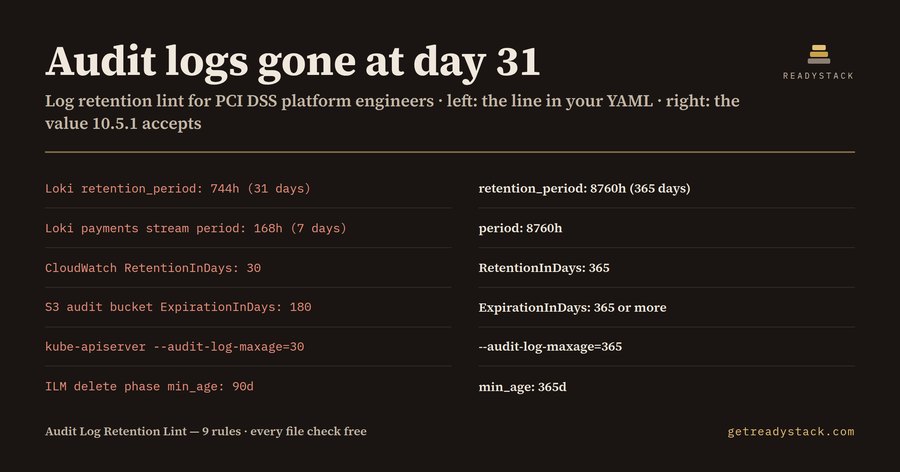
Log retention lint for Loki, CloudWatch, ILM, S3 and Kubernetes audit YAML
Install
audit-log-retention-lint file
Node 18+. The same 9 rules as the VS Code extension, from a terminal or CI.
Free
- Every retention finding in the open YAML file, with the clause and the value that passes, no key needed: Loki retention_period, Loki stream period, RetentionInDays, retentionDays, ILM delete min_age, --audit-log-maxage, S3 expiration, S3 archive transition, CERT-In region.
--ruleslists every rule
With a licence ($29 once)
- Workspace evidence report: every log store's retention across all YAML files in one Markdown table (value, minimum, clause) for your QSA or auditor.
audit-log-retention-lint --dir ./templates --report html --out report.html
One hour of a lawyer with 15 years' experience is $851 on the DOJ Fitzpatrick Matrix (billing year 2026).
Use from an AI agent (MCP)
Claude Code · Cursor · Windsurf · any MCP client - add to your MCP config:
{ "mcpServers": { "audit-log-retention-lint": { "command": "audit-log-retention-lint", "args": ["--mcp"] } } }
Tools: check_text and check_file (free) · check_dir (licence). The agent gets every finding with the line number.
Use in CI
- name: Audit Log Retention Lint (PCI DSS, CERT-In)
  run: pip install rulestamp-audit-log-retention-lint && audit-log-retention-lint --dir . --ci
The folder sweep, reports and CI mode need one licence — one payment, no subscription. Set READYSTACK_LICENSE=<key> or run --license <key> once.
Install (PyPI)
pip install rulestamp-audit-log-retention-lint
audit-log-retention-lint --help
1 maintainer

Metadata
1 maintainer
Release files for rulestamp-audit-log-retention-lint 1.0.2
For a detailed explanation of source distributions (sdists) and built distributions (wheels), please see the package formats documentation.
Source distribution (sdist)
| File | Size | Uploaded | Provenance | Actions |
|---|---|---|---|---|
| rulestamp_audit_log_retention_lint-1.0.2.tar.gz | 16.2 kB | Without provenance | Details for rulestamp_audit_log_retention_lint-1.0.2.tar.gz |
Built distribution (wheel)
| File | Interpreter | ABI | Platform | Actions Reset |
|---|---|---|---|---|
| rulestamp_audit_log_retention_lint-1.0.2-py3-none-any.whl | Python 3 | none | any | Details for rulestamp_audit_log_retention_lint-1.0.2-py3-none-any.whl |
Total release size: 34.7 kB
Release files / rulestamp_audit_log_retention_lint-1.0.2.tar.gz
| Download URL | rulestamp_audit_log_retention_lint-1.0.2.tar.gz |
|---|---|
| Size | 16.2 kB |
| Tags | Source |
|
SHA-256 checksum How to use checksums |
f3a0faa839428879a53719fc051414a97c8c999dbd18ef38c4d9e79b9432390e
|
|
BLAKE2b-256 checksum How to use checksums |
3c47ca40fc82fd98efaf852c6a531bc747d4cf4123c25626763be02941daf50b
|
| Upload date | |
|
Uploaded using Trusted Publishing? What is trusted publishing? |
No |
| Uploaded via |
twine/7.0.0 CPython/3.12.3
|
Release files / rulestamp_audit_log_retention_lint-1.0.2-py3-none-any.whl
| Download URL | rulestamp_audit_log_retention_lint-1.0.2-py3-none-any.whl |
|---|---|
| Size | 18.5 kB |
| Tags | Python 3 |
|
SHA-256 checksum How to use checksums |
0ddb88aaf338f5664063a9fc0c2b67025e63cb282a4f1a8c119da88640433589
|
|
BLAKE2b-256 checksum How to use checksums |
0e91140073b6cf9fb91e70edc43f750cb633c8620e315679a09f0762fb2644e6
|
| Upload date | |
|
Uploaded using Trusted Publishing? What is trusted publishing? |
No |
| Uploaded via |
twine/7.0.0 CPython/3.12.3
|
Security for rulestamp-audit-log-retention-lint 1.0.2
Provenance
Provenance describes where a file came from. On PyPI, provenance is shared via attestations, which provide a verifiable record of the build or publishing details. View details, limitations and caveats.
No provenance found
None of the files in this release were uploaded with provenance metadata.
A note on package security
PyPI is a repository for distributing packages, not a service for auditing them. While third-party security researchers and our staff do their best to detect and remove malicious packages, PyPI cannot guarantee the quality, security or suitability of any given package.
To learn more about protecting yourself from malicious actors, visit our package security documentation.













