
A Dictionary-Based, Variety-Aware Lemmatizer for Romansh

Project description
Dictionary-Based Lemmatizer for Romansh Varieties
This Python package presents a dictionary-based lemmatizer for the Romansh language. Provided a Romansh text, the lemmatizer splits it into words and looks up each word in the Pledari Grond dictionaries of the five primary Romansh idioms Sursilvan, Sutsilvan, Surmiran, Puter and Vallader, as well as in the dictionary of the standard variety Rumantsch Grischun.
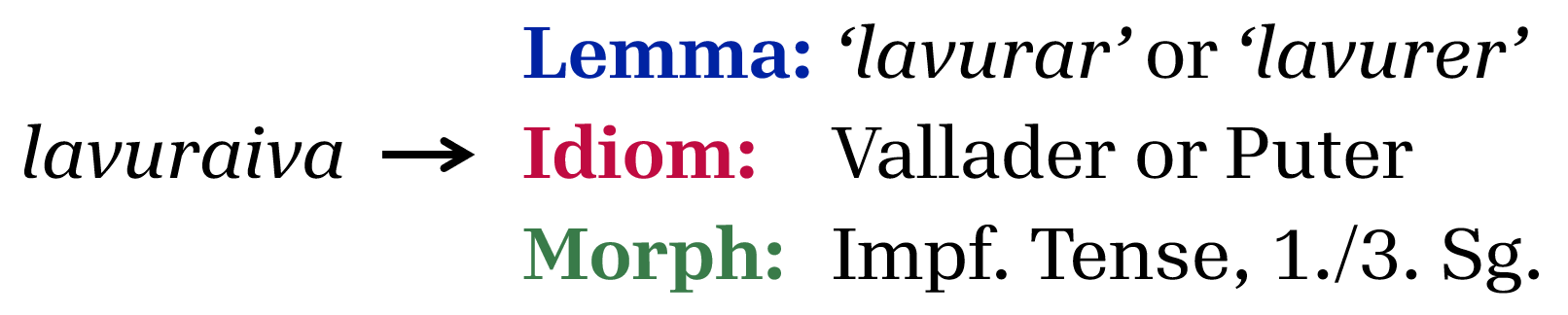
For example, if a Romansh text contains the word lavuraiva, the lemmatizer traces the word back to the Vallader and Puter dictionaries:
Typical use cases for the lemmatizer include:
- Accessing potential German translations (glosses) of Romansh words
- Automatically detecting the variety of a Romansh text, based on how many words are found in the respective dictionaries
A limitation of the current version is that the lemmatizer does not disambiguate between multiple possible ways of lemmatizing a word. Specifically:
- If a word has multiple dictionary entries, all the dictionary entries are returned, irrespective of the context in which the word occurs.
- If there are multiple ways of morphologically analysing a given word form, all possible analyses are returned.
Acknowledgements and Data Rights
This package incorporates dictionary data from the Pledari Grond project.
- The dictionaries for Rumantsch Grischun, Surmiran, Sursilvan and Sutsilvan are openly licensed. © Lia Rumantscha 1980 – 2025
- The dictionaries for Vallader and Puter are kindly provided by Uniun dals Grischs and may only be used in the context of this lemmatizer. © Uniun dals Grischs. All rights reserved.
Usage
Installation
pip install rumlem
or
pip install git+https://github.com/ZurichNLP/rumlem.git@v1.0.1
Demo:
https://huggingface.co/spaces/ZurichNLP/rumlem
Example Code
A couple of example use cases, namely:
- Analysis of words in a corpus
- Idiom classification
- Romansh vs. non-Romansh identification
are provided under "example_notebooks".
Initialising RUMLEM
from rumlem import Lemmatizer

lemmatizer = Lemmatizer()
sent = "La vuolp d'eira darcheu üna jada fomantada."
doc = lemmatizer(sent)
Optionally, the lemmatizer can be initialized with a specific variety, or with activated Edit Trees, a Machine Learning-component that tries to map unknown word forms to known lemmas. This will result in slightly higher lemmatization coverage for a text, with multiple guardrails reducing the risk of inducing false lemmas to a minimum.
lemmatizer = Lemmatizer(idiom="rm-vallader")
lemmatizer = Lemmatizer(learned_et=True)
For each POS-tag, this component learns frequent patterns and their morphology (e.g., masculine adjectives get an -a when turned feminine, or an -s when pluralized). Upon encountering an unknown word from, it will try to lemmatize it along possible edit tree paths. If a potential match is found, the supposed lemma will be checked against existing lemmas within that POS-tag, and will be accepted if a match is present.
Automatic idiom detection
RUMLEM will automatically detect the idiom as the one with the highest coverage score, and return each idiom with its corresponding score.
print("Automatic Idiom Detection:")
print(f"The sentence '{sent}' is in:", doc.idiom)
# <Idiom.VALLADER: 'rm-vallader'>

print("\Scores across idioms:")
for k, v in doc.idiom_scores.items():
    print("\t", k, v)
    # {<Idiom.RUMGR: 'rm-rumgr'>: 0.77..8
    # <Idiom.SURSILV: 'rm-sursilv'>: 0.22...,...}
Idiom detection given a lang-specifically initialised lemmatizer
Here, since the idiom is given, that is the one that will be "detected", and will always be assigned a score of 1, while all others get a score of 0.
idiom = "rm-vallader"
vallader_lemmatizer = Lemmatizer(idiom=idiom)
doc = vallader_lemmatizer(sent)

print(f"\nPassing '{idiom}' as an argument:")
print(f"The sentence '{sent}' is in: ", doc.idiom)
# <Idiom.VALLADER: 'rm-vallader'>

print("\Scores across idioms:")
for k, v in doc.idiom_scores.items():
    print("\t", k, v)
    # {<Idiom.RUMGR: 'rm-rumgr'>: 0.0,
    # <Idiom.SURSILV: 'rm-sursilv'>: 0.0,...}
Accessing the tokens and their attributes
The tokens can be accessed as follows...
print("\n", doc.tokens)
# ['La', 'vuolp', "d'", 'eira', 'darcheu', 'üna', 'jada', 'fomantada', '.']
token = doc.tokens[-2]
...and the lemmas of tokens as described here:
print(f"\nPrint {idiom}-lemmas of token '{token}'")
print(token.lemmas)
# {rm-vallader::fomantar: [PoS=V;VerbForm=PTCP;Tense=PST;Gender=FEM;Number=SG],...}
".all_lemmas" gives lemmas in any idiom, not just in the detected one.
print(f"\nPrint all lemmas of token '{token}'")
for t in token.all_lemmas:
    print(t)
#   rm-surmiran::fomanto: [PoS=ADJ;Gender=FEM;Number=SG],
#   rm-surmiran::fomantar: [PoS=V;VerbForm=PTCP;Tense=PST;Gender=FEM;Number=SG],
#   rm-vallader::fomantar: [PoS=V;VerbForm=PTCP;Tense=PST;Gender=FEM;Number=SG]
#   ...
Lemma objects have an attribute ".translation_de":
token = doc.tokens[1]
lemma = list(token.lemmas.keys())

print(f"\nThe German translation of a lemma, here '{token}' is an attribute of the Lemma object")
for l in lemma:
    print(f"{l}: {l.translation_de}")
    # rm-vallader::vuolp: Filou (Gauner, Spitzbube)
    # rm-vallader::vuolp: Fuchs
    # rm-vallader::vuolp: Schlauberger (Filou)
For more detailed information on object types and their attributes, cf. example_notebooks/overview.ipynb.
Development
Installation
pip install -e ".[dev]"
Running the tests
python -m unittest discover -s tests
pytest -v
License
The software in this project is licensed under the MIT License. For license information regarding the dictionary data, please refer to the Acknowledgements and Data Rights section above.
Release history Release notifications | RSS feed


Download files
Download the file for your platform. If you're not sure which to choose, learn more about installing packages.
Source Distribution
Built Distribution
Filter files by name, interpreter, ABI, and platform.
If you're not sure about the file name format, learn more about wheel file names.
Copy a direct link to the current filters
File details
Details for the file rumlem-1.0.1.tar.gz.
File metadata
- Download URL: rumlem-1.0.1.tar.gz
- Upload date:
- Size: 37.5 MB
- Tags: Source
- Uploaded using Trusted Publishing? No
- Uploaded via: twine/6.2.0 CPython/3.11.5
File hashes
| Algorithm | Hash digest | |
|---|---|---|
| SHA256 |
16eec0636e9b2adf9027794af96527f6f7f1a4498dcd5fc5bcdf2961d3a9d9fb
|
|
| MD5 |
d8c5114263def1dcb415ee7a9a2a4e5e
|
|
| BLAKE2b-256 |
6bd6769747b38a179b36f5b26e52a31c9ac730c0bcd2cac87f1a28926a757a9d
|
File details
Details for the file rumlem-1.0.1-py3-none-any.whl.
File metadata
- Download URL: rumlem-1.0.1-py3-none-any.whl
- Upload date:
- Size: 38.8 MB
- Tags: Python 3
- Uploaded using Trusted Publishing? No
- Uploaded via: twine/6.2.0 CPython/3.11.5
File hashes
| Algorithm | Hash digest | |
|---|---|---|
| SHA256 |
356bdb8043d9a86c34d1e654cad23ce2fd5e5db7526ba9613a2c7dcc62734240
|
|
| MD5 |
99803f48884fe6f575a7665e03e5e6a1
|
|
| BLAKE2b-256 |
04db3035c39ce459fbe91a70fc07d77a84521ad77d744f70ab270ffd7d4449ce
|






