
runboard
Your own live experiment dashboard on Cloudflare, from any cluster or VM.






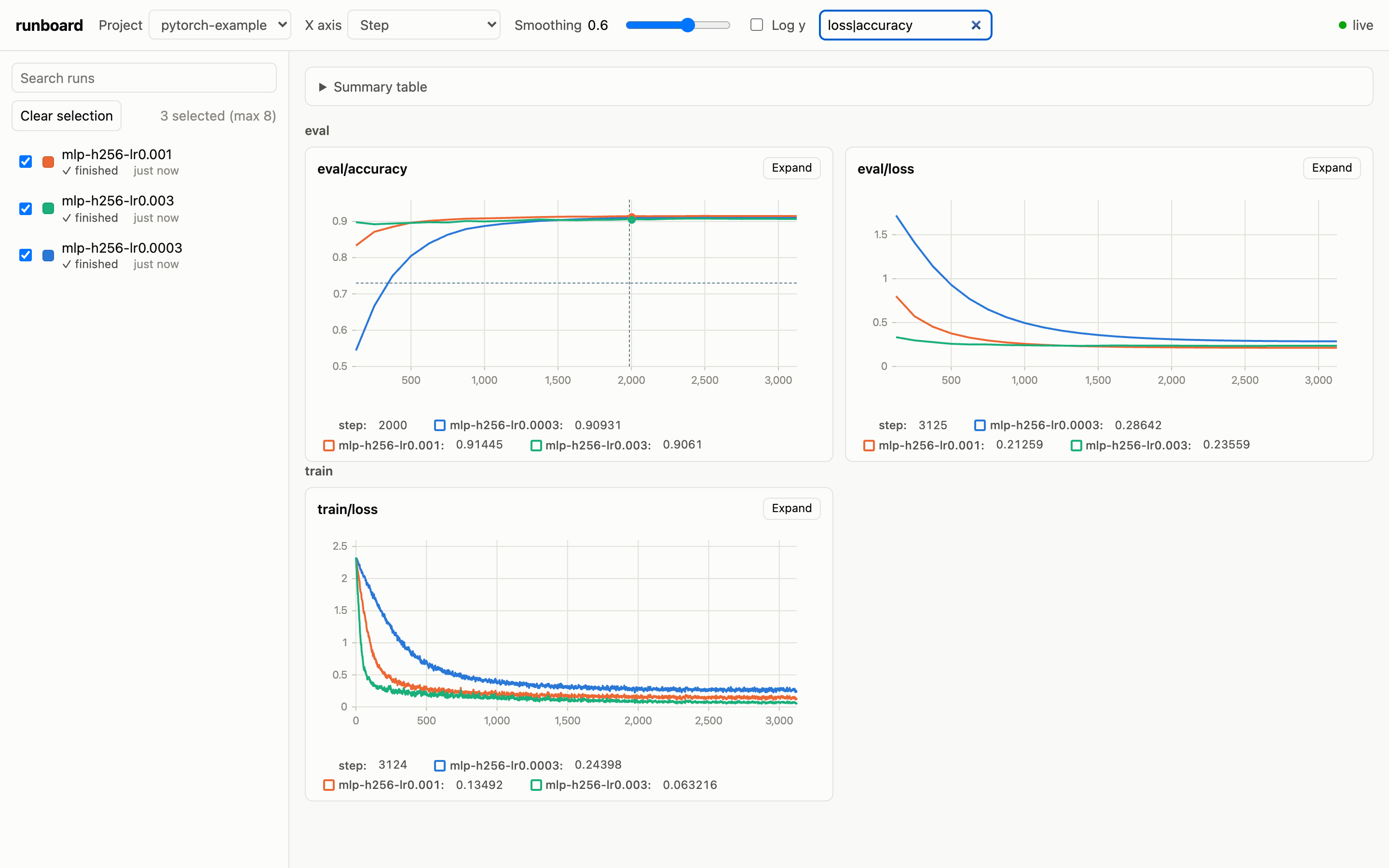
runboard is a personal, W&B-style experiment dashboard. Each researcher deploys one small backend to their own Cloudflare account. Training jobs send metrics directly over HTTPS, so the cluster does not need to host a server and the dashboard keeps the same URL when jobs, login nodes, or laptops restart.
- Two lines in your training code.
runboard.init(...)andrunboard.log({...}). - Bring your own Cloudflare. One click creates a Worker, D1 database, and static dashboard in your account. No domain or always-on cluster process is required.
- One stable URL. Jobs and browsers connect to the same
workers.devHTTPS endpoint from anywhere. - Zero dependencies. The client, server, and dashboard use only the Python standard library.
pip install runboardworks on any cluster, even behind a restrictive proxy. - Keeps network and disk work out of training.
log()appends metrics in memory; a background thread sends batches, retries outages, and spills excess backlog to disk. Remaining metrics are saved when the run finishes. - A local mode when you need it. The same package can store plain JSONL files and serve them from a cluster or laptop without Cloudflare storage.
Contents
- Quickstart
- How it works
- Logging API
- Cloudflare deployment
- Running on a cluster
- The dashboard
- Configuration
- CLI reference
- Security
- FAQ
- Development
Quickstart
1. Deploy your personal backend. Click the button, sign in to Cloudflare, and choose a long random
RUNBOARD_TOKEN when prompted. Cloudflare creates the Worker, database, and dashboard.
Cloudflare gives you a URL such as https://runboard.<account>.workers.dev.
2. Install and connect the Python client on each machine or shared cluster home:
pip install runboard
runboard configure https://runboard.<account>.workers.dev
The command asks for the same token, verifies the deployment, and saves both values in
~/.runboard/server.json with mode 600.
3. Log from your training script:
import runboard

runboard.init(project="resnet", config={"lr": 3e-4, "batch_size": 256})

for step in range(num_steps):
    loss = train_step()
    runboard.log({"train/loss": loss}, step=step)

    if step % 500 == 0:
        runboard.log({"eval/accuracy": evaluate()}, step=step)

runboard.finish()
4. Open the URL printed by runboard configure. Charts update live every two seconds.
runboard.init() reads the saved endpoint automatically. On clusters with a shared home directory,
configure it once and every compute node uses it. For containers or separate machines, set
RUNBOARD_SERVER and RUNBOARD_TOKEN as environment variables.
How it works
  cluster / VM                         your Cloudflare account                 anywhere
 ┌──────────────────┐    HTTPS    ┌───────────────────────────────┐        ┌───────────┐
 │ train.py         │ ──────────► │ Worker: auth + REST API       │ ◄────► │  browser  │
 │   runboard.log() │             │ D1: runs + metric batches     │ HTTPS  │ dashboard │
 │   retry + spool  │             │ Assets: dashboard             │        └───────────┘
 └──────────────────┘             │                               │
                                  └───────────────────────────────┘
- Your script appends metrics to an in-memory buffer. A background thread sends them to the server once per second, in chunks of up to 5,000 rows.
- The Cloudflare Worker authenticates the request and stores run metadata and metric batches in D1. Retried batches have deterministic IDs and are stored once.
- The dashboard is served by the same Worker. It polls every two seconds and fetches only batches it has not seen.
- If Cloudflare or the network is unavailable, the client retries with backoff and writes remaining
data to
~/.runboard/spool/.runboard syncsends it later.
More detail is in docs/architecture.md.
Logging API
import runboard

run = runboard.init(
    project="my-project",      # groups runs in the dashboard
    name="baseline-lr3e-4",    # display name (defaults to the run id)
    config={"lr": 3e-4},       # hyperparameters, shown in run details
    tags=["baseline"],         # searchable in the sidebar
    run_id=None,               # pass an existing id to resume a run
    server=None, token=None,   # override server discovery
    dir=None,                  # write to a shared directory instead of HTTP
)

runboard.log({"train/loss": 0.42, "train/lr": 1e-4}, step=100)   # step is optional; auto-increments
runboard.finish()                                                # also runs automatically at exit
| Behavior | Details |
|---|---|
| Values | Python numbers, NumPy scalars, and 0-d torch tensors all work. NaN and inf become gaps; non-numeric values are ignored. |
| Sections | Metrics named group/name are grouped into dashboard sections (train/…, eval/…). |
| Status | Runs are marked running, finished, crashed (uncaught exception), or killed (Ctrl-C). A run that stops logging for 10 minutes is shown as stale. |
| Metadata | Hostname, command line, and SLURM_JOB_ID are recorded automatically. |
| Multi-GPU | Under torchrun or DDP, only rank 0 logs. init() and log() are no-ops where RANK or LOCAL_RANK is non-zero, so you can call them unconditionally. Pass all_ranks=True to log from every rank. |
| Context manager | with runboard.Run(project="p") as run: run.log(...) marks the run crashed if the block raises. |
When the server is unreachable
Network failures never run inside log(). If the server is down, rows are kept in memory and retried
with backoff; excess backlog is saved in the background. Rows still unsent when the job exits are written to
~/.runboard/spool/. Upload them later with:
runboard sync
Cloudflare deployment
The deploy button is the normal path. It uses Cloudflare's automatic resource provisioning,
so every user receives isolated resources in their own account. A custom domain is optional; the
generated workers.dev address is stable and sufficient.
To deploy from a terminal instead:
git clone https://github.com/Moe-Zbeeb/runboard && cd runboard
npm install
npx wrangler login
npm run deploy
Generate a token, then store it as a Worker secret when Wrangler prompts for its value:
python -c 'import secrets; print(secrets.token_urlsafe(32))'
npx wrangler secret put RUNBOARD_TOKEN
The Worker creates its schema on the first authenticated request. The SQL migration is also kept in
cloudflare/migrations/ for inspection and future upgrades.
For local Worker development, copy .dev.vars.example to .dev.vars, replace its value, and run
npm run dev. Wrangler keeps local D1 data under .wrangler/.
Cloudflare's free plan is enough for personal use and normal research runs, subject to its current Workers, D1 quotas. Large sweeps or very frequent logging can exceed those quotas. Runboard batches writes, but log at a useful interval instead of every inner-loop operation.
Running on a cluster
Recommended: send directly to Cloudflare
If the cluster home is shared, run runboard configure once on a login node. Otherwise inject the
settings into the job:
export RUNBOARD_SERVER="https://runboard.<account>.workers.dev"
export RUNBOARD_TOKEN="your-token"
python train.py
Only outbound HTTPS is required. There is no Runboard daemon on the login node and no tunnel to keep alive.
Local server mode
When experiments must remain inside the cluster, run the included local server:
Run it in tmux or with nohup on the login node:
nohup runboard serve --tunnel > ~/runboard.log 2>&1 &
grep public: ~/runboard.log
If your cluster kills long processes on login nodes, run the server as a low-resource Slurm job (examples/slurm/serve.sbatch):
sbatch examples/slurm/serve.sbatch
grep public: runboard-*.out
Quick-tunnel URL notifications
The quick-tunnel URL changes whenever the server restarts. Use --notify to have each new URL pushed
to your phone through ntfy. Install the app and subscribe to a private,
hard-to-guess topic:
runboard serve --tunnel --notify https://ntfy.sh/my-private-topic-8f3k2
Local server discovery
Nothing extra is needed. Jobs discover the server through ~/.runboard/server.json. See
examples/slurm/train.sbatch and
examples/slurm/sweep.sbatch (a job-array learning-rate sweep).
Compute nodes can't reach the login node?
Some clusters block traffic between nodes. If they share a filesystem, skip HTTP and write straight into the server's run directory:
runboard.init(project="resnet", dir="~/runboard-runs")
or set export RUNBOARD_DIR=~/runboard-runs in your job script. The server picks the files up.
The dashboard
- Runs sidebar. Search, project filter, and status badges. Click a run's name to see its config and metadata.
- Compare runs. Select up to 8 runs. Each run keeps its color while it stays selected.
- One chart per metric. Hover for exact values, drag to zoom, double-click to reset. Legends show each run's latest value.
- Controls. EMA smoothing, log-scale y, x axis as step, relative time, or wall clock, a regex metric filter, and system/light/dark themes.
- Long runs. Charts retain peaks and dips while reducing very large series to a display-sized sample. Original metrics remain in the JSONL files.
- Summary table. Latest value of every metric for the selected runs.
- A responsive layout for phones and desktops.
Configuration
| Environment variable | Default | Purpose |
|---|---|---|
RUNBOARD_SERVER |
from ~/.runboard/server.json |
Server URL used by init() |
RUNBOARD_TOKEN |
from ~/.runboard/server.json |
Access token used by init() |
RUNBOARD_DIR |
unset | If set, init() writes files to this directory instead of using HTTP |
RUNBOARD_HOME |
~/.runboard |
Where the token, server info, and spool files live |
CLI reference
| Command | Description |
|---|---|
runboard configure URL |
Verify and save a personal Cloudflare or other hosted endpoint. Prompts securely for its token; --token is available for automation. |
runboard serve |
Start the server. Options: --dir (default ./runboard-runs), --port (default 8080, falls back to a free port if taken), --host, --tunnel, --notify URL, --advertise URL (address jobs should use) |
runboard ls [--dir D] |
List runs with status and last update |
runboard sync [files…] |
Upload spooled offline metrics |
runboard url |
Print the current dashboard URL |
runboard --version |
Print the version |
Security
- Every request, including the dashboard itself, needs the access token. For Cloudflare, each user chooses it during deployment and stores it as a Worker secret. The local server generates one.
- Opening
/?token=…stores the token in anHttpOnlycookie and removes it from the address bar. - The hosted endpoint uses HTTPS. Run metadata and metric batches are stored in D1 inside the user's Cloudflare account.
- Anyone with the URL and the token can read your metrics. Treat the full URL like a password. To
rotate a Cloudflare token, run
npx wrangler secret put RUNBOARD_TOKENfrom the repository and re-runrunboard configure. For a local server, delete~/.runboard/tokenand restart it.
FAQ
How is this different from W&B or TensorBoard? W&B is a hosted service, so your metrics leave your infrastructure and you need an account. TensorBoard needs port forwarding or a tunnel you set up yourself, and it reads event files. runboard gives every user their own small Cloudflare backend and keeps the Python client dependency-free.
Does it work on clusters with no internet access?
Cloudflare mode needs outbound HTTPS from compute nodes. If that is blocked, use local file mode with
RUNBOARD_DIR and runboard serve, then access it over the internal network or an SSH tunnel.
Can I log from any experiment?
Yes. Log numeric metrics with any names, group them with /, and include any JSON-compatible
hyperparameters in the run config. The tracker has no framework dependency, so it can live in a plain
Python loop or a PyTorch, JAX, or other training script. Each backend retains the run's full metric
history.
Can I analyze the data myself?
Local mode stores every run as <dir>/<project>/<run_id>/metrics.jsonl:
import pandas as pd
df = pd.read_json("runboard-runs/resnet/20260924-101500-a1b2c3/metrics.jsonl", lines=True)
Development
git clone https://github.com/Moe-Zbeeb/runboard && cd runboard
python -m venv .venv && source .venv/bin/activate
pip install -e ".[dev]"
pytest
npm install
npm run check:cloud
Try it end to end with runboard serve in one terminal and python examples/quickstart.py in another.
See CONTRIBUTING.md for details.
License
1 maintainer

Release files for runboard 0.2.0
For a detailed explanation of source distributions (sdists) and built distributions (wheels), please see the package formats documentation.
Source distribution (sdist)
| File | Size | Uploaded | |
|---|---|---|---|
| runboard-0.2.0.tar.gz | 60.7 kB | Details |
Built distribution (wheel)
| File | Interpreter | ABI | Platform | Reset |
|---|---|---|---|---|
| runboard-0.2.0-py3-none-any.whl | Python 3 | none | any | Details |
Total release size: 115.0 kB
Release files / runboard-0.2.0.tar.gz
| Download URL | runboard-0.2.0.tar.gz |
|---|---|
| Size | 60.7 kB |
| Tags | Source |
|
SHA-256 checksum How to use checksums |
33dc4257b2e0cb75032380fe8c54e2a24e63fb8585e65c7f587b5a3a10e6cc42
|
|
BLAKE2b-256 checksum How to use checksums |
8c05d760208c086f76cb064af6504db5b03dd5d1a133f4f57341a4c40fd3d494
|
| Upload date | |
|
Uploaded using Trusted Publishing? What is trusted publishing? |
Yes |
| Uploaded via |
twine/7.0.0 CPython/3.13.14
|
Provenance
Provenance describes where a file came from. On PyPI, provenance is shared via attestations, which provide a verifiable record of the build or publishing details. View details, limitations and caveats.


PyPI Publish Attestation
PyPI verified that this artifact, at this checksum, originated from the publisher listed below.
Signed by GitHub Actions, verified by PyPI on Sep 24, 2026.
Transparency logRelease files / runboard-0.2.0-py3-none-any.whl
| Download URL | runboard-0.2.0-py3-none-any.whl |
|---|---|
| Size | 54.3 kB |
| Tags | Python 3 |
|
SHA-256 checksum How to use checksums |
697b7afe417da6dc2adfb04437e9fc071f513dfb318b2b3039f4dda01c3f9d38
|
|
BLAKE2b-256 checksum How to use checksums |
09e035b1052f9eed58ecf8b4ed0fc99adb64a3cc7979d7c3dfd1a244004aa517
|
| Upload date | |
|
Uploaded using Trusted Publishing? What is trusted publishing? |
Yes |
| Uploaded via |
twine/7.0.0 CPython/3.13.14
|
Provenance
Provenance describes where a file came from. On PyPI, provenance is shared via attestations, which provide a verifiable record of the build or publishing details. View details, limitations and caveats.
PyPI Publish Attestation
PyPI verified that this artifact, at this checksum, originated from the publisher listed below.
Signed by GitHub Actions, verified by PyPI on Sep 24, 2026.
Transparency log












