
ruvector-graph: Property graph traversal in Python
What is ruvector-graph?
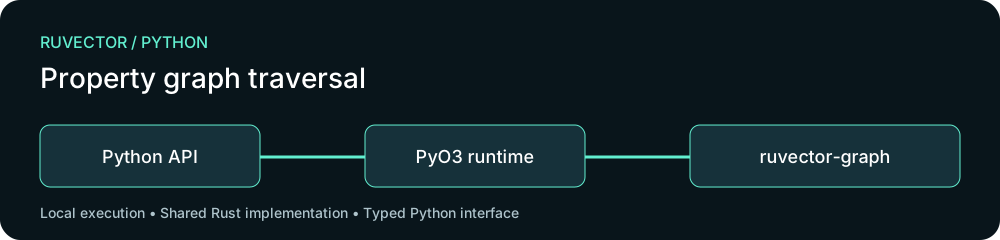
ruvector-graph provides property graph traversal through ruvector-graph in the RuVector Rust library family. It adds a focused Python API over the existing ruvector PyO3 runtime. It does not ship a separate native engine or reduce the shared runtime's installation size.
Install
pip install ruvector-graph==0.2.0
Release candidate: this command works only after publication. From a checkout, install ruvector==0.1.3 and then pip install ./python/portfolio/ruvector-graph. Python 3.10 or newer; native platform support follows the shared runtime wheels.
Quick start
from ruvector_graph import GraphDB, reachable
graph = GraphDB()
a = graph.create_node(["Document"], {"title": "Rust"}, id="a")
b = graph.create_node(["Document"], {"title": "Python"}, id="b")
graph.create_edge(a, b, "RELATED")
assert reachable(graph, a) == [a, b]
API and limitations
Public exports: GraphDB, reachable. In memory property graphs and bounded breadth first traversal. Not a persistent graph server. Node caps do not cap the temporary outgoing edge list; isolate untrusted workloads with process memory limits.
Input conversion can copy arrays. Reuse contiguous float32 arrays for repeated operations. No service, telemetry or credentials are added by this package. Apply application memory and request limits for untrusted data.
How does it relate to RuVector?
The algorithm executes through the existing Rust PyO3 binding, pinned to ruvector==0.1.3. Python implements convenience conversion and result formatting. For vector search use pip install ruvector; for other capabilities see the Python portfolio.
Verification and security
CI tests built wheels against a native runtime compiled from this repository, checks sdists and README rendering, audits resolved dependencies and publishes through PyPI Trusted Publishing. Native vulnerability scanning is a separate required gate. See security scope.
1 maintainer

Metadata
1 maintainer
Release files for ruvector-graph 0.2.0
For a detailed explanation of source distributions (sdists) and built distributions (wheels), please see the package formats documentation.
Built distribution (wheel)
| File | Interpreter | ABI | Platform | Reset |
|---|---|---|---|---|
| ruvector_graph-0.2.0-py3-none-any.whl | Python 3 | none | any | Details |
Release files / ruvector_graph-0.2.0-py3-none-any.whl
| Download URL | ruvector_graph-0.2.0-py3-none-any.whl |
|---|---|
| Size | 4.0 kB |
| Tags | Python 3 |
|
SHA-256 checksum How to use checksums |
2278acfa6255df9bd961c80ebb36fa28621975b36eb7fb41d992b7b5a921b8cc
|
|
BLAKE2b-256 checksum How to use checksums |
f39ee4a80de7d083fce8ac5036a340ceb4ab421ab3072564c442fe8bf27f20ea
|
| Upload date | |
|
Uploaded using Trusted Publishing? What is trusted publishing? |
No |
| Uploaded via |
twine/7.0.0 CPython/3.13.14
|
Security for ruvector-graph 0.2.0
Provenance
Provenance describes where a file came from. On PyPI, provenance is shared via attestations, which provide a verifiable record of the build or publishing details. View details, limitations and caveats.
No provenance found
None of the files in this release were uploaded with provenance metadata.
A note on package security
PyPI is a repository for distributing packages, not a service for auditing them. While third-party security researchers and our staff do their best to detect and remove malicious packages, PyPI cannot guarantee the quality, security or suitability of any given package.
To learn more about protecting yourself from malicious actors, visit our package security documentation.














