

RVCBench
Benchmarking the Robustness of Voice Cloning







Paper · Website · Dataset · Demo · Evaluate your model · Reproduce the paper
News
- 2026-10 ·
pip install rvcbench: score your own model from ZipVoice- or Seed-TTS-style batch lists, compare models in one table, or use the metrics in your own code.- 2026-09 · RVCBench is accepted to NeurIPS 2026.
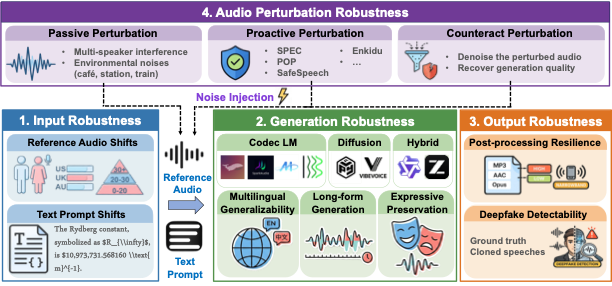
Voice cloning models sound convincing in clean demos. RVCBench measures how they hold up in deployment: noisy, accented or overlapping reference audio; irregular or scam text; long-form and multilingual speech; compression; and anti-cloning protection, with and without denoising. The paper defines 18 robustness evaluations over 14,370 utterances from 204 speakers and evaluates 18 open-source models.
Evaluate your model
Generate speech with your own code, then let RVCBench score it. With ZipVoice, for example:
pip install "rvcbench[eval]"
rvcbench setup-scorers                                # once: download the metric models
rvcbench prompts --suite core-v1 --output prompts/    # reference clips and texts to synthesize
python3 -m zipvoice.bin.infer_zipvoice --model-name zipvoice \
  --test-list prompts/prompts.tsv --res-dir outputs/zipvoice
rvcbench score --suite core-v1 --generated outputs/zipvoice --output results/zipvoice --device cuda
- Works with batch scripts.
prompts/hasprompts.tsv(ZipVoice),prompts.lst(Seed-TTS-eval scripts such as F5-TTS and CosyVoice) andprompts.jsonl. Save each output as<id>.wav. - Compare models in one run. Pass several output folders to
rvcbench scoreand getcomparison.md. - Pinned inputs. Every input is checked by hash against a fixed dataset revision, and target recordings are never exported.
| Suite | Utterances | Use it for |
|---|---|---|
onboarding-v1 |
52 | checking the workflow end to end |
core-v1 |
480 | a quick evaluation covering 16 of the 18 evaluations (about 35 min of scoring) |
full-v1 |
12,724 | every pair of the paper's datasets, without the protection tasks for now (about a day of scoring) |
The same metrics are available in your own code, with the same models and definitions:
from rvcbench import metrics

with metrics.Evaluator(["sim", "wer", "speechmos"], device="cuda") as evaluator:
    evaluator.score("generated.wav", reference="reference.wav", text="Hello there.", language="en")
See the metrics API for every metric and the one-line functions.
Requires Linux, Python 3.10+ and FFmpeg; a GPU is recommended for scoring. More in Evaluate your own model and the Core suite guide.
What it measures
| Dimension | Paper evaluations |
|---|---|
| Input | Reference audio across 12 accents, gender and age; hallucination-style and scam text prompts |
| Generation | English, Chinese and cross-lingual cloning; long text and long references; expressive and persuasive speech |
| Output | MP3, AAC, Opus and telephone-band compression; deepfake detectability |
| Perturbation | Background noise and overlapping speakers; Gaussian noise, SPEC, SafeSpeech, POP and Enkidu protection; denoising of protected references |
Metrics: speaker similarity (SIM, ECAPA-TDNN), naturalness (MOS, UTMOS), word error rate (WER, Whisper medium), mel-cepstral distortion (MCD), emotion consistency and STOI.
Results
From the paper (arXiv v3). SIM, MOS, WER and MCD are on clean LibriTTS prompts; the last three columns are speaker similarity on other datasets. Bold marks the best value per column, and † marks models reported in the paper's appendix.
| Model | SIM ↑ | MOS ↑ | WER ↓ | MCD ↓ | VCTK SIM ↑ | Chinese SIM ↑ | Cross-lingual SIM ↑ |
|---|---|---|---|---|---|---|---|
| Qwen3-TTS | 0.61 | 4.39 | 0.05 | 5.79 | 0.62 | 0.72 | 0.67 |
| IndexTTS | 0.61 | 4.06 | 0.05 | 6.61 | 0.57 | 0.72 | 0.67 |
| dots.tts † | 0.60 | 4.17 | 0.06 | 6.11 | 0.57 | 0.68 | 0.61 |
| CosyVoice 2 | 0.58 | 4.37 | 0.05 | 6.02 | 0.58 | 0.72 | 0.65 |
| ZipVoice | 0.58 | 4.13 | 0.05 | 7.09 | 0.55 | 0.71 | 0.63 |
| MOSS-TTS v1.5 † | 0.57 | 4.32 | 0.06 | 6.66 | 0.51 | 0.68 | 0.65 |
| GLM-TTS | 0.57 | 4.08 | 0.09 | 6.41 | 0.57 | 0.69 | 0.66 |
| MaskGCT | 0.57 | 3.93 | 0.09 | 6.91 | 0.56 | 0.67 | 0.63 |
| Higgs TTS 3 † | 0.56 | 4.23 | 0.05 | 6.32 | 0.45 | 0.63 | 0.30 |
| F5-TTS | 0.56 | 3.99 | 0.12 | 6.96 | 0.54 | 0.70 | 0.65 |
| Higgs Audio | 0.56 | 4.30 | 0.25 | 6.06 | 0.52 | 0.58 | 0.54 |
| Fish Audio S2 † | 0.54 | 4.37 | 0.04 | 6.16 | 0.51 | 0.66 | 0.62 |
| MGM-Omni | 0.54 | 4.28 | 0.09 | 5.82 | 0.45 | 0.71 | 0.63 |
| PlayDiffusion | 0.51 | 4.15 | 0.05 | 8.06 | 0.43 | 0.44 | 0.46 |
| MOSS-TTSD | 0.49 | 4.10 | 0.38 | 7.09 | 0.44 | 0.44 | 0.44 |
| VibeVoice | 0.48 | 3.83 | 0.23 | 6.76 | 0.44 | 0.56 | 0.53 |
| FishSpeech | 0.47 | 4.37 | 0.17 | 6.47 | 0.43 | 0.61 | 0.57 |
| XTTS-v2 | 0.45 | 3.81 | 0.07 | 8.62 | 0.45 | 0.57 | 0.51 |
| Spark-TTS | 0.41 | 4.06 | 0.33 | 5.83 | 0.53 | 0.57 | 0.48 |
| OZSpeech | 0.39 | 3.21 | 0.06 | 6.87 | 0.25 | 0.00 | 0.17 |
| OpenVoice V2 | 0.24 | 4.30 | 0.07 | 7.06 | 0.39 | 0.43 | 0.30 |
| StyleTTS 2 | 0.23 | 4.30 | 0.05 | 6.81 | 0.24 | 0.11 | 0.21 |
Speaker similarity under anti-cloning protection (LibriTTS)
A lower SIM under protection means the protection hides the speaker's voice better.
| Model | Clean | SafeSpeech | SPEC | Enkidu | Gaussian | POP |
|---|---|---|---|---|---|---|
| Qwen3-TTS | 0.61 | 0.38 | 0.36 | 0.50 | 0.41 | 0.58 |
| IndexTTS | 0.61 | 0.35 | 0.32 | 0.47 | 0.39 | 0.57 |
| dots.tts † | 0.60 | 0.41 | 0.39 | 0.49 | 0.44 | 0.57 |
| CosyVoice 2 | 0.58 | 0.32 | 0.30 | 0.45 | 0.38 | 0.55 |
| ZipVoice | 0.58 | 0.29 | 0.26 | 0.44 | 0.26 | 0.54 |
| MOSS-TTS v1.5 † | 0.57 | 0.33 | 0.31 | 0.43 | 0.33 | 0.53 |
| GLM-TTS | 0.57 | 0.33 | 0.31 | 0.44 | 0.39 | 0.53 |
| MaskGCT | 0.57 | 0.30 | 0.28 | 0.41 | 0.31 | 0.53 |
| Higgs TTS 3 † | 0.56 | 0.48 | 0.48 | 0.49 | 0.34 | 0.53 |
| F5-TTS | 0.56 | 0.21 | 0.18 | 0.43 | 0.14 | 0.52 |
| Higgs Audio | 0.56 | 0.26 | 0.24 | 0.43 | 0.27 | 0.52 |
| Fish Audio S2 † | 0.54 | 0.32 | 0.30 | 0.43 | 0.34 | 0.52 |
| MGM-Omni | 0.54 | 0.18 | 0.17 | 0.32 | 0.23 | 0.49 |
| PlayDiffusion | 0.51 | 0.17 | 0.15 | 0.34 | 0.16 | 0.47 |
| MOSS-TTSD | 0.49 | 0.24 | 0.22 | 0.34 | 0.25 | 0.08 |
| VibeVoice | 0.48 | 0.27 | 0.25 | 0.37 | 0.28 | 0.45 |
| FishSpeech | 0.47 | 0.24 | 0.21 | 0.33 | 0.23 | 0.01 |
| XTTS-v2 | 0.45 | 0.26 | 0.24 | 0.31 | 0.24 | 0.41 |
| Spark-TTS | 0.41 | 0.13 | 0.11 | 0.14 | 0.06 | 0.36 |
| OZSpeech | 0.39 | 0.16 | 0.15 | 0.19 | 0.15 | 0.34 |
| OpenVoice V2 | 0.24 | 0.18 | 0.18 | 0.19 | 0.18 | 0.24 |
| StyleTTS 2 | 0.23 | 0.09 | 0.08 | 0.12 | 0.03 | 0.21 |
Results for compression, deepfake detectability, long-form and expressive speech are in the paper and on the website.
Reproduce the paper
To reproduce the paper, use the code released with it, kept on the
v1 branch (tag v1.0). This branch, main, is v2:
the same benchmark rebuilt as an installable package for evaluating new models.
git clone --branch v1 https://github.com/Nanboy-Ronan/RVCBench.git RVCBench-v1
v1 (branch v1) |
v2 (main) |
|
|---|---|---|
| Use it to | Reproduce the paper | Evaluate a new model |
| Status | Frozen at the paper release | Under active development |
| Install | Clone, then pip install a list of packages |
pip install the rvcbench package |
| Run a built-in model | python run_vc.py --config-name ... |
rvcbench run --config-name ... |
| Evaluate your own model | Add an adapter to the codebase | Score audio generated anywhere, or a one-file adapter |
| Evaluation data | Full datasets | Full datasets, plus the core-v1 and full-v1 suites |
Run the built-in models
RVCBench includes adapters for 32 voice cloning models, 5 protection methods and a denoising stage.
Each model runs in its own environment from envs/.
git clone https://github.com/Nanboy-Ronan/RVCBench.git && cd RVCBench
python -m pip install -e '.[eval]'
rvcbench run --config-name ots_vc/clean/libritts/qwen3_tts_ots dataset.speaker_id=1089 adversary.max_samples=5
Every run writes a per-sample run_manifest.json with input and output hashes, seeds, failures and metric
coverage. See Running the built-in models and the run guide.
Documentation
| Guide | Covers |
|---|---|
| Evaluate your own model | Prompt and output formats, batch lists, several models, adapters |
| Core and full suites | Tasks, data, metrics and scoring time |
| Metrics API | Speaker similarity, WER, MOS, MCD, STOI and emotion in your own code |
| Running the built-in models | Installation options, supported models, protection and denoising |
| Datasets | Hub folders, manifest format, preprocessing |
| Run guide | Run records, resuming, scoring saved audio, timing |
| Codebase versions | What changed between v1 and v2 |
| Contributing | Development setup, checks and repository layout |
Citation
@inproceedings{jin2026rvcbench,
  title     = {RVCBench: Benchmarking the Robustness of Voice Cloning Across Modern Audio Generation Models},
  author    = {Jin, Ruinan and Liao, Xinting and Yu, Hanlin and Pandya, Deval and Li, Xiaoxiao},
  booktitle = {Advances in Neural Information Processing Systems},
  url       = {https://arxiv.org/abs/2602.00443},
  year      = {2026}
}
License
CC0-1.0. Model checkpoints, upstream code and source corpora keep their own licenses. Questions and contributions are welcome through issues and pull requests, or at ruinanjin@alumni.ubc.ca.
1 maintainer

Metadata
1 maintainer
Release files for rvcbench 2.0.0
For a detailed explanation of source distributions (sdists) and built distributions (wheels), please see the package formats documentation.
Source distribution (sdist)
| File | Size | Uploaded | |
|---|---|---|---|
| rvcbench-2.0.0.tar.gz | 6.1 MB | Details |
Built distribution (wheel)
| File | Interpreter | ABI | Platform | Reset |
|---|---|---|---|---|
| rvcbench-2.0.0-py3-none-any.whl | Python 3 | none | any | Details |
Total release size: 12.6 MB
Release files / rvcbench-2.0.0.tar.gz
| Download URL | rvcbench-2.0.0.tar.gz |
|---|---|
| Size | 6.1 MB |
| Tags | Source |
|
SHA-256 checksum How to use checksums |
dc3d5aab47baf8e4b4a0e6817c5ae233456787440ff70652053e7d8d489565eb
|
|
BLAKE2b-256 checksum How to use checksums |
e9f0176026be79aabacd8ddc0fbbd8dcb7c91dcfdf67cb52f5c8ca9b45ebabcf
|
| Upload date | |
|
Uploaded using Trusted Publishing? What is trusted publishing? |
Yes |
| Uploaded via |
twine/7.0.0 CPython/3.13.14
|
Provenance
Provenance describes where a file came from. On PyPI, provenance is shared via attestations, which provide a verifiable record of the build or publishing details. View details, limitations and caveats.


PyPI Publish Attestation
PyPI verified that this artifact, at this checksum, originated from the publisher listed below.
Signed by GitHub Actions, verified by PyPI on Oct 4, 2026.
Transparency logRelease files / rvcbench-2.0.0-py3-none-any.whl
| Download URL | rvcbench-2.0.0-py3-none-any.whl |
|---|---|
| Size | 6.5 MB |
| Tags | Python 3 |
|
SHA-256 checksum How to use checksums |
5d240faae6e43895658f83a3ad44db392138353b1f455963e51ad4bec6eb2e2f
|
|
BLAKE2b-256 checksum How to use checksums |
693fc0f1974b44ed18dc348e9b8594187005ee80c7483162c3db68d9f582a241
|
| Upload date | |
|
Uploaded using Trusted Publishing? What is trusted publishing? |
Yes |
| Uploaded via |
twine/7.0.0 CPython/3.13.14
|
Provenance
Provenance describes where a file came from. On PyPI, provenance is shared via attestations, which provide a verifiable record of the build or publishing details. View details, limitations and caveats.
PyPI Publish Attestation
PyPI verified that this artifact, at this checksum, originated from the publisher listed below.
Signed by GitHub Actions, verified by PyPI on Oct 4, 2026.
Transparency log













