
Finger landmark labeling for left handed x-ray images
This project uses two algorithms (symbolic and neural) to extract finger landmarks from left hand x-rays. It's intended to be used as an auxiliary tool for forensics research at UNAM.
Getting Started
The latest stable version can be downloaded from the PyPI.
Prerequisites
The code is written in Python 3, and it relies on OpenCV, SciPy and scikit-image:
Dependencies are automatically managed by pip.
Installing
To download, you can simply create a virtualenv and install the project with pip:
pip install rxhands-unam-colab
Command-line execution
Extraction can be performed with either the symbolic algorithm or the neural one.
rxhands [-h] -al {symbolic,neural} [-ch] [-pre] [-of OUTPUT_FOLDER] INPUT_FOLDER
where:
-hhelpINPUT_FOLDERthe path to the folder where the input images are stored.OUTPUT_FOLDERthe path to the folder where the results will be stored.-alcan receive eithersymbolicorneural.-premeans that gray level normalization will be applied to the input images.-chif present, the script will try to crop the image to contain only the hand.
Examples
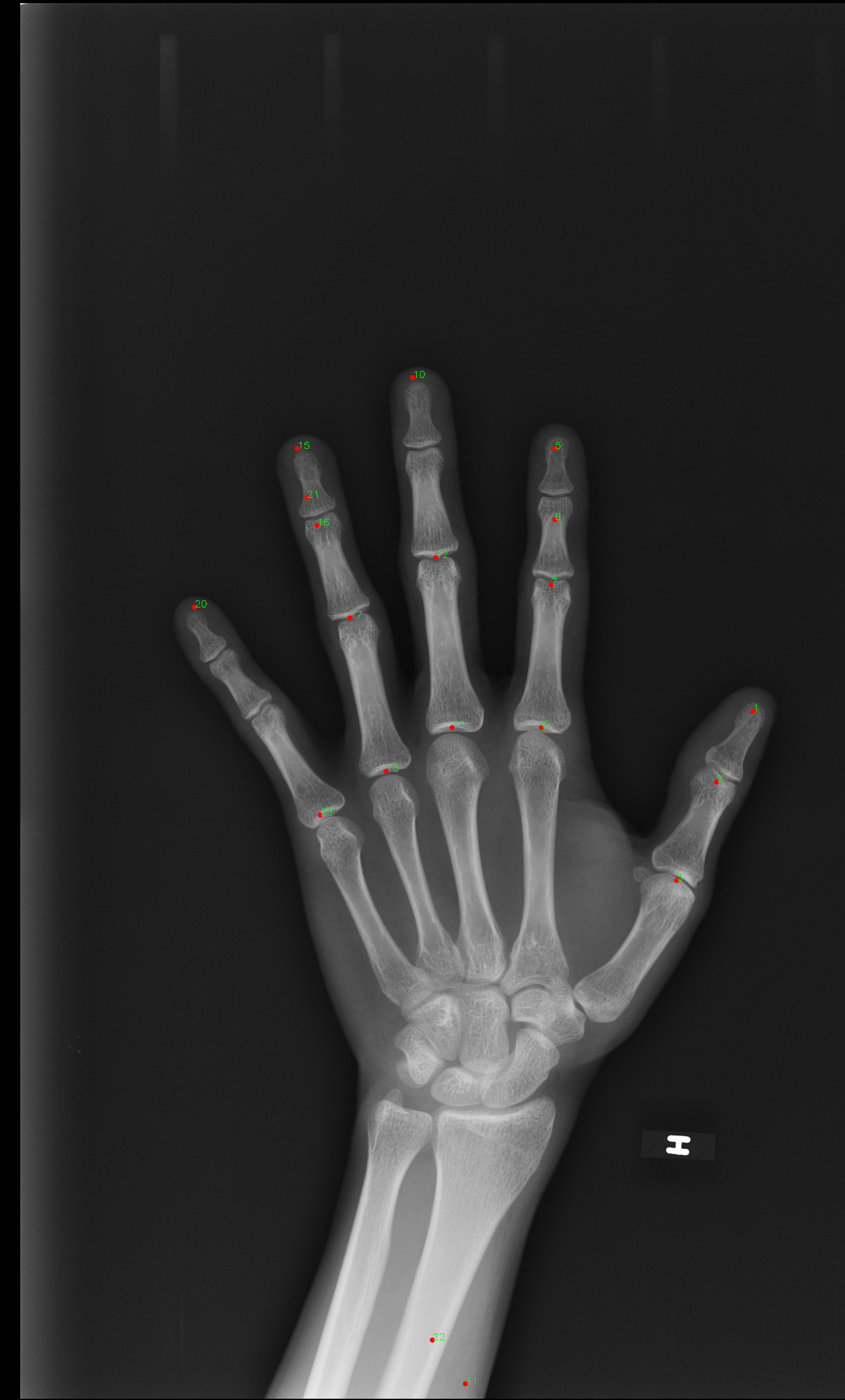
rxhands -al neural -of results/ data/
This command will label landmarks through the neural algorithm.
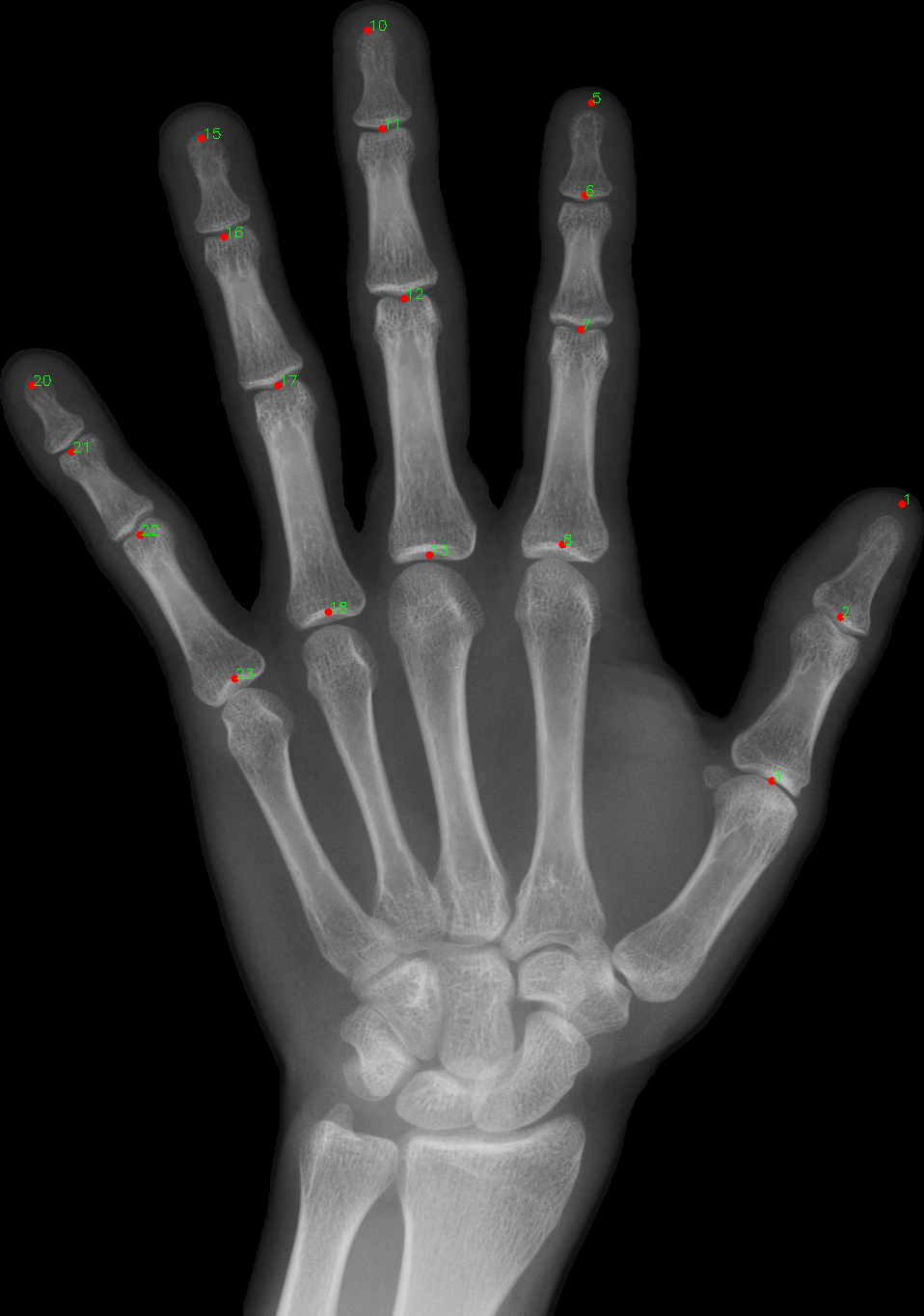
rxhands -al neural -ch -of results/ data/
This command will label landmarks through the neural algorithm. The images in folder data/ will be cropped on input.
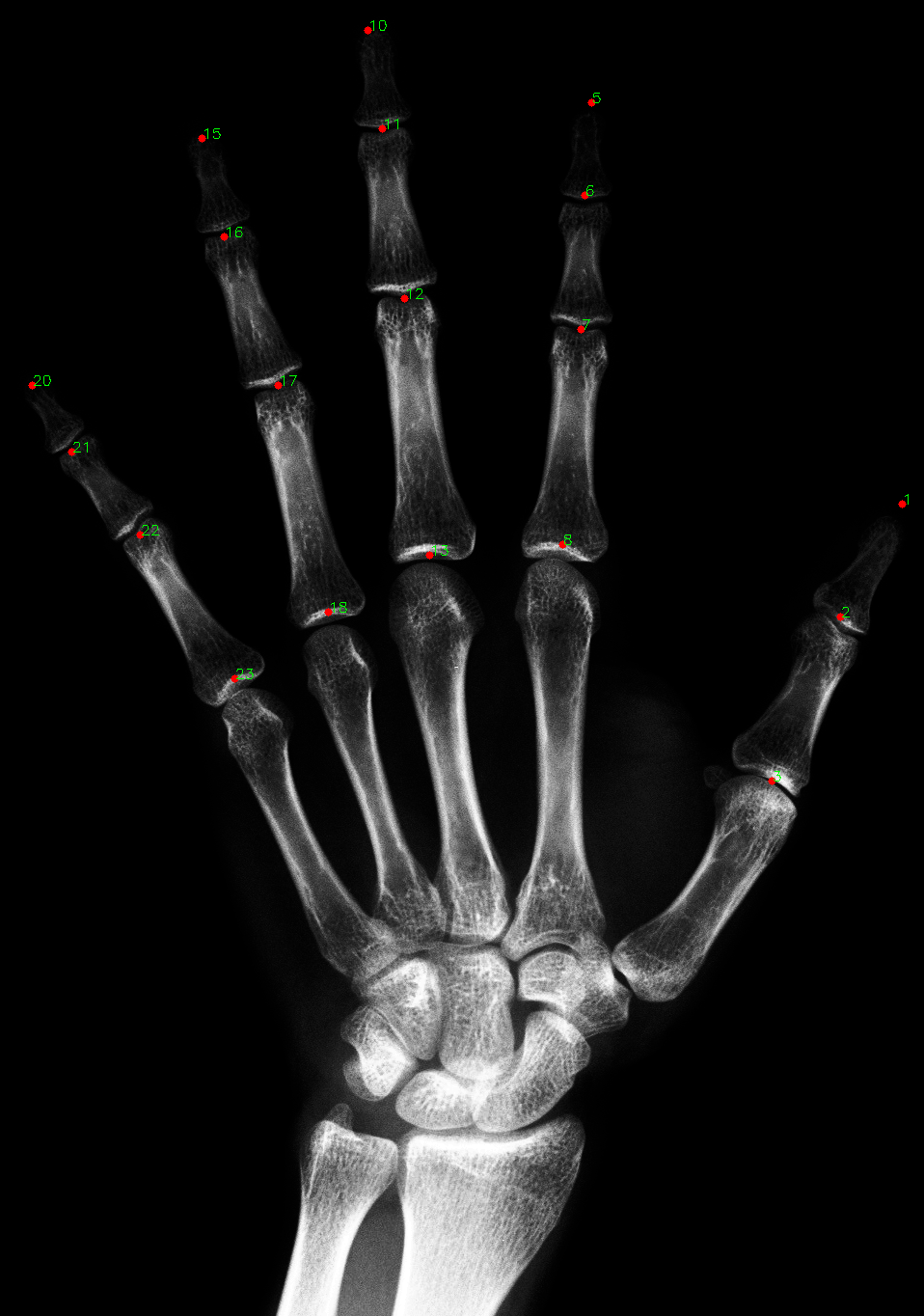
rxhands -al neural -ch -pre -of results/ data/
This command will label landmarks through the neural algorithm. The images in folder data/ will be cropped and preprocessed on input.
rxhands -al symbolic -of results/ data/
This command will label landmarks through the symbolic algorithm.
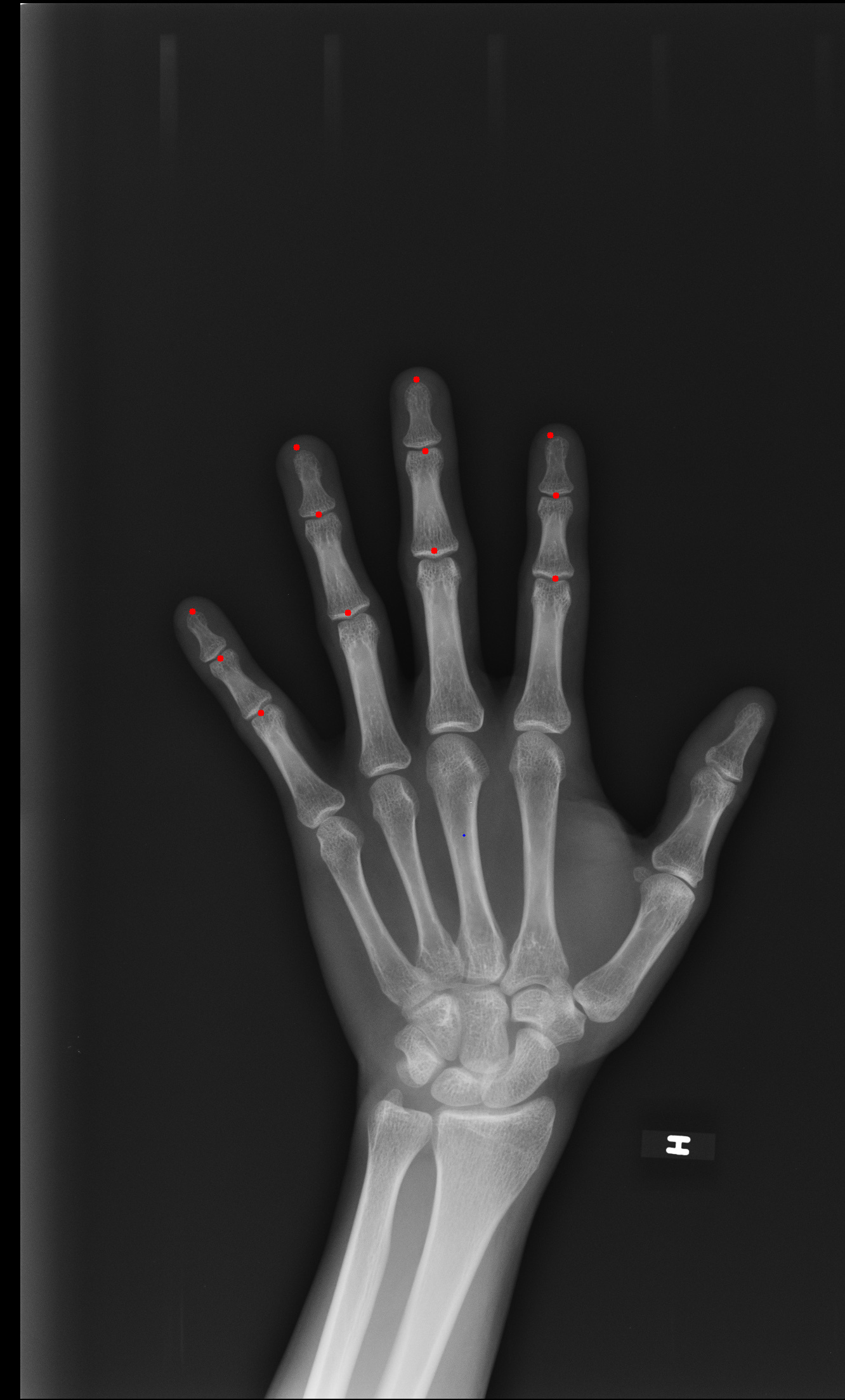
Note that the symbolic algorithm only approximates landmarks in four fingers (not including the metacarpophalangeal joints).
Authors
- Arturo Curiel - Initial work - website
See also the list of contributors who participated in this project.
License
This project is licensed under the GNU/GPL3 License - see the LICENSE.md file for details
Acknowledgments
The neural model was implemented based on the architecture proposed by:
@inproceedings{Payer2016,
  title     = {Regressing Heatmaps for Multiple Landmark Localization Using {CNNs}},
  author    = {Payer, Christian and {\v{S}}tern, Darko and Bischof, Horst and Urschler, Martin},
  booktitle = {Medical Image Computing and Computer-Assisted Intervention - {MICCAI} 2016},
  doi       = {10.1007/978-3-319-46723-8_27},
  pages     = {230--238},
  year      = {2016},
}
Using the Digital Hand Atlas as training data.
1 maintainer

Metadata
1 maintainer
Release files for rxhands-unam-colab 0.25
For a detailed explanation of source distributions (sdists) and built distributions (wheels), please see the package formats documentation.
Built distribution (wheel)
| File | Interpreter | ABI | Platform | Actions Reset |
|---|---|---|---|---|
| rxhands_unam_colab-0.25-py3-none-any.whl | Python 3 | none | any | Details for rxhands_unam_colab-0.25-py3-none-any.whl |
Release files / rxhands_unam_colab-0.25-py3-none-any.whl
| Download URL | rxhands_unam_colab-0.25-py3-none-any.whl |
|---|---|
| Size | 616.3 kB |
| Tags | Python 3 |
|
SHA-256 checksum How to use checksums |
7dd02280c5ad946096860e96c74e780221c1336538ba3d473a5fdfa975f5eb90
|
|
BLAKE2b-256 checksum How to use checksums |
a5fecbf7db6bd0f1c49a05f02f75c0eeb3d870837c3a6af8b521d1a353091ea7
|
| Upload date | |
|
Uploaded using Trusted Publishing? What is trusted publishing? |
No |
| Uploaded via |
twine/5.1.0 CPython/3.12.3
|
Security for rxhands-unam-colab 0.25
Provenance
Provenance describes where a file came from. On PyPI, provenance is shared via attestations, which provide a verifiable record of the build or publishing details. View details, limitations and caveats.
No provenance found
None of the files in this release were uploaded with provenance metadata.
A note on package security
PyPI is a repository for distributing packages, not a service for auditing them. While third-party security researchers and our staff do their best to detect and remove malicious packages, PyPI cannot guarantee the quality, security or suitability of any given package.
To learn more about protecting yourself from malicious actors, visit our package security documentation.














