
A repaid Statistical Analysis tool for Climate or Meteorology data.

Project description
SACPY -- A Python Package for Statistical Analysis of Climate
Sacpy, a repaid Statistical Analysis tool for Climate or Meteorology data.
Author : Zilu Meng
e-mail : mzll1202@163.com
github : https://github.com/ZiluM/sacpy
gitee : https://gitee.com/zilum/sacpy
pypi : https://pypi.org/project/sacpy/
examples or document : https://github.com/ZiluM/sacpy/tree/master/examples or https://gitee.com/zilum/sacpy/tree/master/examples
version : 0.0.9
Why choose Sacpy?
Quick!
For example, Sacpy is more than 60 times faster than the traditional regression analysis with Python (see speed test).
Turn to climate data customization!
Compatible with commonly used meteorological calculation libraries such as numpy and xarray.
Install
You can use pip to install.
pip install sacpy
Or you can visit https://gitee.com/zilum/sacpy/tree/master/dist to download .whl file, then
pip install .whl_file
Speed
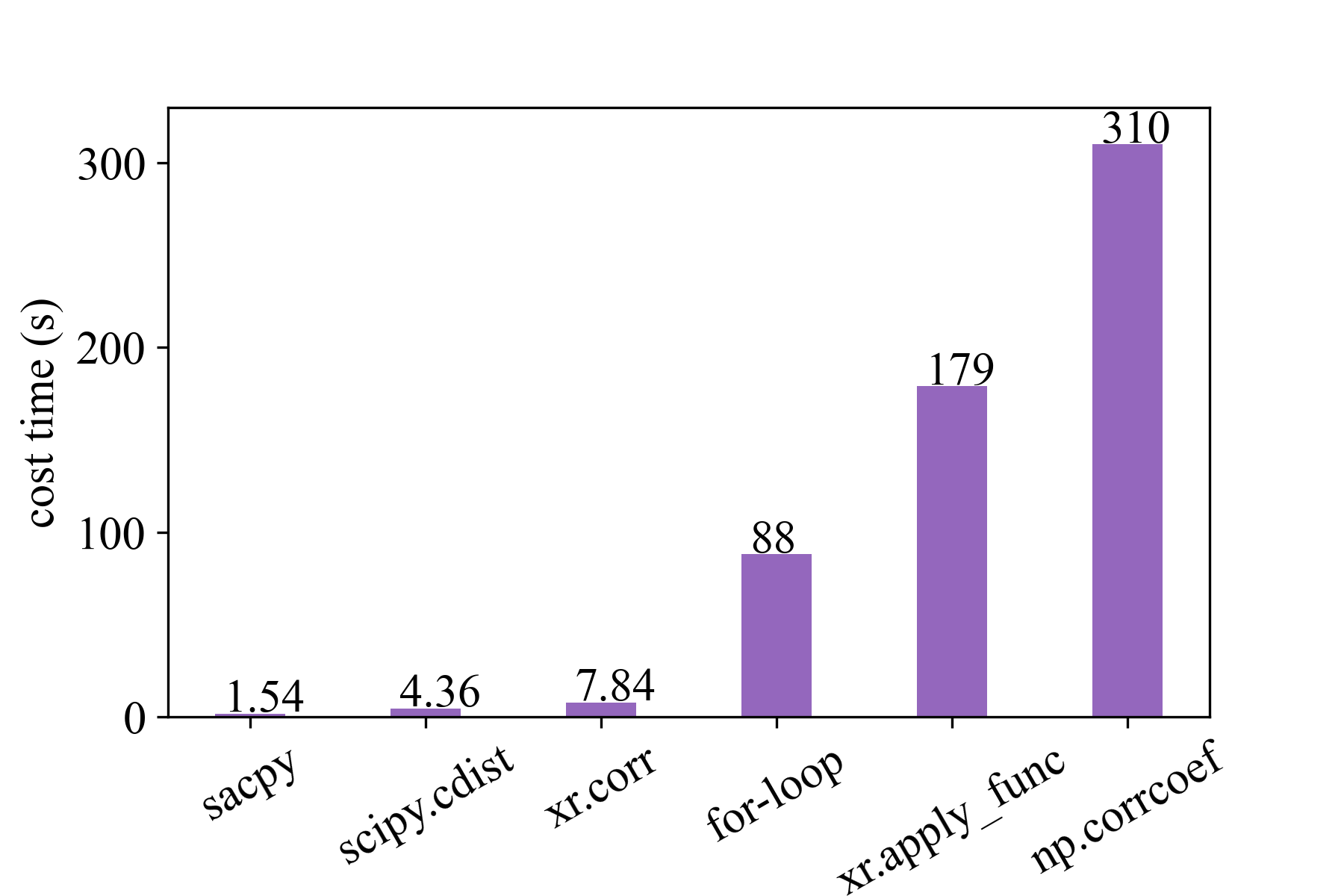
As a comparison, we use the corr function in the xarray library, corrcoef function in numpy library, cdist in scipy, apply_func in xarray and for-loop. The time required to calculate the correlation coefficient between SSTA and nino3.4 for 50 times is shown in the figure below.
It can be seen that we are four times faster than scipy cdist, five times faster than xarray.corr, 60 times faster than forloop, 110 times faster than xr.apply_func and 200 times faster than numpy.corrcoef.
Moreover, xarray and numpy can not return the p value. We can simply check the pvalue attribute of sacpy to get the p value.
All in all, if we want to get p-value and correlation or slope, we only to choose Sacpy is 60 times faster than before.
Example
example1
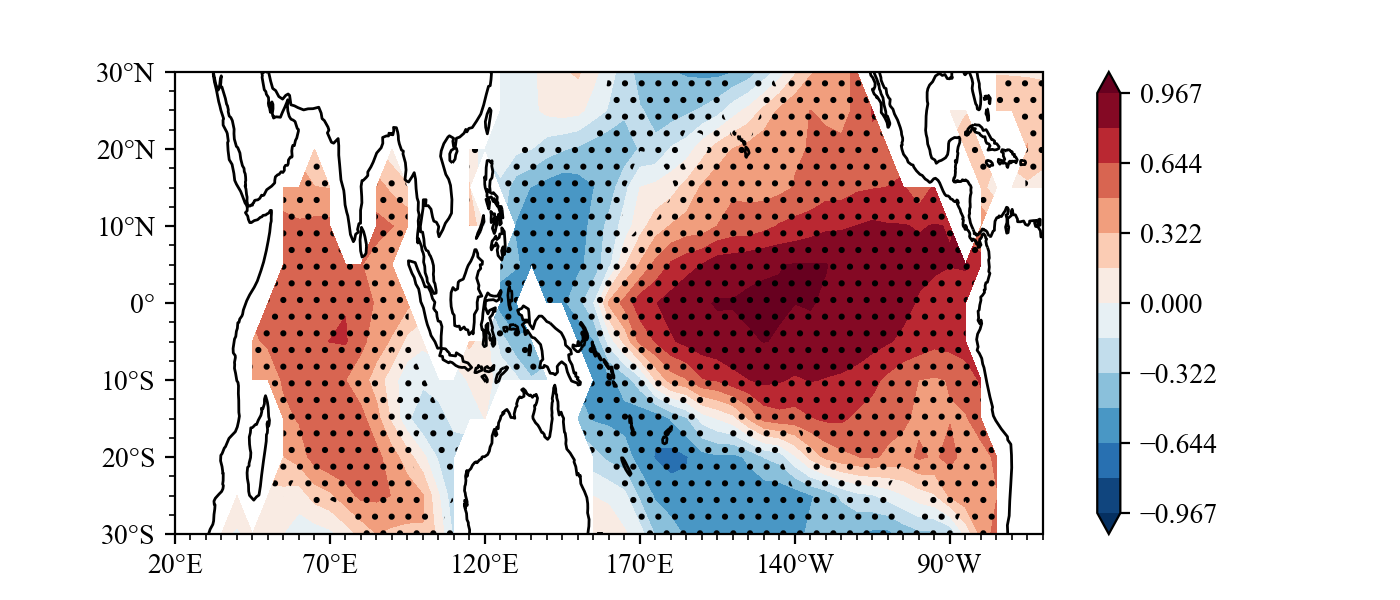
Calculate the correlation between SST and nino3.4 index
import numpy as np
import scapy as scp
import matplotlib.pyplot as plt


# load sst
sst = scp.load_sst()['sst']
# get ssta (method=1, Remove linear trend;method=0, Minus multi-year average)
ssta = scp.get_anom(sst,method=1)
# calculate Nino3.4
Nino34 = ssta.loc[:,-5:5,190:240].mean(axis=(1,2))
# regression
linreg = scp.LinReg(np.array(Nino34),np.array(ssta))
# plot
plt.contourf(linreg.corr)
# Significance test
plt.contourf(linreg.p_value,levels=[0, 0.05, 1],zorder=1,
            hatches=['..', None],colors="None",)
# save
plt.savefig("./nino34.png")
Result(For a detailed drawing process, see example):
example2
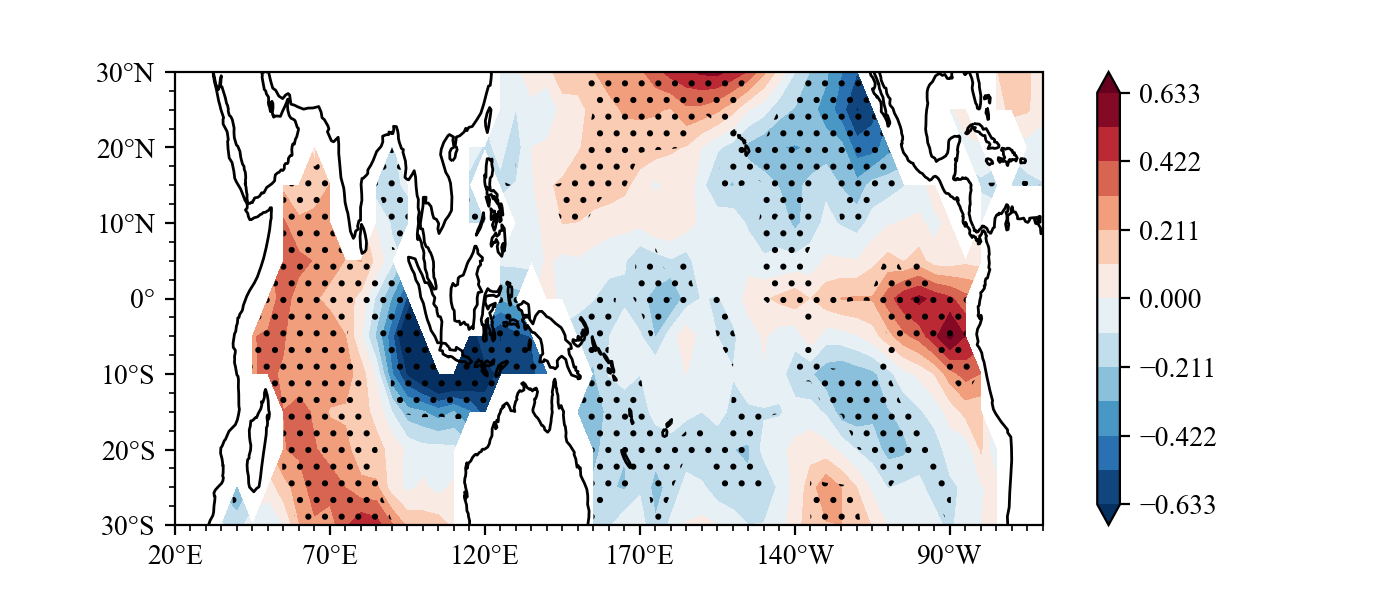
multiple linear regression on Nino3.4 IOD Index and ssta pattern
import numpy as np
import scapy as scp
import matplotlib.pyplot as plt


# load sst
sst = scp.load_sst()['sst']
# get ssta (method=1, Remove linear trend;method=0, Minus multi-year average)
ssta = scp.get_anom(sst,method=1)
# calculate Nino3.4
Nino34 = ssta.loc[:,-5:5,190:240].mean(axis=(1,2))
# calculate IODIdex
IODW = ssta.loc[:,-10:10,50:70].mean(axis=(1,2))
IODE = ssta.loc[:,-10:0,90:110].mean(axis=(1,2))
IODI = +IODW - IODE
# get x
X = np.vstack([np.array(Nino34),np.array(IODI)]).T
# multiple linear regression
MLR = scp.MultLinReg(X,np.array(ssta))
# plot IOD's effect
plt.contourf(MLR.slope[1])
# Significance test
plt.contourf(MLR.pv_i[1],levels=[0, 0.1, 1],zorder=1,
            hatches=['..', None],colors="None",)
plt.savefig("../pic/MLR.png")
Result(For a detailed drawing process, see example):
example3
What effect will ENSO have on the sea surface temperature in the next summer?
import numpy as np
import sacpy as scp
import matplotlib.pyplot as plt
import xarray as xr

# load sst
sst = scp.load_sst()['sst']
ssta = scp.get_anom(sst)

# calculate Nino3.4
Nino34 = ssta.loc[:,-5:5,190:240].mean(axis=(1,2))

# get DJF mean Nino3.4
DJF_nino34 = scp.XrTools.spec_moth_yrmean(Nino34,[12,1,2])

# get JJA mean ssta
JJA_ssta = scp.XrTools.spec_moth_yrmean(ssta, [6,7,8])

# regression
reg = scp.LinReg(np.array(DJF_nino34)[:-1], np.array(JJA_ssta))
# plot
plt.contourf(reg.corr)
# Significance test
plt.contourf(reg.p_value,levels=[0, 0.05, 1],zorder=1,
            hatches=['..', None],colors="None",)
# save
plt.savefig("./ENSO_Next_year_JJA.png",dpi=300)
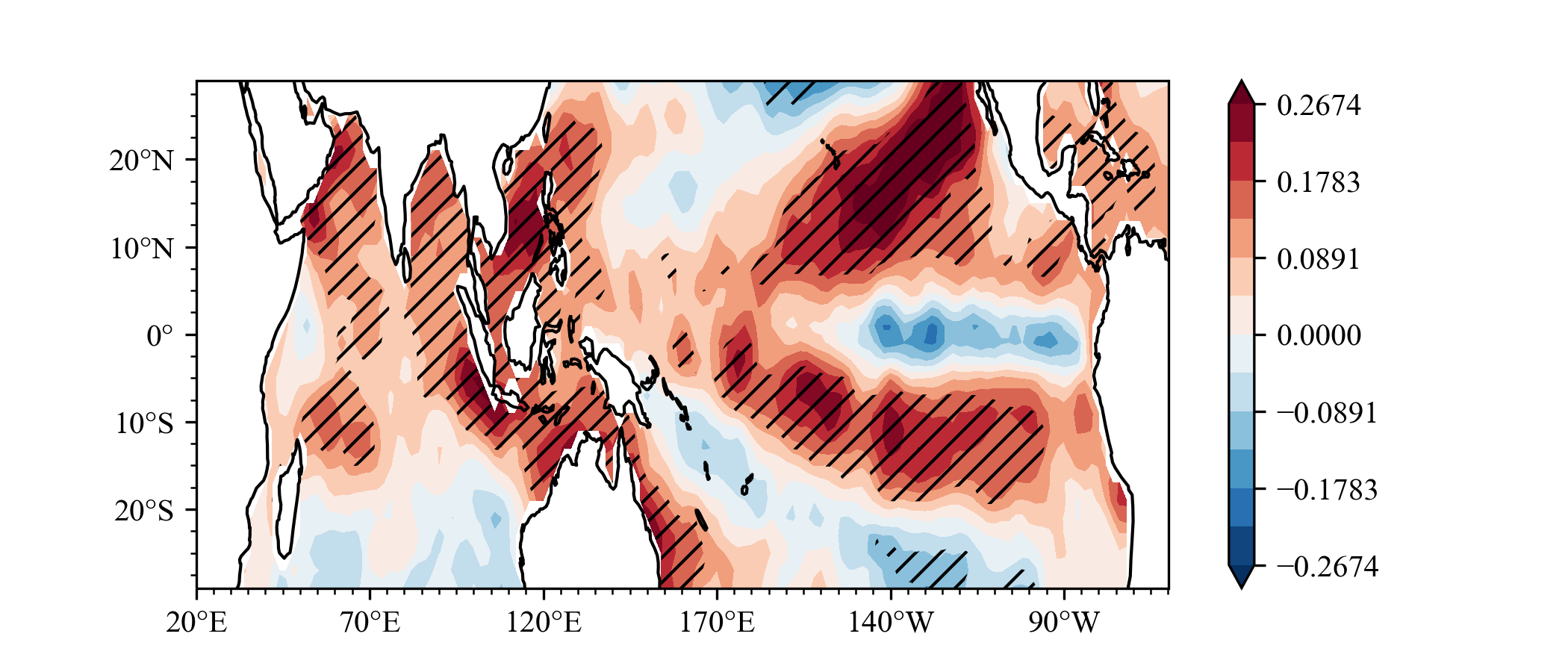
Same as Indian Ocean Capacitor Effect on Indo–Western Pacific Climate during the Summer following El Niño (Xie et al.), the El Nino will lead to Indian ocean warming in next year JJA.
example4
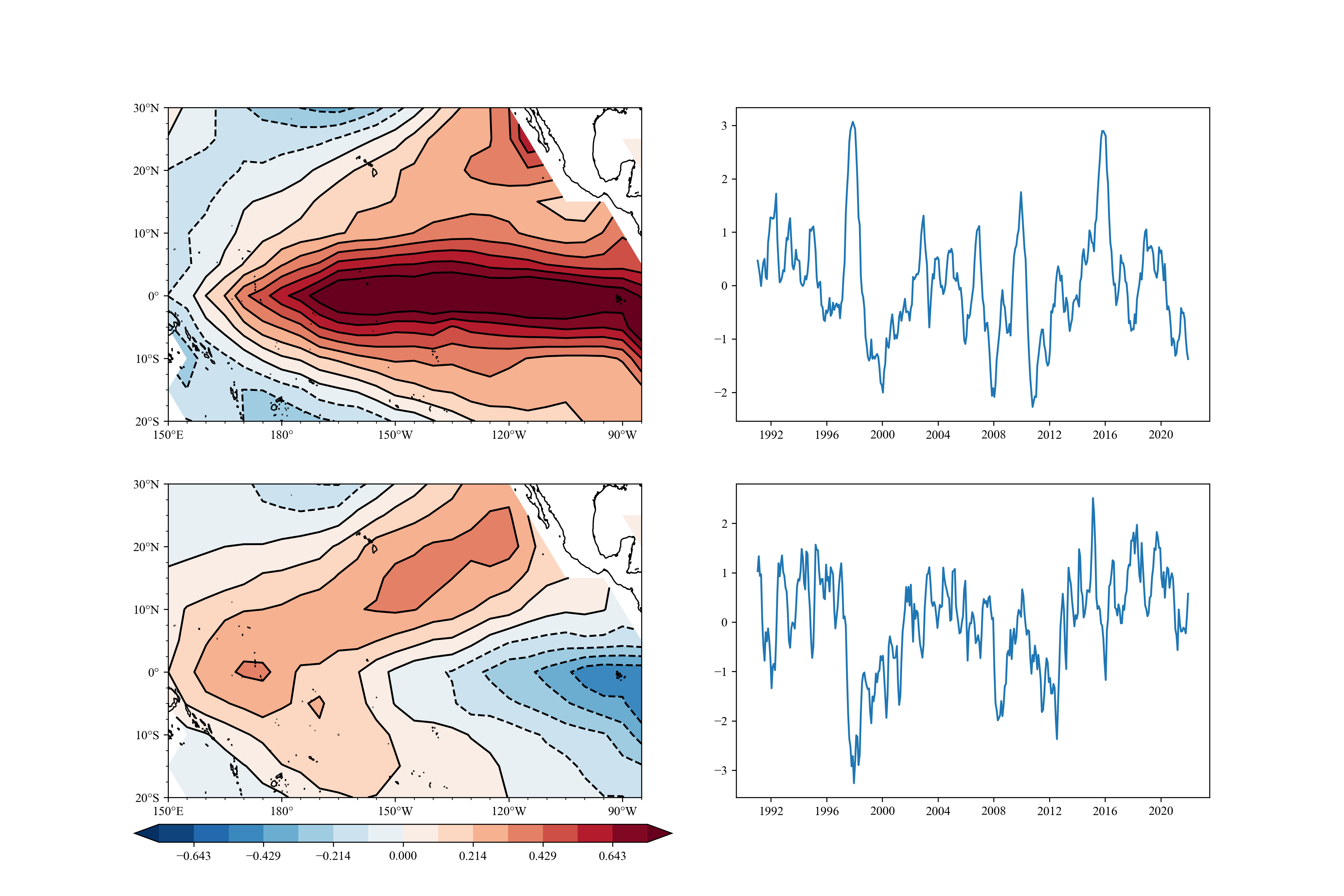
EOF analysis
import sacpy as scp
import numpy as np
import matplotlib.pyplot as plt
# get data
sst = scp.load_sst()["sst"].loc[:, -20:30, 150:275]
ssta = scp.get_anom(sst)
# EOF
eof = scp.EOF(np.array(ssta))
eof.solve()
# get spartial pattern and pc
pc = eof.get_pc(npt=2)
pt = eof.get_pt(npt=2)
# plot
plt.figure(figsize=[12,10])
plt.subplot(221)
plt.contourf(pt[0,:,:])
plt.colorbar()
plt.subplot(222)
plt.plot(sst.time,pc[0])
plt.subplot(223)
plt.contourf(pt[1,:,:])
plt.colorbar()
plt.subplot(224)
plt.plot(sst.time,pc[1])
plt.savefig("../pic/eof_ana.png",dpi=300)
Acknowledgements
Thank Prof. Feng Zhu (NUIST,https://github.com/fzhu2e) for his guidance of this project
Change Log
version 0.0.1
Nothing!
version 0.0.5
First official edition
version 0.0.6
Updated the speed test and changed small errors
version 0.0.7
Add examples and change README.md
version 0.0.9
Add mult_corr,partial_corr in LinReg.py and spec_moth_dat, spec_moth_yrmean in XrTools.
Change examples.
version 0.0.10
Add EOF analysis
Release history Release notifications | RSS feed


Download files
Download the file for your platform. If you're not sure which to choose, learn more about installing packages.
Source Distribution
Built Distribution
Filter files by name, interpreter, ABI, and platform.
If you're not sure about the file name format, learn more about wheel file names.
Copy a direct link to the current filters
File details
Details for the file sacpy-0.0.10.tar.gz.
File metadata
- Download URL: sacpy-0.0.10.tar.gz
- Upload date:
- Size: 9.7 MB
- Tags: Source
- Uploaded using Trusted Publishing? No
- Uploaded via: twine/4.0.0 CPython/3.9.12
File hashes
| Algorithm | Hash digest | |
|---|---|---|
| SHA256 |
6bc5f7dc31913ffca4099ba244658aaf48c846eccf8d7c8f84d477521be5c850
|
|
| MD5 |
660be314bf18aff36cfaaeeb254af90a
|
|
| BLAKE2b-256 |
4891794bb194a53497675df790b0dd4b1707faea891c2449ca21b2b4e984dec1
|
File details
Details for the file sacpy-0.0.10-py3-none-any.whl.
File metadata
- Download URL: sacpy-0.0.10-py3-none-any.whl
- Upload date:
- Size: 9.7 MB
- Tags: Python 3
- Uploaded using Trusted Publishing? No
- Uploaded via: twine/4.0.0 CPython/3.9.12
File hashes
| Algorithm | Hash digest | |
|---|---|---|
| SHA256 |
526f97d05f0bccd8d65d68631f64e0d1d55d53cdce6fca7bd60448fd2a498892
|
|
| MD5 |
c12bdb61909117c61431f7ce73387dda
|
|
| BLAKE2b-256 |
84654b64b713c2020c95fc08dfa4bb86b7a6b413a1b1270f381ece14256300f8
|






