
Simple Annotation Framework

Project description
Simple Annotation Framework (SAF)
The Simple Annotation Framework (SAF) is a lightweight Python library for annotating text data. It provides a simple and flexible way to create, manipulate, and export annotations in various formats.
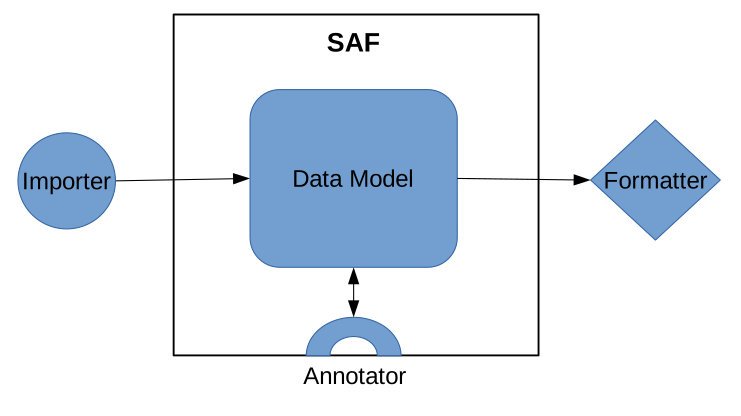
SAF is built upon a minimalistic data model, accessible through its API. This data model is flexible enough to be used by most types of linguistic annotation, and can store other types of data associated to the language items (e.g., statistics, data sources, schemas, etc.)

Installation
To install SAF, you can use pip:
pip install saf
Usage
Importing Text Data
SAF provides importers for different annotated text data formats, including plain text, ConLL and WebAnno.
Plain text
from saf.importers.plain import PlainTextImporter
from saf.constants import annotation
from nltk.tokenize import sent_tokenize, word_tokenize

plain_doc = """
They buy and sell books.
I have no clue.
"""

# Import document
plain_importer = PlainTextImporter(sent_tokenize, word_tokenize)
doc = plain_importer.import_document(plain_doc)

print(len(doc.sentences))  # Number of sentences in the document.
print([tok.surface for tok in doc.sentences[1].tokens])  # Listing tokens for the second sentence in the document.
ConLL
from saf import Document
from saf.constants import annotation
from saf.importers.conll import CoNLLImporter

conll_doc = """
# sent_id = 1
# text = They buy and sell books.
1   They     they    PRON    PRP    Case=Nom|Number=Plur               2   nsubj   2:nsubj|4:nsubj   _
2   buy      buy     VERB    VBP    Number=Plur|Person=3|Tense=Pres    0   root    0:root            _
3   and      and     CCONJ   CC     _                                  4   cc      4:cc              _
4   sell     sell    VERB    VBP    Number=Plur|Person=3|Tense=Pres    2   conj    0:root|2:conj     _
5   books    book    NOUN    NNS    Number=Plur                        2   obj     2:obj|4:obj       SpaceAfter=No
6   .        .       PUNCT   .      _                                  2   punct   2:punct           _

# sent_id = 2
# text = I have no clue.
1   I       I       PRON    PRP   Case=Nom|Number=Sing|Person=1     2   nsubj   _   _
2   have    have    VERB    VBP   Number=Sing|Person=1|Tense=Pres   0   root    _   _
3   no      no      DET     DT    PronType=Neg                      4   det     _   _
4   clue    clue    NOUN    NN    Number=Sing                       2   obj     _   SpaceAfter=No
5   .       .       PUNCT   .     _                                 2   punct   _   _
"""

conll_importer = CoNLLImporter(field_list=[annotation.LEMMA, annotation.UPOS, annotation.POS])
doc = conll_importer.import_document(conll_doc)

print(len(doc.sentences))  # Number of sentences in the document.
print(doc.sentences[0].surface)  # Surface form of the first sentence in the document.
print([tok.annotations[annotation.UPOS] for tok in doc.sentences[1].tokens]) # All universal POS tags from the second sentence.
Annotating Text Data
The saf_datasets library provides various annotated NLP datasets and facilities for automated annotation of your own data.
Exporting Annotated Text Data
SAF provides formatters for different annotation formats:
ConLL
from saf.importers.plain import PlainTextImporter
from saf.constants import annotation
from nltk.tokenize import sent_tokenize, word_tokenize
from saf.formatters.conll import CoNLLFormatter

plain_doc = """
They buy and sell books.
I have no clue.
"""

# Import document
plain_importer = PlainTextImporter(sent_tokenize, word_tokenize)
doc = plain_importer.import_document(plain_doc)

# Annotate tokens
for sent in doc.sentences:
    for i, token in enumerate(sent.tokens):
        token.annotations[annotation.ID] = str(i)

conll_formatter = CoNLLFormatter(field_list=[annotation.ID])
conll_formatted_doc = conll_formatter.dumps(doc)

print(conll_formatted_doc)
Working with vocabularies
Vocabulary objects can be used to quickly index and manage symbols in documents or sentence collections. They facilitate vectorization for language model training, specially with label supervision.
from saf import Document
from saf.constants import annotation
from saf.importers.conll import CoNLLImporter
from saf import Vocabulary

conll_doc = """
# sent_id = 1
# text = They buy and sell books.
1   They     they    PRON    PRP    Case=Nom|Number=Plur               2   nsubj   2:nsubj|4:nsubj   _
2   buy      buy     VERB    VBP    Number=Plur|Person=3|Tense=Pres    0   root    0:root            _
3   and      and     CCONJ   CC     _                                  4   cc      4:cc              _
4   sell     sell    VERB    VBP    Number=Plur|Person=3|Tense=Pres    2   conj    0:root|2:conj     _
5   books    book    NOUN    NNS    Number=Plur                        2   obj     2:obj|4:obj       SpaceAfter=No
6   .        .       PUNCT   .      _                                  2   punct   2:punct           _

# sent_id = 2
# text = I have no clue.
1   I       I       PRON    PRP   Case=Nom|Number=Sing|Person=1     2   nsubj   _   _
2   have    have    VERB    VBP   Number=Sing|Person=1|Tense=Pres   0   root    _   _
3   no      no      DET     DT    PronType=Neg                      4   det     _   _
4   clue    clue    NOUN    NN    Number=Sing                       2   obj     _   SpaceAfter=No
5   .       .       PUNCT   .     _                                 2   punct   _   _
"""

conll_importer = CoNLLImporter(field_list=[annotation.LEMMA, annotation.UPOS, annotation.POS])
doc = conll_importer.import_document(conll_doc)

token_vocab = Vocabulary(doc.sentences, lowercase=False)
upos_vocab = Vocabulary(doc.sentences, source="UPOS", lowercase=False)

# Converting sentences to indices for both tokens and annotations
print(token_vocab.to_indices(doc.sentences))
# [[2, 5, 3, 9, 4, 0], [1, 7, 8, 6, 0]]

print(upos_vocab.to_indices(doc.sentences))
# [[3, 5, 0, 5, 2, 4], [3, 5, 1, 2, 4]]

# Retrieving tokens and annotations from indices
token_vocab.get_symbol(4)
# books

upos_vocab.get_symbol(2)
# NOUN
License
This project is licensed under the GNU General Public License Version 3 - see the LICENSE file for details.


Download files
Download the file for your platform. If you're not sure which to choose, learn more about installing packages.
Source Distribution
Built Distribution
Filter files by name, interpreter, ABI, and platform.
If you're not sure about the file name format, learn more about wheel file names.
Copy a direct link to the current filters
File details
Details for the file saf_nlp-0.5.5.tar.gz.
File metadata
- Download URL: saf_nlp-0.5.5.tar.gz
- Upload date:
- Size: 28.2 kB
- Tags: Source
- Uploaded using Trusted Publishing? No
- Uploaded via: twine/5.0.0 CPython/3.11.5
File hashes
| Algorithm | Hash digest | |
|---|---|---|
| SHA256 |
5bafe21d8f0624badad87b98499336d8094f1a1d8f54b5e885db123767cdc69b
|
|
| MD5 |
c3c1ac08688fceeb4da57b112bc98cfe
|
|
| BLAKE2b-256 |
d9b070697b1b876df69fae7ca34050b97fc38a4669b8553f07049204cfff3fc5
|
File details
Details for the file saf_nlp-0.5.5-py3-none-any.whl.
File metadata
- Download URL: saf_nlp-0.5.5-py3-none-any.whl
- Upload date:
- Size: 35.3 kB
- Tags: Python 3
- Uploaded using Trusted Publishing? No
- Uploaded via: twine/5.0.0 CPython/3.11.5
File hashes
| Algorithm | Hash digest | |
|---|---|---|
| SHA256 |
66cd6b255e599d5a48435342323444d06d64f07976b6613f943133f2c40b8cb0
|
|
| MD5 |
44199e3642906b0fea433deaa7ca24aa
|
|
| BLAKE2b-256 |
2d0881f88ab46e540b24ebd7b7f7151bc206733ed560a0d28c1c14e0792a8ea9
|






