
SafeAgentDB
The Shadow-Sandbox DB Layer for AI Agents
Let AI modify your production database. Without the terror.





Production DB                     In-Memory SQLite Sandbox
      |                                     |
      |--- clone tenant rows -------------->|
      |                                     |--- AI operates freely (CRUD)
      |                                     |--- Pydantic validates every row
      |                                     |--- Rich diff shows what changed
      |<-- atomic sync (on approval) -------|
      |                                     |--- sandbox destroyed
The Problem
You are building AI-powered features. An agent that manages tasks. A copilot that updates billing. An assistant that edits user profiles. Your AI needs write access to the database.
Two things keep you up at night:
| Nightmare | What Happens |
|---|---|
| AI Logical Error | The LLM writes status = 'yolo_swag' instead of 'done'. Or sets balance = -99999. Without a safety net, it goes straight to production. |
| Multi-Tenancy Breach | Your agent operates for User 42 but accidentally touches User 99's rows. One wrong WHERE clause = data breach. |
SafeAgentDB eliminates both. Every AI write is sandboxed, validated, diffed, tenant-scoped, and synced atomically -- or not at all.
The 6 Safety Gates
Every call to commit_to_production() passes through 6 sequential gates. If any gate fails, the entire transaction rolls back. Nothing touches production.
Gate 1: TENANT ISOLATION AT CLONE
  Only rows matching your tenant_id are copied into the sandbox.
  Other tenants' data never enters memory. Ever.

Gate 2: ROW-LEVEL DIFFING
  Every change is computed as an explicit INSERT / UPDATE / DELETE
  with before/after values, keyed on the primary key or your row_key.
  A table whose rows cannot be identified is refused outright.

Gate 3: PYDANTIC RE-VALIDATION
  Every row is validated against your SafeModel schema.
  Strict mode. No type coercion. Bad data = instant rejection.

Gate 4: ROW KEY + TENANT WHERE CLAUSE
  Every UPDATE/DELETE statement carries WHERE <row key> AND tenant_id = ?
  A statement that would match rows by tenant alone is refused, not run.

Gate 5: COMPARE AND SWAP
  The clone-time values are part of the WHERE clause, so checking and
  writing are a single statement with no window between them. If another
  process changed the row first, the statement matches nothing and you
  get a ConflictError naming the drifted columns -- not a silent overwrite.

Gate 6: ATOMIC SYNC
  The entire changeset executes in ONE transaction, in a deterministic
  row order, writing only the columns the agent actually changed.
See Guarantees and limits for what these gates deliberately do not cover.
Getting Started
1. Install
pip install safeagentdb
With database drivers:
pip install safeagentdb[pg]      # PostgreSQL
pip install safeagentdb[mysql]   # MySQL / MariaDB
2. Define Your Schema Validator
Create a SafeModel subclass for each table an AI agent can write to. This is your contract -- any row that violates it will be rejected before it touches production.
from typing import Literal
from safeagentdb import SafeModel

class TaskValidator(SafeModel):
    __table_name__ = "tasks"      # links this validator to the "tasks" table

    id: int
    user_id: int
    title: str
    status: Literal["todo", "in_progress", "done"]  # AI can ONLY write these values
SafeModel inherits from Pydantic BaseModel with strict=True and extra="forbid". No silent type coercion. No extra fields sneaking through.
3. Sandbox the AI Agent
from sqlalchemy import create_engine
from safeagentdb import ShadowDB

engine = create_engine("postgresql://user:pass@localhost/mydb")

with ShadowDB(engine, tables=["tasks"], tenant_id=42) as sandbox:
    # The AI does whatever it wants -- all writes stay in the sandbox
    sandbox.execute("UPDATE tasks SET status = 'done' WHERE id = 1")
    sandbox.execute(
        "INSERT INTO tasks (id, user_id, title, status) "
        "VALUES (100, 42, 'AI-generated task', 'todo')"
    )

    # Review: see exactly what changed, with validation status
    sandbox.diff().print()

    # Approve: sync to production in a single atomic transaction
    sandbox.commit_to_production()
4. Review the Diff
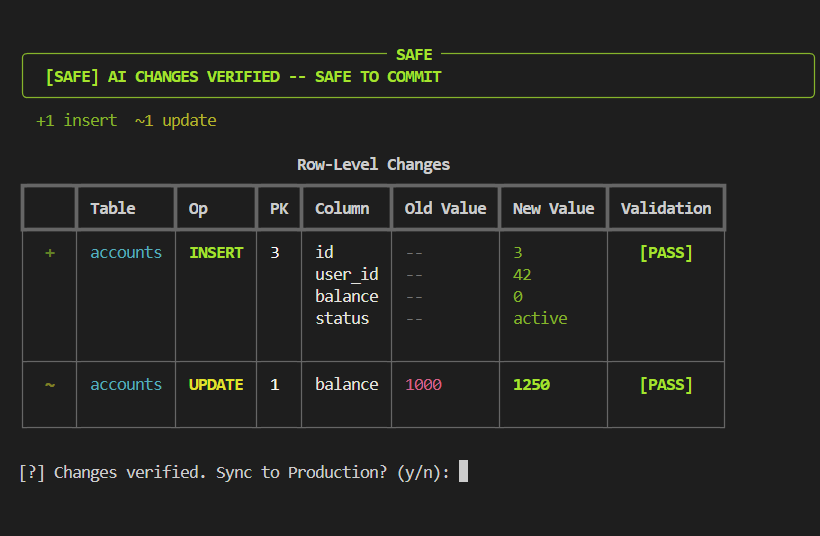
sandbox.diff().print() renders a color-coded Rich dashboard:
+------------------------------------- SAFE --------------------------------------+
|  [SAFE] AI CHANGES VERIFIED -- SAFE TO COMMIT                                   |
+---------------------------------------------------------------------------------+
  +1 insert  ~1 update

                                 Row-Level Changes
+---------------------------------------------------------------------------------+
|     | Table | Op     | PK  | Column  | Old Value | New Value         | Valid.   |
|-----+-------+--------+-----+---------+-----------+-------------------+----------|
|  +  | tasks | INSERT | 100 | id      | --        | 100               | [PASS]   |
|     |       |        |     | user_id | --        | 42                |          |
|     |       |        |     | title   | --        | AI-generated task |          |
|     |       |        |     | status  | --        | todo              |          |
|     |       |        |     |         |           |                   |          |
|-----+-------+--------+-----+---------+-----------+-------------------+----------|
|  ~  | tasks | UPDATE | 1   | status  | todo      | done              | [PASS]   |
|     |       |        |     |         |           |                   |          |
+---------------------------------------------------------------------------------+
  >> ALL VALIDATIONS PASSED
Color coding: INSERT = green, UPDATE = yellow, DELETE = red. Validation badges: [PASS] green, [FAIL] red.
Non-TTY safe: When piped to a file or running in CI, display() automatically falls back to clean plain text with zero ANSI escape codes.
5. Handle Validation Failures
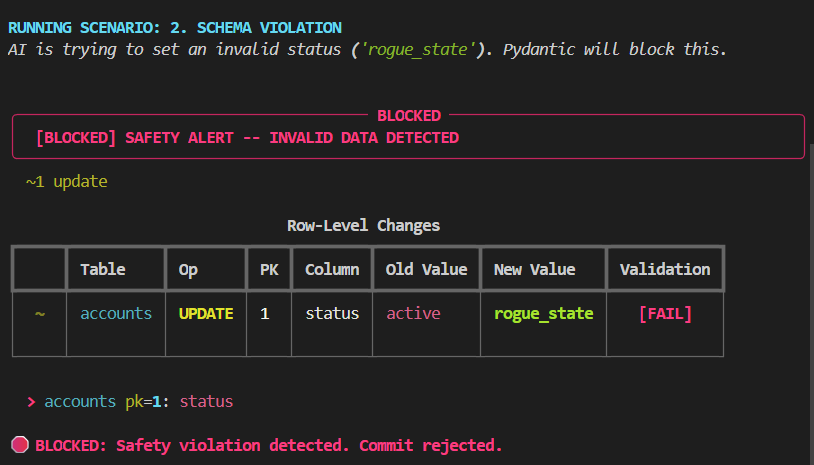
When the AI writes bad data, SafeAgentDB blocks the sync before anything touches production:
with ShadowDB(engine, tables=["tasks"], tenant_id=42) as sandbox:
    sandbox.execute("UPDATE tasks SET status = 'yolo_swag' WHERE id = 1")

    changeset = sandbox.diff()
    changeset.print()     # Shows [BLOCKED] banner with [FAIL] badge

    if not changeset.is_valid:
        print("AI output rejected. Production untouched.")
    else:
        sandbox.commit_to_production()
The [BLOCKED] banner appears:
API Reference
ShadowDB
The core context manager. Creates an isolated sandbox from your production database.
ShadowDB(
    prod_engine: Engine,            # Any SQLAlchemy engine (Postgres, MySQL, SQLite, ...)
    tables: Sequence[str],          # Table names to clone into the sandbox
    tenant_id: Any,                 # The tenant/user ID to scope all operations to
    tenant_column: str = "user_id", # Column name used for tenant filtering
    *,
    row_key: dict[str, list[str]] | None = None,   # Explicit row key per table
    reference_tables: Sequence[str] | None = None, # Shared lookup tables, cloned in full
    on_conflict: "abort" | "ignore" = "abort",     # What to do on production drift
    require_validators: bool = True,               # Missing SafeModel: error or warning
)
Keyword options:
| Option | Default | What it does |
|---|---|---|
row_key |
None |
Explicit row-identifying columns per table, e.g. {"events": ["tenant_id", "event_uuid"]}. Required for a table with no primary key, and usable to override one. The columns must exist and must be unique across the cloned rows, or SchemaError is raised. |
reference_tables |
None |
Tables to clone in full, ignoring the tenant filter. Use it for shared lookup tables (statuses, currencies, plans) so that foreign keys pointing at them are enforced in the sandbox. See Reference tables. |
on_conflict |
"abort" |
"abort" raises ConflictError when a production row changed between clone and commit, rolling the whole changeset back. "ignore" applies the changeset in part: it skips the drifted row, applies the rest, records each skip in skipped_conflicts and raises a ConflictWarning per skipped row. |
require_validators |
True |
True: a table with no registered SafeModel is a failed row in diff() and a MissingValidatorError at commit. False: a warning in both places, and the row is written unvalidated. |
Tables must have an identifiable row. A table with no primary key and no
row_keyraisesSchemaErrorat__enter__. Without a key, SafeAgentDB cannot tell two rows apart, and anyUPDATEit built would match every row the tenant owns.
Generated keys
A serial or identity primary key is filled by a sequence that lives in
production. SQLite has no equivalent, so the sandbox fills the column with a
placeholder and the diff says so rather than showing an id that will not
survive:
 + | tasks | INSERT | pending | id      | -- | (assigned by production)
   |       |        |         | user_id | -- | 42
   |       |        |         | title   | -- | Ship v3
At commit the column is left out of the INSERT, production's sequence assigns
the real key, and it is read back and reported:
with ShadowDB(prod_engine, tables=["tasks"], tenant_id=42) as sandbox:
    sandbox.execute("INSERT INTO tasks (user_id, title) VALUES (42, 'Ship v3')")
    sandbox.commit_to_production()

    for key in sandbox.assigned_keys:
        print(key.table, key.provisional, "->", key.assigned)
        # tasks {'id': 4503599627370497} -> {'id': 901}
Two things are still refused, with GeneratedValueError:
- The agent supplying the key itself. That bypasses the sequence, so a later ordinary insert can collide with it.
- A new row referencing another new row's placeholder. The parent's real key is only known once it is written, and SafeAgentDB will not guess it. Insert the parent through the application first, then let the agent reference its real key.
A generated non-key column (a gen_random_uuid() default, say) is refused
only when the agent leaves it empty; supplying a value is fine.
Reference tables
The clone is tenant-scoped, so a shared lookup table with no tenant column
clones zero rows. A foreign key pointing at it could never be satisfied, so
SafeAgentDB drops that constraint in the sandbox and says so in
unsupported_constraints:
tasks: FOREIGN KEY (status_id) -> statuses not enforced -- the parent table
cloned 0 rows, so every reference would look dangling. If statuses holds no
tenant data, pass reference_tables=['statuses'] to clone it in full.
Listing the table restores the constraint:
with ShadowDB(
    prod_engine,
    tables=["tasks"],
    tenant_id=42,
    reference_tables=["statuses"],       # cloned in full, tenant filter ignored
) as sandbox:
    ...
Two things to know before you list a table:
- Every row becomes visible to the agent. Only list tables whose whole contents any tenant may see. A table holding tenant data must never be listed.
- They are read-only. Reference tables are excluded from the changeset, and
modifying one raises
SyncErrorfromdiff()rather than failing later.
Context Manager Lifecycle:
| Phase | What Happens |
|---|---|
__enter__ |
1. Reflects schema from production. 2. Creates an in-memory SQLite sandbox with foreign keys enforced, carrying constraints, unique indexes and column defaults across. 3. Resolves a row key per table, raising SchemaError if one is missing. 4. Clones only rows where tenant_column = tenant_id. 5. Snapshots the cloned state for later diffing. 6. Opens a SQLAlchemy Session. |
inside with |
AI operates freely on the sandbox via execute(), query(), or session. |
__exit__ |
Session closed. Sandbox engine disposed. All in-memory data destroyed. |
Methods:
| Method | Signature | Description |
|---|---|---|
execute |
(sql: str, params: dict | None) -> CursorResult |
Execute raw SQL inside the sandbox. Wraps the string in text() automatically so AI agents do not need to import it. Returns a standard SQLAlchemy CursorResult. |
query |
(sql: str, params: dict | None) -> list[dict] |
Execute a SELECT and return results as a list of plain dictionaries. Convenience method for AI agents that work with JSON-like data. |
diff |
() -> ChangeSet |
Flushes pending changes, snapshots the current sandbox state, and computes a row-level diff against the original clone. Returns a ChangeSet object. |
commit_to_production |
() -> int |
Runs all 6 safety gates and syncs approved changes to production in one atomic transaction, writing only the columns the agent changed. Returns the number of rows actually written, summed from each statement's rowcount. Raises ConflictError on production drift, GeneratedValueError when a row needs a value only production can generate, IntegrityViolationError when production rejects a row the sandbox accepted, SyncError on tenant breach or a missing row key, MissingValidatorError when a table has no SafeModel, pydantic.ValidationError on schema violations. Can only be called once per sandbox (double-commit raises SyncError). |
Properties:
| Property | Type | Description |
|---|---|---|
clone_stats |
dict[str, int] |
Number of rows cloned per table when the sandbox was created. |
tables |
list[str] |
Table names available in this sandbox. |
dialect |
str |
Production database dialect name ('postgresql', 'mysql', 'sqlite'). |
row_keys |
dict[str, list[str]] |
The row-identifying columns in use for each cloned table. |
reference_table_names |
list[str] |
Tables cloned in full and treated as read-only. |
generated_columns |
dict[str, list[str]] |
Columns whose production-side generated default the sandbox could not reproduce. |
provisional_key_columns |
dict[str, list[str]] |
Key columns the sandbox fills with a placeholder for production to replace. See Generated keys. |
assigned_keys |
list[AssignedKey] |
For the last commit, the real keys production assigned to rows that held a placeholder. |
skipped_conflicts |
list[SkippedConflict] |
Rows the last commit left unapplied under on_conflict="ignore". Empty otherwise. |
unsupported_constraints |
list[str] |
Schema elements that could not be reproduced in the sandbox, and are therefore not enforced there. See below. |
session |
Session |
Raw SQLAlchemy Session for ORM-style operations if needed. |
unsupported_constraints
The sandbox is SQLite; production usually is not. Anything that could not be
carried across is listed here rather than dropped silently, and is rendered in
both the Rich and plain diff output under a NOT ENFORCED IN SANDBOX heading:
with ShadowDB(prod_engine, tables=["users"], tenant_id=42) as sandbox:
    for item in sandbox.unsupported_constraints:
        print(item)
    # users.prefs: JSONB stored as TEXT in the sandbox; values valid here may
    #   still be rejected by production
    # users.code: server default "gen_random_uuid()" has no SQLite equivalent
A violation of anything on this list will not be caught by diff(). It surfaces
only when production rejects the commit.
SafeModel
Pydantic v2 base model for defining table schemas. Subclass it and set __table_name__ to auto-register a validator.
class SafeModel(BaseModel):
    model_config = ConfigDict(strict=True, extra="forbid")
    __table_name__: ClassVar[str] = ""
| Feature | Behavior |
|---|---|
strict=True |
No silent type coercion. An int field rejects "42" (a string). |
extra="forbid" |
Any column not in the model raises a validation error. |
__table_name__ |
Setting this on a subclass auto-registers it in the global validator registry. |
| Auto-registration | Happens at class definition time via __init_subclass__. No manual wiring needed. |
Helper functions (importable from safeagentdb.models):
| Function | Description |
|---|---|
get_validator(table_name) |
Returns the SafeModel subclass registered for a table, or None. |
validate_row(table_name, row_data, *, require_validator=True) |
Validates a dict against the registered model. With require_validator=True (the default) a missing validator raises MissingValidatorError; with False it warns and returns None. Raises ValidationError on bad data. |
missing_validator_message(table_name) |
The single wording used by both RowDiff.validate() and validate_row(), so the dashboard and the commit can never disagree. |
ChangeSet
Returned by sandbox.diff(). Contains the full set of row-level changes.
| Member | Type | Description |
|---|---|---|
diffs |
list[RowDiff] |
Raw list of individual row changes. |
is_empty |
bool |
True if the AI made no changes. |
is_valid |
bool |
True if every row passes Pydantic validation. With require_validators=True, a table with no registered SafeModel makes this False. Check it before calling commit_to_production(). |
unsupported_constraints |
list[str] |
Schema elements not enforced in the sandbox, carried through from ShadowDB so the rendered diff can warn about them. |
summary |
dict[str, int] |
{"INSERT": n, "UPDATE": n, "DELETE": n} |
print() |
-> None |
Renders the Rich color-coded dashboard directly to the terminal. |
display() |
-> str |
Returns the diff as a printable string. Auto-detects TTY: Rich ANSI in terminals, plain ASCII in pipes/CI. |
validate_all() |
-> list[tuple[RowDiff, bool, str]] |
Returns per-row validation results: (diff, is_valid, message). |
RowDiff
A single row-level change.
| Field | Type | Description |
|---|---|---|
table |
str |
Table name. |
diff_type |
DiffType |
DiffType.INSERT, DiffType.UPDATE, or DiffType.DELETE. |
pk |
dict[str, Any] |
Row key values identifying the row: the primary key, or the row_key you supplied. |
old |
dict | None |
Row data before the change (None for INSERTs). |
new |
dict | None |
Row data after the change (None for DELETEs). |
changed_columns() |
-> list[str] |
Column names that differ between old and new (UPDATEs only). |
require_validator |
bool |
Whether a missing SafeModel makes this row invalid. Set from ShadowDB(require_validators=...). |
validate() |
-> tuple[bool, str] |
Runs Pydantic validation on this row. Returns (is_valid, message). Treats a missing validator exactly as the commit will. |
Errors
All exceptions live in safeagentdb.errors and are importable from
safeagentdb. Every one derives from SafeAgentDBError, so a whole agent
session can be wrapped in a single except.
SafeAgentDBError
|-- SchemaError                 production schema cannot be sandboxed safely
|-- SyncError                   a changeset was rejected or could not be applied
|   |-- ConflictError           production drifted between clone and commit
|   |-- GeneratedValueError     a row needs a value only production can generate
|   +-- IntegrityViolationError production rejected a row the sandbox accepted
+-- MissingValidatorError       no SafeModel registered and one is required
Every database error raised while applying a changeset is wrapped, so a single
except SafeAgentDBError really does catch everything above. The driver's own
exception is kept as __cause__.
| Exception | Raised when |
|---|---|
SchemaError |
A cloned table has no primary key and no usable row_key; a row_key names missing columns or is not unique in the cloned rows; the production schema cannot be reproduced in SQLite. |
SyncError |
Tenant isolation is breached, an UPDATE/DELETE has no row-identifying key, a row key disagrees with the declared one, a table is missing from production metadata, or the sandbox is committed twice. |
ConflictError |
A production row changed or was deleted between clone and commit, or a row key matches more than one row. Carries .table, .row_key and .columns (the drifted column names). |
GeneratedValueError |
A new row supplies a key production is meant to assign, needs a generated value the sandbox could not hold for it, or references another new row's placeholder key. Carries .table and .columns. See Generated keys. |
IntegrityViolationError |
Production rejected a row the sandbox accepted, most often a UNIQUE collision with a row belonging to another tenant. Carries .table and .row_key, and the driver's IntegrityError as __cause__. |
MissingValidatorError |
A table has no registered SafeModel and require_validators is True. Also subclasses KeyError, so 0.1.x handlers keep working. |
MissingValidatorWarning |
Not an error: warned when require_validators=False and a row is written unvalidated. |
ConflictWarning |
Not an error: warned once per row skipped under on_conflict="ignore". |
Handling a conflict:
from safeagentdb import ConflictError

try:
    sandbox.commit_to_production()
except ConflictError as exc:
    print(f"{exc.table} row {exc.row_key} drifted on {exc.columns}")
    # Nothing was written. Re-clone and let the agent try again.
Partially applying instead, with on_conflict="ignore":
with ShadowDB(engine, tables=["tasks"], tenant_id=42, on_conflict="ignore") as sandbox:
    ...
    written = sandbox.commit_to_production()   # fewer than the changeset held

    for skip in sandbox.skipped_conflicts:     # never silent
        print(f"skipped {skip.table} {skip.row_key}: {skip.columns} drifted")
Each skipped row also raises a ConflictWarning, so a partial apply is visible
even when nobody inspects the result.
DiffType
Enum with three values: INSERT, UPDATE, DELETE.
Advanced Scenarios
Multi-Table Operations
SafeAgentDB supports sandboxing multiple tables at once. Validators are matched by __table_name__:
class UserValidator(SafeModel):
    __table_name__ = "users"
    id: int
    user_id: int
    email: str
    plan: Literal["free", "pro", "enterprise"]

class InvoiceValidator(SafeModel):
    __table_name__ = "invoices"
    id: int
    user_id: int
    amount_cents: int
    status: Literal["pending", "paid", "refunded"]

with ShadowDB(engine, tables=["users", "invoices"], tenant_id=42) as sandbox:
    sandbox.execute("UPDATE users SET plan = 'pro' WHERE id = 1")
    sandbox.execute("UPDATE invoices SET status = 'paid' WHERE id = 1")
    sandbox.diff().print()
    sandbox.commit_to_production()
Programmatic Approval Workflow
Use is_valid and summary to build approval logic without human intervention:
with ShadowDB(engine, tables=["tasks"], tenant_id=42) as sandbox:
    run_ai_agent(sandbox)  # AI does its thing

    changeset = sandbox.diff()

    if changeset.is_empty:
        print("AI made no changes.")
    elif not changeset.is_valid:
        log.error("AI output rejected", extra=changeset.summary)
    elif changeset.summary["DELETE"] > 10:
        log.warning("AI wants to delete too many rows, needs human review")
    else:
        sandbox.commit_to_production()
Tenant Security: What Gets Blocked
SafeAgentDB enforces tenant isolation at three levels:
# Scenario 1: AI tries to INSERT a row for a different tenant
sandbox.execute("INSERT INTO tasks VALUES (99, 777, 'evil', 'todo')")
sandbox.commit_to_production()
# --> SyncError: "Tenant breach blocked on INSERT: row has user_id=777, expected 42."

# Scenario 2: AI tries to UPDATE a row to change its tenant
sandbox.execute("UPDATE tasks SET user_id = 777 WHERE id = 1")
sandbox.commit_to_production()
# --> SyncError: "Tenant breach blocked on UPDATE: row has user_id=777, expected 42."

# Scenario 3: Even if AI could somehow craft a rogue row,
# every UPDATE/DELETE uses: WHERE pk = ? AND user_id = 42
# at the SQL level -- the database itself enforces the scope.
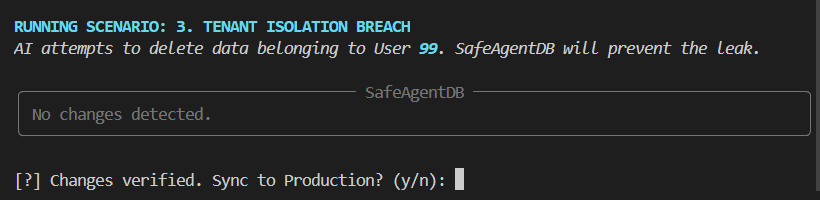
When an AI agent tries to access another tenant's data, the sandbox simply contains no rows for them -- the diff shows nothing changed:
Using the Raw SQLAlchemy Session
For ORM-style access, use sandbox.session directly:
from sqlalchemy import text

with ShadowDB(engine, tables=["tasks"], tenant_id=42) as sandbox:
    result = sandbox.session.execute(text("SELECT count(*) FROM tasks"))
    count = result.scalar()
Supported Databases
SafeAgentDB works with any SQLAlchemy-supported database as the production source. The sandbox is always in-memory SQLite.
| Database | Production | Sandbox | Notes |
|---|---|---|---|
| PostgreSQL | Yes | Auto-mapped | JSONB, UUID, ARRAY, INET, HSTORE, TSVECTOR mapped to SQLite equivalents |
| MySQL / MariaDB | Yes | Auto-mapped | ENUM, YEAR, TINYINT mapped |
| SQLite | Yes | Direct clone | Schema cloned as-is |
| SQL Server | Yes | Auto-mapped | Via SQLAlchemy dialects |
| Oracle | Yes | Auto-mapped | Via SQLAlchemy dialects |
The production sync always uses the original production metadata. The type mapping only applies to the throwaway sandbox. Zero fidelity loss.
Guarantees and limits
SafeAgentDB is a safety net, not a proof of correctness. This section is the honest version of what that means.
What the sandbox does catch
- Schema violations on every INSERT/UPDATE row, via your
SafeModel(strict mode, no coercion, no extra columns). NOT NULL,PRIMARY KEY,UNIQUE,CHECKandFOREIGN KEYviolations, for every constraint that could be reproduced in SQLite. Foreign keys are enforced (PRAGMA foreign_keys=ON).- Column defaults, so an
INSERTthat omits a defaultedNOT NULLcolumn behaves in the sandbox as it does in production. - Cross-tenant writes, at clone time, at validation time, and in the
WHEREclause of every statement. - Unidentifiable rows: a table with no primary key and no
row_keyis refused rather than guessed at. - Production drift: a row changed by another process between clone and
commit is a
ConflictError, not a silent overwrite. The clone-time values are carried in theWHEREclause of theUPDATE/DELETEitself, so the check and the write are one statement. This holds at any isolation level, including PostgreSQLREAD COMMITTEDand MySQLREPEATABLE READ, and takes no row locks. AnUPDATEguards the columns the agent changed, so an unrelated concurrent edit to a different column of the same row is allowed to coexist; aDELETEguards the whole row. - Values only production can generate: a
serial/identity key is left for production's sequence to assign and reported back, never invented by the sandbox. Supplying one by hand, or pointing at a placeholder that does not exist yet, is refused withGeneratedValueError.
What the sandbox cannot catch
-
Anything listed in
unsupported_constraints. Dialect-specific column types are stored asTEXT/VARCHAR, so a malformed UUID or a non-JSON string passes in the sandbox and is rejected by production. Server defaults with no SQLite equivalent, foreign keys pointing outside the cloned tables, andCHECKconstraints that reflection could not reproduce are all listed there. -
Uniqueness against rows you did not clone. The sandbox holds one tenant's rows. A value that is unique within that tenant can still collide with another tenant's row, and that only surfaces when production rejects the commit.
-
Database-side logic. Triggers, rules, row-level security policies, stored procedures, generated columns, partial and functional indexes, deferrable constraints and exclusion constraints are not cloned and never run in the sandbox.
-
Dialect semantics. SQLite has dynamic typing, different collation and case-sensitivity rules, and no fixed-width integer overflow. A value SQLite accepts may be rejected or stored differently by PostgreSQL or MySQL.
-
Concurrency beyond the rows being written. The compare-and-swap guard covers the rows in the changeset. A row the agent merely read is not guarded, so a decision based on stale data can still be applied. Nor is a row inserted by someone else in the meantime: uniqueness against it surfaces as
IntegrityViolationErrorat commit, not as a conflict. -
Columns whose equality is unreliable.
Float/REAL/DOUBLE,JSON,JSONB,ARRAY,HSTORE,TSVECTOR,MONEYand binary columns are excluded from the guard: their values do not survive a driver round-trip reliably enough to gate a write on, and comparing them would reject correct changesets. A concurrent edit confined to such a column is not detected. -
Unguarded columns on an UPDATE. By design only the changed columns are guarded, so a concurrent edit to a column the agent did not touch is allowed through. That is the point -- it keeps unrelated work from colliding -- but it does mean the row as a whole is not frozen between clone and commit.
-
Scale. The entire tenant scope is copied into memory. This is designed for one tenant's working set, not for a full-table migration.
-
A new row referencing another new row. Refused rather than resolved. If your agent needs to build a parent and its children in one go, create the parent through the application first.
Verified against a real server
The sandbox is SQLite, so most of the suite uses SQLite as the stand-in
production database. The claims that only a real server can settle --
compare-and-swap against a genuinely concurrent transaction, sequences assigning
keys, foreign keys, tenant isolation -- are covered by tests/test_server_backed.py,
which CI runs against a PostgreSQL 16 service container. They are skipped
locally unless you set DATABASE_URL:
DATABASE_URL=postgresql+psycopg2://user:pass@localhost/db python -m pytest -m requires_db
MySQL is not covered. Nothing in the library is MySQL-specific, but that is an untested claim rather than a verified one.
Operational notes
- The sandbox is always in-memory SQLite, whatever your production dialect.
MetaData.reflectresolves foreign keys, so asking for one table may clone the tables it references as well. Checkclone_statsto see what was copied.- Foreign key enforcement is suspended while the tenant's rows are loaded, since a tenant-scoped clone is a partial view and may reference parents that were not copied. It is on for everything the agent does afterwards.
commit_to_production()can be called once per sandbox.
Why Not Raw SQLAlchemy?
| Concern | Raw SQLAlchemy | SafeAgentDB |
|---|---|---|
| AI writes bad data | Goes to production immediately | Pydantic validates every row first |
| AI touches wrong tenant | Your problem | Tenant guard on clone, on data, and in SQL WHERE |
| Reviewing changes | Write your own diff logic | sandbox.diff().print() with Rich dashboard |
| Partial failures | Manual transaction handling | Single atomic transaction, all-or-nothing |
| Sandbox isolation | Build it yourself | In-memory SQLite, auto-created, auto-destroyed |
| Cross-dialect support | Handle type mismatches yourself | Auto-maps Postgres/MySQL types to SQLite |
Raw SQLAlchemy is a general-purpose ORM. SafeAgentDB is a purpose-built safety layer for the specific threat model of AI agents writing to databases.
How Sync Works Internally
sandbox.commit_to_production()
  |
  |-- 1. Flush sandbox session
  |-- 2. Snapshot current sandbox state
  |-- 3. Compute row-level diff vs original clone, keyed on the row key
  |
  |-- FOR EACH diff:
  |     |-- 4. Assert tenant_id matches in row data      --> SyncError
  |     |-- 5. Run Pydantic model_validate(row)          --> ValidationError
  |     |                                                    MissingValidatorError
  |     |-- 6. INSERT? insert(table).values(row); count rowcount
  |     |
  |     |-- 7. Assert the row key is present and correct --> SyncError
  |     |      (an UPDATE/DELETE with no key is refused, never executed)
  |     |
  |     '-- 8. Build one compare-and-swap statement:
  |           |-- UPDATE: update(table)
  |           |             .where(row key AND tenant_id
  |           |                    AND each changed column = its clone value)
  |           |             .values(only the changed columns)
  |           |-- DELETE: delete(table)
  |           |             .where(row key AND tenant_id
  |           |                    AND every guardable column = its clone value)
  |           |-- rowcount == 1 --> applied
  |           |-- rowcount == 0 --> re-read to explain --> ConflictError
  |           '-- rowcount > 1  --> the key is not unique --> ConflictError
  |
  '-- 9. All statements execute inside engine.begin(),   --> Single transaction
  |      ordered by table, row key, operation
  '-- Any failure --> full rollback, zero writes
A NULL clone-time value becomes col IS NULL rather than col = NULL, which
never matches. Because the guard value is a Python value rather than a bind
parameter, that branch is exact on every dialect and needs no
IS NOT DISTINCT FROM or <=> handling.
No raw SQL strings are generated. Every statement uses SQLAlchemy Core constructs (insert(), update(), delete()), making the sync engine dialect-agnostic and SQL-injection-proof.
Architecture
safeagentdb/
|-- __init__.py     Public API: ShadowDB, SafeModel, ChangeSet, RowDiff, DiffType, errors
|-- errors.py       SafeAgentDBError hierarchy: SchemaError, SyncError, ConflictError, ...
|-- engine.py       Schema reflection and translation, sandbox creation, row cloning
|-- sandbox.py      ShadowDB context manager with execute(), query(), diff(), commit_to_production()
|-- models.py       SafeModel base class + auto-registration validator registry
|-- diff.py         Row-level diff engine + Rich dashboard renderer + plain-text fallback
|-- sync.py         Atomic production sync: tenant guards, row-key guard, compare-and-swap
'-- py.typed        PEP 561 type checker marker

tests/
|-- test_core.py        End-to-end release check (script style)
|-- test_mega.py        Exhaustive coverage of the public API
|-- test_weaknesses.py  Regression guards for the four findings in docs/AUDIT.md
|-- test_hardening.py   The machinery added in 0.2.0
'-- test_audit_followups.py  Five issues found reviewing that work

docs/
'-- AUDIT.md        The weakness audit those regression guards came from
Run the suite with python -m pytest -q and the linter with ruff check .;
both run in CI on Python 3.10, 3.11 and 3.12.
License
MIT -- see LICENSE.
1 maintainer

Metadata
1 maintainer
Release files for safeagentdb 0.2.0
For a detailed explanation of source distributions (sdists) and built distributions (wheels), please see the package formats documentation.
Source distribution (sdist)
| File | Size | Uploaded | |
|---|---|---|---|
| safeagentdb-0.2.0.tar.gz | 159.6 kB | Details |
Built distribution (wheel)
| File | Interpreter | ABI | Platform | Reset |
|---|---|---|---|---|
| safeagentdb-0.2.0-py3-none-any.whl | Python 3 | none | any | Details |
Total release size: 202.1 kB
Release files / safeagentdb-0.2.0.tar.gz
| Download URL | safeagentdb-0.2.0.tar.gz |
|---|---|
| Size | 159.6 kB |
| Tags | Source |
|
SHA-256 checksum How to use checksums |
4e174a769e43d72fc2ca96597deee409ada16aab0d5ff9d8134b9d578a47b98c
|
|
BLAKE2b-256 checksum How to use checksums |
89f30b37ce584c235c6f2003df5f9f9201436fdac723c6108a28a524381c7c9b
|
| Upload date | |
|
Uploaded using Trusted Publishing? What is trusted publishing? |
No |
| Uploaded via |
twine/7.0.0 CPython/3.11.9
|
Release files / safeagentdb-0.2.0-py3-none-any.whl
| Download URL | safeagentdb-0.2.0-py3-none-any.whl |
|---|---|
| Size | 42.5 kB |
| Tags | Python 3 |
|
SHA-256 checksum How to use checksums |
ad9fdf7007e8d5e2d9c57788e80d3576914e09481a16f8e440ca4dbada4d60de
|
|
BLAKE2b-256 checksum How to use checksums |
c89d51463377de84017730cc279d33cd9bacee320473ee6cd0a3db0e40e0d7ce
|
| Upload date | |
|
Uploaded using Trusted Publishing? What is trusted publishing? |
No |
| Uploaded via |
twine/7.0.0 CPython/3.11.9
|














