
SafeDecide





A small decision model that knows when not to decide.
Decision models such as Jev, Clef, d3 and Laya answer typed questions (yes or no, pick one, rate 0 to N) with a probability for each option. Putting one in production comes down to one question: which answers can you act on, and which should go to a person? SafeDecide answers it with a threshold that is certified on labelled data, not guessed:
With probability at least 1 − δ over the calibration data, at most α of the decisions marked
automateare wrong.
It ships as a 140M model you can run anywhere, including in a browser tab, and as a library that puts the same guarantee on top of any decision model you already use.
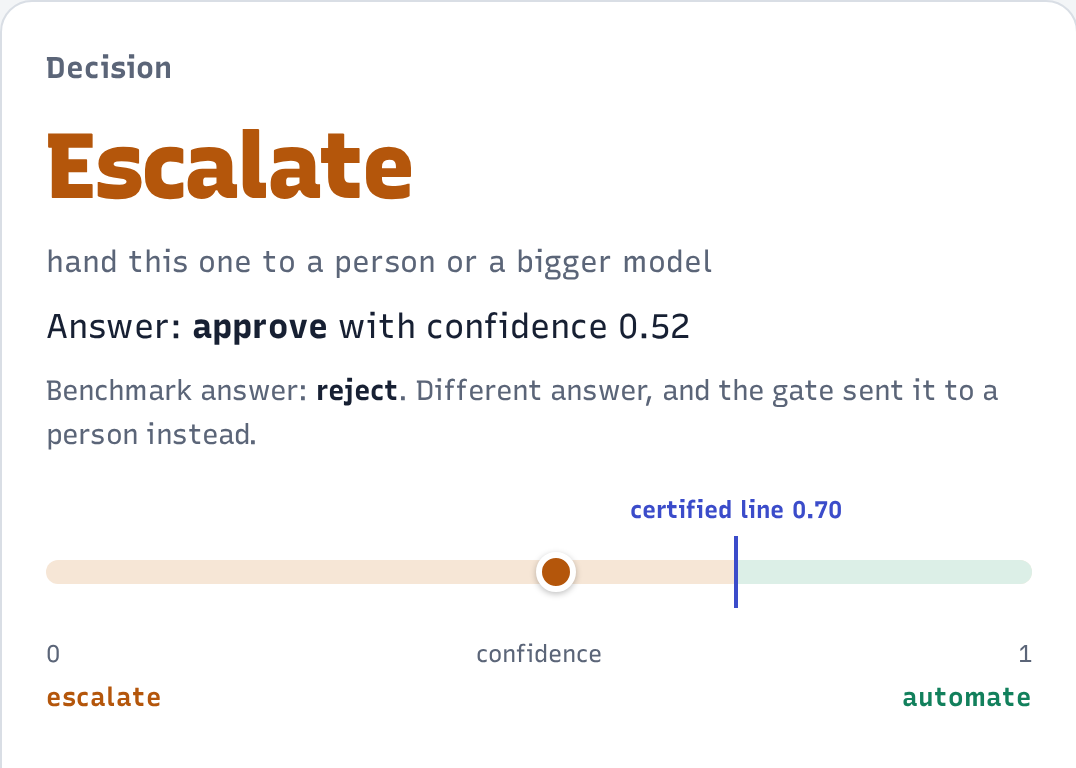
A held-out invoice that duplicates one already paid. The model leans towards approve; the benchmark says reject. Its confidence is below the certified line, so it goes to a person. Try it in your browser.
Demo · Model · Raw results · Method
Why a certified threshold
Picking a confidence cut-off by eye fails quietly. The probabilities these models return move with the task and even with the phrasing: an independent audit measured a 0.125 mean gap between asking the same thing as a yes/no and as a two-option choice. SafeDecide does not trust the probabilities. It tests candidate thresholds against labelled decisions with exact binomial bounds and keeps the lowest one it can certify, so the promise holds even when the model is miscalibrated. On typed-decisions, 300 labelled decisions are enough to certify a 20% budget and about 600 a 10% budget; 5% needs more than that.
Results
On typed-decisions
(test split: 400 cases, 2,000 decisions). SafeDecide was fitted on the benchmark's
train split and never saw test.
| Model | Params | Accuracy ↑ | KL from gold ↓ | Brier ↓ | Automation @ 10% ↑ | Realised error |
|---|---|---|---|---|---|---|
| SafeDecide (released) | 140M | 0.754 | 0.126 | 0.069 | 33.2% ± 5.2 | 6.3% |
| SafeDecide with Conformal Training (ablation) | 140M | 0.753 | 0.130 | 0.070 | 29.7% ± 5.2 | 6.3% |
| Phocinae-Largha-150M-v1, shipped weights (trained on 500 test decisions) | 144M | 0.906 | 0.055 | 0.025 | 93.9% ± 2.9 | 7.8% |
| Prior (ignores the input) | – | 0.487 | 0.328 | 0.181 | 0.0% | – |
Automation @ 10% is the share of decisions the model may take alone with the error among them certified at most 10% (δ = 10%), as mean ± std over 100 random calibration/test splits by case. Out of the box, the threshold shipped with the model, applied unchanged to all 2,000 test decisions, automated 26.2% of them, and 4.4% of those were wrong.
At 5% nothing can be certified on the 600 calibration decisions. The benchmark's gold is the mean of three samples from a teacher model, and a fresh sample from that teacher matches it only 73.5% of the time, so even confident answers carry label noise.
Every model Hugging Face scored, under one calibration
Hugging Face published per-decision results for the models it ran on typed-decisions
(bucket SaylorTwift/typed-decisions-evals).
scripts/automation_board.py
applies the same calibration, case splits and correctness rule to every row, ours
included. That scorer counts a tie in the gold as correct, so accuracies differ
slightly from the table above.
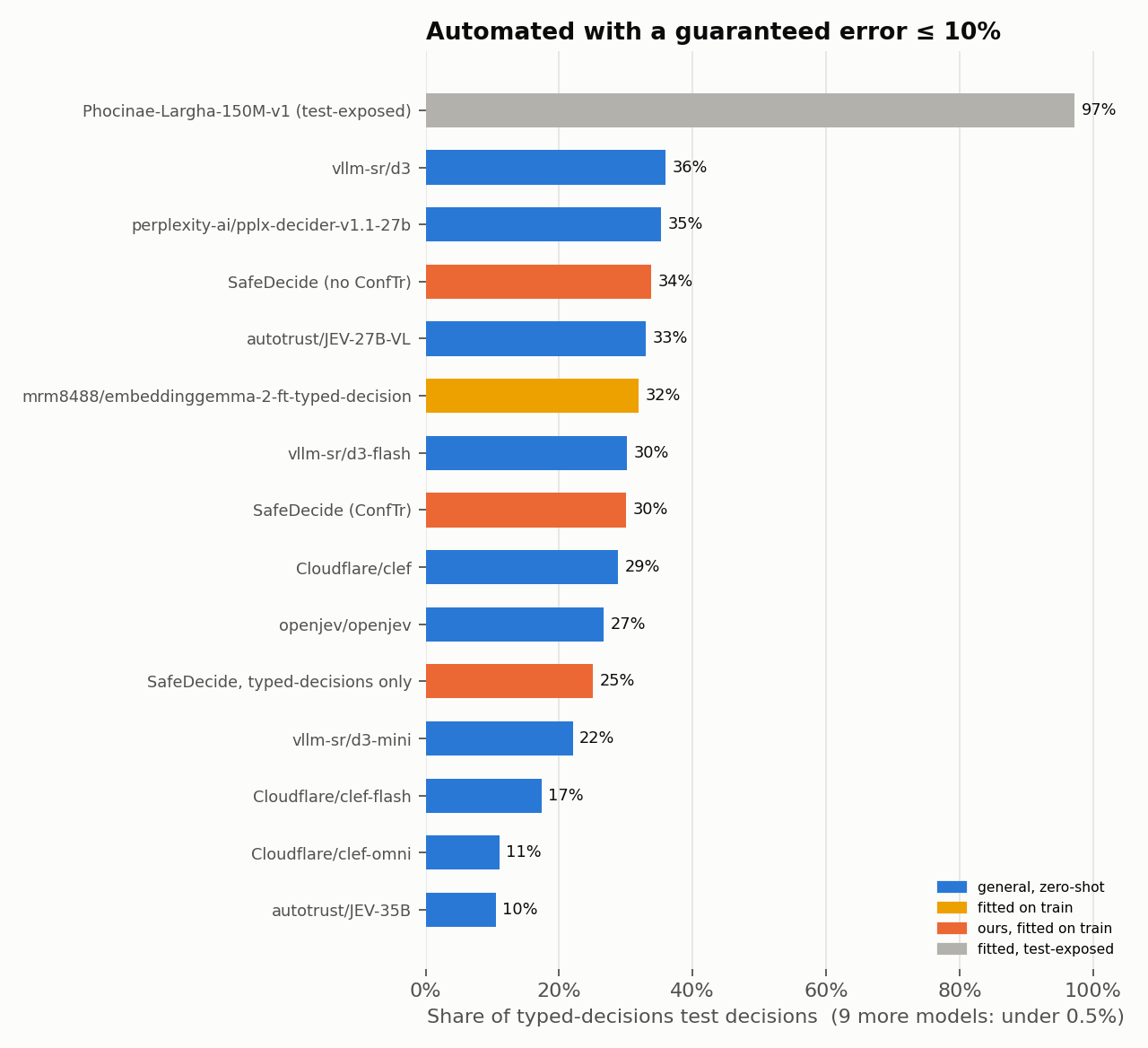
Two things stand out. The order is not the accuracy order: at a 5% budget,
JEV-27B-VL (accuracy 0.688) can take 20.4% of decisions alone, while d3 (0.749) can
take 0.6%. And a 140M model sits next to 27B general models; read that with the
labels, since SafeDecide was fitted on train and they were scored zero-shot.
Full tables with 95% intervals, the Conformal Training ablation and the
distribution-shift test are in results/
and the model card. Every
per-decision prediction is in the results dataset.
Quickstart
pip install "safedecide[all]"
Python 3.11 or newer. The extras are data (dataset loaders), export (ONNX),
serve (HTTP server) and report (figures); all installs them all.
The request below is a held-out customer-service case from typed-decisions, in the
same /v1/systemone shape as Jev, Clef and d3:
from safedecide import SafeDecider

decider = SafeDecider.from_pretrained("yotambr/safedecide-140m")
response = decider.decide(
    {
        "state": {
            "account": {
                "lifetime_value_usd": 228,
                "prior_tickets_90d": 0,
                "seats": 1,
                "tenure_months": 3,
                "tier": "standard",
            },
            "thread": [
                {"role": "customer", "text": "My payment didn’t go through, and I’m now locked out of my account."}
            ],
        },
        "questions": {
            "topic": {
                "type": "choice",
                "instructions": "What is this customer conversation primarily about?",
                "criteria": {
                    "account": "Login, plan changes, profile or access management.",
                    "billing": "A charge, invoice, subscription or payment problem.",
                    "delivery": "Shipping, fulfilment or delivery of a physical item.",
                    "refund": "The customer is explicitly asking for money back.",
                    "technical": "The product or service is not working as expected.",
                },
            },
            "needs_human": {
                "type": "noul",
                "instructions": "This conversation requires a human agent rather than automated handling.",
                "criteria": {
                    "false": "Automation can carry this to resolution.",
                    "true": "A human must take over: judgement, authority or empathy is required.",
                },
            },
        },
    }
)

response["answers"]["topic"]  # choice "billing", confidence 0.92, action "automate"
response["answers"]["needs_human"]  # noul 0.23 (no), confidence 0.77, action "automate"
response["guarantee"]["statement"]  # the promise behind every "automate", in words
The model carries a certified threshold for error budgets of 5%, 10% (the default)
and 20%. Pass alpha=0.2 to decide to use another; a budget the calibration data
could not certify escalates everything rather than promise too much.
To serve it behind the same API as Jev, run
safedecide serve --model yotambr/safedecide-140m and add ?alpha=0.2 to a request
to change the budget.
Calibrate on your own data
The shipped thresholds were certified on typed-decisions. Inputs that look different are outside that guarantee, so before you rely on the flag in production, re-certify on labelled decisions from your own traffic. Ticket systems usually hold these labels already: the team that closed the ticket, whether the refund went through.
Write one labelled question per line, in the same shape as a request:
{"state": {"thread": "..."}, "question": {"type": "choice", "instructions": "Which team?", "criteria": {"billing": "...", "technical": "..."}}, "answer": "billing"}
{"state": {"thread": "..."}, "question": {"type": "noul", "instructions": "This needs a human."}, "answer": true}
answer is the option name for choice, true or false for noul, and the level
number for score. Then:
safedecide calibrate --model yotambr/safedecide-140m --data my_decisions.jsonl --output-dir safedecide-mine
decider = SafeDecider.from_pretrained("safedecide-mine") # same model, your thresholds
The model keeps the temperatures it shipped with, so every line of your file goes to
the threshold (--refit-temperatures spends half of it refitting them instead). How
many lines you need, measured on held-out typed-decisions questions the temperatures
never saw:
| Labelled decisions | 20% budget certified | 10% budget certified |
|---|---|---|
| 300 | in 46 of 50 random draws | in 4 of 50 |
| 450 | in 50 of 50 | in 15 of 50 |
| 600 | yes (66% automated) | yes (23% automated) |
A more accurate model on your data needs fewer; a budget that cannot be certified escalates everything rather than promise too much.
Already running another decision model? The guarantee needs only its confidences and whether each answer was right:
from safedecide import calibrate_selective

rule = calibrate_selective(confidence, correct, alpha=0.1, delta=0.1)
rule.threshold  # automate when confidence >= threshold (inf: nothing could be certified)
Measure any decision model
safedecide benchmark scores any server that speaks /v1/systemone on typed-decisions
and jev-distill, and reports how much it can automate at each certified budget,
with figures:
safedecide benchmark --http http://localhost:8000 --out results/
How the guarantee works
- Fix a grid of thresholds in advance.
- For each threshold, take the calibration decisions at or above it and compute an exact Clopper–Pearson upper bound on their error rate.
- Walk down the grid from four fixed starting points (fixed-sequence testing, δ split four ways), stop each walk at its first failure, and keep the lowest threshold any walk certified.
This is Learn-then-Test (Angelopoulos et al., 2021) with binomial p-values. It needs exchangeable data, not calibrated probabilities. The released model is trained with proper scoring rules (cross-entropy against teacher distributions, Brier score, and ranked probability score for ordinal questions); Conformal Training (Stutz et al., 2022) was tested as an ablation and is not used. docs/METHOD.md has the proof sketch, the assumptions and the known weaknesses.
Limitations
- The guarantee covers data like the calibration set. On shifted data it can break: in the shift test, the error among automated decisions rose from 3.3% to 8.4% against a 5% budget. Re-calibrate on your own traffic.
- It is marginal over the calibration distribution, not per class, per task or per customer.
- On typed-decisions the reference labels come from a teacher model, so "error" means disagreement with that teacher.
- Decisions, not reasoning: questions that need multi-step reasoning or world knowledge belong to a generative model.
- Evaluated in English only, with one training seed per configuration.
- Not for fully automated decisions with legal, medical, financial or employment effects on people.
Reproduce
Two Colab notebooks reproduce every number:
notebooks/01_train_gpu.ipynb: two-stage training, calibration and evaluation, about 80 minutes on one A100.notebooks/02_publish.ipynb: certification, baseline, figures, ONNX export and model card, about 20 minutes on a T4.
The same steps run from a shell with safedecide train | calibrate | benchmark | export | card
(see safedecide --help).
Development
uv sync                       # creates .venv with the dev dependencies
uv run pytest                 # unit, end-to-end (tiny model) and benchmark-reference tests
uv run ruff check . && uv run ruff format --check .
These commands work the same on Linux, macOS and Windows, and CI runs the tests on
all three. uv sync installs the default PyTorch build; for a smaller CPU-only
install on Linux, first run uv pip install torch --index-url https://download.pytorch.org/whl/cpu.
Data and licensing
| Profile | Training data | Model licence |
|---|---|---|
clean (default) |
jev-distill openjev_v2 stream (from Open-Jev, CC0) + typed-decisions train (Apache-2.0) |
Apache-2.0 |
research |
+ jev-distill yuri_v1 and yuri_v3 (labels distilled from TypeSafe's Jev) |
research, non-commercial |
The released model uses clean. Evaluation never touches training rows.
Citation
@software{braun2026safedecide,
  author = {Braun, Yotam},
  title  = {SafeDecide: small decision models with guaranteed automation},
  year   = {2026},
  url    = {https://github.com/yotambraun/safedecide}
}
Built on mmBERT (JHU CLSP), jev-distill-corpus-v3, Open-Jev, typed-decisions and the per-decision results Hugging Face published for it.
1 maintainer

Metadata
1 maintainer
Release files for safedecide 0.1.0
For a detailed explanation of source distributions (sdists) and built distributions (wheels), please see the package formats documentation.
Source distribution (sdist)
| File | Size | Uploaded | Provenance | |
|---|---|---|---|---|
| safedecide-0.1.0.tar.gz | 63.5 kB | With provenance | Details |
Built distribution (wheel)
| File | Interpreter | ABI | Platform | Reset |
|---|---|---|---|---|
| safedecide-0.1.0-py3-none-any.whl | Python 3 | none | any | Details |
Total release size: 121.6 kB
Release files / safedecide-0.1.0.tar.gz
| Download URL | safedecide-0.1.0.tar.gz |
|---|---|
| Size | 63.5 kB |
| Tags | Source |
|
SHA-256 checksum How to use checksums |
18ee59cab1867bf77fd906377fdd536110cbbda804c46c20e1415822407c6435
|
|
BLAKE2b-256 checksum How to use checksums |
89e0cbf326081f51df564522395ec8814877e0c857164603c463a69b6bd7d51c
|
| Upload date | |
|
Uploaded using Trusted Publishing? What is trusted publishing? |
Yes |
| Uploaded via |
twine/7.0.0 CPython/3.13.14
|
Provenance
Provenance describes where a file came from. On PyPI, provenance is shared via attestations, which provide a verifiable record of the build or publishing details. View details, limitations and caveats.


PyPI Publish Attestation
PyPI verified that this artifact, at this checksum, originated from the publisher listed below.
Signed by GitHub Actions, verified by PyPI on Oct 18, 2026.
Transparency logRelease files / safedecide-0.1.0-py3-none-any.whl
| Download URL | safedecide-0.1.0-py3-none-any.whl |
|---|---|
| Size | 58.1 kB |
| Tags | Python 3 |
|
SHA-256 checksum How to use checksums |
24b750d9732b746ed5e4b95d18f9ffc461a53467d02df7ee9bd3292bb71474ed
|
|
BLAKE2b-256 checksum How to use checksums |
ba58cf89e97e596342b0e60151d0c507584a1a01b40bf8f0f51663eabfc1779b
|
| Upload date | |
|
Uploaded using Trusted Publishing? What is trusted publishing? |
Yes |
| Uploaded via |
twine/7.0.0 CPython/3.13.14
|
Provenance
Provenance describes where a file came from. On PyPI, provenance is shared via attestations, which provide a verifiable record of the build or publishing details. View details, limitations and caveats.
PyPI Publish Attestation
PyPI verified that this artifact, at this checksum, originated from the publisher listed below.
Signed by GitHub Actions, verified by PyPI on Oct 18, 2026.
Transparency logSecurity for safedecide 0.1.0
Provenance
Provenance describes where a file came from. On PyPI, provenance is shared via attestations, which provide a verifiable record of the build or publishing details. View details, limitations and caveats.
Full provenance
All 2 files in this release have been uploaded with provenance metadata.
Attestation for safedecide-0.1.0.tar.gz
PyPI Publish Attestation
PyPI verified that this artifact, at this checksum, originated from the publisher listed below.
Signed by GitHub Actions, verified by PyPI on Oct 18, 2026.
Transparency logA note on package security
PyPI is a repository for distributing packages, not a service for auditing them. While third-party security researchers and our staff do their best to detect and remove malicious packages, PyPI cannot guarantee the quality, security or suitability of any given package.
To learn more about protecting yourself from malicious actors, visit our package security documentation.













