
sandbox-fan-out
Run many test agents over one sandbox, in isolation, and merge their results without ever corrupting them.



See it work
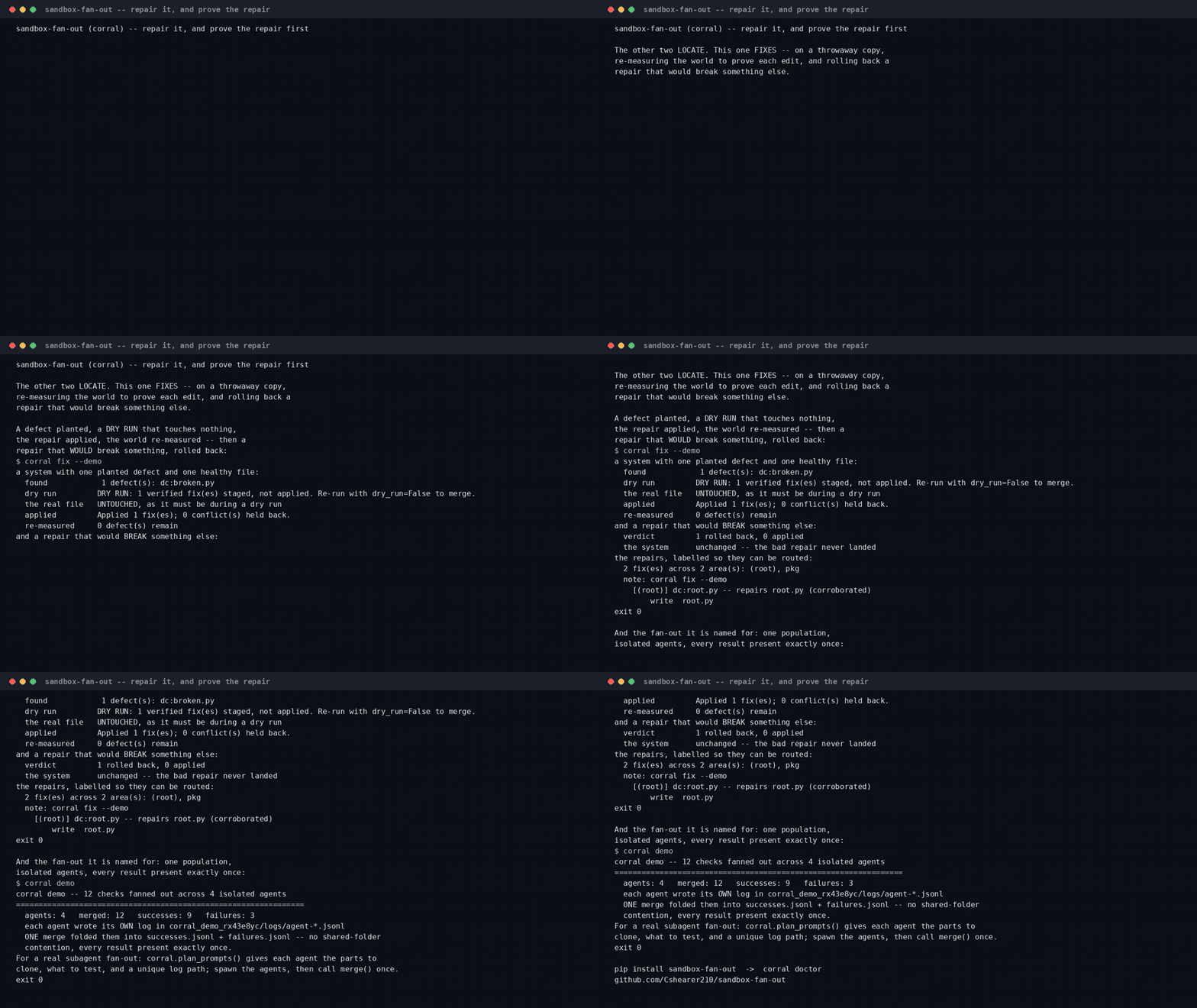
19 seconds. A defect is planted, a dry run touches nothing, the repair is applied, and the world is re-measured to zero defects. Then the beat that is the whole point: a repair that would break something else, rolled back, with the system left unchanged. Anyone can apply a patch; the question is what happens when the patch is wrong.
Every line on screen is the real output of a command that really ran, with its real exit code. Full quality MP4.
183 tests pass — measured 2026-10-04, and reproducible by anyone in under a second:
python3 -m pytest -q        # 183 passed
corral doctor               # 6 checks, and it exits non-zero if any of them is untrue
Two of those tests matter more than the rest and were written by killing the behaviour on purpose: flip "dry run by default" or "only repair what two methods agree on" and the suite fails — which is the only way to know a safety default is load-bearing rather than decorative.
That count is checked against the real suite rather than trusted: if the number here and the number the suite reports ever disagree, the pre-ship gate refuses the push.
Fan a large body of checks out across parallel agents. Each agent clones only the parts it needs,
tests them in its own private workdir, writes its own log, and destroys its clone. When every
agent is done, a single merge step folds all the logs into one successes.jsonl /
failures.jsonl pair. No two agents ever write the same file, and the shared results are written by
exactly one step — so the many-agents-saving-to-one-folder corruption cannot happen by construction.
The import/command name is corral; the project is sandbox-fan-out.

Why it exists
A naive fan-out has every agent append to the same results folder at once. Under real concurrency that loses lines, interleaves them, or double-counts — and the failure is silent, so a run looks complete while results are missing. This library makes that impossible by separating the two things that must never happen together: agents writing in parallel, and writing to a shared file.
split_population   discover the work; split into N disjoint, balanced slices (never a typed list)
checkout           each agent copies ONLY its slice's parts into a private workdir
run_slice          the agent tests in isolation and writes agent-<id>.jsonl  (its own file)
merge              ONE writer, after the fan-out, folds every per-agent log into the shared files
Every result appears exactly once; a unit that raises becomes a logged failure, never a crash of
the run; repeated runs never lose or corrupt. All of this is proven under real thread concurrency in
tests/test_corral.py.
Limits, up front
Scope boundaries, so you know what this is and is not before you install:
- It does not spawn agents for you. The built-in
fanout()runs your work function in-process with threads (deterministic, easy to test). For a real multi-process or subagent fan-out,plan_prompts()hands you one brief per agent — the parts to clone, the units to test, a unique log path — and you spawn them with your orchestrator of choice, then callmerge()once. - Isolation is a file-copy clone, not an OS sandbox.
checkout()gives each agent only the files its slice needs; it separates files, not privileges, processes, or network. Use a container if you need true privilege isolation. - The local executor is threads (GIL-bound). That is ideal for I/O-bound checks and for deterministic testing; it is not a route to CPU-bound parallelism. CPU-heavy work belongs on the real-subagent / multi-process path.
merge()dedupes by(agent_id, unit)and appends. It assumes each agent wrote its own uniquely named log; that invariant is whatrun_slice()andplan_prompts()guarantee.
None of these are bugs — they are the boundary of the problem this solves: safe result-merging for a fan-out, not the agent runtime itself.
Install and run
No dependencies. No account. No network. Python standard library only.
pip install git+https://github.com/Cshearer210/sandbox-fan-out
corral doctor        # verify THIS install actually works -- 4 checks, exits non-zero on any failure
corral demo          # 15-second live tour
corral doctor is there because green CI tells you the source is fine and says nothing about the
copy that landed on your machine. It imports the installed package, checks every name it promises,
splits a population and asserts the slices are disjoint, then runs a real 7-unit fan-out across 3
agents and confirms each wrote its own log and the merge folded them exactly once. If your install
is half-finished, that is the command that says so.
Working on the library itself:
git clone https://github.com/Cshearer210/sandbox-fan-out && cd sandbox-fan-out
python3 -m unittest discover -s tests        # the full test suite
python3 -m corral demo                       # the module form still works everywhere `corral` does
Use it
from corral import fanout

def work(unit, workdir):          # workdir is this agent's private clone (or None)
    ok = run_your_check(unit, workdir)
    return (ok, "what happened")

summary = fanout(
    population=discover_units(),   # a list; the library splits it into disjoint slices
    work_fn=work,
    n_agents=16,
    out_dir="runs/2026-09-23",
    prepare=lambda agent_id: checkout(SRC, parts_needed, f"/tmp/agent-{agent_id}"),
    teardown=cleanup,
)
# summary -> {"agents": 16, "merged": N, "successes": ..., "failures": ...}
# results -> runs/2026-09-23/successes.jsonl  and  failures.jsonl  (written once, by merge)
With real subagents
plan_prompts() gives each agent, from the same disjoint slices, the parts to clone, what to test,
and a unique log path. Spawn the agents (any orchestrator), let each write its own log, then call
merge() once. The safety property is identical — the only shared write is the final merge. See
examples/subagent_fanout.py.
Demo
Real output from python3 -m corral demo:
corral demo -- 12 checks fanned out across 4 isolated agents
================================================================
  agents: 4   merged: 12   successes: 9   failures: 3
  each agent wrote its OWN log in corral_demo_ym_pe5pq/logs/agent-*.jsonl
  ONE merge folded them into successes.jsonl + failures.jsonl -- no shared-folder
  contention, every result present exactly once.

For a real subagent fan-out: corral.plan_prompts() gives each agent the parts to
clone, what to test, and a unique log path; spawn the agents, then call merge() once.
Score a run's merged results by verdict (the token before the first : in each note):
python3 -m corral scoreboard runs/2026-09-23
How it works
split_population(units, n_agents)— round-robins the discovered population into up ton_agentsdisjoint, balanced slices, dropping empty ones (fewer units than agents means fewer agents, never idle ones).checkout(src, parts, dest)/cleanup(dest)— build and tear down an agent's private clone holding only the parts its slice touches.run_slice(...)— runs one slice in isolation and writes exactly one per-agent log; a unit that raises is caught and logged as a failure, never a crash of the run.merge(...)— the single writer. After the fan-out, it folds everyagent-*.jsonlinto the sharedsuccesses.jsonl/failures.jsonl, deduping by(agent_id, unit).fanout(...)— orchestrates split → run-every-slice → merge-once with a thread pool.plan_prompts(...)— the same disjoint slices as briefs for a real subagent fan-out.scoreboard/summarize(...)— reads a run's merged results back into a classified tally.
Status
| Capability | Status |
|---|---|
| Disjoint / balanced / complete slicing | ✅ works today — tested |
Per-agent isolated clone (checkout / cleanup) |
✅ works today — tested |
| Per-agent logs, one writer per file | ✅ works today — tested |
| Exactly-once merge under concurrency | ✅ works today — tested (16 agents × 200 units) |
| Raising unit → logged failure, not a crash | ✅ works today — tested |
| Repeated runs never lose/corrupt | ✅ works today — tested |
Real-subagent briefs (plan_prompts) |
✅ works today — tested (unique logs, disjoint parts) |
| Scoreboard classified tally | ✅ works today — tested |
| Spawning real subagents | ↗ by design, left to your orchestrator (plan_prompts + merge) |
| Multi-process / distributed local executor | ↗ roadmap — local executor is threads today |
| PyPI package | ↗ roadmap — clone-and-run today |
As of the last run: 152 tests pass (python3 -m unittest discover -s tests), at 98% line coverage of the corral package (core.py at 100%). The suite runs on the standard library alone; the property-based tests use hypothesis when it is installed and skip cleanly when it is not.
The safety properties, as tests
- disjoint + complete + balanced slices — no unit tested twice, none dropped.
- isolation — an agent's clone holds only its parts; it is destroyed after.
- exactly-once merge — under 16 concurrent agents over 200 units, every result appears once.
- no shared write during the run — the work function asserts the shared file does not exist yet.
- a raising unit is a failure, not a crash.
- repeated runs never lose or corrupt — totals grow by exactly N each run.
License
MIT — see LICENSE.
Repairing what another tool found
Finding a defect and repairing one are different jobs with different risks. A finder that is wrong costs you a wasted look. A fixer that is wrong costs you your codebase. So the repair half of this library is built so that a bad fix cannot land, rather than being unlikely to:
corral fix --demo
a system with one planted defect and one healthy file:
  found            1 defect(s): dc:broken.py
  dry run         DRY RUN: 1 verified fix(es) staged, not applied.
  the real file   UNTOUCHED, as it must be during a dry run
  applied         Applied 1 fix(es); 0 conflict(s) held back.
  re-measured     0 defect(s) remain

and a repair that would BREAK something else:
  verdict         1 rolled back, 0 applied
  the system      unchanged -- the bad repair never landed
The eight properties that make that true, all mechanical:
| isolated clone | every fix is tried on a throwaway copy; your system is untouched until it is verified |
| verify both directions | after a fix the finder runs again: the defect must disappear and no new one may appear |
| rollback on regression | anything that fails that test is discarded with its clone; nothing partial is left behind |
| single-writer merge | one writer applies verified fixes, so parallel agents cannot collide on one file |
| disjoint work | findings are de-duplicated by identity, so no two agents fix the same thing |
| behavioural targeting | a fix is located by the finding's own signal, never a hard-coded path |
| model-agnostic | the patch comes from a pluggable provider -- mechanical rule or model. The engine trusts neither |
| dry-run first | the default. A call that forgets the keyword reports a plan instead of writing |
The two defaults are the safety story, and both are killed by mutation in the test suite --
dry_run=True, so a forgotten keyword cannot write to a live system, and
require_corroborated=True, so a defect only one method believes in is never auto-repaired. If
either default is ever flipped, the tests fail rather than somebody's repository.
Used from Python, with any finder you like — the engine imports no defect model:
from corral import apply_fixes

report = apply_fixes(root, findings, patch_provider, finder)   # dry run by default
report = apply_fixes(root, findings, patch_provider, finder, dry_run=False)
A finding is any object with .identity, .location, .corroboration, .max_confidence and
.trust — see corral/fixer.py for the contract.
Handing the repairs to somebody else
Verifying a repair and being able to apply it are different problems. The engine above can merge a verified fix straight back, which works when the system in front of you is the system being repaired. It is no use when the two are separated — findings produced on one machine, applied on another; a repair reviewed before it lands; a set of fixes handed to somebody who has to decide which parts of their own system to accept.
So a verified repair can leave as a bundle, and every fix in it is labelled with the area of the system it touches:
2 fix(es) across 2 area(s): (root), pkg
  [pkg] dc:pkg/same.py -- repairs pkg/same.py (corroborated)
      write  pkg/same.py
  [(root)] dc:root.py -- repairs root.py (corroborated)
      write  root.py
from corral import Collector, apply_fixes, write_bundle, apply_bundle, describe

col = Collector()
apply_fixes(root, findings, patch_provider, finder, on_verified=col)   # still a dry run
write_bundle(col.fixes, "out/bundle", root=root)

print(describe("out/bundle"))                                  # read it before accepting it
apply_bundle("out/bundle", other_system, areas=["pkg"], dry_run=False)   # take only your part
| labelled by area | derived from the files a fix actually touches, never from a category somebody typed — so a rename cannot leave the label quietly wrong |
| content-addressed | every target records the hash it is expected to have before the patch. A bundle applied to a file that has since changed is refused, not merged over somebody's newer work |
| self-describing | describe() prints what each fix repairs and which files it writes, in plain text, before you accept anything |
| dry-run first | the default, the same as the engine |
A bundle is not a trust boundary, and the module says so. It carries file contents, so applying one you did not produce writes somebody else's bytes into your system. It refuses on a content mismatch and tells you what it would write; it cannot tell you whether the patch is a good idea.
The proving ground
proving-ground/ is the harness that decides whether these tools actually work: a system with
planted defects of known kinds, and a scoreboard saying, per defect, whether the tool caught
it, stayed correctly quiet, or missed it. A detector is only trustworthy in both directions — it
must fire on a real defect and stay silent on a clean twin of the same code — and that is what
this measures.
python3 proving-ground/paths.py      # which companion tools it can see
python3 proving-ground/run_all.py    # the scoreboard
It needs the companion tools checked out; it finds them next to this repository, or you can point
it at them with RAGGHOST_DIR, CLAIMPROOF_DIR, FULLCIRCLE_DIR. When it cannot find one it
says so rather than scoring it clean — "found nothing" and "could not look" must never produce
the same answer.
1 maintainer

Metadata
1 maintainer
Release files for sandbox-fan-out 0.1.0
For a detailed explanation of source distributions (sdists) and built distributions (wheels), please see the package formats documentation.
Source distribution (sdist)
| File | Size | Uploaded | |
|---|---|---|---|
| sandbox_fan_out-0.1.0.tar.gz | 2.7 MB | Details |
Built distribution (wheel)
| File | Interpreter | ABI | Platform | Reset |
|---|---|---|---|---|
| sandbox_fan_out-0.1.0-py3-none-any.whl | Python 3 | none | any | Details |
Total release size: 2.7 MB
Release files / sandbox_fan_out-0.1.0.tar.gz
| Download URL | sandbox_fan_out-0.1.0.tar.gz |
|---|---|
| Size | 2.7 MB |
| Tags | Source |
|
SHA-256 checksum How to use checksums |
f122272cafc544cc0dfa28adc27c95053451edfb3760235b20096bb8c2a3ebc1
|
|
BLAKE2b-256 checksum How to use checksums |
e3755dcb6d42121575893c02b93b57e2f0fd5c2a9a09f8786e566697b54a05ce
|
| Upload date | |
|
Uploaded using Trusted Publishing? What is trusted publishing? |
Yes |
| Uploaded via |
twine/7.0.0 CPython/3.13.14
|
Provenance
Provenance describes where a file came from. On PyPI, provenance is shared via attestations, which provide a verifiable record of the build or publishing details. View details, limitations and caveats.


PyPI Publish Attestation
PyPI verified that this artifact, at this checksum, originated from the publisher listed below.
Signed by GitHub Actions, verified by PyPI on Oct 4, 2026.
Transparency logRelease files / sandbox_fan_out-0.1.0-py3-none-any.whl
| Download URL | sandbox_fan_out-0.1.0-py3-none-any.whl |
|---|---|
| Size | 32.6 kB |
| Tags | Python 3 |
|
SHA-256 checksum How to use checksums |
b606924181725e563b904e10ad630f409548eddfa5e534d2fde0cebf1aa7b762
|
|
BLAKE2b-256 checksum How to use checksums |
e607b91f911a7dd8c36e629334e6e771f97189acbe5bcf9ce79c4841095c2ed0
|
| Upload date | |
|
Uploaded using Trusted Publishing? What is trusted publishing? |
Yes |
| Uploaded via |
twine/7.0.0 CPython/3.13.14
|
Provenance
Provenance describes where a file came from. On PyPI, provenance is shared via attestations, which provide a verifiable record of the build or publishing details. View details, limitations and caveats.
PyPI Publish Attestation
PyPI verified that this artifact, at this checksum, originated from the publisher listed below.
Signed by GitHub Actions, verified by PyPI on Oct 4, 2026.
Transparency log












