
sankey_mpl





Sankey diagrams for matplotlib, as clean vector output.
from sankey_mpl import render_sankey, save

nodes = {
    "visits": {"label": "Visits (12,400)", "color": "#9AA5B1"},
    "signup": {"label": "Signed up (3,100)", "color": "#4C78A8"},
    "bounced": {"label": "Bounced (9,300)", "color": "#E45756"},
    "paid": {"label": "Subscribed (820)", "color": "#54A24B"},
    "lapsed": {"label": "Lapsed (2,280)", "color": "#F58518"},
}
links = [
    {"from": "visits", "to": "signup", "flow": 3100},
    {"from": "visits", "to": "bounced", "flow": 9300},
    {"from": "signup", "to": "paid", "flow": 820},
    {"from": "signup", "to": "lapsed", "flow": 2280},
]

result = render_sankey(nodes, links)
save(result, "funnel.svg")
Why this one
- Genuinely vector. No rasterised artists anywhere, so SVG and PDF stay scalable and the text stays selectable. Most matplotlib sankey code fakes its gradients with an image, which silently embeds a bitmap per ribbon.
- Reproducible. The same input produces byte-identical output, so a generated document's content hash is stable and golden-file tests are possible.
- Exact pixel geometry. One data unit is one point is one pixel, so the
diagram lands at the size you asked for and
fontsize=12means 12 pixels. - Everything is a config key. Node width, gap, curve shape, gradient resolution, label placement, export settings. No subclassing to tune a number.
- It refuses bad input. Cycles, backward links, disconnected graphs and nodes too short for their own links raise instead of rendering something misleading.
Not a general graph-drawing library: it lays out acyclic left-to-right flows.
Note that matplotlib ships an unrelated matplotlib.sankey for engineering flow
diagrams; this is not that.
Gallery
These five are the test fixtures. They are deliberately silly, and they are
deliberately different shapes. Each one exists because it exercises something
the others cannot, so the gallery doubles as a map of what the layout does. Every
image here is rendered by tools/render_previews.py from the same data the test
suite runs against, and the SVG next to each PNG is the real vector output.
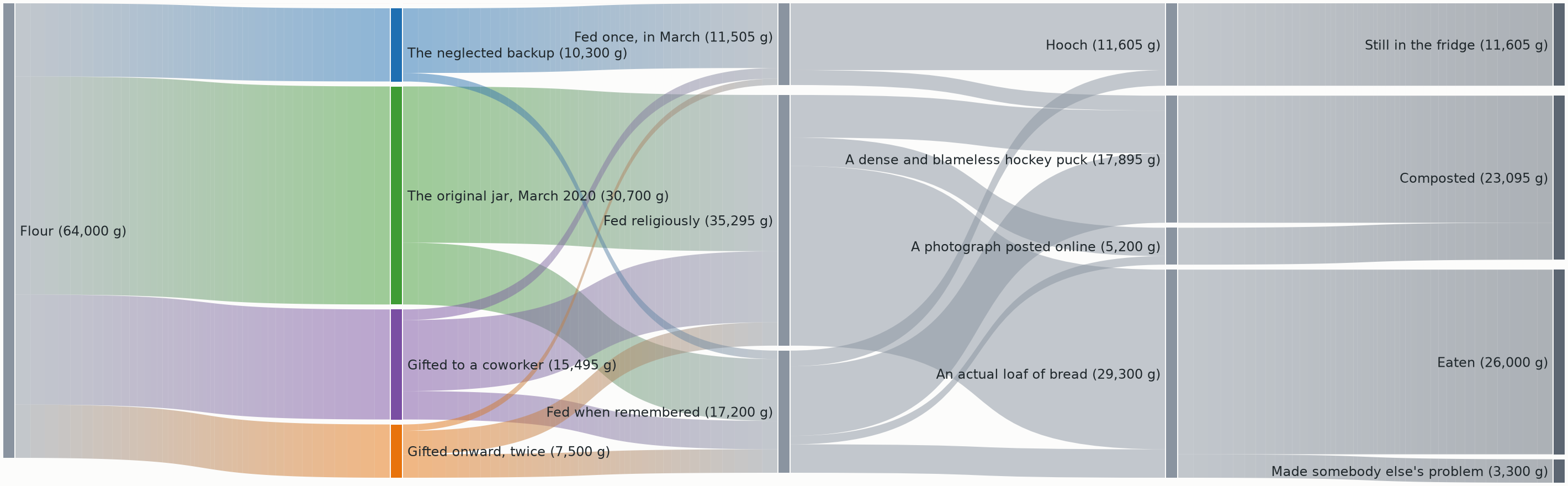
The Sourdough Dynasty: flows that split and rejoin. Both feeding regimes reach "an actual loaf"; three of four generations reach "hooch". The split-and-rejoin diamonds are what make link stacking order visible.
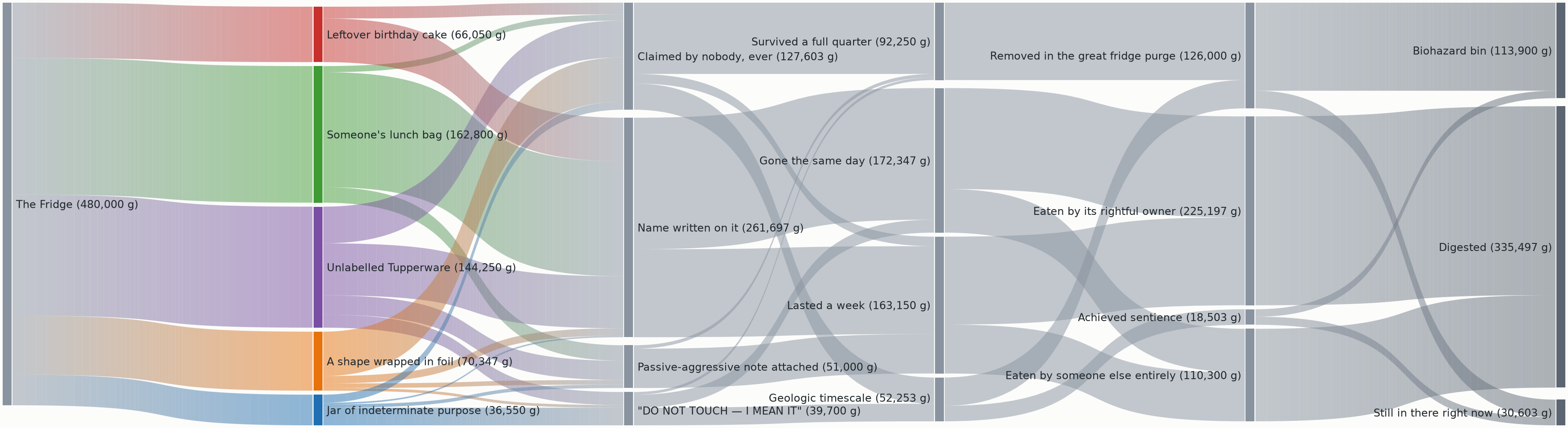
Break Room Forensics: six columns and dense sharing, the widest of the five. Every middle node is fed by four to six upstream nodes, so the per-column overlap sweep does real work in every column and the node gap carries over across five column boundaries.
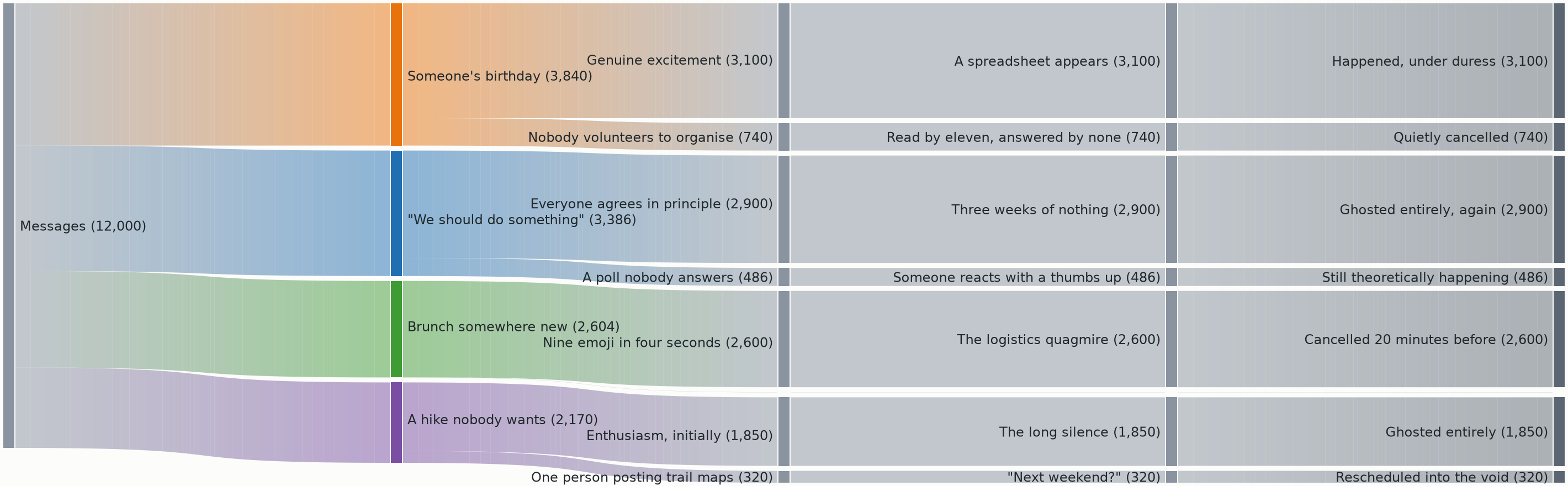
The Group Chat Decides Where to Get Brunch: a pure fan-out tree. No middle node is shared, so nothing ever overlaps and the bands run perfectly parallel; this is the control case, and you can see the absence in the picture. The one plan that actually happened carries four messages and is too thin to label, which is the joke and also the label drop rule working.
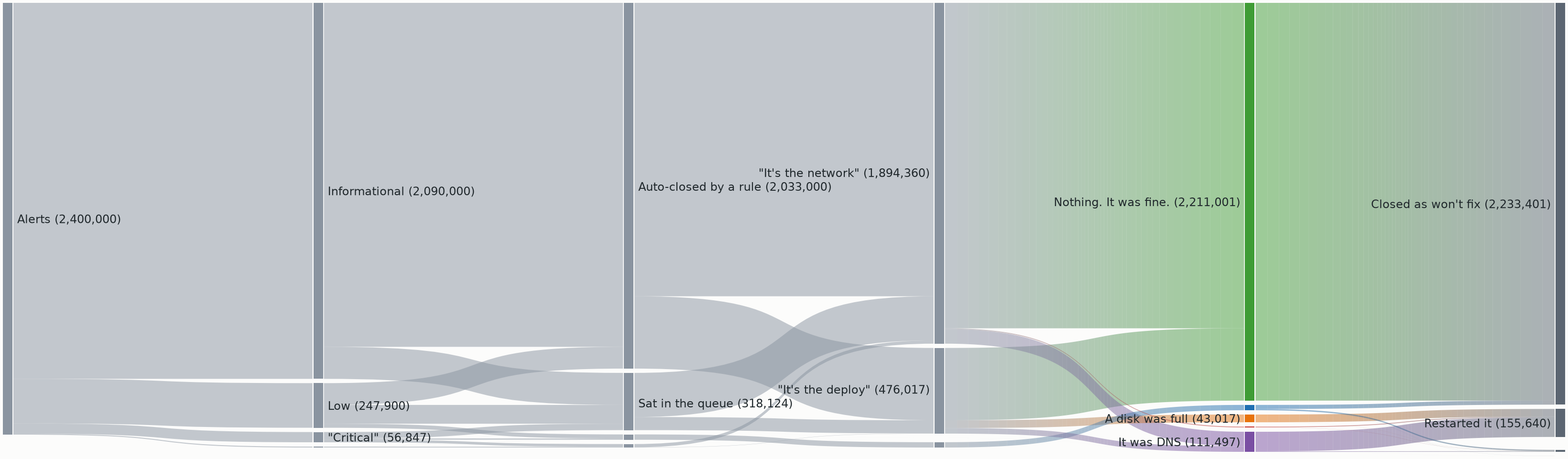
It Was DNS: a convergent funnel spanning six orders of magnitude, and the real limit of a linear sankey. 2.4 million alerts against a single cosmic-ray alert means most of the diagram is one slab and nine of twenty-two labels fall below the drop threshold. That is the intended outcome rather than a bug: the library drops a label it cannot place legibly instead of stacking it on top of its neighbour.
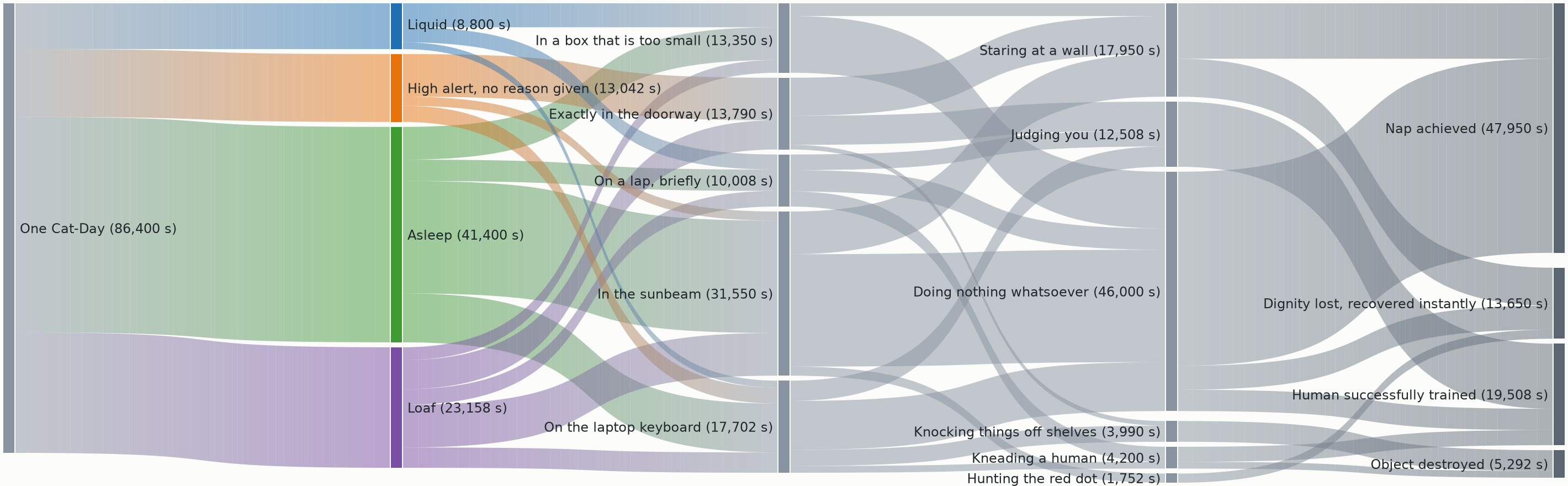
The cat-day diagram at the top of this page is the fifth. Its flows are seconds and they conserve to exactly 86,400, so its arithmetic can be checked by hand, which is why it is the one to reach for when debugging the height calculation.
Install
pip install sankey_mpl
Requires Python 3.10+, matplotlib and numpy.
Documentation
docs/usage.md is the full usage spec: the data model, every configuration key, the coordinate contract, label placement, export and determinism, and what each error means.
Provenance
The layout is a Python port of the algorithm in chartjs-chart-sankey 0.15.0 (MIT, © Jukka Kurkela), reimplemented from a written specification of its behaviour. Given the same input, this library reproduces that library's geometry, verified against golden data generated by running the original. A handful of deliberate differences are listed in docs/usage.md. See NOTICE for the upstream copyright.
UPSTREAM_VERSION records which upstream release the geometry tracks.
Development
pip install -e ".[dev]"
pytest
ruff check .
The golden data in tests/data is regenerated by tools/generate_golden.mjs,
which runs the original JavaScript library over the five dataset specs in
tools/datasets/. That needs Node, and only if you are changing the datasets; CI
does not run it.
cd tools && npm install && node generate_golden.mjs   # goldens (needs Node)
python tools/render_previews.py                       # gallery images (no Node)
The test suite is parametrised over all five datasets, so a change that only breaks
one shape still fails. tests/data/datasets.json records what each is for.
License
MIT.
Attribution
Built with Claude Code.
1 maintainer

Release files for sankey-mpl 0.1.1
For a detailed explanation of source distributions (sdists) and built distributions (wheels), please see the package formats documentation.
Source distribution (sdist)
| File | Size | Uploaded | |
|---|---|---|---|
| sankey_mpl-0.1.1.tar.gz | 79.8 kB | Details |
Built distribution (wheel)
| File | Interpreter | ABI | Platform | Reset |
|---|---|---|---|---|
| sankey_mpl-0.1.1-py3-none-any.whl | Python 3 | none | any | Details |
Total release size: 109.4 kB
Release files / sankey_mpl-0.1.1.tar.gz
| Download URL | sankey_mpl-0.1.1.tar.gz |
|---|---|
| Size | 79.8 kB |
| Tags | Source |
|
SHA-256 checksum How to use checksums |
9a6178c99d9705e8c2a82b3065a0d7126877073463df604207294cfbd64250cf
|
|
BLAKE2b-256 checksum How to use checksums |
43ff795052269f68d56ca13177efaab001a2c17bf28628d1b936a3038b9ca8f7
|
| Upload date | |
|
Uploaded using Trusted Publishing? What is trusted publishing? |
Yes |
| Uploaded via |
twine/7.0.0 CPython/3.13.14
|
Provenance
Provenance describes where a file came from. On PyPI, provenance is shared via attestations, which provide a verifiable record of the build or publishing details. View details, limitations and caveats.


PyPI Publish Attestation
PyPI verified that this artifact, at this checksum, originated from the publisher listed below.
Signed by GitHub Actions, verified by PyPI on Aug 13, 2026.
Transparency logRelease files / sankey_mpl-0.1.1-py3-none-any.whl
| Download URL | sankey_mpl-0.1.1-py3-none-any.whl |
|---|---|
| Size | 29.6 kB |
| Tags | Python 3 |
|
SHA-256 checksum How to use checksums |
157b90f16685005b55d6587a021963456abfed563403d3a7561f8904cc184584
|
|
BLAKE2b-256 checksum How to use checksums |
dbc6c0b40bfb87304f397a45fc14ca6780153f01019da5a0b92bd99331e28164
|
| Upload date | |
|
Uploaded using Trusted Publishing? What is trusted publishing? |
Yes |
| Uploaded via |
twine/7.0.0 CPython/3.13.14
|
Provenance
Provenance describes where a file came from. On PyPI, provenance is shared via attestations, which provide a verifiable record of the build or publishing details. View details, limitations and caveats.
PyPI Publish Attestation
PyPI verified that this artifact, at this checksum, originated from the publisher listed below.
Signed by GitHub Actions, verified by PyPI on Aug 13, 2026.
Transparency log
















