
This release is a pre-release and may not be stable for production use.
SAP Knowledge Pipeline
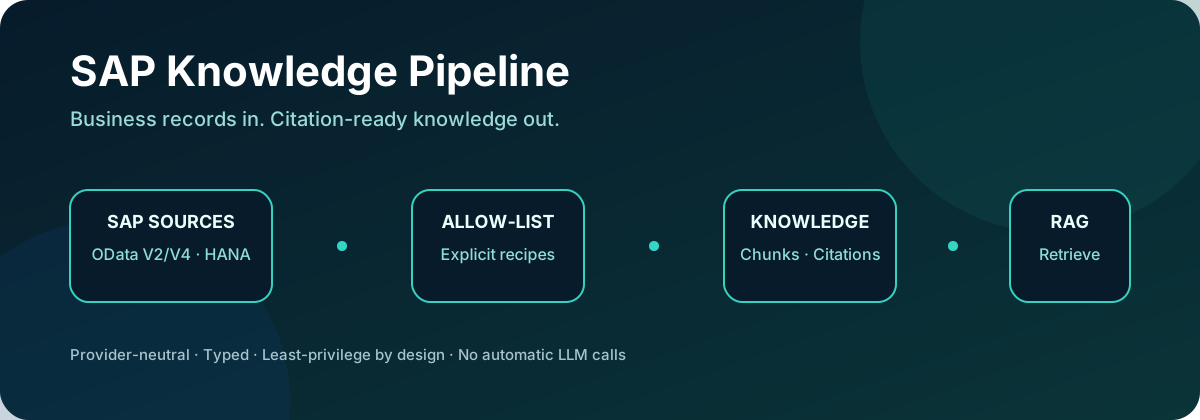
Turn selected SAP OData and HANA business records into secure, citation-ready knowledge for RAG.




Install · OData · HANA · RAG search · Contribute
[!IMPORTANT] This project is an early technical foundation. It is not affiliated with or endorsed by SAP. It does not grant access to SAP systems or reproduce SAP's authorization model.
Installation
Install the core OData and knowledge-transformation package:
python -m pip install sap-knowledge-pipeline
Choose optional integrations explicitly:
python -m pip install "sap-knowledge-pipeline[hana]"
python -m pip install "sap-knowledge-pipeline[fastembed]"
python -m pip install "sap-knowledge-pipeline[all]"
Python 3.11 through 3.14 are supported. This is an early alpha release: pin the version, test recipes against non-production data first, and review the known limitations before adopting it.
How it fits together

See the project roadmap for planned releases and contribution opportunities.
The package's synchronization events are portable, so an application can choose OpenAI, a local embedding model, pgvector, Qdrant, SAP HANA Cloud, or another store without changing SAP extraction.
The optional Qdrant integration now provides the first end-to-end local target.
Current milestone
The first milestone provides the protocol layer required by the later knowledge pipeline:
- OData V2 and V4 JSON page parsing.
- Server-driven pagination using opaque continuation links.
- Continuation-host validation to prevent credential leakage and SSRF.
- V4 changed and deleted entity handling.
- EDMX metadata inspection for entity sets, keys, properties, and navigation properties.
- An async HTTP client that can be tested without a live SAP system.
- Declarative recipes that allow-list fields before they enter RAG.
- Deterministic knowledge documents, citations, and character-aware chunks.
- A conservative SAP Business Partner starter recipe.
- Certificate-validated SAP HANA connections through the optional SAP
hdbclidriver. - Explicit, parameterized HANA
SELECTdatasets streamed in bounded pages. - Local FastEmbed embeddings and a persistent Qdrant knowledge index.
OData synchronization includes durable checkpoints and delta-link handling. The initial HANA adapter performs snapshot reads; resumable keyset pagination and deletion tracking remain future work.
Known limitations
- HANA is currently a Python API; the TOML CLI commands target OData.
- HANA synchronization is snapshot-only and does not reconcile deleted rows.
- The package does not infer SAP module semantics, authorization scope, or safe fields from table names.
- Only Business Partner has a built-in recipe; other datasets require an
explicit
KnowledgeRecipe. - Qdrant local mode is intended for development and smaller indexes.
- No LLM is called automatically. Applications decide where retrieved context is sent.
Development setup
python -m venv .venv
# Windows PowerShell
.venv\Scripts\Activate.ps1
python -m pip install --group dev -e .

# macOS or Linux
source .venv/bin/activate
python -m pip install --group dev -e .
Then run the complete local quality suite:
ruff check .
ruff format --check .
mypy src
pytest
Minimal source example
import asyncio

import httpx

from sap_knowledge.sources.odata import ODataClient, ODataVersion


async def main() -> None:
    async with httpx.AsyncClient() as http:
        client = ODataClient(
            service_root="https://services.odata.org/V4/TripPinServiceRW/",
            version=ODataVersion.V4,
            http=http,
        )

        metadata = await client.metadata()
        people = metadata.entity_set("People")

        async for page in client.pages("People", key_fields=people.keys):
            for record in page.records:
                print(record.key, record.data)


asyncio.run(main())
The same client can consume a configured SAP OData service. Credentials should
be supplied through an httpx.AsyncClient authentication configuration and
must never be committed to the repository.
SAP Business Partner to RAG chunks
Recipes are security boundaries as well as rendering instructions. Only the properties listed by the recipe enter the document text or metadata; an unexpected field in the OData response is ignored.
import asyncio
import os

import httpx

from sap_knowledge import CharacterChunker, KnowledgeRenderer
from sap_knowledge.recipes import BUSINESS_PARTNER
from sap_knowledge.sources.odata import ODataClient, ODataVersion


async def main() -> None:
    async with httpx.AsyncClient(
        auth=(os.environ["SAP_USER"], os.environ["SAP_PASSWORD"]),
        timeout=30,
    ) as http:
        source = ODataClient(
            service_root=os.environ["SAP_ODATA_SERVICE_ROOT"],
            version=ODataVersion.V2,
            http=http,
        )
        renderer = KnowledgeRenderer()
        chunker = CharacterChunker(max_characters=1200, overlap_characters=120)

        async for page in source.pages(
            BUSINESS_PARTNER.entity_set,
            key_fields=BUSINESS_PARTNER.key_fields,
            select=BUSINESS_PARTNER.select_fields,
        ):
            for record in page.records:
                document = renderer.render(record, BUSINESS_PARTNER)
                for chunk in chunker.split(document):
                    # Send chunk.text and chunk.metadata to your chosen target.
                    print(chunk.model_dump_json())


asyncio.run(main())
Every chunk includes:
- A stable chunk and document ID.
- The rendered, embedding-ready text.
- The OData entity set and complete business key.
- The source ETag when supplied by SAP.
- The recipe and document type.
Stable IDs let a later sink upsert changed chunks without duplicating them. The structured citation lets a RAG application show where an answer came from.
SAP HANA to RAG chunks
Install the optional SAP HANA driver:
python -m pip install "sap-knowledge-pipeline[hana]"
Use a dedicated database principal with only SELECT privileges on approved
views. The package rejects obvious multi-statement and non-SELECT input,
but SQL-text validation is not an authorization boundary. Database grants are
the security boundary.
Keep connection values in environment variables:
$env:SAP_HANA_ADDRESS = "your-host.hanacloud.ondemand.com"
$env:SAP_HANA_PORT = "443"
$env:SAP_HANA_USER = "your-read-only-user"
$env:SAP_HANA_PASSWORD = "your-password"
Define an explicit dataset and its stable business key:
import os

from sap_knowledge.sources.hana import HanaClient, HanaDataset


products = HanaDataset(
    name="PRODUCT_KNOWLEDGE",
    statement=(
        'SELECT "PRODUCT_ID", "PRODUCT_NAME", "DESCRIPTION" '
        'FROM "RAG_READ"."PRODUCT_KNOWLEDGE" '
        'WHERE "ACTIVE" = ? ORDER BY "PRODUCT_ID"'
    ),
    key_fields=("PRODUCT_ID",),
    parameters=(True,),
)

with HanaClient.connect(
    address=os.environ["SAP_HANA_ADDRESS"],
    port=int(os.environ.get("SAP_HANA_PORT", "443")),
    user=os.environ["SAP_HANA_USER"],
    password=os.environ["SAP_HANA_PASSWORD"],
) as source:
    for page in source.pages(products, page_size=500):
        for record in page.records:
            print(record.model_dump_json())
Connections always request encryption and certificate validation. Query
parameters are passed separately to the SAP driver. Duplicate result-column
names, missing business keys, and null key values fail before records enter the
knowledge pipeline. See examples/hana_to_rag.py for transformation into
citation-ready chunks.
The adapter works at the HANA SQL layer. It is not specific to S/4HANA: an ECC EHP8 system on HANA, S/4HANA, HANA Cloud, or a custom HANA application can all be sources when the configured user can read a stable view or query. The meaning and safety of SAP application tables still belongs in an explicit recipe or curated database view.
Discover accessible HANA metadata
Catalog discovery returns only metadata visible to the connected principal. It does not select business rows:
with HanaClient.connect(
    address=os.environ["SAP_HANA_ADDRESS"],
    port=int(os.environ.get("SAP_HANA_PORT", "443")),
    user=os.environ["SAP_HANA_USER"],
    password=os.environ["SAP_HANA_PASSWORD"],
) as source:
    catalog = source.catalog()
    for schema in catalog.schemas():
        for database_object in catalog.objects(schema):
            columns = catalog.columns(schema, database_object.name)
            print(schema, database_object.name, columns)
System schemas are excluded by default. HANA system views filter their results
according to the connected user's privileges. Do not grant CATALOG READ to a
production ingestion account merely to make discovery easier; create a curated
schema or grant SELECT only on approved views instead.
Write HANA snapshot events
HanaSnapshotKnowledgePipeline connects HANA to the same portable JSONL event
format consumed by the Qdrant indexer:
pipeline = HanaSnapshotKnowledgePipeline(
    source=source,
    dataset=products,
    recipe=product_recipe,
    sink=JsonlEventSink("data/hana-product-events.jsonl"),
)
result = await pipeline.run()
Snapshot events have deterministic IDs, so rerunning the same approved query upserts the same documents. This initial implementation does not yet detect rows that disappeared between snapshots; incremental cursors and deletion reconciliation are still required for production synchronization.
SAP module coverage
The extraction and RAG layers are module-neutral. FI/CO, MM, SD, PM, HCM,
SuccessFactors replication data, industry add-ons, and custom Z* objects can
all use the same pipeline when represented as stable rows. Module-specific
support is not automatic: joins, organizational scope, authorization rules,
business terminology, keys, sensitive-field exclusions, and change tracking
must be defined by a curated view or explicit query and a KnowledgeRecipe.
The only built-in SAP business recipe currently included is the OData Business Partner recipe. HANA module recipes should be added one validated use case at a time rather than guessing directly from SAP table names.
Command-line usage
Copy the supplied configuration template and edit the service URL:
cp sap-knowledge.example.toml sap-knowledge.toml
On Windows PowerShell:
Copy-Item sap-knowledge.example.toml sap-knowledge.toml
$env:SAP_USER = "your-technical-user"
$env:SAP_PASSWORD = "your-password"
The TOML file contains environment-variable names, never passwords or tokens:
[service]
root = "https://your-sap-host.example/sap/opu/odata/sap/API_BUSINESS_PARTNER/"
version = "2"
username_env = "SAP_USER"
password_env = "SAP_PASSWORD"

[pipeline]
recipe = "business_partner"
events_path = "data/business-partner-events.jsonl"
checkpoint_path = "state/business-partner.json"
max_characters = 1200
overlap_characters = 120
SAP Business Accelerator Hub sandboxes use an API key instead of Basic
authentication. Copy sap-business-partner-sandbox.example.toml, obtain your
personal key from SAP, and set it only in the process environment:
$env:SAP_API_KEY = "your-personal-sandbox-key"
sap-knowledge --config sap-business-partner-sandbox.example.toml inspect
sap-knowledge --config sap-business-partner-sandbox.example.toml sync
The corresponding configuration uses:
api_key_env = "SAP_API_KEY"
api_key_header = "APIKey"
Inspect the service before extracting data:
sap-knowledge --config sap-knowledge.toml inspect
sap-knowledge --config sap-knowledge.toml inspect --entity-set A_BusinessPartner --json
Run or resume synchronization:
sap-knowledge --config sap-knowledge.toml sync
The CLI validates the built-in recipe against live EDMX metadata before it requests business data. It fails early when an entity set, key, or selected property is unavailable.
Inspect checkpoint status without revealing its URLs:
sap-knowledge --config sap-knowledge.toml checkpoint
--reveal-cursors is available for careful local debugging. Avoid copying its
output into logs or issue reports. You can also run the CLI as
python -m sap_knowledge.
Local vector search and RAG context
Install the optional local embedding and Qdrant dependencies:
python -m pip install "sap-knowledge-pipeline[fastembed]"
For a source checkout:
python -m pip install -e ".[fastembed]"
The sandbox example config includes a persistent local Qdrant index and the small English BGE embedding model:
[vector]
path = "data/qdrant-business-partners"
collection = "sap_business_partners"
model = "BAAI/bge-small-en-v1.5"
model_cache_path = "state/embedding-models"
batch_size = 128
After sync has produced the JSONL events, embed and index them:
sap-knowledge --config sap-business-partner-sandbox.example.toml index
Run semantic retrieval:
sap-knowledge --config sap-business-partner-sandbox.example.toml search \
  "industrial manufacturing and engineering company" --limit 3
Results contain the score, source text, document and chunk IDs, and the original SAP entity set and business key. To create a grounded prompt that can be sent to any chat model:
sap-knowledge --config sap-business-partner-sandbox.example.toml prompt \
  "Which business partners manufacture industrial components?" --limit 5
The prompt requires numbered citations, tells the model to use only retrieved sources, and treats SAP text as untrusted data rather than instructions. Prompt construction does not call an LLM or send SAP data to a third party.
The collection records its embedding model and vector dimension. Search and index operations fail explicitly if configuration changes, preventing vectors from incompatible embedding spaces from being mixed silently.
Qdrant local mode is intended for development and smaller indexes. The adapter uses the same Qdrant collection operations needed for a server or cloud target, but remote connection configuration and production hardening are future work.
Live compatibility smoke test
The regular test suite is fully offline. An opt-in example checks real public services without retaining their data:
python examples/live_odata_smoke.py
It inspects the public SAP Business Accelerator Hub catalog metadata, then runs the complete temporary JSONL/checkpoint pipeline against the OData reference Northwind V2 and TripPin V4 services. Network availability and those external services are outside this project's control, so this is deliberately not part of CI.
Durable synchronization to JSONL
ODataKnowledgePipeline combines extraction, rendering, chunking, deletion
events, and checkpoints. JSONL is the first portable sink: it is easy to
inspect, replay, import into another system, or use as the input to a custom
embedding worker.
from pathlib import Path

from sap_knowledge.sync import (
    FileCheckpointStore,
    JsonlEventSink,
    ODataKnowledgePipeline,
)

pipeline = ODataKnowledgePipeline(
    source=source,
    recipe=BUSINESS_PARTNER,
    sink=JsonlEventSink(Path("data/business-partner-events.jsonl")),
    checkpoints=FileCheckpointStore(Path("state/business-partner.json")),
)

result = await pipeline.run()
print(result.model_dump())
The first run reads the complete entity set. The checkpoint records each next link only after that page's events have been flushed to disk. A later call:
- Resumes an interrupted pagination cursor.
- Uses the saved delta link when the OData service provides one.
- Emits
deleteevents for V4 removed entities. - Returns immediately when a snapshot is complete and has no delta link.
Pass force_full=True to intentionally start a new complete snapshot:
await pipeline.run(force_full=True)
Upserts contain the complete chunk set for a document. A downstream adapter
should replace all chunks with the same document_id; deletes should remove
all of them.
[!NOTE] Synchronization is intentionally at least once. If event output succeeds but checkpoint persistence fails, the page is replayed. Consumers must upsert by stable IDs. Use only one writer per JSONL/checkpoint pair.
[!WARNING] OData continuation and delta URLs may contain opaque access state. Protect the checkpoint directory like a credential, never commit it, and do not expose it in logs.
Use a separate checkpoint file for every sink. Recipe and chunker settings are
fingerprinted; changing either one requires force_full=True, which prevents a
new transformation configuration from being applied only to later changes.
Defining a custom recipe
from sap_knowledge import FieldMapping, KnowledgeRecipe

MATERIAL = KnowledgeRecipe(
    name="material",
    entity_set="A_Product",
    key_fields=("Product",),
    title_fields=("ProductName", "Product"),
    document_type="sap_material",
    fields=(
        FieldMapping(source="ProductName", label="Product name"),
        FieldMapping(source="Product", label="Product ID", required=True),
        FieldMapping(source="ProductType", label="Product type"),
        FieldMapping(source="BaseUnit", label="Base unit"),
    ),
)
Pass MATERIAL.select_fields to ODataClient.pages(). This requests only the
keys and allowed properties and provides a second guard in case the service
returns additional data.
[!CAUTION] Field allow-listing does not replace SAP authorization. Use a least-privilege technical user, validate which business data may leave SAP, and apply tenant or user-level authorization again when retrieving chunks.
Contributing
Contributions are welcome, including small fixtures and documentation fixes. Read CONTRIBUTING.md for setup, testing, pull-request, and SAP test-data safety guidance.
1 maintainer

Download files
Download the file for your platform. If you're not sure which to choose, learn more about installing packages.
Source Distribution
Built Distribution
Filter files by name, interpreter, ABI, and platform.
If you're not sure about the file name format, learn more about wheel file names.
Copy a direct link to the current filters
File details
Details for the file sap_knowledge_pipeline-0.1.0a1.tar.gz.
File metadata
- Download URL: sap_knowledge_pipeline-0.1.0a1.tar.gz
- Upload date:
- Size: 49.3 kB
- Tags: Source
- Uploaded using Trusted Publishing? Yes
- Uploaded via: twine/7.0.0 CPython/3.13.14
File hashes
| Algorithm | Hash digest | |
|---|---|---|
| SHA256 |
84ce28e92a81523546de14e224d4c8bdd1f7731f5a37bd610ee8990239229e6b
|
|
| MD5 |
682d5ae01b4e4b28e6b40f915e74726c
|
|
| BLAKE2b-256 |
66f24878eb275f74a72997274fd5fe73ed1cb54fe5c63e4590d78a6a592befb4
|
Provenance
The following attestation bundles were made for sap_knowledge_pipeline-0.1.0a1.tar.gz:
Publisher:
publish.yml on yassinbahri/sap-knowledge-pipeline
-
Statement:
-
Statement type:
https://in-toto.io/Statement/v1 -
Predicate type:
https://docs.pypi.org/attestations/publish/v1 -
Subject name:
sap_knowledge_pipeline-0.1.0a1.tar.gz -
Subject digest:
84ce28e92a81523546de14e224d4c8bdd1f7731f5a37bd610ee8990239229e6b - Sigstore transparency entry: 2312235860
- Sigstore integration time:
-
Permalink:
yassinbahri/sap-knowledge-pipeline@13a71d39dfc7746eb0437fd4e47ac48159474a1a -
Branch / Tag:
refs/tags/v0.1.0a1 - Owner: https://github.com/yassinbahri
-
Access:
public
-
Token Issuer:
https://token.actions.githubusercontent.com -
Runner Environment:
github-hosted -
Publication workflow:
publish.yml@13a71d39dfc7746eb0437fd4e47ac48159474a1a -
Trigger Event:
release
-
Statement type:
File details
Details for the file sap_knowledge_pipeline-0.1.0a1-py3-none-any.whl.
File metadata
- Download URL: sap_knowledge_pipeline-0.1.0a1-py3-none-any.whl
- Upload date:
- Size: 44.7 kB
- Tags: Python 3
- Uploaded using Trusted Publishing? Yes
- Uploaded via: twine/7.0.0 CPython/3.13.14
File hashes
| Algorithm | Hash digest | |
|---|---|---|
| SHA256 |
04e50a8fd171f809119a30e4aa6d1b3399e2e703e078b89e77ffb4d841c4ac42
|
|
| MD5 |
9b623446ebcb6a6c88c78fb596c274d2
|
|
| BLAKE2b-256 |
3553f886e06229b43ce8feaf6dba54bf1ea40520b3be042a332a09ef76332d1c
|
Provenance
The following attestation bundles were made for sap_knowledge_pipeline-0.1.0a1-py3-none-any.whl:
Publisher:
publish.yml on yassinbahri/sap-knowledge-pipeline
-
Statement:
-
Statement type:
https://in-toto.io/Statement/v1 -
Predicate type:
https://docs.pypi.org/attestations/publish/v1 -
Subject name:
sap_knowledge_pipeline-0.1.0a1-py3-none-any.whl -
Subject digest:
04e50a8fd171f809119a30e4aa6d1b3399e2e703e078b89e77ffb4d841c4ac42 - Sigstore transparency entry: 2312236118
- Sigstore integration time:
-
Permalink:
yassinbahri/sap-knowledge-pipeline@13a71d39dfc7746eb0437fd4e47ac48159474a1a -
Branch / Tag:
refs/tags/v0.1.0a1 - Owner: https://github.com/yassinbahri
-
Access:
public
-
Token Issuer:
https://token.actions.githubusercontent.com -
Runner Environment:
github-hosted -
Publication workflow:
publish.yml@13a71d39dfc7746eb0437fd4e47ac48159474a1a -
Trigger Event:
release
-
Statement type:







