
Scalable Data Loading for Deep Learning on Large-Scale Single-Cell Omics

Project description
scDataset



Scalable Data Loading for Deep Learning on Large-Scale Single-Cell Omics
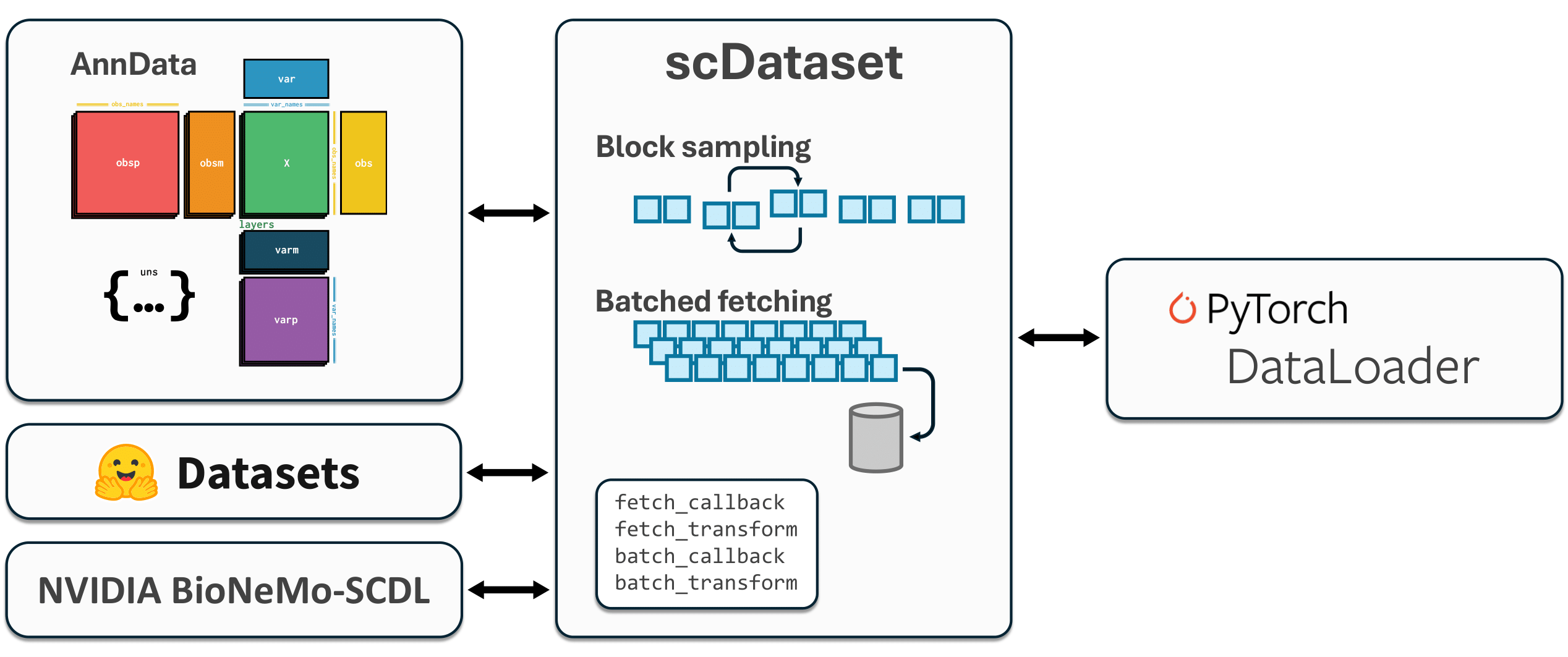
scDataset is a flexible and efficient PyTorch IterableDataset for large-scale single-cell omics datasets. It supports a variety of data formats (e.g., AnnData, HuggingFace Datasets, NumPy arrays) and is designed for high-throughput deep learning workflows. While optimized for single-cell data, it is general-purpose and can be used with any dataset.
Features
- Flexible Data Source Support: Integrates seamlessly with AnnData, HuggingFace Datasets, NumPy arrays, PyTorch Datasets, and more.
- Scalable: Handles datasets with billions of samples without loading everything into memory.
- Efficient Data Loading: Block sampling and batched fetching optimize random access for large datasets.
- Dynamic Splitting: Split datasets into train/validation/test dynamically, without duplicating data or rewriting files.
- Custom Hooks: Apply transformations at fetch or batch time via user-defined callbacks.
Installation
Install the latest release from PyPI:
pip install scDataset
Or install the latest development version from GitHub:
pip install git+https://github.com/Kidara/scDataset.git
Usage
Basic Usage with Sampling Strategies
scDataset v0.2.0 uses a strategy-based approach for flexible data sampling:
from scdataset import scDataset, Streaming
from torch.utils.data import DataLoader

# Create dataset with streaming strategy
data = my_data_collection  # Any indexable object (numpy array, AnnData, etc.)
strategy = Streaming()
dataset = scDataset(data, strategy, batch_size=64)
loader = DataLoader(dataset, batch_size=None)  # scDataset handles batching internally
Note: Set
batch_size=Nonein the DataLoader to delegate batching toscDataset.
Sampling Strategies
Sequential Sampling (Streaming)
from scdataset import Streaming

# Simple sequential access
strategy = Streaming()
dataset = scDataset(data, strategy, batch_size=64)

# Sequential with buffer-level shuffling (like Ray Dataset or WebDataset). The buffer size is equal to batch_size * fetch_factor (defined in the scDataset init)
strategy = Streaming(shuffle=True)
dataset = scDataset(data, strategy, batch_size=64, fetch_factor=8)

# Use only a subset of indices
train_indices = [0, 2, 4, 6, 8, ...]  # Your training indices
strategy = Streaming(indices=train_indices)
dataset = scDataset(data, strategy, batch_size=64)
Block Shuffling for Locality
from scdataset import BlockShuffling

# Shuffle blocks while maintaining some data locality
strategy = BlockShuffling(block_size=8)
dataset = scDataset(data, strategy, batch_size=64)

# With subset of indices
strategy = BlockShuffling(block_size=8, indices=train_indices)
dataset = scDataset(data, strategy, batch_size=64)
Weighted Sampling
from scdataset import BlockWeightedSampling

# Uniform weighted sampling
strategy = BlockWeightedSampling(total_size=10000, block_size=16)
dataset = scDataset(data, strategy, batch_size=64)

# Custom weights (e.g., for imbalanced data)
sample_weights = compute_weights(data)  # Your weight computation
strategy = BlockWeightedSampling(
    weights=sample_weights,
    total_size=5000,
    block_size=16
)
dataset = scDataset(data, strategy, batch_size=64)
Automatic Class Balancing
from scdataset import ClassBalancedSampling

# Automatically balance classes from labels
cell_types = ['T_cell', 'B_cell', 'NK_cell', ...]  # Your class labels
strategy = ClassBalancedSampling(cell_types, total_size=8000)
dataset = scDataset(data, strategy, batch_size=64)
Multi-Modal Data with MultiIndexable
Handle multiple related data modalities that need to be indexed together:
from scdataset import MultiIndexable, Streaming

# Group multiple data modalities
multi_data = MultiIndexable(
    genes=gene_expression_data,    # Shape: (n_cells, n_genes)
    proteins=protein_data,         # Shape: (n_cells, n_proteins)
    metadata=cell_metadata         # Shape: (n_cells, n_features)
)

# Use with any sampling strategy
strategy = Streaming()
dataset = scDataset(multi_data, strategy, batch_size=64)

for batch in dataset:
    genes = batch['genes']       # Gene expression for this batch
    proteins = batch['proteins'] # Corresponding protein data
    metadata = batch['metadata'] # Corresponding metadata
Performance Optimization
Configure fetch_factor to fetch multiple batches worth of data at once:
strategy = BlockShuffling(block_size=16)
dataset = scDataset(
    data,
    strategy,
    batch_size=64,
    fetch_factor=8  # Fetch 8*64=512 samples at once
)
loader = DataLoader(
    dataset,
    batch_size=None,
    num_workers=4,
    prefetch_factor=9  # fetch_factor + 1
)
We recommend setting prefetch_factor to fetch_factor + 1 for efficient data loading. For parameter details, see the original paper.
Custom Transforms and Callbacks
Apply custom transformations at fetch or batch time using the new callback system:
Transform Overview
-
fetch_callback(collection, indices):
Customizes how samples are fetched from the underlying data collection.
Use this if your collection does not support batched indexing or requires special access logic.- Input: the data collection and an array of indices
- Output: the fetched data
-
fetch_transform(fetched_data):
Transforms each fetched chunk (e.g., sparse-to-dense conversion, normalization).- Input: the fetched data
- Output: the transformed data
-
batch_callback(fetched_data, batch_indices):
Selects or arranges a minibatch from the fetched/transformed data.- Input: the fetched/transformed data and a list of batch indices within the chunk
- Output: the batch to yield
-
batch_transform(batch):
Applies final processing to each batch before yielding (e.g., collation, augmentation).- Input: the batch
- Output: the processed batch
from scdataset import scDataset, Streaming

def fetch_transform(chunk):
    # Example: convert sparse to dense, normalization, etc.
    # Applied to entire fetched chunk
    return chunk.toarray() if hasattr(chunk, 'toarray') else chunk

def batch_transform(batch):
    # Example: batch-level augmentation or tensor conversion
    import torch
    return torch.from_numpy(batch).float()

strategy = Streaming()
dataset = scDataset(
    data,
    strategy,
    batch_size=64,
    fetch_transform=fetch_transform,
    batch_transform=batch_transform
)
Complete Example with Multiple Strategies
from scdataset import scDataset, BlockShuffling, Streaming
from torch.utils.data import DataLoader
import numpy as np

# Your data
data = my_data_collection
train_indices = np.arange(0, 8000)
val_indices = np.arange(8000, 10000)

# Training with block shuffling
train_strategy = BlockShuffling(block_size=32, indices=train_indices)
train_dataset = scDataset(
    data,
    train_strategy,
    batch_size=64,
    fetch_factor=8
)

train_loader = DataLoader(
    train_dataset,
    batch_size=None,
    num_workers=4,
    prefetch_factor=9
)

# Validation with streaming (deterministic)
val_strategy = Streaming(indices=val_indices)
val_dataset = scDataset(
    data,
    val_strategy,
    batch_size=64,
    fetch_factor=8
)

val_loader = DataLoader(
    val_dataset,
    batch_size=None,
    num_workers=4,
    prefetch_factor=9
)

# Training loop
for epoch in range(num_epochs):
    # Training
    for batch in train_loader:
        # Training code here
        pass

    # Validation
    for batch in val_loader:
        # Validation code here
        pass
Citing
If you use scDataset in your research, please cite the following paper:
@article{scdataset2025,
  title={scDataset: Scalable Data Loading for Deep Learning on Large-Scale Single-Cell Omics},
  author={D'Ascenzo, Davide and Cultrera di Montesano, Sebastiano},
  journal={arXiv:2506.01883},
  year={2025}
}
Migration from v0.1.x to v0.2.0
scDataset v0.2.0 introduces breaking changes with a new strategy-based API. Here's how to migrate your code:
Old v0.1.x API
# v0.1.x - No longer supported
from scdataset import scDataset

dataset = scDataset(data, batch_size=64, block_size=8, fetch_factor=4)
dataset.subset(train_indices)
dataset.set_mode('train')
New v0.2.0 API
# v0.2.0 - Strategy-based approach
from scdataset import scDataset, BlockShuffling, Streaming

# Training with shuffling
train_strategy = BlockShuffling(block_size=8, indices=train_indices)
train_dataset = scDataset(data, train_strategy, batch_size=64, fetch_factor=4)

# Evaluation with streaming
val_strategy = Streaming(indices=val_indices)
val_dataset = scDataset(data, val_strategy, batch_size=64, fetch_factor=4)
Key Changes:
- Required strategy parameter: Must provide a
SamplingStrategyinstance - No more
subset()andset_mode(): Use strategyindicesparameter and different strategy types - Create separate datasets: For different splits instead of modifying a single instance
- New import: Import specific strategies like
Streaming,BlockShuffling, etc.
License
This project is licensed under the MIT License.
Contributing
Contributions are welcome! Please open issues or pull requests on GitHub.


Download files
Download the file for your platform. If you're not sure which to choose, learn more about installing packages.
Source Distribution
Built Distribution
Filter files by name, interpreter, ABI, and platform.
If you're not sure about the file name format, learn more about wheel file names.
Copy a direct link to the current filters
File details
Details for the file scdataset-0.2.0.tar.gz.
File metadata
- Download URL: scdataset-0.2.0.tar.gz
- Upload date:
- Size: 19.2 kB
- Tags: Source
- Uploaded using Trusted Publishing? No
- Uploaded via: twine/6.1.0 CPython/3.12.9
File hashes
| Algorithm | Hash digest | |
|---|---|---|
| SHA256 |
d01e32669f289c661d8112370e42d1324067e5056e0f9bba18c013aa5496ba7d
|
|
| MD5 |
49f84a3692b7c17fea8147b31636b791
|
|
| BLAKE2b-256 |
8b10d32c89fe5f3234a711fe3ecc16d426744adfb1a7a34cc2efd7e814eefce2
|
File details
Details for the file scdataset-0.2.0-py3-none-any.whl.
File metadata
- Download URL: scdataset-0.2.0-py3-none-any.whl
- Upload date:
- Size: 21.3 kB
- Tags: Python 3
- Uploaded using Trusted Publishing? No
- Uploaded via: twine/6.1.0 CPython/3.12.9
File hashes
| Algorithm | Hash digest | |
|---|---|---|
| SHA256 |
3f6e10421ad284a0aa7c3949ff8aae559116311a3b2643e0a45341c9fad0211f
|
|
| MD5 |
930f11de3434c6da7a0866b86713452b
|
|
| BLAKE2b-256 |
328a580def2b713cb09e996b0a4a10a61f0f5c1646795c68c55d522d9be1e7e5
|






