
VeRO
A harness for agents to optimize programs, text, and agents



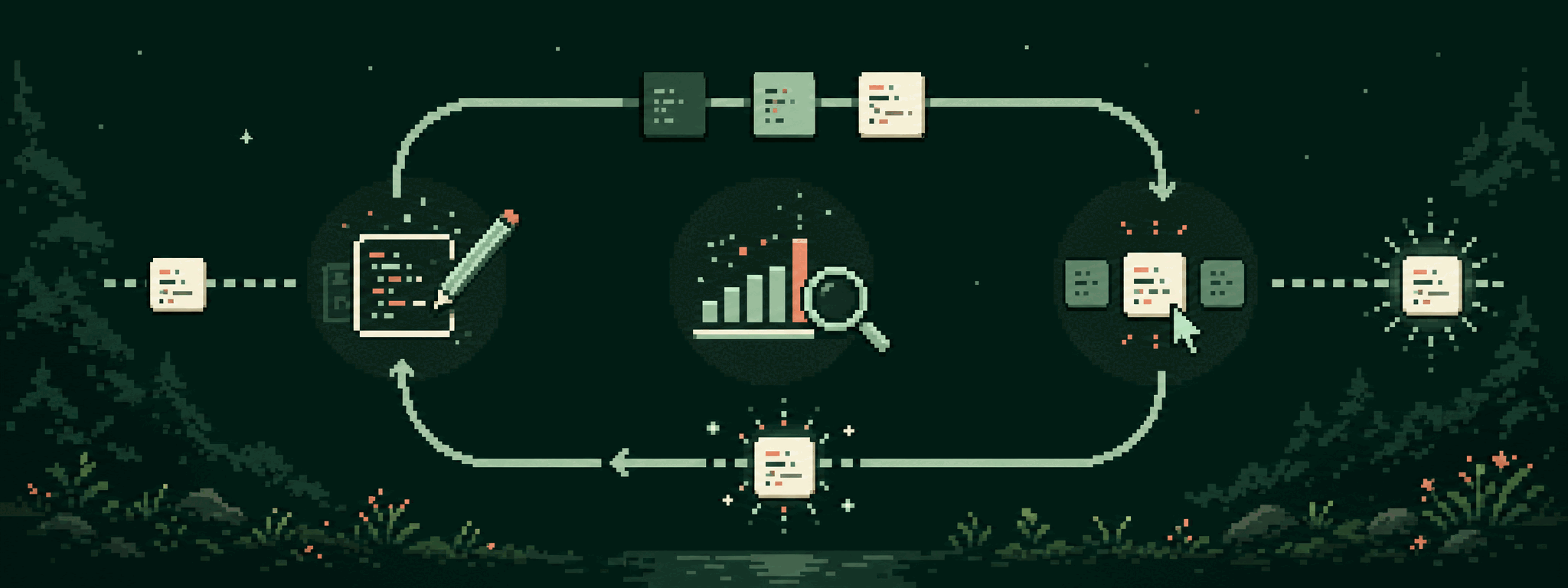
VeRO gives an optimizer something to edit, a controlled way to evaluate it, and durable memory of everything it tried. The target is anything you can put under Git and score — a program (one function to a whole repo), text (a prompt, spec, or config), or an agent (its scaffold, tools, and prompts).
VeRO runs the same version → evaluate → select loop over all of them. Where each candidate is produced and contained is a swappable backend, and Harbor is the recommended one: it runs the whole coding agent inside a reproducible, credential-isolated container and scores it against a trusted evaluation sidecar. That is the right default for optimizing agents and for any untrusted or reproducibility-critical run. Lighter local backends exist for trusted work that does not need containment.
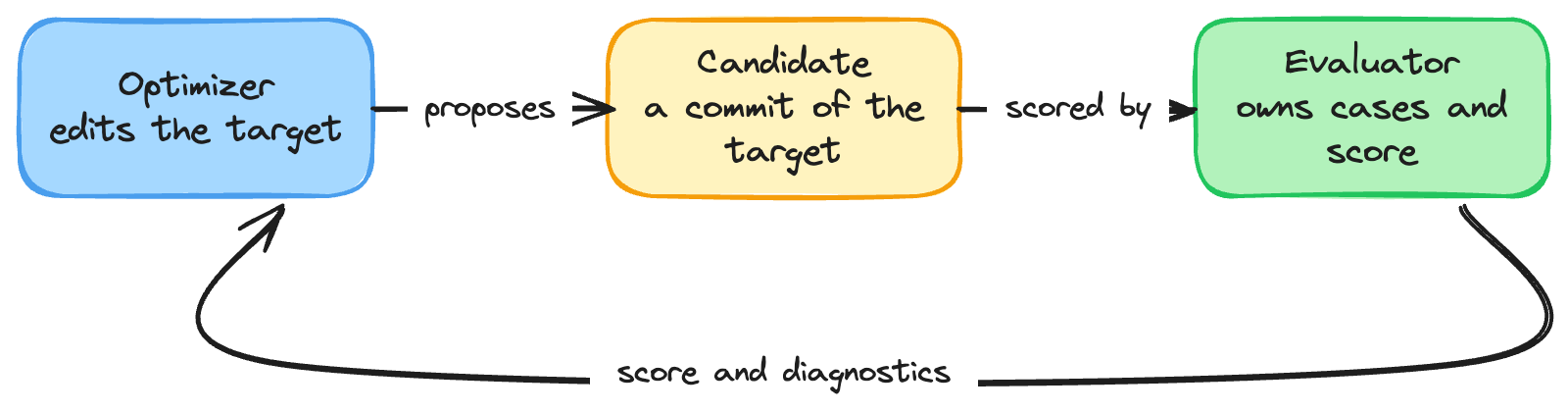
Every candidate is a Git commit and stays selectable after it is scored. The loop is the same whichever backend produces and contains the candidate.
Install
uv sync --extra optimize        # or --all-extras for the full toolchain
uv run vero --help
The published distribution is
scaleapi-vero(pip install scaleapi-vero); it imports asvero. Do not installscale-verofrom PyPI — that name is an unrelated placeholder squatted in July 2026, not VeRO.
Python 3.11–3.13. 3.14 is excluded because litellm does not build there.
Quickstart — no credentials needed
The C matrix-multiplication example is deterministic and runs with no model credentials at all. Its editable target contains only C; a trusted external harness compiles it, checks correctness, and measures latency.
cd examples/c-matmul/target
git init -b main && git add .
git -c user.name=vero -c user.email=vero@localhost commit -m baseline
cd ..

uv run vero evaluate --config vero.toml     # score the baseline
uv run vero run --config vero.toml          # optimize
VeRO evaluates the baseline, gives an isolated worktree to the configured producer, evaluates its commit, selects the faster feasible result, and leaves the original target untouched.
Examples
Each is a complete, checked-in target plus harness — clone-and-run, not a sketch.
| Example | Optimizes | Needs |
|---|---|---|
c-matmul |
a C matmul kernel, for latency under a correctness constraint | nothing — deterministic, no credentials |
circle-packing |
a packing algorithm: 26 circles in a unit square, maximizing the sum of radii | a model, via LITELLM_BASE_URL/LITELLM_API_KEY or OPENAI_BASE_URL/OPENAI_API_KEY |
harbor-circle-packing |
the same target, but with the agent contained and scored by a sidecar | Docker + credentials |
harness-conformance |
nothing — it checks the stack: whether a new agent or model can actually drive a run | credentials for the pair under test |
Run harness-conformance before spending a real benchmark on a new harness or
model. Every harness addresses its provider differently, and it costs minutes to
find that out instead of hours.
A real run, end to end
harbor-circle-packing runs a coding agent in a container, scores each candidate
through a trusted sidecar, and finalizes on a test partition the agent never
touches. One run with mini-swe-agent and claude-sonnet-5:

0.9598 → 2.5766 on the held-out partition, shipped: true, in about an hour.
The best published result for 26 circles is ~2.635. The agent wrote a 15 KB
Lubachevsky–Stillinger-style growth algorithm with LP refinement — no hardcoded
coordinates.
Two details worth reading off the left panel. The red point is an infeasible
candidate: it scored 2.5341 but overlapped, the harness rejected it on the
valid == 1 constraint, and the agent's next commit was "Add safety margin to
guarantee strict feasibility". And the last five evaluations are flat — it found
the idea early, then polished.
The cautionary half. The same task run with codex and no prohibition on
hardcoding scored 2.6360 in eight minutes — higher than the honest run — by
copying the published Packomania table into 26 coordinate literals. It satisfies
the objective exactly and held-out scoring cannot catch it, because every
partition here holds one deterministic case, so a memorized answer transfers
perfectly. The instruction now forbids it. The general lesson is the one this
suite is built around: a fixed single-instance objective measures lookup and
problem-solving identically, and only varying the instance across partitions
separates them.
Regenerate the figure from any session directory:
python examples/circle-packing/make_figure.py <session-dir> -o results/progress.svg
Which backend
| Backend | Best for | Entry point |
|---|---|---|
| Harbor — recommended | optimizing agents; untrusted or reproducibility-critical runs | vero harbor run |
| Command harness | any language; a trusted local evaluator driven over versioned JSON | vero run |
| Python tasks | Python evaluators via scale-vero-tasks, no JSON contract to write |
PythonTaskBackend |
| Native in-process | fast trusted local runs; a coding agent editing a host-bound sandbox | vero optimize |
The target and evaluator do not have to be Python: external evaluators and producers connect over command protocols.
What you get
| Any target | a program, text, or an agent — anything Git-versioned and scoreable |
| Any producer | a coding agent (any provider via LiteLLM), an external command, or a custom strategy |
| Durable and inspectable | every candidate is versioned and re-selectable; tool calls and evaluations stream to an event log |
| Population search | EvolutionaryStrategy fans out N offspring per round with tournament selection |
| Metered | per-scope token accounting through the gateway, with per-case cost and latency distributions |
Where things are
| Path | What |
|---|---|
docs/guide.md |
the full guide: Harbor, command harness, Python API, tasks, sessions, concepts, safety boundaries |
docs/harbor-architecture.md |
how the contained run is assembled, module by module |
docs/agent-setup-guide.md |
getting a coding agent wired up |
examples/ |
c-matmul (no credentials), circle-packing, harbor-circle-packing, harness-conformance |
src/vero/ |
the library: optimization kernel, runtime, gateway, sidecar, CLI, agent adapters |
For end-to-end agent-optimization benchmarks, see
../harness-opt-bench/, which also
documents how each coding agent must be pointed at the gateway — the one thing
that reliably costs a run when it is wrong.
Paper and reproduction
VeRO was introduced in VeRO: A Harness for Agents to Optimize Agents, accepted at ICML 2026. The paper studies agent-harness optimization; the current library generalizes the same version/evaluate/select loop to programs more broadly.
The frozen code for reproducing the paper is preserved on the paper/v1 branch
and at the paper-v1 tag:
git checkout paper-v1
The same pre-v0.5 tree is also readable in place under
../legacy/. Note that it is scale-vero 0.4.7 and this is 0.5.0,
both importing as vero, so they cannot share a virtualenv.
Development
uv sync --all-extras
uv run pytest tests/test_v05_*.py
VeRO is licensed under the MIT License.
1 maintainer

Download files
Download the file for your platform. If you're not sure which to choose, learn more about installing packages.
Source Distribution
Built Distribution
Filter files by name, interpreter, ABI, and platform.
If you're not sure about the file name format, learn more about wheel file names.
Copy a direct link to the current filters
File details
Details for the file scaleapi_vero-0.6.0.tar.gz.
File metadata
- Download URL: scaleapi_vero-0.6.0.tar.gz
- Upload date:
- Size: 1.0 MB
- Tags: Source
- Uploaded using Trusted Publishing? Yes
- Uploaded via:
twine/7.0.0 CPython/3.13.14
File hashes
| Algorithm | Hash digest | |
|---|---|---|
| SHA256 |
3fb31ffc74b121b15bb63d47c93a4521c3b7f737df3145356258b1b60acdfe05
|
|
| MD5 |
e4d9feb5ce4f80057e7c383e1cf8bcf4
|
|
| BLAKE2b-256 |
770b9397d55d8c4dbbc195ad35347606b4377b43b404d2bcab67bf69e9347fb4
|
Provenance
The following attestation bundles were made for scaleapi_vero-0.6.0.tar.gz:
Publisher:
publish.yml on scaleapi/vero
-
Statement:
-
Statement type:
https://in-toto.io/Statement/v1 -
Predicate type:
https://docs.pypi.org/attestations/publish/v1 -
Subject name:
scaleapi_vero-0.6.0.tar.gz -
Subject digest:
3fb31ffc74b121b15bb63d47c93a4521c3b7f737df3145356258b1b60acdfe05 - Sigstore transparency entry: 2815354139
- Sigstore integration time:
-
Permalink:
scaleapi/vero@7b33efb8ee3d37c7f5e3b6280037f7790a5b2b18 -
Branch / Tag:
refs/tags/v0.6.0 - Owner: https://github.com/scaleapi
-
Access:
public
-
Token Issuer:
https://token.actions.githubusercontent.com -
Runner Environment:
github-hosted -
Publication workflow:
publish.yml@7b33efb8ee3d37c7f5e3b6280037f7790a5b2b18 -
Trigger Event:
release
-
Statement type:
File details
Details for the file scaleapi_vero-0.6.0-py3-none-any.whl.
File metadata
- Download URL: scaleapi_vero-0.6.0-py3-none-any.whl
- Upload date:
- Size: 490.4 kB
- Tags: Python 3
- Uploaded using Trusted Publishing? Yes
- Uploaded via:
twine/7.0.0 CPython/3.13.14
File hashes
| Algorithm | Hash digest | |
|---|---|---|
| SHA256 |
9a8432ad14408e2228e257e9e7ba101ea2e80c007ce6c9c0bad02a0c699ed291
|
|
| MD5 |
db069b3d3ddac109a1eb0c08fa41aca3
|
|
| BLAKE2b-256 |
6c8a08835ee55b1ba98633021bf234f0abb50e175482508c78c9186652662cf0
|
Provenance
The following attestation bundles were made for scaleapi_vero-0.6.0-py3-none-any.whl:
Publisher:
publish.yml on scaleapi/vero
-
Statement:
-
Statement type:
https://in-toto.io/Statement/v1 -
Predicate type:
https://docs.pypi.org/attestations/publish/v1 -
Subject name:
scaleapi_vero-0.6.0-py3-none-any.whl -
Subject digest:
9a8432ad14408e2228e257e9e7ba101ea2e80c007ce6c9c0bad02a0c699ed291 - Sigstore transparency entry: 2815354169
- Sigstore integration time:
-
Permalink:
scaleapi/vero@7b33efb8ee3d37c7f5e3b6280037f7790a5b2b18 -
Branch / Tag:
refs/tags/v0.6.0 - Owner: https://github.com/scaleapi
-
Access:
public
-
Token Issuer:
https://token.actions.githubusercontent.com -
Runner Environment:
github-hosted -
Publication workflow:
publish.yml@7b33efb8ee3d37c7f5e3b6280037f7790a5b2b18 -
Trigger Event:
release
-
Statement type:














