
scanfuse



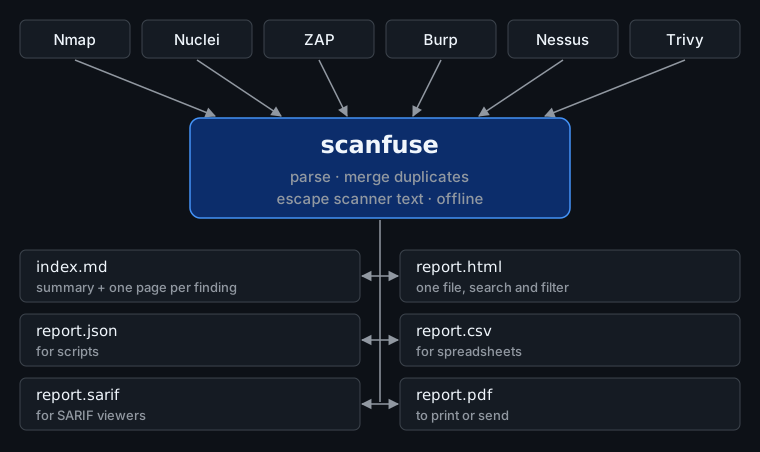
scanfuse parses output from Nmap, Nuclei, OWASP ZAP, Burp Suite, Nessus and Trivy, merges duplicate findings across scanners, and writes a single report as Markdown (with an index and a standalone HTML page), JSON, CSV, SARIF or PDF. It runs offline and makes no network calls.
Release notes are in CHANGELOG.md.
Example
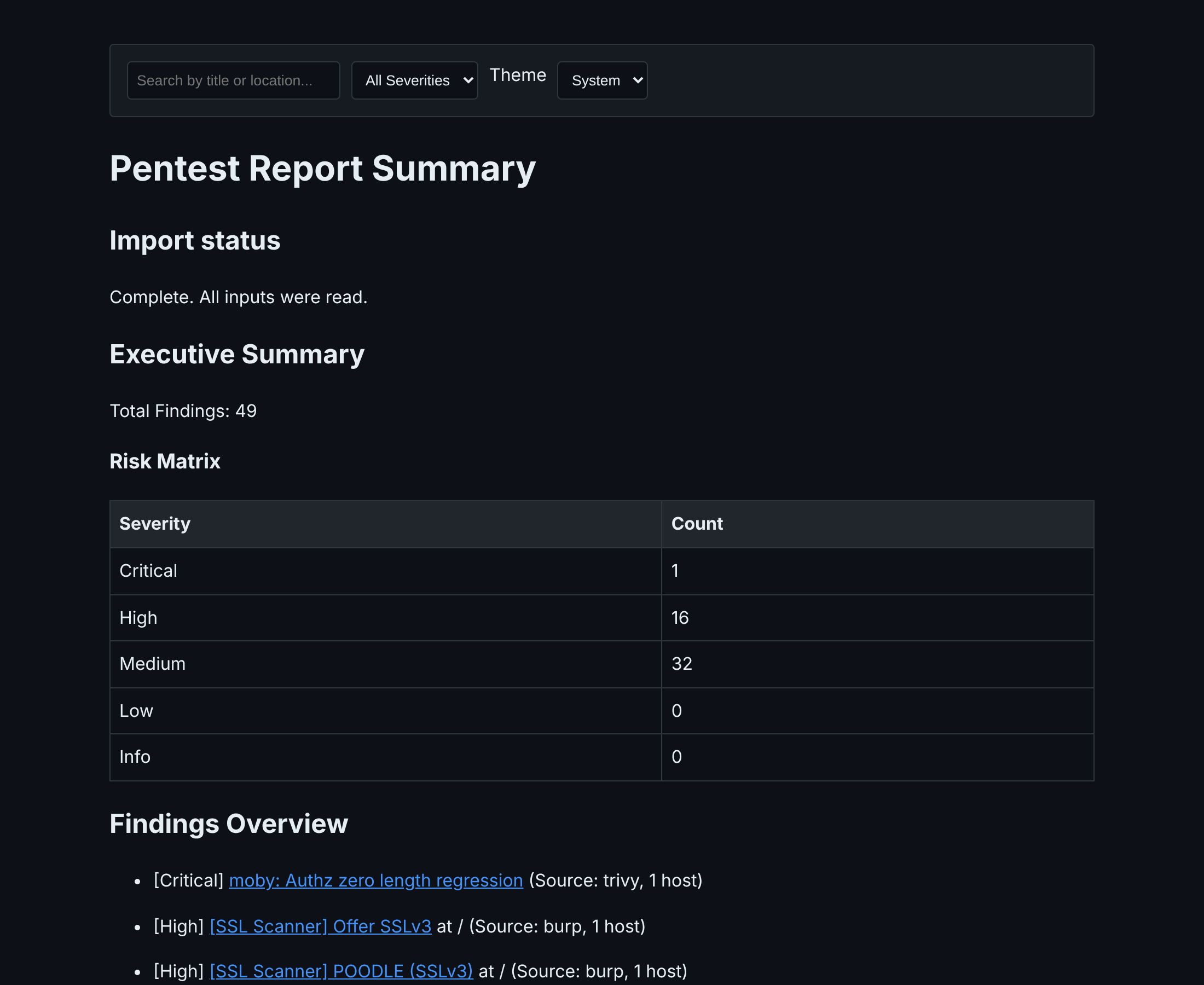
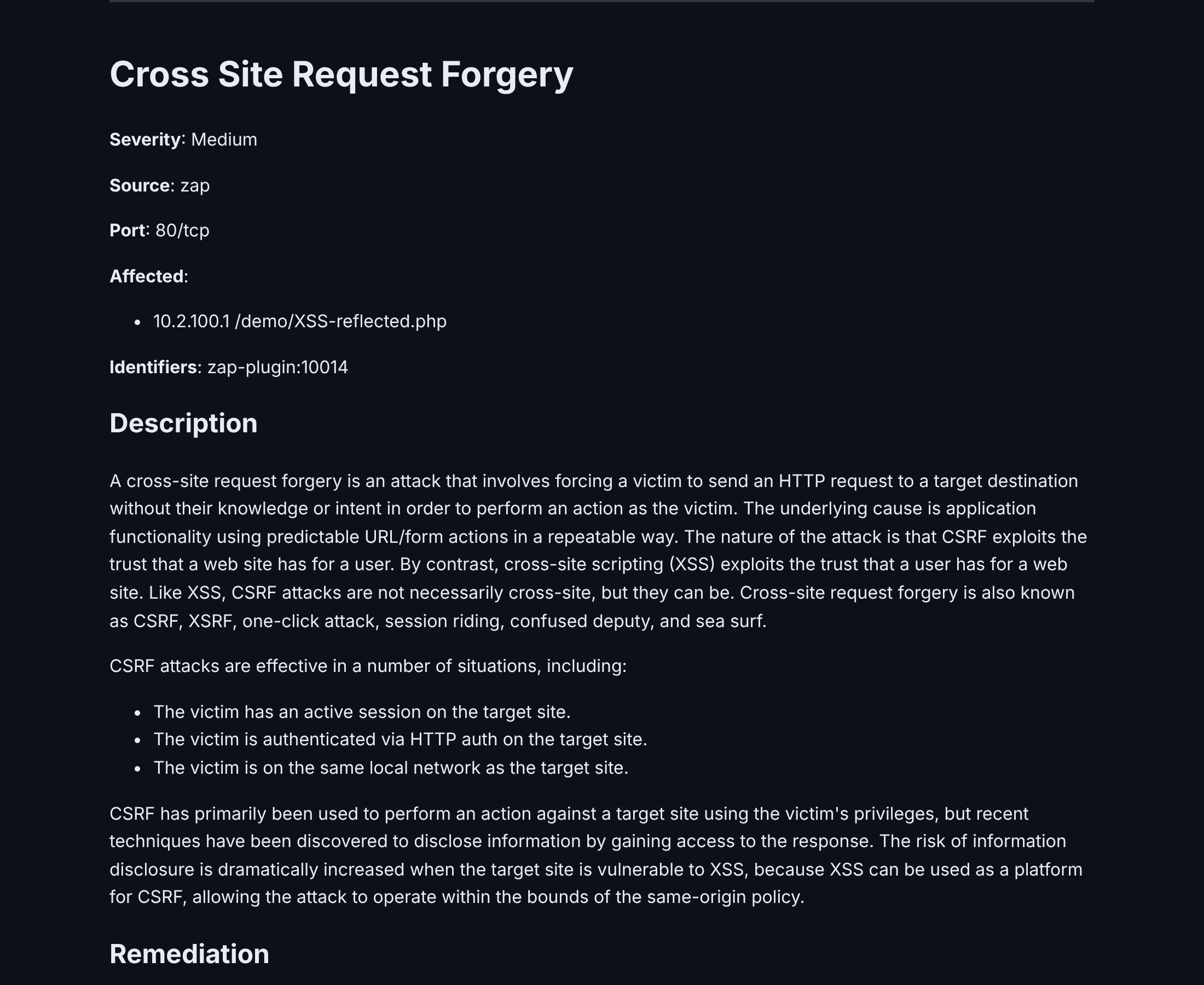
report.html follows the light or dark setting of your system by default. The Theme menu switches between System, Light and Dark and remembers the choice in the browser. The screenshots show the dark theme.
The report above was made from six real scan files from five tools (Nmap, ZAP, Trivy, Burp, Nessus). The input files, the command and the full report are in examples/.
Install
You need Python 3.12 or newer.
pipx install scanfuse                                   # from PyPI
pipx install git+https://github.com/gencay-e/scanfuse   # latest state from GitHub
pip install scanfuse works as well. From a checkout of this repository: pipx install .
Ready-made programs for Linux, Windows and macOS (no Python needed) are on the Releases page, with a SHA256SUMS file. To build one yourself, see Build a standalone program.
Use
scanfuse scan.xml -o report
scanfuse nmap.xml nuclei.json zap.xml -o report
scanfuse scan.json -f trivy --format-out json -o report
scanfuse scan.xml --min-severity High --host 192.0.2.1 -o report
cat scan.json | scanfuse -o report
scanfuse takes one or more files, or - for standard input. It detects nmap, nuclei, zap, burp, nessus and trivy files by itself. Use -f to choose the format. The experimental formats below are never detected automatically and always need -f.
| Option | Meaning |
|---|---|
-f, --format |
Input format. auto (default) detects nmap, nuclei, zap, burp, nessus and trivy. sarif, semgrep, grype, nikto and testssl are experimental and must be set explicitly. |
-o, --output |
Output directory. Default report. |
--format-out |
markdown (default), json, csv, sarif or pdf. markdown writes one file per finding, index.md and report.html. |
-s, --min-severity |
Critical, High, Medium, Low or Info. Case does not matter. |
--host |
Only findings on this host. Must match the IP or host name exactly, ignoring case. * and ? are wildcards, for example 10.0.0.*. |
-t, --template-dir |
Folder with your own finding.md.j2 and index.md.j2. The folder must exist. Missing files fall back to the built-in templates. |
--replace |
Overwrite an existing report. See below. |
--csv-excel |
CSV with a byte order mark and ; as separator, which German-language Excel expects. |
--version |
Print the version. |
Experimental input formats
These formats are new in 1.0.0 and are tested with sample files written from the tools' documented output, not yet with files from real scans. Set the format with -f:
-f |
Tool and file |
|---|---|
sarif |
Any SARIF 2.1.0 file (CodeQL, Semgrep --sarif and others). The title is the rule's short description or name, the result message goes into the description. |
semgrep |
Semgrep --json |
grype |
Grype -o json. CVSS score and vector are taken from the highest valid score. |
nikto |
Nikto -Format json (a list of hosts) and -Format xml. CSV is read, but not tested. |
testssl |
testssl.sh --jsonfile and --jsonfile-pretty. OK, INFO and WARN lines are skipped; FATAL marks the file as unreadable. |
scanfuse results.sarif -f sarif -o report
scanfuse testssl.json -f testssl -o report
If a file is read wrongly, open an issue with a cleaned sample.
Existing reports
scanfuse never overwrites files by accident. If the output directory already contains a file that the new report would write, it stops with exit code 2 and changes nothing. Add --replace to overwrite the report. With --replace, files of the earlier report that are no longer part of it are removed. Files that scanfuse did not write are left alone.
The report is built in a temporary folder first. If moving the files fails, scanfuse tries to restore the old report. If restoration also fails, the error gives the location of the retained backup. A process or system crash during replacement can still leave a mixed report.
Incomplete runs
If one input file cannot be read, scanfuse still writes the findings from the other files and exits with code 1. The report says so:
report.json:"complete": falseand the list oferrors.index.mdandreport.html: an INCOMPLETE notice with the errors.report.csv: the columnImport Statussaysincomplete (...)in every row.
An invalid .scanfuse.yaml counts as an error too. The report is then incomplete, because ignore rules were not applied.
Exit codes
| Code | Meaning |
|---|---|
| 0 | Complete. |
| 1 | Incomplete or failed: an input could not be read, .scanfuse.yaml is invalid, nothing could be written, or no input was given. |
| 2 | Invalid option, or the output files already exist (use --replace). |
Merging duplicates
Findings from several files are merged when they are the same finding:
- the titles are equal, ignoring case and surrounding spaces,
- they carry the same CVE or GHSA ids,
- they have the same port, and
- the same tool does not give them different tool ids (for example two Nessus plugin ids).
Titles that are only similar are not merged. A merged finding keeps all hosts and all evidence. Evidence shows which tool reported it. What each tool wrote (description, remediation, severity, CVSS score and vector, ids) is listed under Reported by in the Markdown and in sources in the JSON. The summary severity is the highest of all reports. The summary CVSS score is the highest score, together with its own vector. If the tools give CVSS vectors with different base metrics, cvss_merge_conflict is true in the JSON.
Output
JSON
report.json is an object:
{
  "schema_version": 2,
  "complete": true,
  "errors": [],
  "findings": [ { "title": "...", "severity": "High", "identifiers": ["CVE-2024-0001"], "port": "443/tcp", "sources": [] } ]
}
CSV
Columns: Title, Severity, CVSS, Hosts, Source Tool, Description, Remediation, Evidence, CVSS Vector, Port, Identifiers, References, Other Reports, Import Status. Hosts shows ip (host name) when a host name is known.
Cells that start with =, +, - or @ get a leading ' to reduce the risk of spreadsheet formulas. This also covers look-alike characters such as a full-width = and a leading no-break space. These cases were tested by reading the files back.
In Excel, import --csv-excel output with Data > From Text/CSV and use the semicolon delimiter. Disable automatic data type detection and check the imported values before using them: in one Excel test, automatic detection changed the host 192.0.2.1 to 192021. Disabling detection can leave numeric values as text. In an earlier Windows Excel test, this import preserved a multiline evidence field; the older Text Import Wizard split it across rows. Formula handling and LibreOffice remain unverified in those applications.
SARIF
--format-out sarif writes report.sarif (SARIF 2.1.0) with one rule per finding, for tools that read SARIF, such as GitHub code scanning.
--format-out pdf writes report.pdf with a summary page and one page per finding. It uses a Unicode font of the system (Arial or Segoe UI on Windows, DejaVu, FreeSans or Liberation on Linux, Arial on macOS). Without one, characters outside Latin-1 are replaced by ?. The PDF is slow for large scans: 5,000 findings took 40 seconds and made a 3.6 MB file. Use Markdown, JSON or CSV for very large reports.
Scanner text in the report
Scanner output is untrusted. scanfuse treats it like this:
- Titles, host names, ids and tool names are shown as plain text. They cannot add links, headings or HTML.
- Descriptions and remediation text keep Markdown formatting, including links. Raw HTML is escaped, and the text cannot create a heading. A link in a scanner description is shown as the scanner wrote it, so check it before you click.
- Evidence is shown unchanged in a code block.
- The HTML page removes scripts, images, frames and
javascript:links. - XML with entity declarations is rejected.
Configuration: .scanfuse.yaml
scanfuse reads .scanfuse.yaml from the current directory.
ignore_titles:
  - "Wappalyzer"
  - "Header Missing"
Findings whose title contains one of these texts (ignoring case) are left out. ignore_titles must be a list of strings. A single string is read as a list with one entry. Anything else, a file that is not a mapping, or a YAML syntax error is reported as an error and the rules are not applied.
overrides change the severity of matching findings or add tags, exclusions leave matching findings out:
overrides:
  - cve: CVE-2024-1234          # matches any id of the finding (CVE, GHSA, tool id)
    severity: High               # Critical, High, Medium, Low or Info
    tags: [confirmed]
  - host: "10.0.0.*"
    port: "443/tcp"
    severity: Low
exclusions:
  - tool_id: "10202"
  - host: "test-*.example.test"
A rule matches when all of its keys match: cve and tool_id against the finding's ids (ignoring case), port exactly, host against IP or host name with * and ?. A rule without any of these keys matches nothing. Overrides are applied in order, so a later rule wins. Overrides and exclusions are applied after merging and before --min-severity and --host, so a raised severity is not filtered out. overrides or exclusions that are not lists are reported as an error.
Build a standalone program
uv sync --extra dev
uv run python build.py
The program is written to dist/. To check it against the test suite:
SCANFUSE_EXE=dist/scanfuse uv run pytest tests/test_packaged_cli.py     # Linux, macOS
$env:SCANFUSE_EXE = (Resolve-Path .\dist\scanfuse.exe).Path             # Windows PowerShell
A program built on Linux depends on the C library of the system it was built on. Build on the oldest system you want to support.
Development
uv sync --locked --extra dev
uv run ruff check .
uv run mypy scanfuse
uv run pytest tests/
Limits
- scanfuse was tested with real output from nmap (7.94, 7.12, 6.40), ZAP 1.4, Burp, Nessus and Trivy (three file layouts), taken from the public DefectDojo sample-scan-files. Those files are old. Newer versions of the tools may add fields that scanfuse does not read yet. Nuclei has no real sample file in the tests. Open an issue with a cleaned sample if a file fails.
- Format detection looks at the start of the file and only knows the six stable formats. Use
-fif it guesses wrong. - The experimental formats (SARIF, Semgrep, Grype, Nikto, testssl.sh) have no real scan files in the tests yet.
- The HTML page and the CSV file were checked by reading the files. They were not opened by hand in a browser, Excel or LibreOffice.
- 100,000 results were processed completely in all three output formats on one Linux machine (4 CPUs, 16 GB). JSON took 14 seconds, CSV 10 seconds, Markdown with HTML 124 seconds, and the peak memory was between 0.7 and 1.0 GB. The HTML page for that many findings is large. You can repeat the check with
python tools/large_check.py 100000. - Standalone programs are built and tested in CI on Ubuntu 22.04 (x86_64), Windows (x86_64) and macOS (arm64). Other Linux distributions, Linux on ARM and macOS on Intel were not tested.
License
MIT, see LICENSE. The standalone programs include third-party packages, among them fpdf2 (LGPL-3.0). Their licenses are in THIRD_PARTY_LICENSES.txt in each release archive.
1 maintainer

Metadata
1 maintainer
Release files for scanfuse 1.0.2
For a detailed explanation of source distributions (sdists) and built distributions (wheels), please see the package formats documentation.
Source distribution (sdist)
| File | Size | Uploaded | Provenance | Actions |
|---|---|---|---|---|
| scanfuse-1.0.2.tar.gz | 798.6 kB | With provenance | Details for scanfuse-1.0.2.tar.gz |
Built distribution (wheel)
| File | Interpreter | ABI | Platform | Actions Reset |
|---|---|---|---|---|
| scanfuse-1.0.2-py3-none-any.whl | Python 3 | none | any | Details for scanfuse-1.0.2-py3-none-any.whl |
Total release size: 851.0 kB
Release files / scanfuse-1.0.2.tar.gz
| Download URL | scanfuse-1.0.2.tar.gz |
|---|---|
| Size | 798.6 kB |
| Tags | Source |
|
SHA-256 checksum How to use checksums |
774564ccce1650167658010a96f98c74d6bb6b5de86cba82fcc91590c7ad1bd0
|
|
BLAKE2b-256 checksum How to use checksums |
f45c1eea2c45cff0f5ded2da262031e8099ece522f29872214e75622639268f7
|
| Upload date | |
|
Uploaded using Trusted Publishing? What is trusted publishing? |
Yes |
| Uploaded via |
twine/7.0.0 CPython/3.13.16
|
Provenance
Provenance describes where a file came from. On PyPI, provenance is shared via attestations, which provide a verifiable record of the build or publishing details. View details, limitations and caveats.


PyPI Publish Attestation
PyPI verified that this artifact, at this checksum, originated from the publisher listed below.
Signed by GitHub Actions, verified by PyPI on Nov 12, 2026.
Transparency logRelease files / scanfuse-1.0.2-py3-none-any.whl
| Download URL | scanfuse-1.0.2-py3-none-any.whl |
|---|---|
| Size | 52.4 kB |
| Tags | Python 3 |
|
SHA-256 checksum How to use checksums |
de0d03e4e78f52b7eecc6bcf7bf5a48ab84cb1cb9f84eb5f2462148aa8818048
|
|
BLAKE2b-256 checksum How to use checksums |
cd5b1207bac78e1c0ef24dd65fcff24f8a85a95060cc155a54c5af82dda46622
|
| Upload date | |
|
Uploaded using Trusted Publishing? What is trusted publishing? |
Yes |
| Uploaded via |
twine/7.0.0 CPython/3.13.16
|
Provenance
Provenance describes where a file came from. On PyPI, provenance is shared via attestations, which provide a verifiable record of the build or publishing details. View details, limitations and caveats.
PyPI Publish Attestation
PyPI verified that this artifact, at this checksum, originated from the publisher listed below.
Signed by GitHub Actions, verified by PyPI on Nov 12, 2026.
Transparency logSecurity for scanfuse 1.0.2
Provenance
Provenance describes where a file came from. On PyPI, provenance is shared via attestations, which provide a verifiable record of the build or publishing details. View details, limitations and caveats.
Full provenance
Both files in this release have been uploaded with provenance metadata.
Attestation for scanfuse-1.0.2.tar.gz
PyPI Publish Attestation
PyPI verified that this artifact, at this checksum, originated from the publisher listed below.
Signed by GitHub Actions, verified by PyPI on Nov 12, 2026.
Transparency logA note on package security
PyPI is a repository for distributing packages, not a service for auditing them. While third-party security researchers and our staff do their best to detect and remove malicious packages, PyPI cannot guarantee the quality, security or suitability of any given package.
To learn more about protecting yourself from malicious actors, visit our package security documentation.














