
Parameter calibration using Shuffle Complex Evolution algorithm.
Verified details
These details have been verified by PyPIProject links
GitHub Statistics
Maintainers

Project description
SCE-UA: Parameter Calibration with Shuffle Complex Evolution Algorithm








SCE-UA is a lightweight Python package that implements the Shuffled Complex Evolution (SCE-UA) algorithm for parameter calibration of hydrological models. Built on NumPy and SciPy, it's designed for seamless integration into existing Python workflows while providing robust global optimization capabilities.
Full documentation is available at sceua.readthedocs.io.
🌟 Features
The major improvements over the original SCE-UA algorithm include:
- Adaptive smoothing parameter (theta) based on problem scale, which helps with numerical stability and convergence
- Latin Hypercube Sampling for initial population generation instead of uniform random sampling, providing better coverage of the parameter space
- PCA-based recovery mechanism to identify and recover lost dimensions in the population (from Chu et al. 2010)
- Best solution inclusion in every complex to accelerate convergence
- Optimized complex evolution strategy with improved reflection, contraction, and mutation operations
- Automatic parameter determination with sensible defaults based on problem dimensionality
- Multithreading support for parallel evaluation of the objective function
- Comprehensive convergence criteria including function value tolerance, parameter tolerance, and maximum iterations
- Detailed results object that provides comprehensive information about the optimization process
- Type hinting and modern Python implementation following best practices for better code maintainability
📦 Installation
Choose your preferred installation method:
Using pip
pip install sceua
Using micromamba (recommended)
micromamba install -c conda-forge sceua
Alternatively, you can use conda or mamba.
🚀 Quick Start Guide
The SCE-UA package has one main function called minimize, which is used to optimize a
given objective function. The API follows a similar pattern to scipy.optimize.minimize
for easy adoption.
Key Parameters
The most important tuning parameters are n_complexes and n_points_complex for all
cases, and pca_freq and pca_tol for cases with highly correlated parameters and/or
high-dimensional problems. The default values are set to reasonable defaults, but you
can adjust them based on your specific problem, if needed. Please refer to the
API reference for more details.
Example Usage
The signature for the objective function can be either:
def objective(params: FloatArray) -> float:
    """Objective function to minimize."""
    # Your implementation here
or
def objective(params: FloatArray, *args: Any) -> float:
    """Objective function to minimize."""
    # Your implementation here
where params is a NumPy array of parameters to optimize, and args is a tuple of
additional arguments to pass to the objective function. The function should return a
single floating-point value representing the objective function value.
Here's a simple example of how to use the package:
from typing import Any
import numpy as np
from numpy.typing import NDArray

import sceua

FloatArray = NDArray[np.floating[Any]]


def objective(params: FloatArray, *args: Any) -> float:
    """Objective function to minimize."""
    sim_arg1, sim_arg2, obs = args
    sim = simulation_func(params, sim_arg1, sim_arg2)
    return metric_func(sim, obs)


# Define parameter bounds as a sequence of (min, max) pairs
bounds = [(lower1, upper1), (lower2, upper2), ..., (lowerN, upperN)]

# Run optimization
result = sceua.minimize(objective, bounds, args=(sim_arg1, sim_arg2, obs), seed=42, max_workers=8)

# Access the optimization results
best_params = result.x
best_function_value = result.fun
num_iterations = result.nit
num_function_evaluations = result.nfev
Result Object
The result object contains the following attributes:
x(numpy.ndarray): Best parameters found.fun(float): Best function value corresponding to the best parameters.nit(int): Number of iterations.nfev(int): Number of function evaluations.message(str): Message describing the termination reason.success(bool): Whether the optimization was successful.xv(numpy.ndarray): All evaluated parameter sets.funv(numpy.ndarray): Function values for all evaluated parameter sets.
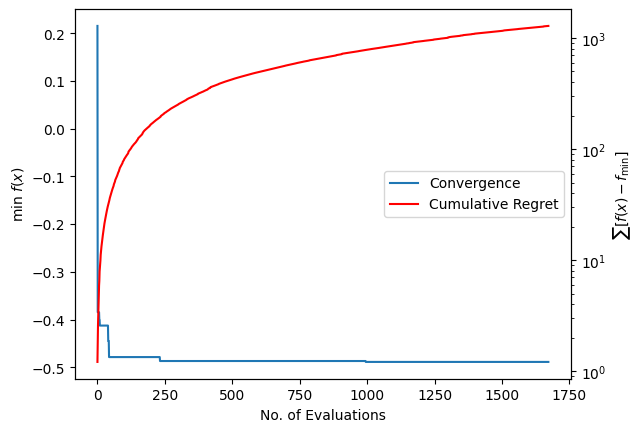
Visualization
The result attributes can be used to create convergence plots and analyze optimization performance:
import matplotlib.pyplot as plt


_, ax1 = plt.subplots()
ax1.plot(np.minimum.accumulate(results.funv))
ax2 = ax1.twinx()
ax2.set_yscale("log")
ax2.plot(np.cumsum(results.funv - true_min), color="r")
Check the docs for more examples and API details.
📚 References
This package is based on the following references:
- Duan, Q., Sorooshian, S., & Gupta, V. K. (1992). Effective and efficient global optimization for conceptual rainfall-runoff models. Water Resources Research, 28(4), 1015-1031. doi:10.1029/91WR02985
- Duan, Q., Gupta, V. K., & Sorooshian, S. (1994). Optimal use of the SCE-UA global optimization method for calibrating watershed models. Journal of Hydrology, 158(3-4), 265-284. doi:10.1016/0022-1694(94)90057-4
- Duan, Q., Sorooshian, S., & Gupta, V. K. (1994). A shuffled complex evolution approach for effective and efficient global minimization. Journal of optimization theory and applications, 76(3), 501-521. doi:10.1007/BF00939380
- Muttil, N., & Jayawardena, A. W. (2008). Shuffled Complex Evolution model calibrating algorithm: enhancing its robustness and efficiency. Hydrological Processes, 22(23), 4628-4638. Portico. doi:10.1002/hyp.7082
- Chu, W., Gao, X., & Sorooshian, S. (2010). Improving the shuffled complex evolution scheme for optimization of complex nonlinear hydrological systems: Application to the calibration of the Sacramento soil-moisture accounting model. Water Resources Research, 46(9). Portico. doi:10.1029/2010wr009224
Additionally, some ideas were inspired by UQPyL and SAMBO Python packages.
🤝 Contributing
We welcome contributions! Please see the contributing section for guidelines and instructions.
📄 License
This project is licensed under the MIT License - see the LICENSE file for details.
Project details
Verified details
These details have been verified by PyPIProject links
GitHub Statistics
Maintainers
Release history Release notifications | RSS feed

Download files
Download the file for your platform. If you're not sure which to choose, learn more about installing packages.
Source Distribution
Built Distribution
Filter files by name, interpreter, ABI, and platform.
If you're not sure about the file name format, learn more about wheel file names.
Copy a direct link to the current filters
File details
Details for the file sceua-0.1.0.tar.gz.
File metadata
- Download URL: sceua-0.1.0.tar.gz
- Upload date:
- Size: 438.9 kB
- Tags: Source
- Uploaded using Trusted Publishing? Yes
- Uploaded via: twine/6.1.0 CPython/3.12.9
File hashes
| Algorithm | Hash digest | |
|---|---|---|
| SHA256 |
c5eafe6569747112b1227e7c80521bdcf4b02cbfa9408f5af0ad9225846e1a6f
|
|
| MD5 |
129e12dcabb04843b631b4034a8d87fb
|
|
| BLAKE2b-256 |
94c07b5bfdf41cabcb8266982d29eae132601803f96a7d66fcb5f7a510dda511
|
Provenance
The following attestation bundles were made for sceua-0.1.0.tar.gz:
Publisher:
release.yml on cheginit/sceua
-
Statement:
-
Statement type:
https://in-toto.io/Statement/v1 -
Predicate type:
https://docs.pypi.org/attestations/publish/v1 -
Subject name:
sceua-0.1.0.tar.gz -
Subject digest:
c5eafe6569747112b1227e7c80521bdcf4b02cbfa9408f5af0ad9225846e1a6f - Sigstore transparency entry: 180406476
- Sigstore integration time:
-
Permalink:
cheginit/sceua@592c12632799053150d2dfc3ab8983cc923f095b -
Branch / Tag:
refs/tags/v0.1.0 - Owner: https://github.com/cheginit
-
Access:
public
-
Token Issuer:
https://token.actions.githubusercontent.com -
Runner Environment:
github-hosted -
Publication workflow:
release.yml@592c12632799053150d2dfc3ab8983cc923f095b -
Trigger Event:
push
-
Statement type:
File details
Details for the file sceua-0.1.0-py3-none-any.whl.
File metadata
- Download URL: sceua-0.1.0-py3-none-any.whl
- Upload date:
- Size: 11.4 kB
- Tags: Python 3
- Uploaded using Trusted Publishing? Yes
- Uploaded via: twine/6.1.0 CPython/3.12.9
File hashes
| Algorithm | Hash digest | |
|---|---|---|
| SHA256 |
6136026356e04af0e73c0a8da05a4e0dc1cf2b72002af12cd4d70834dea4f03a
|
|
| MD5 |
5ed3ef5f247ff07248998c9d41defd35
|
|
| BLAKE2b-256 |
8be9905508ac9697144a66597514fa4b8728a30f5e9503eec1da35b6a3f82d11
|
Provenance
The following attestation bundles were made for sceua-0.1.0-py3-none-any.whl:
Publisher:
release.yml on cheginit/sceua
-
Statement:
-
Statement type:
https://in-toto.io/Statement/v1 -
Predicate type:
https://docs.pypi.org/attestations/publish/v1 -
Subject name:
sceua-0.1.0-py3-none-any.whl -
Subject digest:
6136026356e04af0e73c0a8da05a4e0dc1cf2b72002af12cd4d70834dea4f03a - Sigstore transparency entry: 180406478
- Sigstore integration time:
-
Permalink:
cheginit/sceua@592c12632799053150d2dfc3ab8983cc923f095b -
Branch / Tag:
refs/tags/v0.1.0 - Owner: https://github.com/cheginit
-
Access:
public
-
Token Issuer:
https://token.actions.githubusercontent.com -
Runner Environment:
github-hosted -
Publication workflow:
release.yml@592c12632799053150d2dfc3ab8983cc923f095b -
Trigger Event:
push
-
Statement type:






