
Computing Littlewood-Richardson coefficients of Schubert polynomials

Project description
schubmult
Program and package for computing Littlewood-Richardson coefficients of Schubert polynomials
This is a set of python scripts written by Matt Samuel for computing Littlewood-Richardson coefficients of (ordinary or double) Schubert polynomials. It has the same command line syntax as the program "schubmult" in lrcalc by Anders Buch. Example:
schubmult_py 1 2 4 9 11 6 8 12 3 5 7 10 - 6 8 1 2 3 4 7 10 12 14 5 9 11 13
schubmult_double 1 3 4 6 2 5 - 2 1 5 7 3 4 6
schubmult_yz 1 3 4 6 2 5 - 2 1 5 7 3 4 6
Runtime will vary tremendously by case. The general problem is #P-hard. Though the result is always nonnegative and the problem is in GapP, it is not known to be in #P at this time.
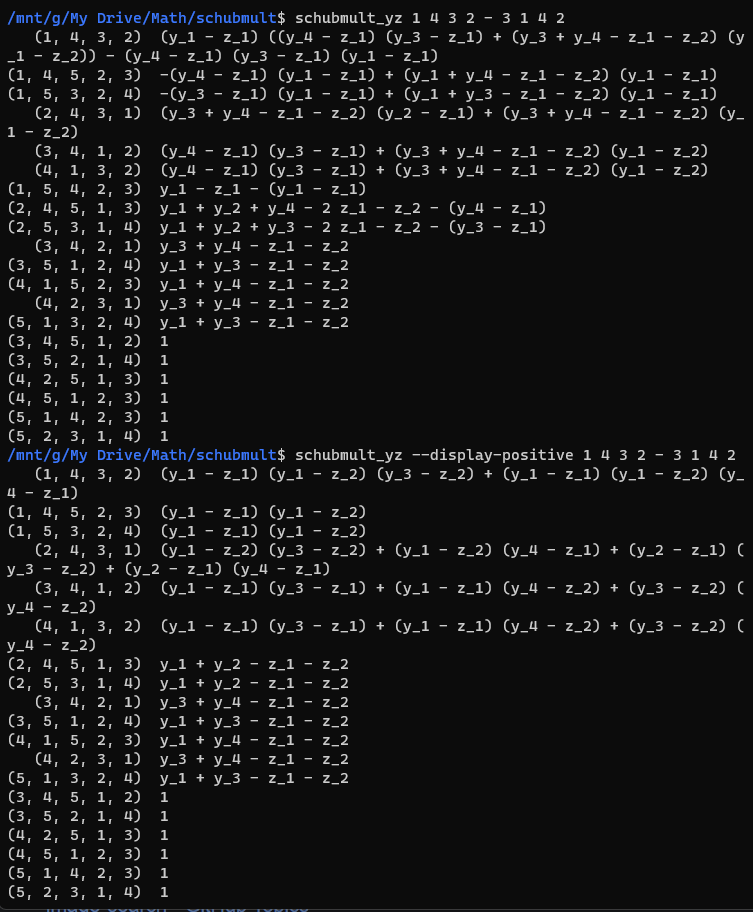
schubmult_py is for multiplying ordinary Schubert polynomials. schubmult_yz is for multiplying double Schubert polynomials in different sets of coefficient variables (labeled y and z), and schubmult_double is for multiplying double Schubert polynomials in the same set of coefficient variables. Both have the same command line syntax as schubmult. schubmult_double displays the result with nonnegative coefficients in terms of the negative simple roots. Both are of course slower than schubmult_py, and expressing the result positively for schubmult_double slows it down even more.
When imported as a python package, the relevant packages are schubmult.perm_lib, which has various permutation manipulation functions, and three modules that have functions of the same name (function name is "schubmult"): schubmult.schubmult_py, schubmult.schubmult_yz, schubmult.schubmult_double. Function takes a permutation dictionary (keys are tuples of ints, which must be trimmed permutations, and values are either integers or symengine values, which can also be integers) as well as a permutation as its second argument, which is the (double) Schubert polynomial to multiply by. Returns a dictionary of the same form with the coefficients.
from schubmult.schubmult_yz import schubmult

coeff_dict = schubmult({(1,3,4,6,2,5): 1},(2,1,5,7,3,4,6)) # outputs dictionary with results
from schubmult.schubmult_py import schubmult

coeff_dict = schubmult({(1,3,4,6,2,5): 1},(2,1,5,7,3,4,6))
Note versions 1.0.15 and prior had a bug that failed to upgrade the executable. The coefficients it computed were correct, but it was not using the updated version.
Version 1.0.18 adds the command line argument --display-positive to schubmult_yz, which displays the result positively (if possible, this is still only always possible conjecturally). This is highly processor intensive.
Release history Release notifications | RSS feed


Download files
Download the file for your platform. If you're not sure which to choose, learn more about installing packages.
Source Distribution
File details
Details for the file schubmult-1.0.20.tar.gz.
File metadata
- Download URL: schubmult-1.0.20.tar.gz
- Upload date:
- Size: 22.6 kB
- Tags: Source
- Uploaded using Trusted Publishing? No
- Uploaded via: twine/4.0.2 CPython/3.11.0rc1
File hashes
| Algorithm | Hash digest | |
|---|---|---|
| SHA256 |
7ea6eabcb44c34f85e233632cc49c54cab2d194d4e99b1a52b10b787ef1ffb09
|
|
| MD5 |
2cb670dd3fd2de876a7e3c3a2e1e0610
|
|
| BLAKE2b-256 |
9a818ad0f7a889ed1cc96100511fc2a61e495450c14f0efe9e90332a79cba364
|






