

- Explore scientific data with a set of tools for human-guided or automated discovery
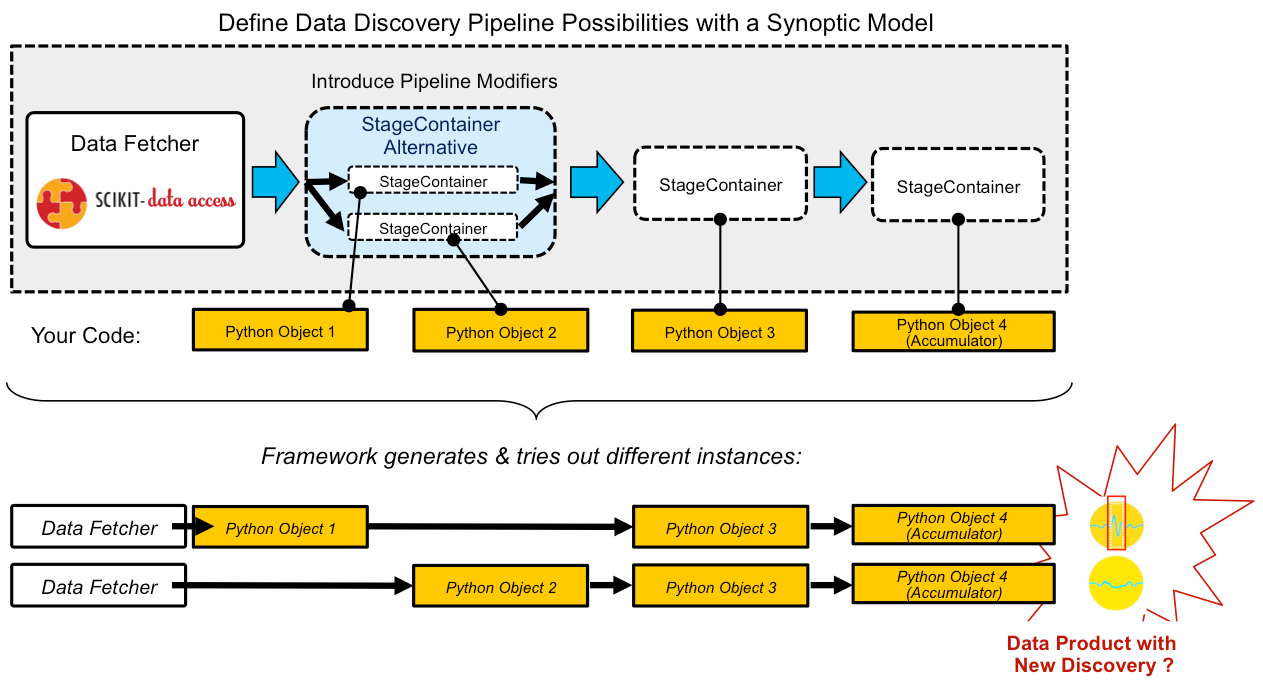
- Design & configure data processing pipelines
- Define the parameter ranges for your algorithms, available algorithmic choices, and the framework will generate pipeline instances for you
- Use automatically perturbed data processing pipelines to create different data products.
- Easy to use with scikit-dataaccess for integration of a variety of scientific data sets
Install
pip install scikit-discovery
Documentation
See https://github.com/MITHaystack/scikit-discovery/tree/master/skdiscovery/docs
Contributors
Project lead: Victor Pankratius (MIT)
Contributors: Cody M. Rude, Justin D. Li, David M. Blair, Michael G. Gowanlock, Evan Wojciechowski, Victor Pankratius
Acknowledgements
We acknowledge support from NASA AIST14-NNX15AG84G, NASA AIST16-80NSSC17K0125, NSF ACI-1442997, NSF AGS-1343967, and Amazon AWS computing access support.
Examples
Example code with complete science case studies are available as Jupyter Notebooks at:
1 maintainer

Metadata
1 maintainer
Release files for scikit-discovery 0.9.18
For a detailed explanation of source distributions (sdists) and built distributions (wheels), please see the package formats documentation.
Source distribution (sdist)
| File | Size | Uploaded | Provenance | Actions |
|---|---|---|---|---|
| scikit-discovery-0.9.18.tar.gz | 1.4 MB | Without provenance | Details for scikit-discovery-0.9.18.tar.gz |
Release files / scikit-discovery-0.9.18.tar.gz
| Download URL | scikit-discovery-0.9.18.tar.gz |
|---|---|
| Size | 1.4 MB |
| Tags | Source |
|
SHA-256 checksum How to use checksums |
b93a4499a42f9c1c98fc4e1f25cfe724972fab861bc051589ab50efd7c36dc96
|
|
BLAKE2b-256 checksum How to use checksums |
83c6331394e1f1da7926a4c9b7a017267f042cc052dcf55d459a367c525843c3
|
| Upload date | |
|
Uploaded using Trusted Publishing? What is trusted publishing? |
No |
| Uploaded via |
twine/1.11.0 pkginfo/1.4.2 requests/2.19.0 setuptools/39.2.0 requests-toolbelt/0.8.0 tqdm/4.23.4 CPython/3.6.5
|
Security for scikit-discovery 0.9.18
Provenance
Provenance describes where a file came from. On PyPI, provenance is shared via attestations, which provide a verifiable record of the build or publishing details. View details, limitations and caveats.
No provenance found
None of the files in this release were uploaded with provenance metadata.
A note on package security
PyPI is a repository for distributing packages, not a service for auditing them. While third-party security researchers and our staff do their best to detect and remove malicious packages, PyPI cannot guarantee the quality, security or suitability of any given package.
To learn more about protecting yourself from malicious actors, visit our package security documentation.














