
scikit-fem-native: native assembly for scikit-fem-style Python workflows





scikit-fem-native is an independent native finite-element assembly engine for scikit-fem-style Python workflows. It accelerates reusable assembly, geometry, quadrature, and sparse-scatter kernels while preserving readable Python weak forms and, for its supported feature subset, scikit-fem-compatible DOF ordering and numerical results.
Motivation
The project exists to improve the performance of Python assembly workflows represented by scikit-fem without replacing their Python programming model. Weak forms, nonlinear constitutive updates, contact formulations, and solver policy remain ordinary Python components; stable and reusable numerical kernels are moved to native code where doing so provides a practical benefit.
This boundary is becoming more important in the era of AI-assisted coding. Application-specific nonlinear formulations can now be developed, reviewed, and revised rapidly when they remain small, explicit Python components. Libraries such as scikit-fem therefore become more valuable, not less: they provide a transparent mathematical vocabulary while avoiding the cost of embedding every new formulation in a monolithic compiled solver.
scikit-fem-native aims to combine that flexibility with faster assembly. It is a
selectable backend for Python finite-element applications, not a separate owner
of their material models or physical formulations.
Built on the work of scikit-fem
This project exists because scikit-fem demonstrated how effective a finite-element library can be when mathematical forms remain concise, readable Python. scikit-fem is implemented in pure Python, which makes its environment straightforward to install, inspect, and reproduce across development machines, notebooks, and CI systems. Its small and composable API makes the connection between a weak formulation and the assembled system unusually clear. That transparency is valuable for teaching and research, but also for production engineering: new elements, multiphysics terms, nonlinear material models, and contact formulations can be inspected and changed without hiding the governing equations behind a large generated or compiled framework. See the scikit-fem documentation for its installation guide, examples, and API reference.
scikit-fem also provides the practical foundation on which scikit-fem-native is
built: its public abstractions, element conventions, DOF ordering, examples,
and extensive body of implementation work define the compatibility target of
this project. scikit-fem-native does not seek to replace that contribution. It
explores how selected assembly kernels can be accelerated while preserving the
Python-first model that makes scikit-fem useful.
We are grateful to the scikit-fem authors and contributors. The usefulness of this backend is a direct consequence of the careful design and sustained work of that community.
Installation
python -m pip install scikit-fem-native
The distribution is named scikit-fem-native; import it as skfemntv.
Quick start
import skfemntv
from skfemntv.helpers import dot, grad

mesh = skfemntv.MeshTet()
basis = skfemntv.Basis(mesh, skfemntv.ElementTetP1())

@skfemntv.BilinearForm
def diffusion(u, v, w):
    return dot(grad(u), grad(v))

matrix = skfemntv.asm(diffusion, basis)
Applications can select skfem.asm or skfemntv.asm at their backend
boundary while preserving the weak-form call site. skfemntv is not yet a
complete replacement for every scikit-fem feature, so backend selection should
remain explicit.
For the supported mesh, element, basis, and assembly subset, the compatibility target is stronger: changing
import skfem
to
import skfemntv as skfem
should preserve public DOF ordering and numerical results. Higher-order DOFs are numbered by topological entity, following scikit-fem: vertices first, shared edges or facets next, and element interiors last. This makes assembled vectors and matrices directly interchangeable without a coordinate permutation.
Solver conveniences such as solve, enforce, and penalize are outside the
native assembly backend. Applications may continue to use scikit-fem or SciPy
for these operations.
Capabilities
- functional, linear, bilinear, and cross-bilinear assembly
- meshes, elements, bases, tabulation, and quadrature
- caller-supplied tensor coefficient assembly
- threaded native kernels and sparse scatter
- cut-cell and implicit-interface quadrature
- interface supermeshes and contact-facet search
Scalar anisotropic diffusion uses the same readable helper syntax as scikit-fem:
from skfemntv.helpers import dot, grad, mul

@skfemntv.BilinearForm
def anisotropic_diffusion(u, v, w):
    return dot(mul(w.diffusion, grad(u)), grad(v))

A = np.array([[2.0, 0.4], [0.1, 0.8]])
matrix = skfemntv.asm(anisotropic_diffusion, basis, diffusion=A)
The recommended public layout is the scikit-fem component-first form
(dim, dim, entities, quadrature). A constant (dim, dim) tensor is also
accepted and broadcast over all integration points. The entity-first native
layout (entities, quadrature, dim, dim) remains accepted for low-level
compatibility, but is not the preferred user-facing representation. The
native kernel uses that internal layout so each quadrature-local tensor is
contiguous in memory. Nonsymmetric tensors are retained rather than silently
symmetrized. This first typed operation targets scalar H1 fields;
vector-field fourth-order constitutive tensors remain separate work.
Coefficient components follow scikit-fem's component-first convention as
well: w.material[0] selects axis 0. Multiple named fields can be used in a
single typed form, for example:
@skfemntv.BilinearForm
def material_form(u, v, w):
    return (
        w.material[0] * dot(u, v)
        + w.material[1] * ddot(grad(u), grad(v))
        + dot(mul(w.diffusion, grad(u)), grad(v))
    )
Component indices must be integers. Missing fields and out-of-range components are reported with the coefficient name before assembly.
The mathematical compatibility boundary is also available at runtime:
skfemntv.supports("space.h1")       # True
skfemntv.supports("space.hcurl")    # False (declared as planned)
skfemntv.require_capability("space.hcurl")  # precise capability error
Use skfemntv.capabilities() for the complete machine-readable registry.
Experimental capabilities require include_experimental=True; solver policy
is explicitly marked external.
Experimental H(curl) simplex slices
The lowest-order first-family Nédélec element is available as a deliberately small experimental API for affine triangular meshes:
import numpy as np
from scipy.sparse.linalg import spsolve
import skfemntv

mesh = skfemntv.MeshTri.init_tensor(
    np.linspace(0.0, 1.0, 9), np.linspace(0.0, 1.0, 7)
)
basis = skfemntv.AffineTriN1Basis(mesh, intorder=3)
assembler = skfemntv.TriN1Assembler(basis)
linear_assembler = skfemntv.TriN1LinearAssembler(basis)
matrix = assembler.assemble_maxwell(
    mass_coefficient=1.0, curl_coefficient=0.05
).copy()

boundary = basis.boundary_dofs()
free = np.setdiff1d(np.arange(basis.N), boundary)
load = linear_assembler.assemble_vector_load(
    lambda x: np.array((0.0 * x[0], np.sin(np.pi * x[0])))
).copy()
solution = np.zeros(basis.N)
solution[free] = spsolve(matrix[free][:, free], load[free])
Analytic vector fields can be interpolated by their globally oriented edge moments and evaluated at basis quadrature points:
def field(x):
    return np.array((0.0 * x[0], x[0] * x[1]))

edge_values = basis.interpolate_edge_moments(field)
values = basis.evaluate(edge_values)       # (component, cell, quadrature)
curls = basis.evaluate_curl(edge_values)   # (cell, quadrature)
points = basis.global_coordinates          # (component, cell, quadrature)
The tetrahedral counterpart uses the same explicit workflow:
axis = np.linspace(0.0, 1.0, 5)
mesh = skfemntv.MeshTet.init_tensor(axis, axis, axis)
basis = skfemntv.AffineTetN1Basis(mesh, intorder=3)
assembler = skfemntv.TetN1Assembler(basis)
linear_assembler = skfemntv.TetN1LinearAssembler(basis)

# TetN1 integration is cell-parallel; applications retain thread ownership.
with skfemntv.thread_limit(4):
    matrix = assembler.assemble_maxwell(
        mass_coefficient=1.0, curl_coefficient=0.05
    ).copy()

load = linear_assembler.assemble_vector_load(
    lambda x: np.array((1.0 + 0.0 * x[0], x[0], -x[1]))
).copy()
boundary = basis.boundary_dofs()
TetN1 values and vector curls both use
(basis, component, cell, quadrature) publicly; evaluated fields and curls
use (component, cell, quadrature). The complete runnable example is
examples/hcurl_tet_n1_maxwell.py.
These slices include oriented global edge numbering, affine covariant Piola
mapping, mass/curl-curl/Maxwell CSR assembly, coefficient fields, memory
preflight, and boundary-edge selection. They support only affine triangles and
tetrahedra with one lowest-order tangential moment per edge. Neither basis is
accepted by the general Basis or asm; curved mappings, higher order, and
solver policy are not provided. Both bases support edge-moment interpolation
and quadrature-point evaluation. The triangle example is
examples/hcurl_tri_n1_maxwell.py.
TriN1Assembler uses NumPy/SciPy integration. TetN1Assembler uses a fused
cell-parallel C++ integration kernel and the same fixed-CSR ownership model.
Names describe their mathematical spaces rather than implementation details.
Assembly methods reuse
and overwrite one result object, so call .copy() before another assembly when
results must be retained. Public basis values use component-first shape
(basis, component, cell, quadrature) and curls use
(basis, cell, quadrature) for triangles and
(basis, component, cell, quadrature) for tetrahedra; coefficient fields use
(cell, quadrature).
basis.geometry_diagnostics reports minimum signed/absolute Jacobian
determinants, minimum cell area/volume, an edge-based aspect indicator, and the
number of negatively oriented cells. An optional max_aspect_ratio constructor
argument rejects meshes beyond an application-selected quality limit. Tests
cover distorted meshes and mixed cell orientations, including manufactured
PDE convergence. With this sharply limited scope, space.hcurl is declared
experimental; this does not imply support for general meshes or form syntax.
Assembly memory preflight
Estimate native bilinear-assembler memory before its CSR pattern and scatter map are allocated:
estimate = skfemntv.estimate_bilinear_memory(basis)

print(skfemntv.format_bytes(
    estimate.construction_peak_total_bytes_upper_bound
))

if not estimate.fits_in(available_bytes, safety_factor=1.25):
    raise MemoryError("assembly does not fit the configured memory budget")
The same check can be enforced atomically before native CSR and scatter-map allocation:
assembler = skfemntv.NativeBilinearForm(
    basis,
    memory_limit_bytes=16 * 1024**3,
    memory_safety_factor=1.25,
)
NativeCrossBilinearForm accepts the same options. A failed check raises
AssemblyMemoryBudgetError containing the estimate, configured budget,
safety-adjusted requirement, and largest estimated allocation. The default
safety factor is 1.25. Supplying no limit preserves existing behavior and does
not impose a process-wide policy. Segmented CutCellBasis bilinear and cross
assemblers use active-cell counts and flattened cut quadrature in the same
preflight and budget API.
The report separates memory already retained by the basis from persistent native assembler allocations and temporary CSR-pattern construction memory. Its CSR nonzero count is a conservative, allocation-free upper bound. Python object overhead, allocator fragmentation, and coefficient arrays supplied at assembly time are intentionally excluded and listed in the report assumptions.
Use estimate_bilinear_memory(test_basis, trial_basis) for a rectangular
cross-bilinear block. For mixed spaces,
estimate_composite_bilinear_memory(basis, field_pairs=...) estimates the
selected independently cached blocks; omitting field_pairs assumes all
ordered field pairs are assembled once. Repeat a field pair when distinct
value/gradient contraction kinds create multiple cached native blocks.
Assembly performance
The following reference run compares warm-cache Poisson P1 matrix and right-hand-side assembly using identical meshes and spaces. Results depend on hardware, thread affinity, and package versions; they are an example rather than a universal performance guarantee.
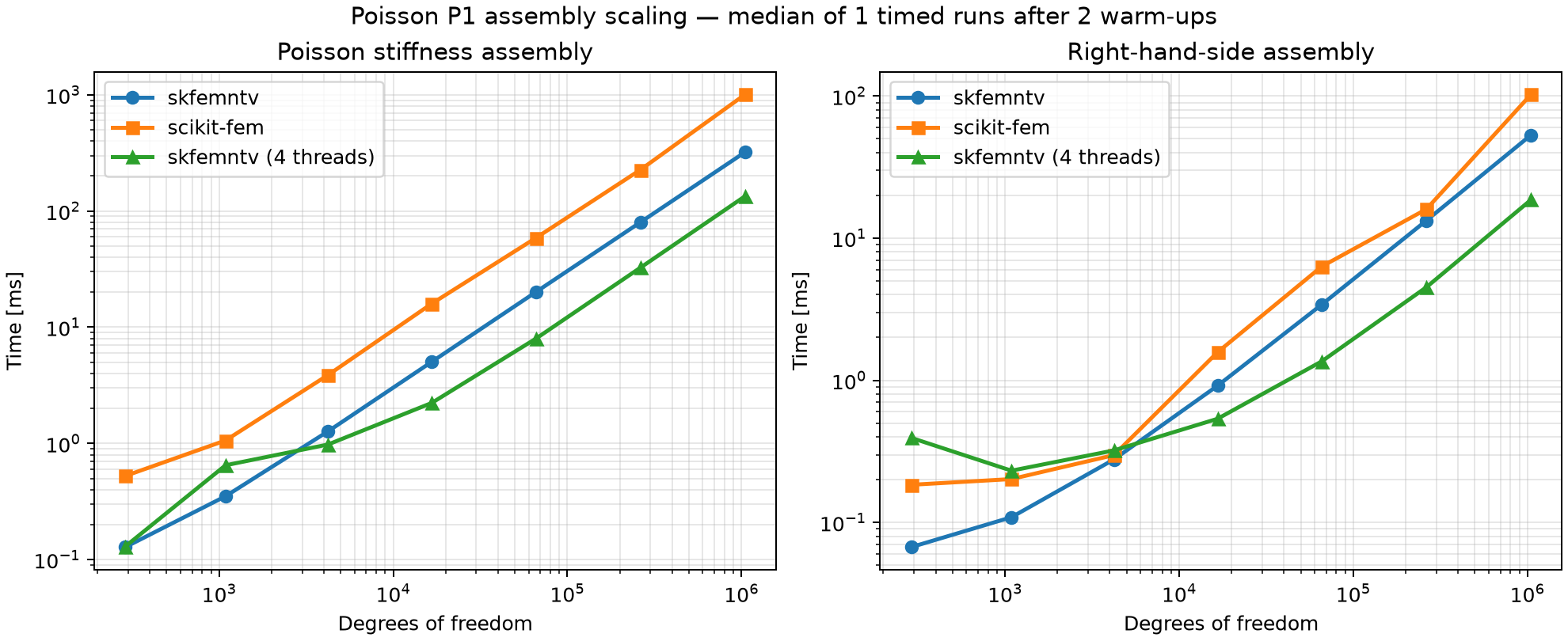
See the benchmark methodology and recorded environment and values for details.
See DEVELOPMENT.md for the motivation, architecture boundary, and development principles.
Documentation
Read the scikit-fem-native documentation, including the precise scikit-fem compatibility boundary and the assembly performance methodology.
Build the Sphinx documentation locally:
python -m pip install -e '.[docs]'
sphinx-build -M html docs docs/_build
Open docs/_build/html/index.html after the build completes.
Development
python -m pip install -e '.[test]'
pytest -q
1 maintainer

Metadata
1 maintainer
Release files for scikit-fem-native 0.3.1
For a detailed explanation of source distributions (sdists) and built distributions (wheels), please see the package formats documentation.
Source distribution (sdist)
| File | Size | Uploaded | |
|---|---|---|---|
| scikit_fem_native-0.3.1.tar.gz | 2.5 MB | Details |
Built distributions (wheels)
Total release size: 9.5 MB
Release files / scikit_fem_native-0.3.1.tar.gz
| Download URL | scikit_fem_native-0.3.1.tar.gz |
|---|---|
| Size | 2.5 MB |
| Tags | Source |
|
SHA-256 checksum How to use checksums |
a1cab78affeba281bec5eca7fc1c46b168f757a196306b15388de79fc23d5717
|
|
BLAKE2b-256 checksum How to use checksums |
7a309179c4573d2ab0c74380dd4dbd6a4f659f15fa73719a82ef11bab02072b4
|
| Upload date | |
|
Uploaded using Trusted Publishing? What is trusted publishing? |
Yes |
| Uploaded via |
twine/7.0.0 CPython/3.13.14
|
Provenance
Provenance describes where a file came from. On PyPI, provenance is shared via attestations, which provide a verifiable record of the build or publishing details. View details, limitations and caveats.


PyPI Publish Attestation
PyPI verified that this artifact, at this checksum, originated from the publisher listed below.
Signed by GitHub Actions, verified by PyPI on Aug 20, 2026.
Transparency logRelease files / scikit_fem_native-0.3.1-cp314-cp314-win_amd64.whl
| Download URL | scikit_fem_native-0.3.1-cp314-cp314-win_amd64.whl |
|---|---|
| Size | 498.1 kB |
| Tags | CPython 3.14 Windows x86-64 |
|
SHA-256 checksum How to use checksums |
4cad7812c55b3fa05dfcb338701dc6ead15811dc325e95ba02c77e4acdd1722e
|
|
BLAKE2b-256 checksum How to use checksums |
ca5dd598d7796b65a927cb66beaacea4a0b10cc2b07de36024f6646ded3bc85f
|
| Upload date | |
|
Uploaded using Trusted Publishing? What is trusted publishing? |
Yes |
| Uploaded via |
twine/7.0.0 CPython/3.13.14
|
Provenance
Provenance describes where a file came from. On PyPI, provenance is shared via attestations, which provide a verifiable record of the build or publishing details. View details, limitations and caveats.
PyPI Publish Attestation
PyPI verified that this artifact, at this checksum, originated from the publisher listed below.
Signed by GitHub Actions, verified by PyPI on Aug 20, 2026.
Transparency logRelease files / scikit_fem_native-0.3.1-cp314-cp314-manylinux_2_27_x86_64.manylinux_2_28_x86_64.whl
| Download URL | scikit_fem_native-0.3.1-cp314-cp314-manylinux_2_27_x86_64.manylinux_2_28_x86_64.whl |
|---|---|
| Size | 333.6 kB |
| Tags | CPython 3.14 Linux glibc 2.27+ x86-64 Linux glibc 2.28+ x86-64 |
|
SHA-256 checksum How to use checksums |
0b6bfe90698447c5fa80132d9ab0d72442b28bc7d536f1487ba0fd90b0ee80eb
|
|
BLAKE2b-256 checksum How to use checksums |
0b5cb55dc3b9fea97554f3dfcfbaff9a3c9eac1d2777430ddf4d7970bcb7b7d4
|
| Upload date | |
|
Uploaded using Trusted Publishing? What is trusted publishing? |
Yes |
| Uploaded via |
twine/7.0.0 CPython/3.13.14
|
Provenance
Provenance describes where a file came from. On PyPI, provenance is shared via attestations, which provide a verifiable record of the build or publishing details. View details, limitations and caveats.
PyPI Publish Attestation
PyPI verified that this artifact, at this checksum, originated from the publisher listed below.
Signed by GitHub Actions, verified by PyPI on Aug 20, 2026.
Transparency logRelease files / scikit_fem_native-0.3.1-cp314-cp314-macosx_11_0_arm64.whl
| Download URL | scikit_fem_native-0.3.1-cp314-cp314-macosx_11_0_arm64.whl |
|---|---|
| Size | 282.7 kB |
| Tags | CPython 3.14 macOS 11.0+ ARM64 |
|
SHA-256 checksum How to use checksums |
d12c0c37244bd8b4b4aecac3eedc430eb59440ae0ebef93bbd4eb769186afedd
|
|
BLAKE2b-256 checksum How to use checksums |
ab8b1d779ddd09103654fcb85e436b926f357103380221971834581cf512cfee
|
| Upload date | |
|
Uploaded using Trusted Publishing? What is trusted publishing? |
Yes |
| Uploaded via |
twine/7.0.0 CPython/3.13.14
|
Provenance
Provenance describes where a file came from. On PyPI, provenance is shared via attestations, which provide a verifiable record of the build or publishing details. View details, limitations and caveats.
PyPI Publish Attestation
PyPI verified that this artifact, at this checksum, originated from the publisher listed below.
Signed by GitHub Actions, verified by PyPI on Aug 20, 2026.
Transparency logRelease files / scikit_fem_native-0.3.1-cp314-cp314-macosx_10_15_x86_64.whl
| Download URL | scikit_fem_native-0.3.1-cp314-cp314-macosx_10_15_x86_64.whl |
|---|---|
| Size | 298.1 kB |
| Tags | CPython 3.14 macOS 10.15+ x86-64 |
|
SHA-256 checksum How to use checksums |
b9caaf680113f58181a97151dc9ddf2fd2e6a04f24783667bcda7fd5ffa02ae9
|
|
BLAKE2b-256 checksum How to use checksums |
339ff9103e08d3feaf99607ac2ebe735516fe9e450b5b1f8de61106ed8f60d91
|
| Upload date | |
|
Uploaded using Trusted Publishing? What is trusted publishing? |
Yes |
| Uploaded via |
twine/7.0.0 CPython/3.13.14
|
Provenance
Provenance describes where a file came from. On PyPI, provenance is shared via attestations, which provide a verifiable record of the build or publishing details. View details, limitations and caveats.
PyPI Publish Attestation
PyPI verified that this artifact, at this checksum, originated from the publisher listed below.
Signed by GitHub Actions, verified by PyPI on Aug 20, 2026.
Transparency logRelease files / scikit_fem_native-0.3.1-cp313-cp313-win_amd64.whl
| Download URL | scikit_fem_native-0.3.1-cp313-cp313-win_amd64.whl |
|---|---|
| Size | 486.4 kB |
| Tags | CPython 3.13 Windows x86-64 |
|
SHA-256 checksum How to use checksums |
5b6500d41924090fcdc3b062ffed009891da253ae7f8f1ea77c799063af3f127
|
|
BLAKE2b-256 checksum How to use checksums |
ed789a342089db8783272f819ecd73a67674149ba60cf27fe611d23d2e612658
|
| Upload date | |
|
Uploaded using Trusted Publishing? What is trusted publishing? |
Yes |
| Uploaded via |
twine/7.0.0 CPython/3.13.14
|
Provenance
Provenance describes where a file came from. On PyPI, provenance is shared via attestations, which provide a verifiable record of the build or publishing details. View details, limitations and caveats.
PyPI Publish Attestation
PyPI verified that this artifact, at this checksum, originated from the publisher listed below.
Signed by GitHub Actions, verified by PyPI on Aug 20, 2026.
Transparency logRelease files / scikit_fem_native-0.3.1-cp313-cp313-manylinux_2_27_x86_64.manylinux_2_28_x86_64.whl
| Download URL | scikit_fem_native-0.3.1-cp313-cp313-manylinux_2_27_x86_64.manylinux_2_28_x86_64.whl |
|---|---|
| Size | 333.5 kB |
| Tags | CPython 3.13 Linux glibc 2.27+ x86-64 Linux glibc 2.28+ x86-64 |
|
SHA-256 checksum How to use checksums |
6032713f1be9a6e8c6ca6f911ec812b38862df9de8594c845d9e2d4927b39089
|
|
BLAKE2b-256 checksum How to use checksums |
a45b2a5a1d090dcf174ed93c2df4f24f1bc77612ec41bd34e7ea70c5c372bf64
|
| Upload date | |
|
Uploaded using Trusted Publishing? What is trusted publishing? |
Yes |
| Uploaded via |
twine/7.0.0 CPython/3.13.14
|
Provenance
Provenance describes where a file came from. On PyPI, provenance is shared via attestations, which provide a verifiable record of the build or publishing details. View details, limitations and caveats.
PyPI Publish Attestation
PyPI verified that this artifact, at this checksum, originated from the publisher listed below.
Signed by GitHub Actions, verified by PyPI on Aug 20, 2026.
Transparency logRelease files / scikit_fem_native-0.3.1-cp313-cp313-macosx_11_0_arm64.whl
| Download URL | scikit_fem_native-0.3.1-cp313-cp313-macosx_11_0_arm64.whl |
|---|---|
| Size | 282.2 kB |
| Tags | CPython 3.13 macOS 11.0+ ARM64 |
|
SHA-256 checksum How to use checksums |
b6fd558f8854698d60b364702e63734f3a4e8336d1ec10793563ed6c791c2b08
|
|
BLAKE2b-256 checksum How to use checksums |
19f3a61f892de9ab82fb0cf6bd1b4b84d06e9a8ed1bbffe4cd53e99690197250
|
| Upload date | |
|
Uploaded using Trusted Publishing? What is trusted publishing? |
Yes |
| Uploaded via |
twine/7.0.0 CPython/3.13.14
|
Provenance
Provenance describes where a file came from. On PyPI, provenance is shared via attestations, which provide a verifiable record of the build or publishing details. View details, limitations and caveats.
PyPI Publish Attestation
PyPI verified that this artifact, at this checksum, originated from the publisher listed below.
Signed by GitHub Actions, verified by PyPI on Aug 20, 2026.
Transparency logRelease files / scikit_fem_native-0.3.1-cp313-cp313-macosx_10_13_x86_64.whl
| Download URL | scikit_fem_native-0.3.1-cp313-cp313-macosx_10_13_x86_64.whl |
|---|---|
| Size | 297.9 kB |
| Tags | CPython 3.13 macOS 10.13+ x86-64 |
|
SHA-256 checksum How to use checksums |
deeabb571f6aee74b2c5c3a61853a2fa10757c53253e99d7ef8e46b7191ffb02
|
|
BLAKE2b-256 checksum How to use checksums |
58ea86ea940f069b6e77495fc303d25ebaef9fcbc5dc872f7265f4bd1be28411
|
| Upload date | |
|
Uploaded using Trusted Publishing? What is trusted publishing? |
Yes |
| Uploaded via |
twine/7.0.0 CPython/3.13.14
|
Provenance
Provenance describes where a file came from. On PyPI, provenance is shared via attestations, which provide a verifiable record of the build or publishing details. View details, limitations and caveats.
PyPI Publish Attestation
PyPI verified that this artifact, at this checksum, originated from the publisher listed below.
Signed by GitHub Actions, verified by PyPI on Aug 20, 2026.
Transparency logRelease files / scikit_fem_native-0.3.1-cp312-cp312-win_amd64.whl
| Download URL | scikit_fem_native-0.3.1-cp312-cp312-win_amd64.whl |
|---|---|
| Size | 486.3 kB |
| Tags | CPython 3.12 Windows x86-64 |
|
SHA-256 checksum How to use checksums |
e607b8ead4bf93d0ddfcf7124e46e92c714c3cfbe9fe1f348651f6704aa68200
|
|
BLAKE2b-256 checksum How to use checksums |
06204ef7ff8026157311a428b045bc684f22015778dcb034c470ffed73f047a1
|
| Upload date | |
|
Uploaded using Trusted Publishing? What is trusted publishing? |
Yes |
| Uploaded via |
twine/7.0.0 CPython/3.13.14
|
Provenance
Provenance describes where a file came from. On PyPI, provenance is shared via attestations, which provide a verifiable record of the build or publishing details. View details, limitations and caveats.
PyPI Publish Attestation
PyPI verified that this artifact, at this checksum, originated from the publisher listed below.
Signed by GitHub Actions, verified by PyPI on Aug 20, 2026.
Transparency logRelease files / scikit_fem_native-0.3.1-cp312-cp312-manylinux_2_27_x86_64.manylinux_2_28_x86_64.whl
| Download URL | scikit_fem_native-0.3.1-cp312-cp312-manylinux_2_27_x86_64.manylinux_2_28_x86_64.whl |
|---|---|
| Size | 333.5 kB |
| Tags | CPython 3.12 Linux glibc 2.27+ x86-64 Linux glibc 2.28+ x86-64 |
|
SHA-256 checksum How to use checksums |
3d43d764a8792f7f942f397bbdc3e30efff819b27051eae3626933c5ff81e80c
|
|
BLAKE2b-256 checksum How to use checksums |
3ba820b136aae0b23d2554aae88fa8e402bd08827c0e5a20ed079d788d7f362b
|
| Upload date | |
|
Uploaded using Trusted Publishing? What is trusted publishing? |
Yes |
| Uploaded via |
twine/7.0.0 CPython/3.13.14
|
Provenance
Provenance describes where a file came from. On PyPI, provenance is shared via attestations, which provide a verifiable record of the build or publishing details. View details, limitations and caveats.
PyPI Publish Attestation
PyPI verified that this artifact, at this checksum, originated from the publisher listed below.
Signed by GitHub Actions, verified by PyPI on Aug 20, 2026.
Transparency logRelease files / scikit_fem_native-0.3.1-cp312-cp312-macosx_11_0_arm64.whl
| Download URL | scikit_fem_native-0.3.1-cp312-cp312-macosx_11_0_arm64.whl |
|---|---|
| Size | 282.2 kB |
| Tags | CPython 3.12 macOS 11.0+ ARM64 |
|
SHA-256 checksum How to use checksums |
93ab266331efc92bad366d732c6244fb21465dd3162631bb231797154f704933
|
|
BLAKE2b-256 checksum How to use checksums |
4e3c1dc8ffd9272b2aba3921bfb9196a6524596aa67d61876c8139e6f2c99d39
|
| Upload date | |
|
Uploaded using Trusted Publishing? What is trusted publishing? |
Yes |
| Uploaded via |
twine/7.0.0 CPython/3.13.14
|
Provenance
Provenance describes where a file came from. On PyPI, provenance is shared via attestations, which provide a verifiable record of the build or publishing details. View details, limitations and caveats.
PyPI Publish Attestation
PyPI verified that this artifact, at this checksum, originated from the publisher listed below.
Signed by GitHub Actions, verified by PyPI on Aug 20, 2026.
Transparency logRelease files / scikit_fem_native-0.3.1-cp312-cp312-macosx_10_13_x86_64.whl
| Download URL | scikit_fem_native-0.3.1-cp312-cp312-macosx_10_13_x86_64.whl |
|---|---|
| Size | 297.9 kB |
| Tags | CPython 3.12 macOS 10.13+ x86-64 |
|
SHA-256 checksum How to use checksums |
6aed004a2d160fb98c26a30a17b95dcdf1e45dc3862722d3f9ea9f3802ba11d6
|
|
BLAKE2b-256 checksum How to use checksums |
ca2205b57ca9164aa3ffe6033258148b885778998c243d2891c591c1a99913f9
|
| Upload date | |
|
Uploaded using Trusted Publishing? What is trusted publishing? |
Yes |
| Uploaded via |
twine/7.0.0 CPython/3.13.14
|
Provenance
Provenance describes where a file came from. On PyPI, provenance is shared via attestations, which provide a verifiable record of the build or publishing details. View details, limitations and caveats.
PyPI Publish Attestation
PyPI verified that this artifact, at this checksum, originated from the publisher listed below.
Signed by GitHub Actions, verified by PyPI on Aug 20, 2026.
Transparency logRelease files / scikit_fem_native-0.3.1-cp311-cp311-win_amd64.whl
| Download URL | scikit_fem_native-0.3.1-cp311-cp311-win_amd64.whl |
|---|---|
| Size | 483.0 kB |
| Tags | CPython 3.11 Windows x86-64 |
|
SHA-256 checksum How to use checksums |
f5b3c44c31c7e165dd9c672a6f54b1babfe1b0fa07cac4fc6ad0bad09af7e97a
|
|
BLAKE2b-256 checksum How to use checksums |
d880a59eced9cc620c2772a23653526818a8e1edd3ffa2a02aa94941a0e664e9
|
| Upload date | |
|
Uploaded using Trusted Publishing? What is trusted publishing? |
Yes |
| Uploaded via |
twine/7.0.0 CPython/3.13.14
|
Provenance
Provenance describes where a file came from. On PyPI, provenance is shared via attestations, which provide a verifiable record of the build or publishing details. View details, limitations and caveats.
PyPI Publish Attestation
PyPI verified that this artifact, at this checksum, originated from the publisher listed below.
Signed by GitHub Actions, verified by PyPI on Aug 20, 2026.
Transparency logRelease files / scikit_fem_native-0.3.1-cp311-cp311-manylinux_2_27_x86_64.manylinux_2_28_x86_64.whl
| Download URL | scikit_fem_native-0.3.1-cp311-cp311-manylinux_2_27_x86_64.manylinux_2_28_x86_64.whl |
|---|---|
| Size | 331.3 kB |
| Tags | CPython 3.11 Linux glibc 2.27+ x86-64 Linux glibc 2.28+ x86-64 |
|
SHA-256 checksum How to use checksums |
4b29bda14f0bc640580c2cd87bbbd44997901e3b72e6a746a20a7d4a8107354f
|
|
BLAKE2b-256 checksum How to use checksums |
fba2d79c86234886aae9cb5f480944942bc56674baf7dc5ad9fec696c4366cad
|
| Upload date | |
|
Uploaded using Trusted Publishing? What is trusted publishing? |
Yes |
| Uploaded via |
twine/7.0.0 CPython/3.13.14
|
Provenance
Provenance describes where a file came from. On PyPI, provenance is shared via attestations, which provide a verifiable record of the build or publishing details. View details, limitations and caveats.
PyPI Publish Attestation
PyPI verified that this artifact, at this checksum, originated from the publisher listed below.
Signed by GitHub Actions, verified by PyPI on Aug 20, 2026.
Transparency logRelease files / scikit_fem_native-0.3.1-cp311-cp311-macosx_11_0_arm64.whl
| Download URL | scikit_fem_native-0.3.1-cp311-cp311-macosx_11_0_arm64.whl |
|---|---|
| Size | 281.1 kB |
| Tags | CPython 3.11 macOS 11.0+ ARM64 |
|
SHA-256 checksum How to use checksums |
65763c1c68fe730eef233d2e63fb82519809fac5d4b67f849e1e4d3af2ad3cb3
|
|
BLAKE2b-256 checksum How to use checksums |
0500d15a5fa0afa0767dd8d402d497d6b7fc68b5e376d7decef0f0d9853c6b8c
|
| Upload date | |
|
Uploaded using Trusted Publishing? What is trusted publishing? |
Yes |
| Uploaded via |
twine/7.0.0 CPython/3.13.14
|
Provenance
Provenance describes where a file came from. On PyPI, provenance is shared via attestations, which provide a verifiable record of the build or publishing details. View details, limitations and caveats.
PyPI Publish Attestation
PyPI verified that this artifact, at this checksum, originated from the publisher listed below.
Signed by GitHub Actions, verified by PyPI on Aug 20, 2026.
Transparency logRelease files / scikit_fem_native-0.3.1-cp311-cp311-macosx_10_9_x86_64.whl
| Download URL | scikit_fem_native-0.3.1-cp311-cp311-macosx_10_9_x86_64.whl |
|---|---|
| Size | 295.1 kB |
| Tags | CPython 3.11 macOS 10.9+ x86-64 |
|
SHA-256 checksum How to use checksums |
5fe69a8c78f3e0ad3ec573220e40d982a136e410ba2c782f4ff96019b4d2ae10
|
|
BLAKE2b-256 checksum How to use checksums |
8a046436a912dd18997bf71a340483aa145b33c948ee7bc3a835acf8b206f34a
|
| Upload date | |
|
Uploaded using Trusted Publishing? What is trusted publishing? |
Yes |
| Uploaded via |
twine/7.0.0 CPython/3.13.14
|
Provenance
Provenance describes where a file came from. On PyPI, provenance is shared via attestations, which provide a verifiable record of the build or publishing details. View details, limitations and caveats.
PyPI Publish Attestation
PyPI verified that this artifact, at this checksum, originated from the publisher listed below.
Signed by GitHub Actions, verified by PyPI on Aug 20, 2026.
Transparency logRelease files / scikit_fem_native-0.3.1-cp310-cp310-win_amd64.whl
| Download URL | scikit_fem_native-0.3.1-cp310-cp310-win_amd64.whl |
|---|---|
| Size | 482.0 kB |
| Tags | CPython 3.10 Windows x86-64 |
|
SHA-256 checksum How to use checksums |
03517a3b8944af5d3f921c77c5862fbf4574be7985a51394035294686c477096
|
|
BLAKE2b-256 checksum How to use checksums |
c631800604c35474d2cbce3a41a325d4231c320571be640dd923dba5056c634c
|
| Upload date | |
|
Uploaded using Trusted Publishing? What is trusted publishing? |
Yes |
| Uploaded via |
twine/7.0.0 CPython/3.13.14
|
Provenance
Provenance describes where a file came from. On PyPI, provenance is shared via attestations, which provide a verifiable record of the build or publishing details. View details, limitations and caveats.
PyPI Publish Attestation
PyPI verified that this artifact, at this checksum, originated from the publisher listed below.
Signed by GitHub Actions, verified by PyPI on Aug 20, 2026.
Transparency logRelease files / scikit_fem_native-0.3.1-cp310-cp310-manylinux_2_27_x86_64.manylinux_2_28_x86_64.whl
| Download URL | scikit_fem_native-0.3.1-cp310-cp310-manylinux_2_27_x86_64.manylinux_2_28_x86_64.whl |
|---|---|
| Size | 331.0 kB |
| Tags | CPython 3.10 Linux glibc 2.27+ x86-64 Linux glibc 2.28+ x86-64 |
|
SHA-256 checksum How to use checksums |
eecb1a70d19830d49bd476f16530c09168c4ddd28d2a2721c577112e9cdebfd4
|
|
BLAKE2b-256 checksum How to use checksums |
d02b8e65dcd77213b25f9c6249f83dc386450e5c98e61ec6fd3c6daf9c26edd5
|
| Upload date | |
|
Uploaded using Trusted Publishing? What is trusted publishing? |
Yes |
| Uploaded via |
twine/7.0.0 CPython/3.13.14
|
Provenance
Provenance describes where a file came from. On PyPI, provenance is shared via attestations, which provide a verifiable record of the build or publishing details. View details, limitations and caveats.
PyPI Publish Attestation
PyPI verified that this artifact, at this checksum, originated from the publisher listed below.
Signed by GitHub Actions, verified by PyPI on Aug 20, 2026.
Transparency logRelease files / scikit_fem_native-0.3.1-cp310-cp310-macosx_11_0_arm64.whl
| Download URL | scikit_fem_native-0.3.1-cp310-cp310-macosx_11_0_arm64.whl |
|---|---|
| Size | 279.9 kB |
| Tags | CPython 3.10 macOS 11.0+ ARM64 |
|
SHA-256 checksum How to use checksums |
015c4b6c65c1c081c754f9484504fe156eba9de64c65aa3243ab7d9af51aead4
|
|
BLAKE2b-256 checksum How to use checksums |
4605fea3ac1d842fa89d56d8e63a3d788f893e2961faefd4aba8f24995bef99c
|
| Upload date | |
|
Uploaded using Trusted Publishing? What is trusted publishing? |
Yes |
| Uploaded via |
twine/7.0.0 CPython/3.13.14
|
Provenance
Provenance describes where a file came from. On PyPI, provenance is shared via attestations, which provide a verifiable record of the build or publishing details. View details, limitations and caveats.
PyPI Publish Attestation
PyPI verified that this artifact, at this checksum, originated from the publisher listed below.
Signed by GitHub Actions, verified by PyPI on Aug 20, 2026.
Transparency logRelease files / scikit_fem_native-0.3.1-cp310-cp310-macosx_10_9_x86_64.whl
| Download URL | scikit_fem_native-0.3.1-cp310-cp310-macosx_10_9_x86_64.whl |
|---|---|
| Size | 294.0 kB |
| Tags | CPython 3.10 macOS 10.9+ x86-64 |
|
SHA-256 checksum How to use checksums |
156b3ba01b5551247b4c03242266d66f11816038e0a3a0f02aef3261d466f2b3
|
|
BLAKE2b-256 checksum How to use checksums |
62a202d46446d5edc54e08d933660bfe6f75427c87652f47165a866b8cb6b562
|
| Upload date | |
|
Uploaded using Trusted Publishing? What is trusted publishing? |
Yes |
| Uploaded via |
twine/7.0.0 CPython/3.13.14
|
Provenance
Provenance describes where a file came from. On PyPI, provenance is shared via attestations, which provide a verifiable record of the build or publishing details. View details, limitations and caveats.
PyPI Publish Attestation
PyPI verified that this artifact, at this checksum, originated from the publisher listed below.
Signed by GitHub Actions, verified by PyPI on Aug 20, 2026.
Transparency log












