
Scikit-NeuroMSI










Scikit-NeuroMSI is an open-source Python framework that simplifies the implementation of neurocomputational models of multisensory integration.
Motivation
Research on the neural mechanisms underlying multisensory integration—where unisensory signals combine to produce distinct multisensory responses—has surged in recent years. Despite this progress, a unified theoretical framework for multisensory integration remains elusive. Scikit-NeuroMSI aims to bridge this gap by providing a standardized, flexible, and extensible platform for modeling multisensory integration, fostering the development of theories that connect neural and behavioral responses.
Features
Scikit-NeuroMSI was designed to meet three fundamental requirements in the computational study of multisensory integration:
-
Modeling Standardization: Standardized interface for implementing and analyzing different types of models. The package currently handles the following model families: Maximum Likelihood Estimation, Bayesian Causal Inference, and Neural Networks.
-
Data Processing Pipeline: Multidimensional data processing across spatial dimensions (1D to 3D spatial coordinates), temporal sequences, and multiple sensory modalities (e.g., visual, auditory, touch).
-
Analysis Tools: Integrated tools for parameter sweeping across model configurations, result visualization and export, and statistical analysis of model outputs.
In addition, there is a core module with features to facilitate the implementation of new models of multisensory integration.
Requirements
You need Python 3.10+ to run scikit-neuromsi.
Installation
Run the following command:
pip install scikit-neuromsi
or clone this repo and then inside the local directory execute:
pip install -e .
Usage Examples
Run models of multisensory integration
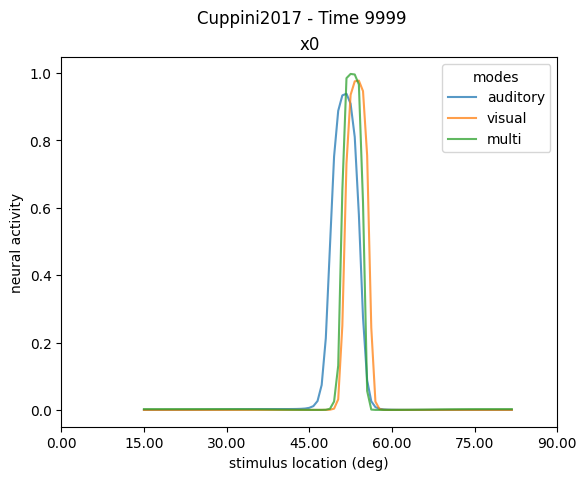
Simulate responses from existing models of multisensory integration (e.g. audio-visual causal inference network from Cuppini et al. (2017)):
from skneuromsi.neural import Cuppini2017

# Model setup
model_cuppini2017 = Cuppini2017(neurons=90,
                                position_range=(0, 90))

# Model execution
res = model_cuppini2017.run(auditory_position=35,
                            visual_position=52)

# Results plot
ax1 = plt.subplot()
res.plot.linep(ax=ax1)
ax1.set_ylabel("neural activity")
ax1.set_xlabel("stimulus location (deg)")
Simulate experimental paradigms
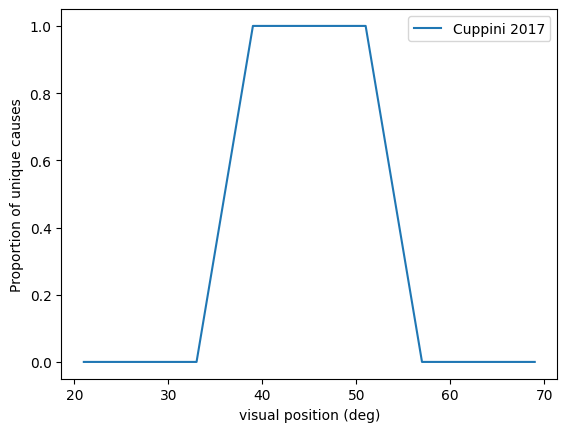
Simulate multisensory integration experiments (e.g. causal inference under spatial disparity - "ventriloquist effect") using the parameter sweep tool:
from skneuromsi.sweep import ParameterSweep
import numpy as np

# Experiment setup
spatial_disparities = np.array([-24, -12, -6, -3, 3, 6, 12, 24])

sp_cuppini2017 = ParameterSweep(model=model_cuppini2017,
                                target="visual_position",
                                repeat=1,
                                range=45 + spatial_disparities)

# Experiment run
res_sp_cuppini2017 = sp_cuppini2017.run(auditory_position=45,
                                        auditory_sigma=4.5,
                                        visual_sigma=3.5)

# Experiment results plot
ax1 = plt.subplot()
res_sp_cuppini2017.plot(kind="unity_report", label="Cuppini 2017", ax=ax1)
ax1.set_xlabel("visual position (deg)")
For more detailed examples and advanced usage, refer to the Scikit-NeuroMSI Documentation.
Contribute to Scikit-NeuroMSI
We welcome contributions to Scikit-NeuroMSI!
If you're a multisensory integration researcher, we encourage you to integrate your models directly into our package. If you're a software developer, we'd love your help in enhancing the overall functionality of Scikit-NeuroMSI.
For detailed information on how to contribute ideas, report bugs, or improve the codebase, please refer to our Contribuiting Guidelines.
License
Scikit-NeuroMSI is under The 3-Clause BSD License
This license allows unlimited redistribution for any purpose as long as its copyright notices and the license’s disclaimers of warranty are maintained.
How to cite?
If you want to cite Scikit-NeuroMSI, please use the following references:
Paredes, R., Cabral, J. B., & Series, P. (2025). Scikit-NeuroMSI: A Generalized Framework for Modeling Multisensory Integration. bioRxiv, 2025-05. doi: https://doi.org/10.1101/2025.05.26.656124
Paredes, R., Series, P., Cabral, J. (2023). Scikit-NeuroMSI: a Python framework for multisensory integration modelling. IX Congreso de Matematica Aplicada, Computacional e Industrial, 9, 545–548.
1 maintainer

Download files
Download the file for your platform. If you're not sure which to choose, learn more about installing packages.
Source Distribution
Built Distribution
Filter files by name, interpreter, ABI, and platform.
If you're not sure about the file name format, learn more about wheel file names.
Copy a direct link to the current filters
File details
Details for the file scikit_neuromsi-1.0.2.tar.gz.
File metadata
- Download URL: scikit_neuromsi-1.0.2.tar.gz
- Upload date:
- Size: 77.6 kB
- Tags: Source
- Uploaded using Trusted Publishing? No
- Uploaded via:
twine/6.1.0 CPython/3.10.18
File hashes
| Algorithm | Hash digest | |
|---|---|---|
| SHA256 |
2f0df0dd4b4cd4b5db2dfdb78dcbe6b472d281432a7b1756628734a5b2d2f229
|
|
| MD5 |
42e07217890c1a1d76de710632f36eea
|
|
| BLAKE2b-256 |
33b55c3f33e73914a05b60dcec46521b20a615aa300e03509efc86c143f84789
|
File details
Details for the file scikit_neuromsi-1.0.2-py3-none-any.whl.
File metadata
- Download URL: scikit_neuromsi-1.0.2-py3-none-any.whl
- Upload date:
- Size: 100.1 kB
- Tags: Python 3
- Uploaded using Trusted Publishing? No
- Uploaded via:
twine/6.1.0 CPython/3.10.18
File hashes
| Algorithm | Hash digest | |
|---|---|---|
| SHA256 |
12c3658faa4b514656a749676dc6df6908ca78ce6e1ba51889f034a6e33bdd6a
|
|
| MD5 |
00a97a0b822dda7d287d2662e277d150
|
|
| BLAKE2b-256 |
2581a5379adca9709dadc6125c2ea0aeb684a54e818deaea09bbae3793172f55
|














