
scopia
σκοπιά — the watchtower. See what your AI is building, while it builds it.
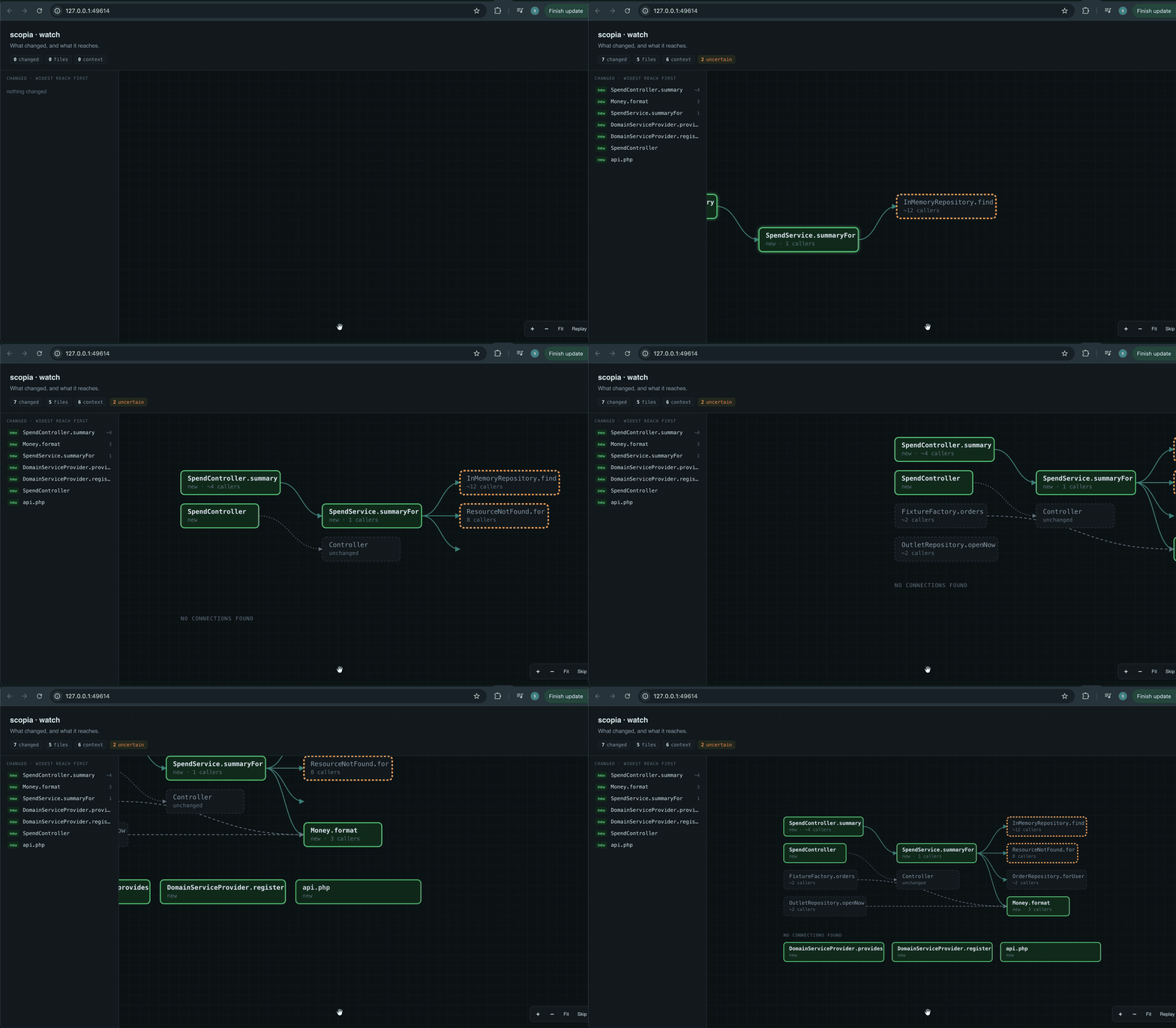
AI agents write code at a speed and volume no reviewer can match. By the time the agent says done, you are staring at a twenty-file diff in alphabetical order, with no idea which piece matters or how the pieces connect. The hard part of review is no longer reading the code — it is getting the lay of the land.
scopia is a visualisation layer for code changes. It draws one graph — what
changed, what calls it, and what it calls — and it does so two ways:
- Live — watch the graph grow in real time as the agent writes, so you already understand the change before it finishes.
- Static — point it at any commit, branch or range and get the same graph for code that was already committed.
No config, no init step, no language servers required. Just git and Python.
Quick start
pip install scopia # or: uv tool install scopia / pipx install scopia
Run these from anywhere inside a git repository:
| I want to… | Command |
|---|---|
| Watch the graph build live while an agent works | scopia --watch --html |
| Watch live in the terminal instead | scopia --watch |
| Review my uncommitted work | scopia |
| Analyse a past commit | scopia <sha>~1..<sha> |
| Review a branch (the pull-request case) | scopia main.. |
| Analyse the last 5 commits | scopia HEAD~5..HEAD |
| Save a clickable report to share | scopia main.. --html review.html |
| Paste a diagram into a PR comment | scopia --format mermaid |
| Feed it to other tools | scopia --format json |
| Trace each change back to the route/job/command that triggers it | scopia --to-entry |
| Sharpen uncertain edges with a language server | scopia --lsp |
Requires Python 3.10+ and git. Every dependency ships as a pre-built wheel, so no
compiler is needed. Check with scopia --version.
Live mode: review while the agent is still typing
scopia --watch --html
This opens a live page in your browser. Start your agent in another window and watch the
graph fill in as files land: changed symbols in green, the code they touch around them,
new arrivals marked ● just now.
- The page patches itself in place. The node you are reading stays selected and the view does not jump when the agent saves.
- Half-written code is held, not thrashed. A file that does not parse yet keeps the last good graph on screen, with a note.
- No-op rewrites are ignored. A formatter or a
touchthat leaves the graph unchanged causes no redraw. - Private by default. It is served on
127.0.0.1only (it serves your source), on a random port.--no-openprints the URL instead of opening a browser.
scopia --watch               # same idea, rendered in the terminal
scopia --watch --html r.html # live page, and keep r.html up to date too
Ctrl-C leaves your terminal as it found it.
Static mode: understand a commit after the fact
The same graph works on history. Give it a commit and it shows what that commit changed and what the change reaches — useful for reviewing a teammate's (or an agent's) PR, for auditing something that already merged, or for onboarding onto unfamiliar code.
scopia HEAD~1..HEAD --html commit.html && open commit.html
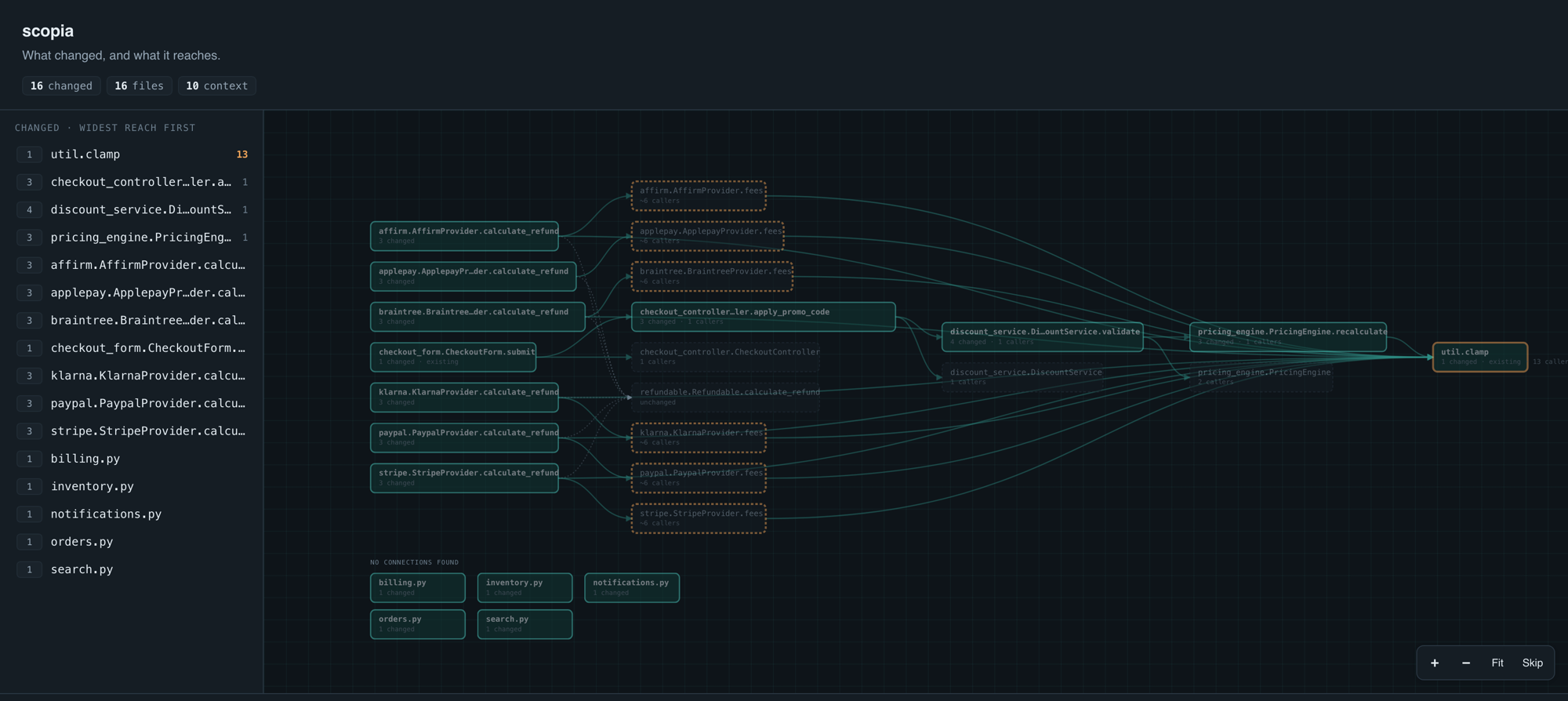
A real 16-file commit adding refunds to a payments codebase. Left to right: seven provider
classes gained a calculate_refund, and a new checkout path runs four layers deep to
land on util.clamp — a one-line edit to existing code that 13 places call, drawn
with an amber border. Dashed boxes are unchanged context; the five files at the bottom are
changed but untraceable (NO CONNECTIONS FOUND). Click any node to focus its
neighbourhood; the rest recedes rather than disappearing. One self-contained file — no
CDN, no network, opens from disk years from now.
Pass <sha>~1..<sha> for "what this commit changed":
scopia 3036712be90~1..3036712be90
~1 has no meaning on a repo's first commit; use scopia <sha> there. Skip merge
commits — ~1 follows only the first parent and reports something misleading.
Reading the output
The same commit as plain text:
$ scopia HEAD~1..HEAD

16 symbols touched across 16 files  (10 shown for context)

CALL CHAINS  — indented → means the line above calls it
  checkout_form.CheckoutForm.submit  1 line changed · existing code  app/
     └→ checkout_controller.CheckoutController.apply_promo_code  3 lines changed  app/
        └→ discount_service.DiscountService.validate  4 lines changed  app/
           └→ pricing_engine.PricingEngine.recalculate  3 lines changed  app/
              └→ util.clamp  1 line changed · called from 13 places · existing code  app/

  stripe.StripeProvider.calculate_refund  3 lines changed  app/providers/
     └→ stripe.StripeProvider.fees  called from ~6 places · context  app/providers/
        └→ util.clamp  1 line changed · called from 13 places · existing code  app/
     ┈ implements refundable.Refundable.calculate_refund

NO CONNECTIONS FOUND  — scopia could not trace these; not a statement that they are safe
  billing.py  1 line changed  config/
  inventory.py  1 line changed  config/
Three things a file list cannot tell you, all visible at a glance:
- A new checkout path runs four layers deep and bottoms out in
util.clamp— a one-line edit to existing code that 13 places call. The riskiest change in the diff is one line long. - Several providers implement the same new interface method, grouped by their
implementsedges — read the pattern once instead of seven times. ApplepayProvidernever callsclamp, unlike its siblings. scopia does not claim that is wrong, only that it differs — which is where attention belongs.
| Section | What it means |
|---|---|
CALL CHAINS |
What changed and what it reaches. Indentation is a call: the line above calls the line below. Heaviest chain first. |
CHANGED, REFERENCED FROM |
Changed things that call nothing themselves, shown with who calls them. Small edits with wide reach land here. |
NO CONNECTIONS FOUND |
scopia could not trace these. Not a claim that they are safe. |
NOT ANALYSED |
Changed files in unsupported languages. The graph says nothing about them. |
NOT CERTAIN |
Edges matched by name that may be wrong, each with its reason. Leads, not facts. |
| Annotation | Meaning |
|---|---|
3 lines changed |
Lines changed inside that symbol |
new |
The file did not exist before |
existing code |
Edits something that was already there — other code may depend on it |
called from 12 places |
Repo-wide caller count |
~12 |
Count is shared across several same-named definitions; approximate |
context |
Unchanged, shown only to orient you |
+3 hidden |
Neighbours cut by --max-nodes |
The number that matters is callers, not lines. 1 line changed · called from 40 places deserves more attention than a fifty-line change nothing calls.
Mermaid and JSON
--format mermaid prints a diagram GitHub renders natively — paste it straight into a
pull-request comment:
flowchart LR
  n0["CheckoutForm.submit"] -->|"1"| n1["CheckoutController.apply_promo_code"]
  n1 -->|"2"| n2["DiscountService.validate"]
  n2 -->|"3"| n3["PricingEngine.recalculate"]
  n3 -->|"4"| n4["util.clamp<br/>13 callers"]
  n5["StripeProvider.calculate_refund"] --> n4
  n5 -.->|"implements"| n6["Refundable.calculate_refund"]
  class n4 hot
  classDef hot stroke-width:3px,stroke:#b45309
--format json is for anything downstream. Every edge carries its provenance
(static, inferred, …), so a consumer can tell a resolved call from a guess. Nodes
carry touched, added, fan_in, changed_lines; the top level reports truncated,
utilities_hidden, files_changed and unparsed.
Options
scopia [revisions] [options]

  --html [PATH]      write a self-contained, clickable HTML report
                     (with --watch and no PATH: serve a live page)
  --watch            follow the working tree and redraw as files settle
  --to-entry         climb callers until each chain reaches an entry point
  --lsp              confirm name-matched calls with a language server, if installed
  --no-open          with --watch --html, print the URL instead of opening it
  --format FORMAT    text (default), mermaid, or json
  --hops N           neighbour hops to expand (default: 1)
  --max-nodes N      cap on drawn nodes (default: 60)
  --utility N        hide unchanged helpers called from more than N places
                     (default: 12; 0 keeps everything)
  --exclude GLOB     skip paths matching GLOB (repeatable)
  --always           draw even when the diff is below the gate
  --jobs N           parser processes used when indexing
  --no-color         disable ANSI colour
  --version          print the version
Too noisy? Hide shared plumbing — a logger every handler calls says nothing about
this change — or exclude paths (vendor/, node_modules/, .venv/, migrations/,
dist/, build/ and similar are already skipped):
scopia --utility 6
scopia --exclude 'tests/*' --exclude 'generated/*'
Too small? Raise the node cap if the report says nodes were hidden (edges to cut nodes are not drawn, which can make a symbol look unreferenced), look further out, or force a graph for a tiny diff:
scopia --max-nodes 300
scopia --hops 2
scopia --always
Languages
| Language | Extensions | Status |
|---|---|---|
| Python | .py .pyi |
supported — including aliased imports (from x import run as v3) |
| PHP | .php .phtml |
supported — no PHP runtime needed, parsed via tree-sitter |
| Java | .java |
supported — no JDK needed; reads the type each parameter, field and local declares |
| React | .jsx .tsx .js .ts .mjs .cjs .mts .cts |
supported — no Node, no tsc, no node_modules |
PHP resolves the class a call site names — app(Service::class)->show(),
new Service(), Service::show(), typed properties — including inherited methods. On a
Laravel-shaped app that removed roughly a third of all edges as false.
React: <Button /> is a call (composition is the call graph; <div> is left
alone); const Panel = () => …, memo(forwardRef(…)), useCallback(…) and
styled.div\…`are definitions, so a one-line edit inside a handler is attributed to the handler rather than the 200-line component around it; hooks are ordinary calls; handlers wired through props are followed and listed as references. TypeScript is read where it states a type, and.js/.ts/.tsx` are one language, so a call between them
is an ordinary edge.
Sharper edges with a language server
pip install "scopia[lsp]"   # adds jedi-language-server — pure Python, no Node
scopia --lsp                # or: scopia --watch --lsp
Where scopia could only match a call by name, --lsp asks a language server where the
call really goes. One confirmed target becomes a solid edge; a definition outside your
repo (dict.get, the standard library) removes the name-matched edges outright. If no
server is installed, or it fails or times out, you get exactly the graph you would have
had without the flag — plus a line saying so. In watch mode the graph is drawn from
tree-sitter immediately and upgraded when answers arrive, so a slow server never stalls
a redraw.
Measured on Python (uncertain edges as a share of all edges, before → after):
| Repo | Before | After |
|---|---|---|
| scopia | 30% | 4% |
| pygls | 67% | 10% |
| parso | 64% | 21% |
| jedi (190,000 edges, uncapped) | 67% | 64% |
The last row is the honest limit: in heavily dynamic code a language server sharpens what types can settle, and does not conjure types that are not there. Python is the only language wired up so far.
Adding a language means writing one adapter. See CONTRIBUTING.md.
The ideas it is built on
- A one-line change is a first-class change. The unit of analysis is the enclosing function, never the size of the hunk. A one-line sign flip in a helper called from forty places outranks a two-hundred-line rewrite of something nobody calls.
- Uncertainty is shown, never disguised. Every edge carries its provenance; a call
through an unknown receiver is marked
inferredeven when only one candidate exists. - It does not claim knowledge it lacks. Unsupported files are listed, not omitted. Untraceable symbols are "no connections found", not "no edges" — a reviewer reads the second as "safe to skip".
- It is not a correctness checker. scopia does not judge code or hunt for bugs; it reduces how much you must read. The metric it optimises is hunks a reviewer didn't have to open.
- Small diffs get no graph. Touch fewer than three files with nothing connecting them and scopia tells you to just read the diff.
How it works
git diff --unified=0gives exact changed line ranges; context lines would overstate the blast radius. Untracked files are added separately.- Each changed line maps to its smallest enclosing definition.
- A symbol and reference index over the repo, cached per git blob SHA in
.git/scopia/, so only files whose content actually changed are ever re-parsed. - One hop of expansion to callers and callees — never a transitive closure, so graph size scales with the diff rather than the repo.
- Edges resolved and tagged by how the call named its target.
A 1,200-file repo with a 200-file diff: 1.7s cold, 0.9s warm. To force a clean
re-index, rm -rf .git/scopia.
Development
git clone https://github.com/printSamarth/scopia && cd scopia
python3 -m venv .venv && .venv/bin/pip install -e ".[dev]"
.venv/bin/python -m pytest -q
.venv/bin/ruff check .
Status
First stable release. The graph, live watch mode and all four language adapters work. Planned: hunk clustering (read a repeated pattern once, then only what differs), framework/DI edge recognition, and runtime-trace ingestion for the dynamic dispatch static analysis cannot see.
License
MIT
1 maintainer

Metadata
1 maintainer
Release files for scopia 1.0.0
For a detailed explanation of source distributions (sdists) and built distributions (wheels), please see the package formats documentation.
Source distribution (sdist)
| File | Size | Uploaded | |
|---|---|---|---|
| scopia-1.0.0.tar.gz | 104.8 kB | Details |
Built distribution (wheel)
| File | Interpreter | ABI | Platform | Reset |
|---|---|---|---|---|
| scopia-1.0.0-py3-none-any.whl | Python 3 | none | any | Details |
Total release size: 198.6 kB
Release files / scopia-1.0.0.tar.gz
| Download URL | scopia-1.0.0.tar.gz |
|---|---|
| Size | 104.8 kB |
| Tags | Source |
|
SHA-256 checksum How to use checksums |
dc0291246d8abac32315f24c953c3440f2bcd604e9c31a934b987cd3364c4cd4
|
|
BLAKE2b-256 checksum How to use checksums |
15fe2cc8ea507cc771573b47e48607173566a318a56765aafcff457494af7f4e
|
| Upload date | |
|
Uploaded using Trusted Publishing? What is trusted publishing? |
No |
| Uploaded via |
twine/7.0.0 CPython/3.13.5
|
Release files / scopia-1.0.0-py3-none-any.whl
| Download URL | scopia-1.0.0-py3-none-any.whl |
|---|---|
| Size | 93.8 kB |
| Tags | Python 3 |
|
SHA-256 checksum How to use checksums |
638ba1ad0f5132e16696446bea3bd99ed45c97daabd72315d1f208568e5d70ba
|
|
BLAKE2b-256 checksum How to use checksums |
f4c61f25dd495d6aca73c75be8c239e165d6d146ddce4ec8b183f8249eea670a
|
| Upload date | |
|
Uploaded using Trusted Publishing? What is trusted publishing? |
No |
| Uploaded via |
twine/7.0.0 CPython/3.13.5
|













