
YAML-driven web scraper framework with AI agent integrations
Verified details
These details have been verified by PyPIProject links
GitHub Statistics
Maintainers

Project description
Scrapit



A modular, YAML-driven web scraper framework. Describe any scraping target in a config file — Scrapit handles fetching, parsing, transforming, validating, and storing the data.
No code required for new targets. Just write a YAML.
Features
| Feature | Description |
|---|---|
| YAML directives | Declarative scrape configs — selectors, transforms, validation, cache |
| Two backends | BeautifulSoup (fast, static) or Playwright (JS-rendered) |
| Fallback selectors | Per-field list of CSS selectors tried in order |
all: true |
Extract all matches for a selector, not just the first |
| Pagination | Follow "next page" links automatically |
| Spider mode | Discover and scrape all linked pages from an index |
| Multi-site | Scrape multiple URLs with the same spec in one directive |
| Transform pipeline | Declarative field transforms: strip, regex, float, replace, split… |
| Validation | Per-field rules: required, type, min/max, pattern, enum |
| Five output backends | JSON, CSV (append), SQLite (zero-config), MongoDB, PostgreSQL |
| HTTP cache | File-based cache with TTL — avoid re-fetching during dev |
| Change detection | Diff result against previous run, fire webhook on change |
| Webhook notifications | POST JSON payload to any URL when changes detected |
| Stats reporter | Field coverage %, timing, error count per run |
| Hook system | Register callbacks for scrape lifecycle events |
| Async queue | RabbitMQ producer/consumer for background processing |
| Structured logging | Console + output/scraper.log |
Installation
git clone <repo-url>
cd scrapit

python3 -m venv .venv
source .venv/bin/activate

pip install -r requirements.txt

# if you use the playwright backend:
playwright install chromium
Copy and fill in your credentials:
cp scraper/.env.example .env
# MongoDB (optional)
MONGO_URI=mongodb+srv://user:pass@cluster/
MONGO_DATABASE=mydb
MONGO_COLLECTION=scraped

# RabbitMQ (optional)
RABBITMQ_HOST=localhost
RABBITMQ_PORT=5672
RABBITMQ_USER=guest
RABBITMQ_PASS=guest

# Webhook notifications (optional)
SCRAPIT_WEBHOOK_URL=https://hooks.example.com/...
Quick Start
# create a new directive interactively
python -m scraper.main init

# scrape Wikipedia, save to JSON
python -m scraper.main scrape wikipedia --json

# scrape Hacker News (paginated), save to SQLite
python -m scraper.main scrape hn --sqlite

# spider Books to Scrape, preview only
python -m scraper.main scrape books --preview

# scrape all directives in the default folder
python -m scraper.main batch --json

# list available directives
python -m scraper.main list
CLI Reference
init — create a new directive interactively
python -m scraper.main init
Guides you through a series of prompts and generates a ready-to-edit YAML in scraper/directives/:
? Site URL: https://news.ycombinator.com
? Scraping backend (beautifulsoup/playwright) [beautifulsoup]:
? Output file name (without .yaml): hackernews
? Fields to scrape (comma-separated, e.g. titles, links, scores): titles, links, scores

→ Created scraper/directives/hackernews.yaml

Next steps:
  1. Open scraper/directives/hackernews.yaml and replace each 'FIXME' with a real CSS selector.
  2. Run: python -m scraper.main scrape hackernews --preview
  3. Save results: python -m scraper.main scrape hackernews --json
Each field is stubbed with a FIXME placeholder — open the file, fill in your CSS selectors, and you're ready to scrape.
scrape — single directive
python -m scraper.main scrape <directive> [--json|--csv|--sqlite|--mongo] [--preview] [--diff]
<directive> can be a name (wikipedia), filename (wikipedia.yaml), or path.
| Flag | Description |
|---|---|
--json |
Save to output/<name>.json (default) |
--csv |
Append to output/<name>.csv |
--sqlite |
Save to output/scrapit.db |
--mongo |
Save to MongoDB |
--excel |
Append to output/<name>.xlsx |
--format |
JSON format: pretty (indented, default) or compact (minified) |
--preview |
Print result, do not save |
--diff |
Compare with previous JSON output and show changes |
batch — all directives in a folder
python -m scraper.main batch [folder] [--json|--csv|--sqlite|--mongo|--excel] [--preview] [--diff]
Default folder: scraper/directives/
list — inspect directives
python -m scraper.main list [--dir path/to/folder]
Shows site, backend, fields, transforms, validation rules, and cache config.
suggest-selectors — ask Claude for CSS selectors
scrapit suggest-selectors https://books.toscrape.com --fields "title,price,rating"
Fetches the page and asks Claude to suggest the best CSS selectors for each field. Outputs a ready-to-paste scrape: block. Requires pip install anthropic.
share — share a directive with the community
scrapit share wikipedia
Creates a GitHub issue in the Scrapit repo with your directive YAML, making it available to everyone. Requires the gh CLI authenticated.
ai-init — generate a directive with Claude
scrapit ai-init https://news.ycombinator.com --name hackernews
scrapit ai-init https://books.toscrape.com --fields "title,price,rating"
Fetches the page, sends the content to Claude, and generates a ready-to-use YAML directive. Requires pip install anthropic and ANTHROPIC_API_KEY in your environment.
query — read stored data
# recent scrapes from SQLite
python -m scraper.main query --backend sqlite --limit 10

# filter by directive name
python -m scraper.main query --directive wikipedia

# filter by URL fragment
python -m scraper.main query --url wikipedia.org
cache — manage HTTP cache
python -m scraper.main cache stats        # show cache size and entry count
python -m scraper.main cache clear        # delete all cached responses
python -m scraper.main cache invalidate --url https://example.com
Writing Directives
VS Code autocomplete: add this line to the top of any directive YAML for inline docs and validation:
# yaml-language-server: $schema=https://raw.githubusercontent.com/joaobenedetmachado/scrapit/main/scrapit.schema.json
Minimal directive
site: https://example.com
use: beautifulsoup   # or playwright

scrape:
  field_name:
    - 'css-selector'
    - attr: text     # 'text' = inner text, or any HTML attribute (href, src, …)
All directive options
site: https://example.com
use: beautifulsoup       # or playwright

# ── Mode ─────────────────────────────────────────────────────────────────────
mode: single             # single (default) | spider

# ── Multiple sites (same scrape spec applied to each) ────────────────────────
sites:
  - https://example.com/page-1
  - https://example.com/page-2

# ── Request options ───────────────────────────────────────────────────────────
retries: 3               # HTTP retries with exponential backoff (bs4)
timeout: 15              # seconds (bs4) or milliseconds (playwright)
headers:                 # extra HTTP headers
  Authorization: Bearer xxx
cookies:                 # bs4: dict  |  playwright: list of {name,value,domain}
  session_id: abc123
proxy: http://proxy:8080

# Proxy with authentication:
# proxy: http://user:password@proxy:8080
# proxy: https://user:password@proxy:8080
# proxy: socks5://user:password@proxy:1080

# Using environment variable (set in .env):
# proxy: ${PROXY_URL}

# ── Cache ─────────────────────────────────────────────────────────────────────
cache:
  ttl: 3600              # seconds (0 = disabled)

# ── Playwright-only ───────────────────────────────────────────────────────────
wait_for: '#content'     # wait for selector before parsing
screenshot: true         # save full-page screenshot to output/

# ── Scrape spec ───────────────────────────────────────────────────────────────
scrape:
  title:
    - 'h1'               # single selector
    - attr: text

  image:
    - ['img.hero', 'img.main', 'img']   # fallback selectors
    - attr: src

  all_links:
    - 'a.result'
    - attr: href
      all: true          # return list of all matches

# ── Pagination (bs4 only) ─────────────────────────────────────────────────────
paginate:
  selector: 'a.next-page'
  attr: href
  max_pages: 5

# ── Spider mode (bs4 only) ────────────────────────────────────────────────────
follow:
  selector: 'a.article-link'
  attr: href
  max: 50                # max pages to scrape
  same_domain: true      # stay on same domain

# ── Transform pipeline ────────────────────────────────────────────────────────
transform:
  price:
    - strip
    - {replace: {"€": "", ",": "."}}
    - float
  title:
    - strip
    - upper
  description:
    - strip
    - {slice: {end: 200}}
  tags:
    - {split: ","}
    - first

# ── Validation ────────────────────────────────────────────────────────────────
validate:
  title:
    required: true
    min_length: 2
    max_length: 500
  price:
    type: float
    min: 0
  status:
    in: [active, inactive, pending]

# ── Notifications ─────────────────────────────────────────────────────────────
notify:
  webhook: https://hooks.slack.com/...   # called when --diff detects changes
Available transforms
| Transform | Argument | Description |
|---|---|---|
strip |
— | Strip whitespace |
lower / upper / title |
— | Change case |
capitalize |
— | First character upper, rest unchanged |
sentence_case |
— | First character upper, rest lower |
int / float |
— | Parse number (removes non-numeric chars) |
count |
— | Length of a string or list |
regex |
pattern |
Extract first regex match |
regex_group |
{pattern, group} |
Extract specific capture group |
replace |
{old: new} |
String substitution (multiple pairs) |
split |
"," |
Split string into list |
join |
", " |
Join list into string |
first / last |
— | Pick first/last item from list |
default |
value |
Fallback if value is None |
slice |
{start, end} or N |
Substring / sublist |
prepend / append |
"str" |
Add text before/after |
remove_tags |
— | Strip HTML tags |
template |
"prefix {value}" |
String template with {value} or {other_field} |
slugify |
— | Convert text to a URL-friendly slug (Hello World → hello-world) |
truncate |
N |
Truncate to N characters without breaking words, appends ... |
normalize_whitespace |
— | Collapse multiple spaces/tabs into a single space and strip |
Available validation rules
| Rule | Example | Description |
|---|---|---|
required |
true |
Must not be None |
type |
float |
Type check: str, int, float, list, bool |
not_empty |
true |
Must not be empty string/list |
min / max |
0 / 1000 |
Numeric range |
min_length / max_length |
2 / 500 |
String/list length |
pattern |
^\d{4}$ |
Regex must match |
in |
[a, b, c] |
Value must be in enum |
not_in |
[a, b, c] |
Value must NOT be in enum |
Output
All outputs go to output/ at the project root.
| File | Description |
|---|---|
output/<name>.json |
Last scrape as JSON |
output/<name>.csv |
All scrapes in append-mode CSV |
output/scrapit.db |
SQLite database with all scrapes |
output/scraper.log |
Full log (also printed to console) |
output/<name>_<ts>.png |
Screenshot (Playwright + screenshot: true) |
PostgreSQL scrapes table |
All scrapes saved to PostgreSQL database |
Project Structure
scrapit/
  scraper/
    main.py                   CLI entry point (init/scrape/batch/list/query/cache)
    config.py                 Environment variables and paths
    logger.py                 Logging → console + output/scraper.log
    hooks.py                  Lifecycle hook registry
    reporter.py               Timing and field coverage stats
    directives/               Built-in example directives
      wikipedia.yaml
      hn.yaml                 Hacker News (paginated)
      books.yaml              Books to Scrape (spider mode)
      github_trending.yaml    GitHub trending (all: true)
    scrapers/
      __init__.py             Pipeline dispatcher
      bs4_scraper.py          BeautifulSoup backend
      playwright_scraper.py   Playwright backend
      paginator.py            Pagination support
      spider.py               Spider / link-following
    transforms/
      __init__.py             Transform pipeline engine
    validators/
      __init__.py             Validation engine
    storage/
      mongo.py                MongoDB (lazy connect)
      json_file.py            JSON output
      csv_file.py             CSV output (append)
      sqlite.py               SQLite (zero-config)
      diff.py                 Change detection
    cache/
      __init__.py             HTTP cache with TTL
    notifications/
      __init__.py             Webhook notifications
    queue/
      producer.py             RabbitMQ producer
      consumer.py             RabbitMQ consumer
  output/                     Generated data (gitignored)
  .cache/                     HTTP cache (gitignored)
  requirements.txt
  .env
Hook System
Register Python callbacks for scrape lifecycle events:
from scraper import hooks

@hooks.on("after_scrape")
def log_result(result, dados):
    print(f"scraped {result['url']} — {len(result)} fields")

@hooks.on("on_change")
def alert(changes, result):
    print(f"change in {result['url']}: {list(changes.keys())}")

@hooks.on("on_error")
def handle_error(exc, dados):
    print(f"failed on {dados['site']}: {exc}")
Available events: before_scrape, after_scrape, on_error, on_save, on_change
AI Agent Integrations
Scrapit integrates natively with every major AI agent framework. Give any agent the ability to scrape the web on demand — no boilerplate required.
MCP Server (Claude Desktop, Cursor, Claude Code)
The fastest way to add Scrapit to Claude:
# Claude Code
claude mcp add scrapit -- python -m scraper.integrations.mcp
For Claude Desktop, add to ~/Library/Application Support/Claude/claude_desktop_config.json:
{
  "mcpServers": {
    "scrapit": {
      "command": "python",
      "args": ["-m", "scraper.integrations.mcp"],
      "cwd": "/path/to/scrapit"
    }
  }
}
After adding, Claude will have 4 web scraping tools available automatically.
Anthropic SDK (native tool use)
import anthropic
from scraper.integrations.anthropic import as_anthropic_tools, handle_tool_call

client = anthropic.Anthropic()
tools  = as_anthropic_tools()

response = client.messages.create(
    model="claude-opus-4-6",
    max_tokens=1024,
    tools=tools,
    messages=[{"role": "user", "content": "What are the top posts on Hacker News?"}],
)

for block in response.content:
    if block.type == "tool_use":
        result = handle_tool_call(block.name, block.input)

# Or use the built-in agent loop:
from scraper.integrations.anthropic import ScrapitAnthropicAgent

agent = ScrapitAnthropicAgent(model="claude-opus-4-6")
answer = agent.run("Summarize the top 3 Hacker News posts today.")
LangChain / CrewAI / LangGraph
from scraper.integrations.langchain import ScrapitToolkit
from langchain.agents import initialize_agent, AgentType
from langchain_openai import ChatOpenAI

tools = ScrapitToolkit().get_tools()
# → [ScrapitTool, ScrapitPageTool, ScrapitSelectorTool]

agent = initialize_agent(
    tools=tools,
    llm=ChatOpenAI(model="gpt-4o"),
    agent=AgentType.OPENAI_FUNCTIONS,
)
agent.run("What does the Wikipedia article on Python say?")
Works with CrewAI — pass ScrapitToolkit().get_tools() to any Agent(tools=[...]).
OpenAI SDK (function calling)
from openai import OpenAI
from scraper.integrations.openai import as_openai_functions, handle_function_call

client = OpenAI()
tools  = as_openai_functions()

response = client.chat.completions.create(
    model="gpt-4o", tools=tools,
    messages=[{"role": "user", "content": "Scrape the top GitHub trending repos."}],
)

# Or use the built-in agent loop:
from scraper.integrations.openai import ScrapitOpenAIAgent

agent = ScrapitOpenAIAgent(model="gpt-4o")
answer = agent.run("What are the trending Python repos on GitHub today?")
LlamaIndex (RAG pipelines)
from scraper.integrations.llamaindex import ScrapitReader
from llama_index.core import VectorStoreIndex

reader = ScrapitReader()
docs   = reader.load_data(urls=["https://site1.com", "https://site2.com"])  # parallel

index  = VectorStoreIndex.from_documents(docs)
engine = index.as_query_engine()
response = engine.query("Summarize the main points.")
Quick programmatic API (no YAML needed)
from scraper.integrations import scrape_url, scrape_page, scrape_with_selectors, scrape_many

# Clean text — ready to feed to an LLM
text = scrape_url("https://news.ycombinator.com")

# Structured metadata: title, description, links, word_count
page = scrape_page("https://example.com")

# Agent-defined extraction with CSS selectors — no YAML needed
data = scrape_with_selectors(
    "https://books.toscrape.com/catalogue/a-light-in-the-attic_1000",
    selectors={"title": "h1", "price": "p.price_color"},
)

# Parallel scraping
pages = scrape_many(["https://a.com", "https://b.com"], mode="page")

# Run a directive and get structured data
data = scrape_directive("wikipedia")
Optional dependencies
All integration dependencies are lazy — Scrapit works without any of them installed. Install only what you need:
pip install anthropic          # Anthropic SDK integration
pip install openai             # OpenAI integration
pip install langchain-core     # LangChain / CrewAI / LangGraph
pip install llama-index-core   # LlamaIndex
pip install mcp                # MCP server (Claude Desktop / Cursor / Claude Code)
Async Queue (RabbitMQ)
Send a directive to the background queue:
from scraper.queue.producer import call_producer
call_producer("directives/wikipedia.yaml")
Start a consumer worker:
python -m scraper.queue.consumer
Workers scrape each received directive and save to MongoDB automatically.
Programmatic Usage
import asyncio
from scraper.scrapers import grab_elements_by_directive
from scraper.storage import json_file

result = asyncio.run(grab_elements_by_directive("scraper/directives/wikipedia.yaml"))
json_file.save(result, "wikipedia")
Contributing
Contributions are welcome! Whether it's a bug fix, a new transform, a new storage backend, or just sharing a directive YAML that works for a site you scraped.
See CONTRIBUTING.md here, for a full guide on how to get started.
Quick ways to contribute:
- Share a directive — open an issue with the "Share a Directive" template
- New transform — add a function to
scraper/transforms/__init__.pyand open a PR - Bug report — use the bug report issue template
Contributors

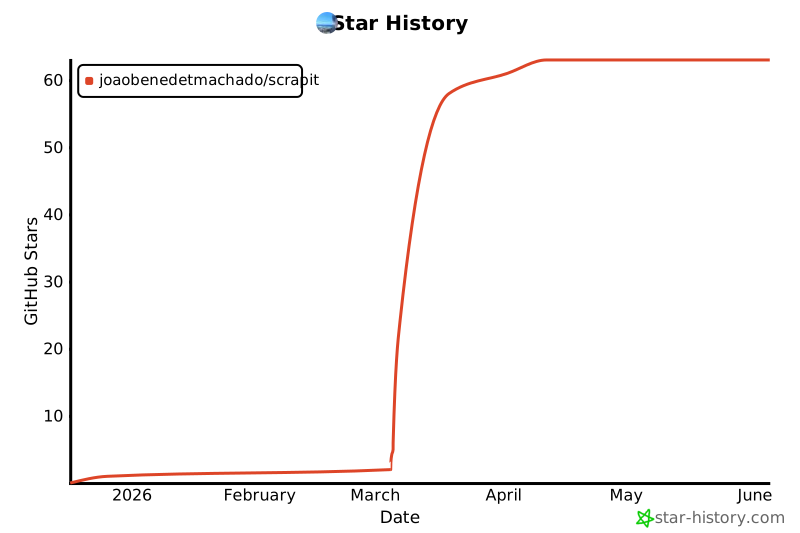
Star History
Requirements
- Python 3.10+
requests,bs4,pyyaml— always requiredplaywright— only for playwright backendpymongo,python-dotenv— only for MongoDBpika— only for RabbitMQ queue- SQLite is included in Python's stdlib (no install needed)
License
MIT © João Benedet Machado
Proxy Configuration
You can use proxies in your directives to route requests through proxy servers.
Basic Usage
site: example.com
use: bs4

scrape:
  url: https://example.com/products
  items:
    selector: ".product"
    fields:
      name:
        selector: "h3"
        method: text

# Proxy configuration
proxy:
  enabled: true
  url: "http://proxy.example.com:8080"
  # Or use environment variables
  # url: "${HTTP_PROXY}"
Using with Environment Variables
proxy:
  enabled: true
  url: "${HTTP_PROXY}"  # Reads from HTTP_PROXY or HTTPS_PROXY env var
Proxies for Different Protocols
proxy:
  http: "http://http-proxy.example.com:8080"
  https: "https://https-proxy.example.com:8080"
Rotating Proxies
proxy:
  enabled: true
  rotate: true
  proxies:
    - "http://proxy1.example.com:8080"
    - "http://proxy2.example.com:8080"
Common Proxy Providers
- SmartProxy - Residential proxies
- Oxylabs - Enterprise proxies
- ScraperAPI - API with proxy rotation
- ScrapingBee - Headless browser with proxies
Best Practices
- Use residential proxies for sensitive sites
- Rotate proxies to avoid blocks
- Set appropriate delay between requests
- Monitor proxy health and replace dead proxies
Project details
Verified details
These details have been verified by PyPIProject links
GitHub Statistics
Maintainers
Release history Release notifications | RSS feed


Download files
Download the file for your platform. If you're not sure which to choose, learn more about installing packages.
Source Distribution
Built Distribution
Filter files by name, interpreter, ABI, and platform.
If you're not sure about the file name format, learn more about wheel file names.
Copy a direct link to the current filters
File details
Details for the file scrapit_scraper-0.3.0.tar.gz.
File metadata
- Download URL: scrapit_scraper-0.3.0.tar.gz
- Upload date:
- Size: 56.7 kB
- Tags: Source
- Uploaded using Trusted Publishing? Yes
- Uploaded via: twine/6.1.0 CPython/3.13.7
File hashes
| Algorithm | Hash digest | |
|---|---|---|
| SHA256 |
e491ff1c9b3ea2b39ba0c8b0fc026a145ec728b25b5a029404f0d0e738fccc10
|
|
| MD5 |
b7c816aa75a223134d9bac2fa301d035
|
|
| BLAKE2b-256 |
f98d4970c01b3b817aab0fff81e29f04713d26b562492efe7a4e1ae59fad579a
|
Provenance
The following attestation bundles were made for scrapit_scraper-0.3.0.tar.gz:
Publisher:
publish.yml on joaobenedetmachado/scrapit
-
Statement:
-
Statement type:
https://in-toto.io/Statement/v1 -
Predicate type:
https://docs.pypi.org/attestations/publish/v1 -
Subject name:
scrapit_scraper-0.3.0.tar.gz -
Subject digest:
e491ff1c9b3ea2b39ba0c8b0fc026a145ec728b25b5a029404f0d0e738fccc10 - Sigstore transparency entry: 1057592404
- Sigstore integration time:
-
Permalink:
joaobenedetmachado/scrapit@57fbc39d265adc2cdaebfffefcdaa3782eab326a -
Branch / Tag:
refs/tags/v0.3.0 - Owner: https://github.com/joaobenedetmachado
-
Access:
public
-
Token Issuer:
https://token.actions.githubusercontent.com -
Runner Environment:
github-hosted -
Publication workflow:
publish.yml@57fbc39d265adc2cdaebfffefcdaa3782eab326a -
Trigger Event:
release
-
Statement type:
File details
Details for the file scrapit_scraper-0.3.0-py3-none-any.whl.
File metadata
- Download URL: scrapit_scraper-0.3.0-py3-none-any.whl
- Upload date:
- Size: 76.2 kB
- Tags: Python 3
- Uploaded using Trusted Publishing? Yes
- Uploaded via: twine/6.1.0 CPython/3.13.7
File hashes
| Algorithm | Hash digest | |
|---|---|---|
| SHA256 |
86d91d816209fb978ada13f035cf785ba5a2f2d658717efc695719d9a5ec8f3e
|
|
| MD5 |
3b1ab76e0529e15068b21880c90bc929
|
|
| BLAKE2b-256 |
ee8b8a950d09af4b45909539e2795eb0f465923c4e06dea4da89fe8c0006c54b
|
Provenance
The following attestation bundles were made for scrapit_scraper-0.3.0-py3-none-any.whl:
Publisher:
publish.yml on joaobenedetmachado/scrapit
-
Statement:
-
Statement type:
https://in-toto.io/Statement/v1 -
Predicate type:
https://docs.pypi.org/attestations/publish/v1 -
Subject name:
scrapit_scraper-0.3.0-py3-none-any.whl -
Subject digest:
86d91d816209fb978ada13f035cf785ba5a2f2d658717efc695719d9a5ec8f3e - Sigstore transparency entry: 1057592412
- Sigstore integration time:
-
Permalink:
joaobenedetmachado/scrapit@57fbc39d265adc2cdaebfffefcdaa3782eab326a -
Branch / Tag:
refs/tags/v0.3.0 - Owner: https://github.com/joaobenedetmachado
-
Access:
public
-
Token Issuer:
https://token.actions.githubusercontent.com -
Runner Environment:
github-hosted -
Publication workflow:
publish.yml@57fbc39d265adc2cdaebfffefcdaa3782eab326a -
Trigger Event:
release
-
Statement type:






