
SCRAPL: Scattering Transform with Random Paths for Machine Learning




scrapl-loss is a Python package for efficient evaluation of multivariable scattering transforms, specifically designed for use as a differentiable loss function in machine learning applications and perceptual quality assessment of deep inverse problems in computer vision, speech, and audio processing.
It implements the "Scattering Transform with Random Paths for Machine Learning" (SCRAPL) algorithm, which accelerates gradient-based optimization of neural networks with scattering transforms by stochastically sampling scattering paths to approximate the full transform's gradient.
This reduces the computational and memory costs by one to three orders of magnitude.
SCRAPL also leverages specialized stochastic optimization techniques (𝒫-Adam, 𝒫-SAGA) and an architecture-informed importance sampling heuristic (θ-IS) to stabilize gradients and improve convergence.
For more details, please see the ICLR 2026 paper.
scrapl-loss contains a PyTorch and JAX implementation of the SCRAPL algorithm for the joint time–frequency scattering transform (JTFS), which demodulates spectrotemporal patterns at multiple scales and rates, and has been shown to correlate with human perception (Lostanlen et al., 2021; Tian et al., 2025).
In our experiments, we find that SCRAPL accomplishes a favorable tradeoff between goodness of fit and computational efficiency on unsupervised sound matching, i.e., a nonlinear inverse problem in which the forward operator implements an audio synthesizer.
In the context of differentiable digital signal processing (DDSP), the state-of-the-art perceptual loss function for this task is multiscale spectral loss (MSS, Yamamoto et al., 2020; Engel et al., 2020).
However, the gradient of MSS is uninformative when input and reconstruction are misaligned or when the synthesizer controls involve spectrotemporal modulations (Vahidi et al., 2023).
Taking advantage of the stability guarantees of JTFS, SCRAPL expands the class of synthesizers which can be effectively decoded via DDSP.
Overall, SCRAPL with the JTFS is best suited for comparing audio signals that meet one or more of the following criteria:
- Contain spectrotemporal modulations
- Are non-stationary
- Benefit from multi-resolution analysis like percussive sounds (which consist of both transients and sustained components)
- Are misaligned in time or frequency and therefore benefit from temporal and frequential shift invariance
- Cannot be effectively compared with time-domain (e.g. mean squared error (MSE) / error-to-signal ratio (ESR) loss), frequency-domain (e.g. multiscale spectral (MSS) loss), or neural embedding-based (e.g. CLAP / PANNs / EnCodec distances) losses
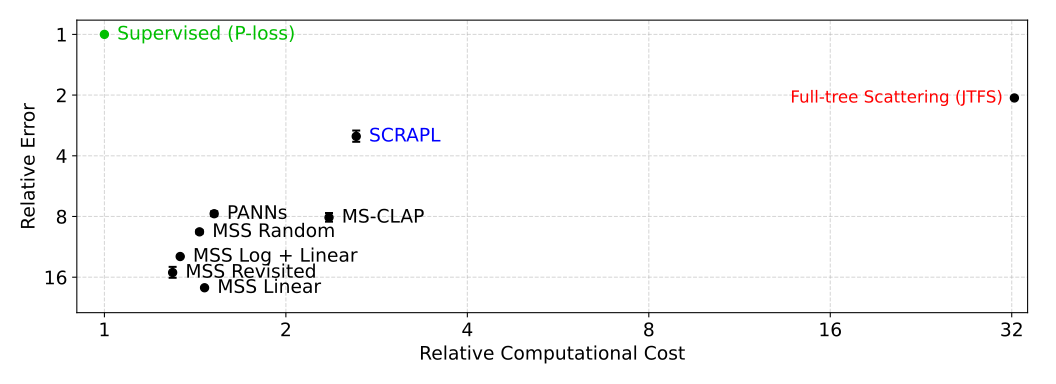
Figure 1: Mean average synthesizer parameter error (y-axis) versus computational cost (x-axis) of unsupervised sound matching models for the granular synthesis task. Both axes are rescaled by the performance of a supervised model with the same number of parameters. Whiskers denote 95% CI, estimated over 20 random seeds. Due to computational limitations, JTFS-based sound matching is evaluated only once.
Table of Contents
- Installation
- Examples (PyTorch)
- Hyperparameters
- Best Practices
- Algorithm
- Known Issues (PyTorch)
- Citation
Installation
1. PyTorch implementation:
uv add 'scrapl-loss[torch]'
or
pip install 'scrapl-loss[torch]'
Then:
from scrapl.torch import SCRAPLLoss or from scrapl import SCRAPLLoss
2. JAX implementation:
uv add 'scrapl-loss[jax]'
or
pip install 'scrapl-loss[jax]'
Then:
from scrapl.jax import SCRAPLLoss
3. All extras:
uv add 'scrapl-loss[torch,jax,test]'
or
pip install 'scrapl-loss[torch,jax,test]'
4. From source checkout:
git submodule update --init scrapl/kymatio scrapl/pytorch_hessian_eigenthings
uv sync --extra torch --extra jax --extra test
To run the test suite with uv:
uv run pytest
Requirements:
The package requires Python 3.13 or higher, numpy>=2.1.0, and scipy>=1.14.1.
The Torch backend requires torch>=2.6.0 and packaging>=20.0, and the JAX backend requires
jax>=0.5.0, equinox>=0.11.5, optax>=0.2.5, jaxtyping>=0.2.20, and tqdm>=4.66.0.
A bare installation with no extras includes neither framework, so PyTorch users
should select [torch].
Trying to access an uninstalled backend will report the required installation command.
Examples (PyTorch)
Importing and initializing SCRAPLLoss with the minimum required arguments:
# Import SCRAPLLoss from the scrapl.torch Python package
from scrapl.torch import SCRAPLLoss

# Initialize SCRAPLLoss with the minimum required arguments
scrapl_loss = SCRAPLLoss(
    shape=48000,  # Length of x and x_target in samples
    J=12,         # Number of octaves (1st and 2nd order temporal filters)
    Q1=8,         # Wavelets per octave (1st order temporal filters)
    Q2=2,         # Wavelets per octave (2nd order temporal filters)
    J_fr=3,       # Number of octaves (2nd order frequential filters)
    Q_fr=2,       # Wavelets per octave (2nd order frequential filters)
)
Console output:
INFO:scrapl.scrapl_loss:SCRAPLLoss:
J=12, Q1=8, Q2=2, Jfr=3, Qfr=2, T=None, F=None
use_rho_log1p          = False, eps = 0.001
grad_mult              = 100000000.0
use_p_adam             = True
use_p_saga             = True
sample_all_paths_first = False
n_theta                = 1
min_prob_frac          = 0.0
number of SCRAPL paths = 315
unif_prob              = 0.00317460
Calculating the loss for two signals:
import torch as tr

# Set the random seed so that this example is reproducible
tr.manual_seed(0)

# Create two random tensors of shape (batch_size, num_channels, signal_length)
# (x requires grad here to stand in for the output of a model being trained)
x = tr.randn(4, 1, 48000, requires_grad=True) # Example input tensor
x_target = tr.randn(4, 1, 48000) # Example target tensor
# Compute the SCRAPL loss between x and x_target. Since SCRAPL is stochastic,
# the loss value will be different each time `scrapl_loss()` is called.
loss = scrapl_loss(x, x_target)
# backward() is needed to update path_counts (and the P-Adam / P-SAGA state),
# since they are only updated in the backward pass, not in the forward pass
loss.backward()
print(f"SCRAPL loss: {loss.item()}")
SCRAPLLoss utility attributes and methods:
print(f"Number of scattering paths: {scrapl_loss.n_paths}")
print(f"Uniform path sampling probability: {scrapl_loss.unif_prob:.6f}")
print(f"Most recently sampled path index (prev. example): {scrapl_loss.last_sampled_path_idx}")

# Calculate the loss for a specific path index
loss = scrapl_loss(x, x_target, path_idx=8)
# backward() is needed for this path to be counted in path_counts
loss.backward()
print(f"Most recently sampled path index (specific): {scrapl_loss.last_sampled_path_idx}")

# Calculate the loss with a random seed for deterministic path sampling
# (this will sample the same path index every time)
loss = scrapl_loss(x, x_target, seed=42)
# backward() is needed for this path to be counted in path_counts
loss.backward()
print(f"Most recently sampled path index (random seed): {scrapl_loss.last_sampled_path_idx}")
print(f"Path sampling statistics (original): {scrapl_loss.path_counts}")

# Get the state dictionary of the SCRAPLLoss instance
state_dict = scrapl_loss.state_dict()

# Clear all state of the SCRAPLLoss instance
scrapl_loss.clear()
print(f"Path sampling statistics (cleared): {scrapl_loss.path_counts}")

# Load a state dictionary into the SCRAPLLoss instance
scrapl_loss.load_state_dict(state_dict)
print(f"Path sampling statistics (loaded): {scrapl_loss.path_counts}")
Console output:
Number of scattering paths: 315
Uniform path sampling probability: 0.003175
Most recently sampled path index (prev. example): 267
Most recently sampled path index (specific): 8
Most recently sampled path index (random seed): 211
Path sampling statistics (original): defaultdict(<class 'int'>, {267: 1, 8: 1, 211: 1})
INFO:scrapl.scrapl_loss:Cleared state
Path sampling statistics (cleared): defaultdict(<class 'int'>, {})
Path sampling statistics (loaded): defaultdict(<class 'int'>, {267: 1, 8: 1, 211: 1})
Using 𝒫-Adam and 𝒫-SAGA
𝒫-Adam and 𝒫-SAGA are enabled by default when initializing SCRAPLLoss.
The Adam hyperparameters β1, β2, and ε can be set using the p_adam_b1, p_adam_b2, and p_adam_eps arguments in the SCRAPLLoss constructor.
For example:
from torch import nn

# Toy example model
model = nn.Sequential(
    nn.Linear(in_features=48000, out_features=8),
    nn.PReLU(),
    nn.Linear(in_features=8, out_features=48000),
    nn.Tanh(),
)

# Attach the learnable weights of the model to the SCRAPLLoss instance
# for P-Adam and P-SAGA
scrapl_loss.attach_params(model.parameters())

# Since we are using P-Adam and / or P-SAGA, we should use vanilla SGD with no
# momentum and optional weight decay as the downstream optimizer
from torch.optim import SGD
sgd_optimizer = SGD(model.parameters(), lr=1e-4, weight_decay=0.01)

# Example forward and backward step with P-Adam and P-SAGA now active
sgd_optimizer.zero_grad()
x_hat = model(x)
loss = scrapl_loss(x_hat, x_target)
loss.backward()
# Even though vanilla SGD is called here, the gradients of the model parameters
# have been modified by P-Adam and P-SAGA under the hood during the backward pass
sgd_optimizer.step()

# To detach parameters (generally not necessary), simply attach an empty list
scrapl_loss.attach_params([])
Console output:
INFO:scrapl.scrapl_loss:Attached 5 parameter tensors (816009 weights)
INFO:scrapl.scrapl_loss:Detached 5 parameter tensors
Importance Sampling Warmup
The SCRAPL algorithm includes an importance sampling heuristic (θ-IS) that learns a non-uniform sampling distribution over scattering paths given an encoder and decoder (synth) self-supervised training architecture. This is done by measuring the curvature of the loss landscape with respect to the encoder output / decoder (synth) input parameters θsynth for each path, see Sections 3.4, 4.3, and 5.2 in the paper for more details. This warmup step is done once before training on a subset of the training data (typically 32-256 samples) and can be parallelized across paths (currently implemented) and θsynth (to be added in the future).
import torch as tr
from torch import nn
from scrapl import SCRAPLLoss

# Setup
tr.set_printoptions(precision=4, sci_mode=False)
tr.manual_seed(42)
bs = 4
n_ch = 1
n_samples = 8192
# Number of parameters output by the encoder and input to the decoder (synth)
n_theta = 3
# Number of batches to use for warmup; when possible, one large batch filling all
# available GPU memory is more efficient than many smaller batches
n_batches = 1

# Provide a neural network encoder that outputs `n_theta` parameters
encoder = nn.Sequential(
    nn.Linear(n_samples, n_theta),
    nn.PReLU(),
    nn.Linear(n_theta, n_theta),
    nn.Sigmoid(),
)
# Make the encoder forward call functional (stateless)
theta_fn = lambda x: encoder(x.squeeze(1))

# Provide a differentiable decoder (synth) that takes as input `n_theta` parameters
decoder = nn.Sequential(
    nn.Linear(n_theta, n_theta),
    nn.PReLU(),
    nn.Linear(n_theta, n_samples),
    nn.Tanh(),
)
# Make the decoder forward call functional (stateless) and ensure it outputs the
# correct shape for the SCRAPLLoss (bs, n_ch, n_samples)
synth_fn = lambda theta: decoder(theta).unsqueeze(1)

# Create a list of dictionaries with batches of input data for `theta_fn`;
# typically this would be gathered from a dataloader
theta_is_batches = [tr.rand((bs, n_ch, n_samples)) for _ in range(n_batches)]
theta_fn_kwargs = [{"x": batch} for batch in theta_is_batches]

# Get the trainable weights of the encoder to pass to the warmup function
params = [p for p in encoder.parameters()]

# Initialize SCRAPLLoss with the minimum required arguments and `n_theta`
scrapl_loss = SCRAPLLoss(
    shape=n_samples,
    J=3,
    Q1=1,
    Q2=1,
    J_fr=2,
    Q_fr=1,
    n_theta=n_theta,
)
# We see that at initialization, all path sampling probabilities are uniform
print(f"Uniform path sampling probability: {scrapl_loss.unif_prob:.6f}")
print(
    f"[min, max] path sampling probabilities (before warmup): "
    f"[{scrapl_loss.probs.min():.6f}, {scrapl_loss.probs.max():.6f}]"
)

# The encoder and decoder (synth) must be deterministic during warmup,
# but can be non-deterministic otherwise
scrapl_loss.check_is_deterministic(theta_fn, theta_fn_kwargs[0], synth_fn)

# Run the warmup. This can be parallelized across paths by specifying different
# `start_path_idx` and `end_path_idx` subsets on multiple devices.
scrapl_loss.warmup_lc_hvp(
    theta_fn=theta_fn,
    synth_fn=synth_fn,
    theta_fn_kwargs=theta_fn_kwargs,
    params=params,
)
# We see that after warmup, the path sampling probabilities are no longer uniform
print(
    f"[min, max] path sampling probabilities (after warmup): "
    f"[{scrapl_loss.probs.min():.6f}, {scrapl_loss.probs.max():.6f}]"
)

# If warmup was conducted in parallel across multiple devices, the path sampling
# probabilities can be loaded from a directory
scrapl_loss.load_probs_from_warmup_dir(warmup_dir="scrapl_warmup")
Console output:
INFO:scrapl.scrapl_loss:SCRAPLLoss:
J=3, Q1=1, Q2=1, Jfr=2, Qfr=1, T=None, F=None
use_rho_log1p          = False, eps = 0.001
grad_mult              = 100000000.0
use_p_adam             = True
use_p_saga             = True
sample_all_paths_first = False
n_theta                = 3
min_prob_frac          = 0.0
number of SCRAPL paths = 7
unif_prob              = 0.14285714

Uniform path sampling probability: 0.142857
[min, max] path sampling probabilities (before warmup): [0.142857, 0.142857]
INFO:scrapl.scrapl_loss:Starting warmup_lc_hvp with agg = none for 5 parameter(s) and 1 batch(es), 20 iter (multibatch = False)
INFO:scrapl.scrapl_loss:path_idx = 0, curr_vals = tensor([0.1189, 2.5856, 0.6996]) Tot: 287ms | power iter error: 0.0000
INFO:scrapl.scrapl_loss:path_idx = 1, curr_vals = tensor([0.1053, 1.8463, 0.5497]) Tot: 339ms | power iter error: 0.0001
INFO:scrapl.scrapl_loss:path_idx = 2, curr_vals = tensor([0.1051, 2.0229, 0.6366]) Tot: 350ms | power iter error: 0.0000
INFO:scrapl.scrapl_loss:path_idx = 3, curr_vals = tensor([0.1080, 2.0151, 0.5734]) Tot: 544ms | power iter error: 0.0000
INFO:scrapl.scrapl_loss:path_idx = 4, curr_vals = tensor([0.1047, 1.8369, 0.5450]) Tot: 515ms | power iter error: 0.0001
INFO:scrapl.scrapl_loss:path_idx = 5, curr_vals = tensor([0.1044, 2.0086, 0.6305]) Tot: 393ms | power iter error: 0.0000
INFO:scrapl.scrapl_loss:path_idx = 6, curr_vals = tensor([0.1076, 2.0071, 0.5698]) Tot: 463ms | power iter error: 0.0000
INFO:scrapl.scrapl_loss:Saving warmup SCRAPL sampling probabilities to /path/to/scrapl_warmup/probs.pt
[min, max] path sampling probabilities (after warmup): [0.132245, 0.168210]
INFO:scrapl.scrapl_loss:Cleared state
INFO:scrapl.scrapl_loss:Loading probs from directory:
	/path/to/scrapl_warmup
	min prob = 0.132245, max prob = 0.168210
Hyperparameters
SCRAPLLoss (SCRAPL Algorithm Implementation for the JTFS in PyTorch)
While the only required hyperparameters to initialize SCRAPLLoss are those necessary to define the JTFS, there are several additional hyperparameters that can be used to customize the behavior of the SCRAPL algorithm.
However, the default values of these additional hyperparameters have been chosen to work well for most situations.
For more information about the JTFS and the J, Q1, Q2, J_fr, Q_fr, T, and F hyperparameters, please visit: https://www.kymat.io/ismir23-tutorial/intro.html
shape(int)- The length of the input signal (number of samples).
J(int)- Number of octaves in the JTFS (1st and 2nd order temporal filters)
Q1(int)- Wavelets per octave in the JTFS (1st order temporal filters)
Q2(int)- Wavelets per octave in the JTFS (2nd order temporal filters)
J_fr(int)- Number of octaves in the JTFS (2nd order frequential filters)
Q_fr(int)- Wavelets per octave in the JTFS (2nd order frequential filters)
T(str | int | None)- Temporal averaging size in samples of the JTFS. If 'global', averages over the entire signal. If 'None', averages over 2**J samples.
- Defaults to None.
F(str | int | None)- Frequential averaging size in frequency bins of the JTFS. If 'global', averages over all bins. If 'None', averages over J_fr * Q_fr bins.
- Defaults to None.
p(int, optional)- The order of the norm used for the distance calculation.
- Defaults to 2 (Euclidean norm).
use_rho_log1p(bool, optional)- If True, applies log1p scaling to the scattering coefficients (log(1 + x /
log1p_eps)) before computing the distance. If True,grad_multis no longer necessary and can be set to a value of 1. - Defaults to False.
- If True, applies log1p scaling to the scattering coefficients (log(1 + x /
log1p_eps(float, optional)- The epsilon value used in the log1p scaling.
- Defaults to 1e-3.
grad_mult(float, optional)- A scalar multiplier applied to gradients to prevent JTFS precision errors when squaring gradient values in commonly used optimizers like Adam.
- See https://hal.science/hal-05124224v1 for more information.
- When
use_rho_log1pis True,grad_multis no longer necessary and can be set to a value of 1. - When
grad_multis not 1,attach_params()must be called with the model parameters being optimized for this to have an effect. - Defaults to 1e8.
use_p_adam(bool, optional)- If True, enables the 𝒫-Adam algorithm.
- When True,
attach_params()must be called before training with the model parameters being optimized and vanilla stochastic gradient descent (SGD) with no momentum and optional weight decay should be used as the downstream optimizer. - Defaults to True.
use_p_saga(bool, optional)- If True, enables the 𝒫-SAGA algorithm.
- When True,
attach_params()must be called before training with the model parameters being optimized and vanilla stochastic gradient descent (SGD) with no momentum and optional weight decay should be used as the downstream optimizer. - Defaults to True.
sample_all_paths_first(bool, optional)- If True, forces the sampler to visit every possible scattering path once in order before switching to the internal path sampling distribution.
- Defaults to False.
n_theta(int, optional)- Given an encoder and decoder (synth) self-supervised training architecture, the number of encoder output / decoder (synth) input parameters θsynth.
- This is only required for the importance sampling heuristic (θ-IS) and calling the
warmup_lc_hvp()method before training. - Defaults to 1.
min_prob_frac(float, optional)- When using θ-IS, the minimum fraction of the uniform sampling probability assigned to any path, ensuring no path has zero probability of being sampled.
- Defaults to 0.0.
probs_path(str | None, optional)- File path to a
.ptfile containing pre-computed sampling probabilities for the scattering paths. - Defaults to None.
- File path to a
eps(float, optional)- A small value for numerical stability in probability calculations.
- Defaults to 1e-12.
p_adam_b1(float, optional)- β1 Adam hyperparameter for the internal 𝒫-Adam algorithm.
- Defaults to 0.9.
p_adam_b2(float, optional)- β2 Adam hyperparameter for the internal 𝒫-Adam algorithm.
- Defaults to 0.999.
p_adam_eps(float, optional)- ε Adam hyperparameter for the internal 𝒫-Adam algorithm.
- Defaults to 1e-8.
SCRAPLLoss.warmup_lc_hvp (Importance Sampling (θ-IS) Warmup)
Parallelization: To speed up warmup, this method can be run on multiple GPUs simultaneously by assigning disjoint [start_path_idx, end_path_idx) ranges to each process and providing a save_dir. After all processes finish, use load_probs_from_warmup_dir to load the aggregated path sampling probability distribution into a SCRAPLLoss instance.
theta_fn(Callable[..., T])- The encoder function. It must accept arguments provided in
theta_fn_kwargsand return a tensor θsynth of shape(batch_size, n_theta). - This function should be deterministic during warmup, but can be non-deterministic otherwise.
- The encoder function. It must accept arguments provided in
synth_fn(Callable[[T, ...], T])- The decoder (synthesizer) function. It must accept the θsynth tensor output by
theta_fn(and optionalsynth_fn_kwargs) and return a signal tensorx_hatof shape(batch_size, n_ch, n_samples). - This function should be deterministic during warmup, but can be non-deterministic otherwise.
- The decoder (synthesizer) function. It must accept the θsynth tensor output by
theta_fn_kwargs(list[dict[str, Any]])- A list of dictionaries, where each dictionary contains a batch of input arguments for
theta_fn. One of these arguments must be the input signalxof shape(batch_size, n_ch, n_samples). - The length of this list determines the number of batches used for the loss landscape curvature estimation and is a tradeoff between computational cost and curvature estimation accuracy.
- A list of dictionaries, where each dictionary contains a batch of input arguments for
params(list[Parameter])- A list of encoder parameters (learnable weights) involved in the computation of θsynth.
- These parameters must have no prior gradients (i.e.
p.grad is Nonefor allpinparams) before calling this method.
synth_fn_kwargs(list[dict[str, Any]] | None, optional)- A list of dictionaries corresponding to
theta_fn_kwargs, containing additional arguments forsynth_fn. - If provided, must have the same length as
theta_fn_kwargs. - Defaults to None.
- A list of dictionaries corresponding to
start_path_idx(int, optional)- The starting index of the scattering paths to compute. Used for parallelizing the warmup across multiple devices.
- Defaults to 0.
end_path_idx(int | None, optional)- The ending index (exclusive) of the scattering paths to compute. If None, defaults to
self.n_paths. - Defaults to None.
- The ending index (exclusive) of the scattering paths to compute. If None, defaults to
save_dir(str | None, optional)- Directory path where intermediate eigenvalues (
vals_{path_idx}.pt) and the final path sampling probability distribution (probs.pt) will be saved. - Defaults to "scrapl_warmup".
- Directory path where intermediate eigenvalues (
n_iter(int, optional)- The maximum number of power iteration steps used to approximate the largest eigenvalue of the Hessian.
- Higher values increase precision at the cost of computation time.
- Defaults to 20.
agg(Literal["none", "mean", "max", "med"], optional)- The aggregation strategy if
paramsare split into individual tensors. - Usually kept as "none" to aggregate across the full parameter set provided unless it does not fit in GPU memory, in which case curvature is estimated for each parameter tensor separately and then aggregated at the end.
- If you are seeing "out of memory" errors, try switching this to "med" to reduce memory usage at the cost of computation time.
- Defaults to "none".
- The aggregation strategy if
force_multibatch(bool, optional)- Debugging tool. If True, forces the calculation to use multibatch logic even if
theta_fn_kwargscontains only a single batch. - Defaults to False.
- Debugging tool. If True, forces the calculation to use multibatch logic even if
Best Practices
- SCRAPL with the JTFS is best suited for comparing audio signals that meet one or more of the following criteria:
- Contain spectrotemporal modulations
- Are non-stationary
- Benefit from multi-resolution analysis like percussive sounds (which consist of both transients and sustained components)
- Are misaligned in time or frequency and therefore benefit from temporal and frequential shift invariance
- Cannot be effectively compared with time-domain (e.g. mean squared error (MSE) / error-to-signal ratio (ESR) loss), frequency-domain (e.g. multiscale spectral (MSS) loss), or neural embedding-based (e.g. CLAP / PANNs / EnCodec distances) losses
- Choosing the best JTFS hyperparameters for a given task is very important and requires some understanding of how wavelet scattering transforms work. For an introduction to the JTFS for audio signal processing, check out our ISMIR 2023 tutorial: Kymatio: Deep Learning meets Wavelet Theory for Music Signal Processing
- If GPU memory is becoming a bottleneck, try reducing the number of scattering paths by decreasing the required JTFS arguments or disabling 𝒫-SAGA and then 𝒫-Adam.
- If the SCRAPL loss is not converging and 𝒫-Adam and 𝒫-SAGA are enabled and the model parameters have been attached to the
SCRAPLLossinstance, try reducing the learning rate of the downstream vanilla SGD optimizer. - When using 𝒫-Adam and / or 𝒫-SAGA, use vanilla SGD with no momentum and optional weight decay as the downstream optimizer.
- When using 𝒫-Adam, 𝒫-SAGA, or
grad_mult != 1.0, ensure thatattach_params()is called before training for these features to have any effect. - When using θ-IS, ensure that the encoder and decoder (synth) are deterministic during the warmup phase, but they can be non-deterministic otherwise.
- The
warmup_lc_hvpmethod can be parallelized across paths by assigning disjoint [start_path_idx,end_path_idx) ranges to each process and providing asave_dir. After all processes finish, useload_probs_from_warmup_dirto load the aggregated path sampling probability distribution into aSCRAPLLossinstance. - The
warmup_lc_hvpmethod is most efficient when used with a single large batch filling all available GPU memory rather than many smaller batches.
Algorithm

Known Issues (PyTorch)
- Resuming training from a checkpoint when model parameters have been attached (i.e. 𝒫-Adam, 𝒫-SAGA or
grad_multare enabled) is currently not supported. - Parallelization of the
warmup_lc_hvpmethod across θsynth is currently not implemented for PyTorch, which may lead to long warmup times when the number of encoder output / decoder (synth) input parametersn_thetais large.
Citation
If you find this project helpful for your own work, please consider citing it:
Accepted to the International Conference on Learning Representations (ICLR), Rio de Janeiro, Brazil, 23 - 27 April 2026.
@inproceedings{mitcheltree2026scrapl,
    title={{SCRAPL}: Scattering Transform with Random Paths for Machine Learning},
    author={Christopher Mitcheltree and Vincent Lostanlen and Emmanouil Benetos and Mathieu Lagrange},
    booktitle={Proceedings of the International Conference on Learning Representations (ICLR)},
    month={April},
    year={2026}
}
1 maintainer

Metadata
1 maintainer
Release files for scrapl-loss 0.2.0
For a detailed explanation of source distributions (sdists) and built distributions (wheels), please see the package formats documentation.
Source distribution (sdist)
| File | Size | Uploaded | Provenance | Actions |
|---|---|---|---|---|
| scrapl_loss-0.2.0.tar.gz | 691.2 kB | Without provenance | Details for scrapl_loss-0.2.0.tar.gz |
Built distribution (wheel)
| File | Interpreter | ABI | Platform | Actions Reset |
|---|---|---|---|---|
| scrapl_loss-0.2.0-py3-none-any.whl | Python 3 | none | any | Details for scrapl_loss-0.2.0-py3-none-any.whl |
Total release size: 1.5 MB
Release files / scrapl_loss-0.2.0.tar.gz
| Download URL | scrapl_loss-0.2.0.tar.gz |
|---|---|
| Size | 691.2 kB |
| Tags | Source |
|
SHA-256 checksum How to use checksums |
8112601ce748265ddaeb14f3c5e00b4192d2de36c0112045259378eb62a33232
|
|
BLAKE2b-256 checksum How to use checksums |
192706f7301704626fb97d94e3030350f8cef0aef83b4501e695e336b45a86b6
|
| Upload date | |
|
Uploaded using Trusted Publishing? What is trusted publishing? |
No |
| Uploaded via |
uv/0.12.21 {"installer":{"name":"uv","version":"0.12.21","subcommand":["publish"]},"python":null,"implementation":{"name":null,"version":null},"distro":{"name":"macOS","version":null,"id":null,"libc":null},"system":{"name":null,"release":null},"cpu":null,"openssl_version":null,"setuptools_version":null,"rustc_version":null,"ci":null}
|
Release files / scrapl_loss-0.2.0-py3-none-any.whl
| Download URL | scrapl_loss-0.2.0-py3-none-any.whl |
|---|---|
| Size | 793.3 kB |
| Tags | Python 3 |
|
SHA-256 checksum How to use checksums |
877b535afce734849baa7c70f355169d13d3f82bc668ec29d78b15c1db43b8b4
|
|
BLAKE2b-256 checksum How to use checksums |
0b5dc12af5cc33e2460f08358415c0b5f5c5dec5a7d0b5fd454aac17ce78f15f
|
| Upload date | |
|
Uploaded using Trusted Publishing? What is trusted publishing? |
No |
| Uploaded via |
uv/0.12.21 {"installer":{"name":"uv","version":"0.12.21","subcommand":["publish"]},"python":null,"implementation":{"name":null,"version":null},"distro":{"name":"macOS","version":null,"id":null,"libc":null},"system":{"name":null,"release":null},"cpu":null,"openssl_version":null,"setuptools_version":null,"rustc_version":null,"ci":null}
|
Security for scrapl-loss 0.2.0
Provenance
Provenance describes where a file came from. On PyPI, provenance is shared via attestations, which provide a verifiable record of the build or publishing details. View details, limitations and caveats.
No provenance found
None of the files in this release were uploaded with provenance metadata.
A note on package security
PyPI is a repository for distributing packages, not a service for auditing them. While third-party security researchers and our staff do their best to detect and remove malicious packages, PyPI cannot guarantee the quality, security or suitability of any given package.
To learn more about protecting yourself from malicious actors, visit our package security documentation.














