
Scrutai
A panel of AI specialists reviews your code. An adversarial critic kills the false positives.
Every finding survives scrutiny, or it doesn't ship.





Quickstart · How it works · GitHub Action · Agent theater · MCP server · Configuration · Benchmark · Contributing · Releases
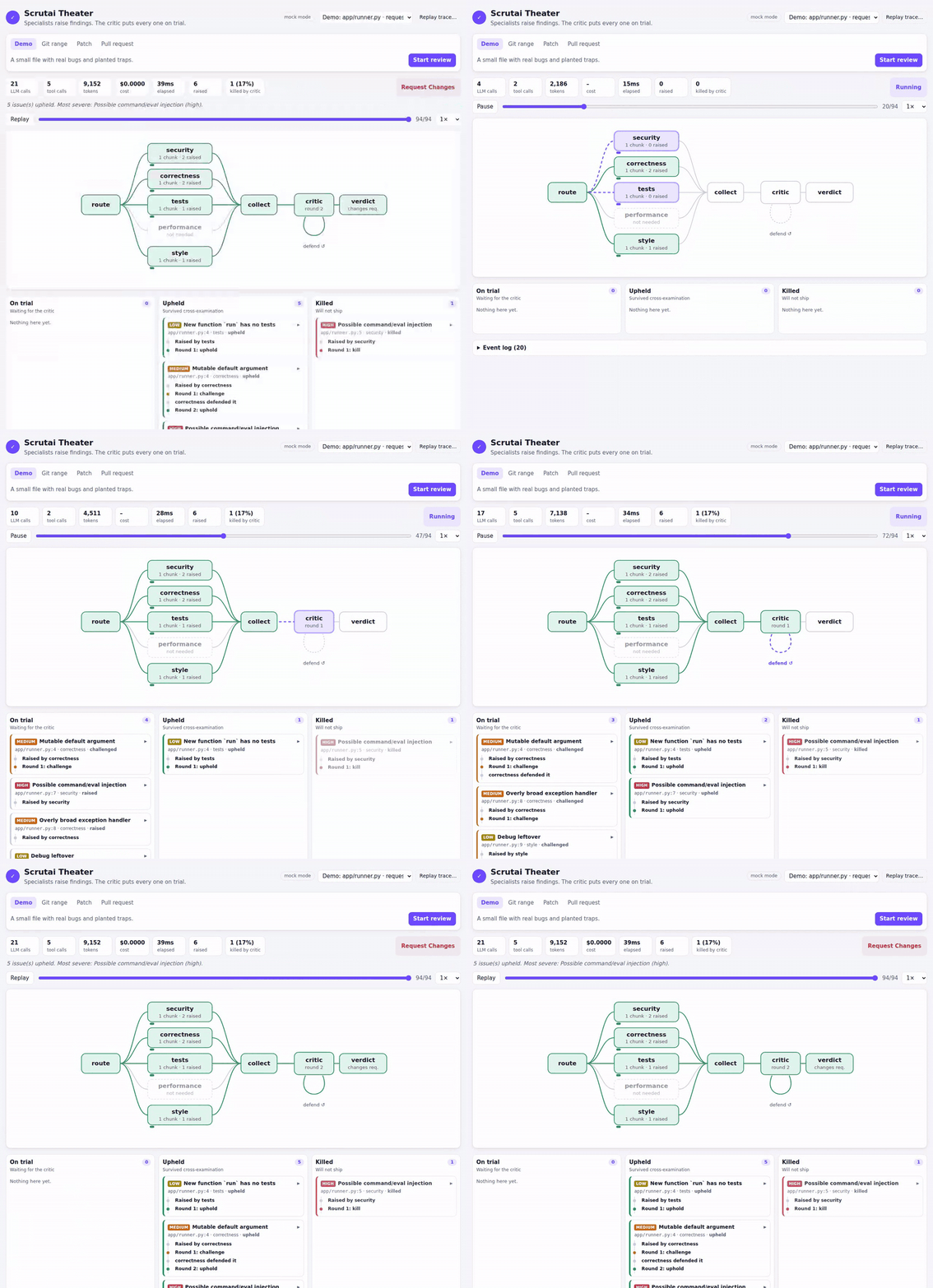
The agent theater replaying a real review of the bundled demo (mock mode) · watch it as MP4 · more screenshots
Table of contents
- Why Scrutai
- Features
- Quickstart
- Installation
- Usage
- Running with a real model (bring your own key)
- How it works
- Configuration reference
- Benchmark
- Security and privacy
- Project layout
- FAQ
- Roadmap
- Contributing
- License
Why Scrutai
Most AI code reviewers make a single pass: diff → model → comments. They are fast, and they
are noisy. A reviewer that raises thirty plausible-sounding issues, three of them real, trains
people to ignore it, and then it catches nothing.
Scrutai is built around one rule: every finding survives scrutiny, or it doesn't ship.
- A panel of specialists reviews the change: security, correctness, tests, performance and style. Each one wakes only when the change touches its area.
- They are grounded in the real repository. Each specialist is a ReAct agent that reads files,
searches the codebase, checks
git blameand runs Semgrep before it makes a claim. - An adversarial critic puts every finding on trial. It checks the claim against the cited code and decides to uphold, downgrade, kill or challenge it. A challenged finding goes back to its specialist, who must defend it with fresh evidence or withdraw it.
- You get what survived: a short list of real issues, each with its exact file and line, the evidence, and the critic's reasoning. Everything that was killed is still available, with the reason, if you want to audit the critic.
And because a reviewer you can't measure is a reviewer you can't trust, Scrutai ships with a benchmark harness that reports precision and recall with and without the critic, so the critic has to earn its tokens.
Features
| 🧑⚖️ Adversarial critic | Four decisions (uphold / downgrade / kill / challenge) and a bounded debate in which specialists defend or withdraw. Findings the critic could not judge are withheld, never shipped. |
| 🔎 Grounded specialists | Five ReAct agents with sandboxed tools: read_file, grep, git_blame, semgrep. |
| 🧭 Smart routing | A docs-only change wakes nobody; security only wakes on risky code or sensitive paths. Optional LLM router that can only narrow the selection. |
| 🛡️ Semgrep built in | Runs when installed; a bundled offline ruleset needs no network. A rule firing on the exact line is the strongest evidence a finding can carry. |
| 🐙 GitHub Action | One summary comment edited in place, plus inline comments that are never re-posted across pushes. SARIF output for GitHub code scanning. |
| 🤖 MCP server | scrutai mcp gives Claude Code, Claude Desktop, Cursor and other MCP clients review, explain and benchmark tools, over stdio or authenticated HTTP. It posts to a PR only after the user confirms. |
| 🎭 Agent theater | A React UI that shows a review live (or replays a recording): the agent graph, and a trial board following each finding from raised to upheld or killed. |
| 📏 Benchmark harness | 50 labelled cases including deliberate traps; precision, recall, clean-diff false-positive rate and the critic's lift; usable as a CI gate. |
| 💸 Cost guardrails | Per-review token and dollar caps; partial reviews are flagged, and nothing unjudged ships. |
| ⚡ Built for big diffs | Diffs are chunked (~250 added lines), each chunk is routed on its own, and agents run concurrently. |
| 🔭 Observability | JSONL traces of every node, LLM call, tool call and critic decision; OpenTelemetry and Langfuse exporters. |
| 🔌 Framework-agnostic | One seam (Specialist._loop); a CrewAI backend ships today, with identical results on the benchmark. |
| 🌐 Any model | Anything LiteLLM supports. Defaults to Claude; runs fully offline in mock mode. |
Quickstart
No API key needed. Scrutai runs in mock mode by default: the whole pipeline executes offline against a deterministic stand-in model, so you can see every moving part before spending anything.
pip install "scrutai[web]"

scrutai review --demo --show-dropped   # a sample file with real bugs and planted traps
scrutai serve                          # the agent theater at http://127.0.0.1:8765
scrutai eval                           # the benchmark: precision, recall, critic lift
What the demo prints: five findings survived cross-examination, and the critic killed a planted trap (a shell call that only appears in a comment).
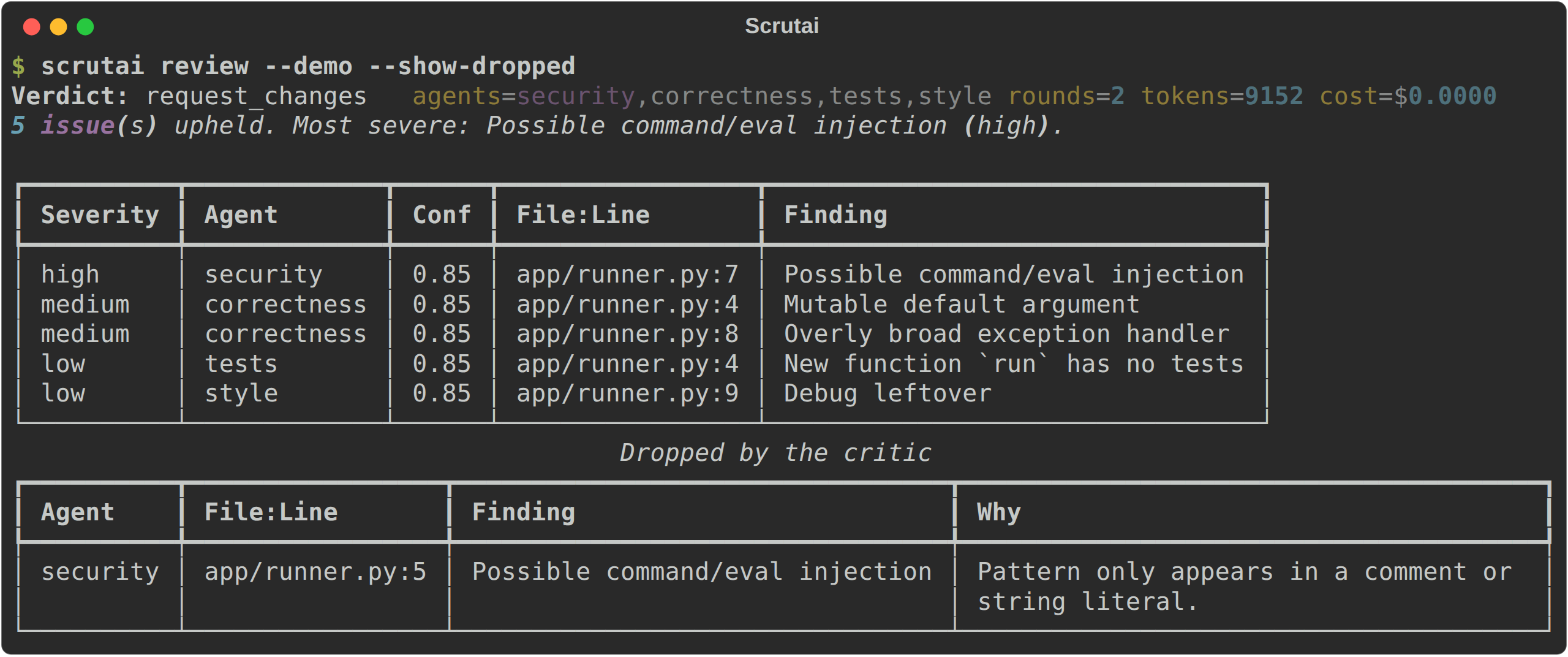
See it in action
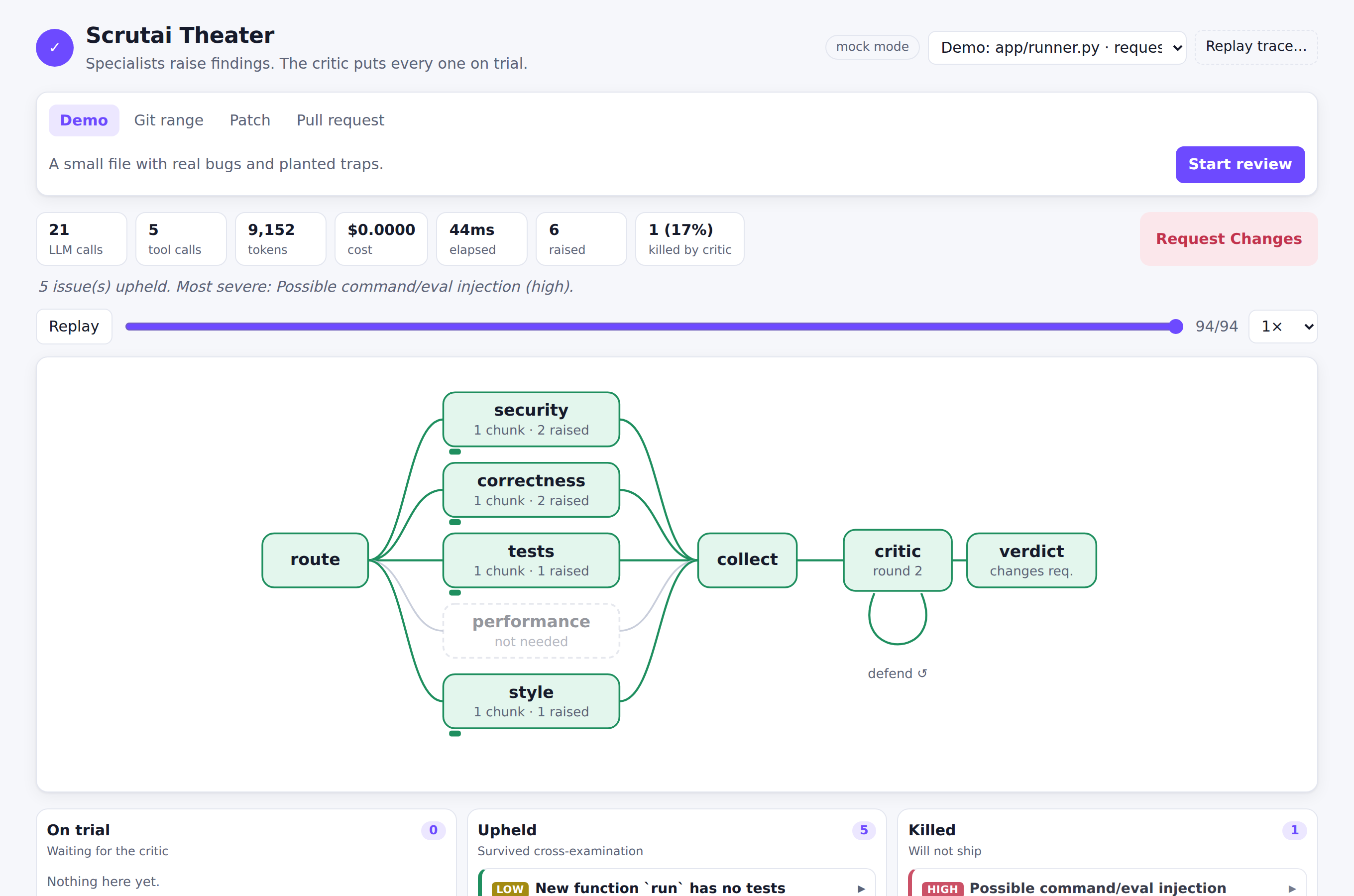
The agent theater (scrutai serve): every finding goes on trial. Expand a card to read the
critic's challenge, the specialist's defense and the final ruling.
 |
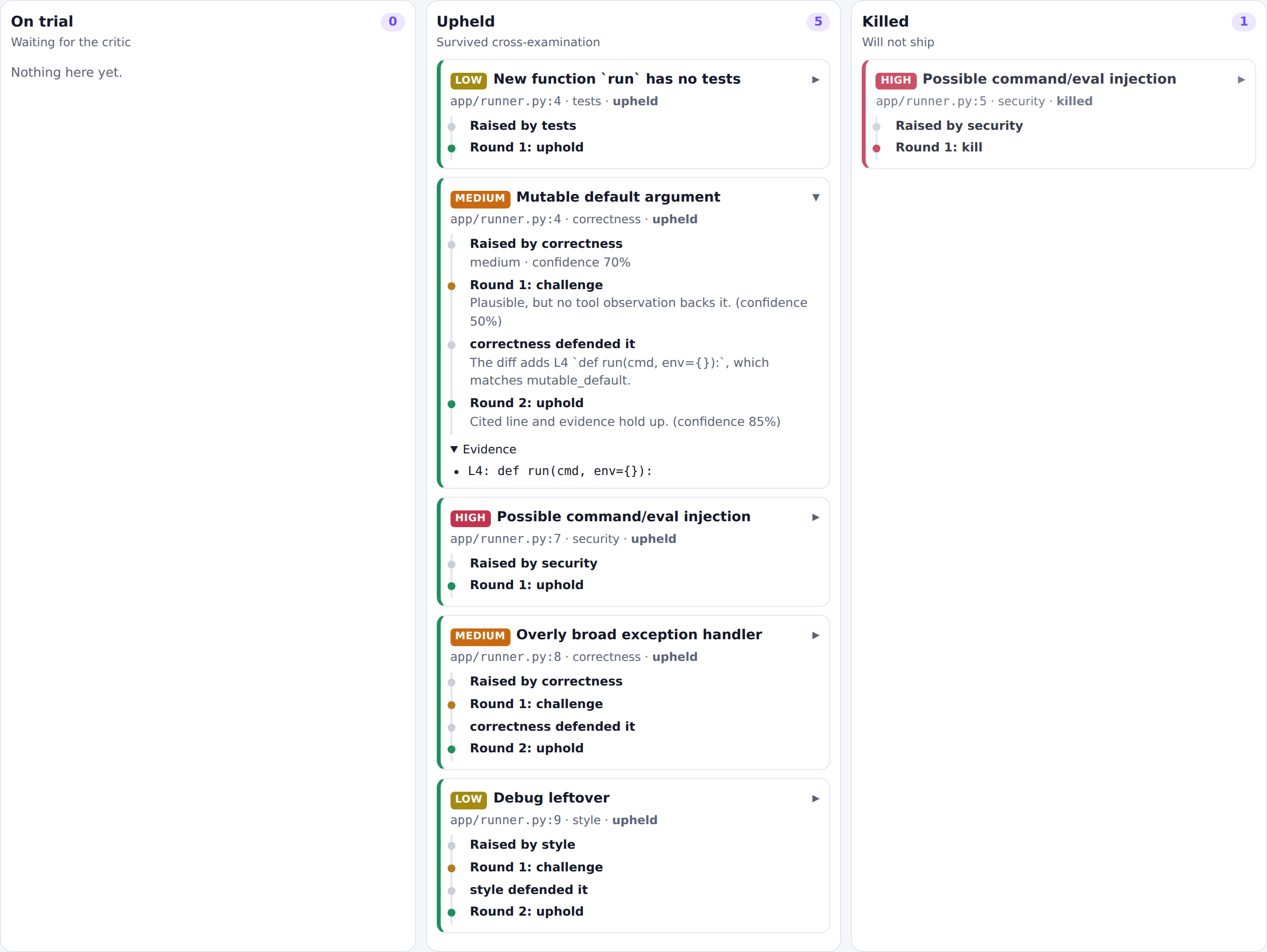 |
| The finished review: stats, verdict and the review graph. | A finding's trial: challenged, defended, then upheld. |
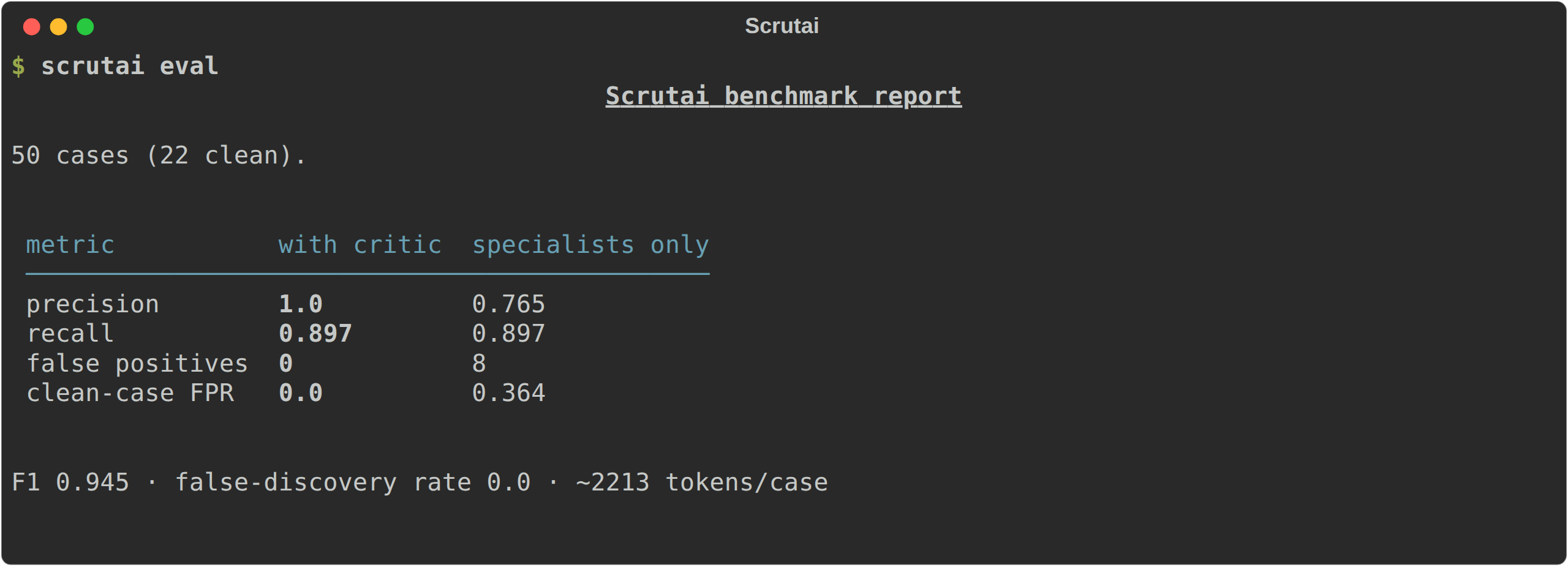
The benchmark (scrutai eval): the critic removes every false positive without losing recall.
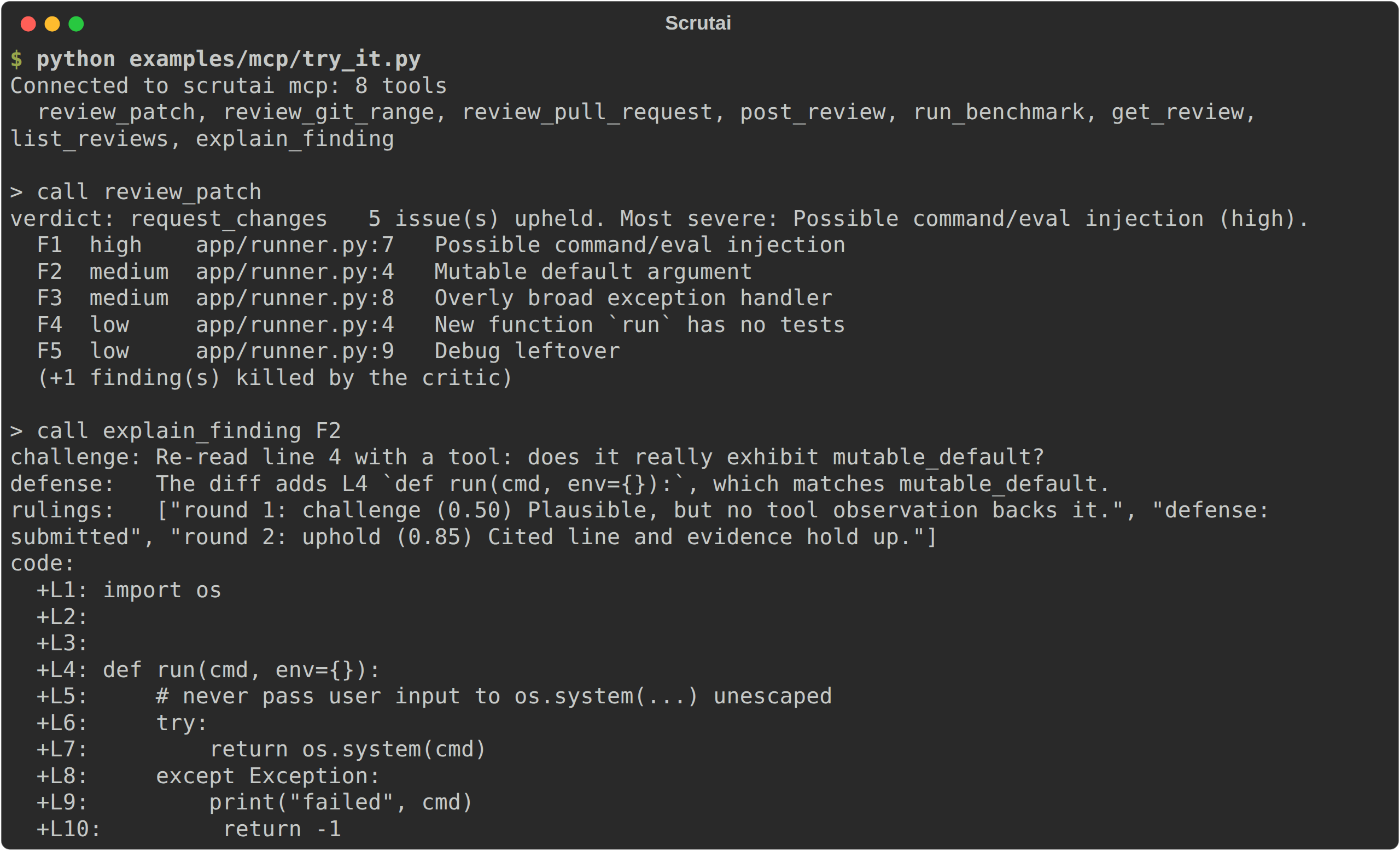
From an AI assistant (scrutai mcp): any MCP client can review and dig into findings.
examples/mcp/try_it.py is a ten-second, offline way to try it.
All screenshots and the recording are captured from real runs by
scripts/capture_media.py.
Installation
Requirements
| Needed for | Notes | |
|---|---|---|
Python 3.12+ and git |
everything | |
| Your own model API key | real reviews only (llm_mode: live) |
Mock mode (the default) needs no key and sends nothing anywhere. Scrutai ships no credentials: you use your own provider account, and calls are billed to it. See Running with a real model. |
| ripgrep | optional | Faster search; Scrutai falls back to git grep or pure Python. |
| Semgrep | optional | SAST evidence for the security agent (pip install "scrutai[semgrep]"). |
GITHUB_TOKEN |
optional | Only for review --pr and posting PR comments. |
| Node.js | developing the web UI only | The built UI ships inside the package. |
Scrutai is on PyPI:
# Core: CLI, agents, critic, benchmark, GitHub integration
pip install scrutai

# With extras (combine as needed)
pip install "scrutai[web,mcp,semgrep]"

# The latest development version, straight from GitHub
pip install "scrutai @ git+https://github.com/imkarthiknr/Scrutai.git"
| Extra | Adds | Install when you want |
|---|---|---|
web |
FastAPI, Uvicorn | the agent theater (scrutai serve) |
semgrep |
Semgrep | SAST evidence for the security agent |
mcp |
MCP Python SDK | the MCP server (scrutai mcp) |
crewai |
CrewAI | the CrewAI framework backend |
otel |
OpenTelemetry API + SDK | tracing: otel |
langfuse |
Langfuse | tracing: langfuse |
dev |
test, lint and type-check tooling | to contribute (see DEVELOPMENT.md) |
Usage
Scrutai has four commands: review, serve, mcp and eval. Run any of them with --help.
Review a branch, a patch or a PR
scrutai review --base main                  # your branch vs main (merge-base, like a PR)
scrutai review --base v1.2 --head feature   # any two refs
scrutai review --diff change.patch          # a unified diff file
git diff | scrutai review --diff -          # ...or stdin
scrutai review --pr 128                     # a GitHub PR (needs GITHUB_TOKEN)
scrutai review --pr 128 --post              # ...and post the review on it
scrutai review --demo                       # the bundled sample
| Option | What it does |
|---|---|
--base, --head |
Git refs to compare (default main and HEAD). |
--repo |
Repository root (default .). |
--diff FILE |
Review a unified diff file; - reads stdin. |
--pr N, --post, --github-repo |
Review a GitHub pull request; optionally post the review. |
-f, --format |
table (default), json, markdown or sarif. --json is a shorthand. |
-o, --output FILE |
Write the report to a file. |
--show-dropped |
Also list the findings the critic killed, and why. |
--trace FILE |
Write a JSONL trace of every step (replayable in the theater). |
--config FILE |
Config file (default .scrutai.yml; every key is optional). |
Exit codes make it CI-friendly: 0 no blocking finding · 1 a finding at or above
fail_on (default high) · 2 usage, diff or API error.
Output formats:
table: a human-readable summary in the terminal.json: the fullReviewResult, including dropped findings and the critic's history for each.markdown: what the GitHub Action posts.sarif: SARIF 2.1.0 for GitHub code scanning and other SAST dashboards, with stable fingerprints.
Use it on every pull request
Add .github/workflows/scrutai.yml to the repository you want reviewed:
name: scrutai
on: pull_request

permissions:
  contents: read
  pull-requests: write     # summary + inline comments
  security-events: write   # SARIF upload (optional)

jobs:
  review:
    runs-on: ubuntu-latest
    steps:
      - uses: actions/checkout@v4
        with:
          ref: ${{ github.event.pull_request.head.sha }}   # tools read the PR's code
      - uses: imkarthiknr/Scrutai@main
        with:
          llm-mode: live
          install-semgrep: "true"
          sarif-file: scrutai.sarif
        env:
          ANTHROPIC_API_KEY: ${{ secrets.ANTHROPIC_API_KEY }}   # or any LiteLLM provider key
      - uses: github/codeql-action/upload-sarif@v3
        if: always() && hashFiles('scrutai.sarif') != ''
        with:
          sarif_file: scrutai.sarif
What the Action does on the PR:
- One summary comment, found again by a hidden marker and edited in place on every push, so it never piles up.
- One inline comment per finding, on the exact added line. Each carries a fingerprint that ignores line numbers, so a finding that survives a push is never posted twice, even if the code around it moved.
- The full report in the job summary, and the
verdictas a step output.
| Input | Default | Description |
|---|---|---|
config |
.scrutai.yml |
Path to the config file in the repository. |
llm-mode |
(from config) | mock or live. |
post-comments |
true |
Post the summary and inline comments. |
sarif-file |
(none) | Also write SARIF to this path. |
install-semgrep |
false |
Install Semgrep for SAST evidence. |
fail-on-findings |
true |
Fail the job on a finding at or above fail_on. |
python-version |
3.12 |
Python used to run Scrutai. |
| Output | Description |
|---|---|
verdict |
approve, comment or request_changes. |
Watch it think: the agent theater
pip install "scrutai[web]"
scrutai serve                       # http://127.0.0.1:8765
scrutai serve --replay run.jsonl    # open a recorded trace (from review --trace)
Start a review from the browser (demo, git range, pasted patch or PR number) and watch it happen:
- The review graph: the router picks specialists, each agent lights up per diff chunk, and the
critic loops through rounds with the
defendstep. - The trial board: every finding moves from On trial to Upheld or Killed, with its story: who raised it, the critic's challenge, the specialist's defense or withdrawal, and the ruling with its reason.
- Live stats: LLM and tool calls, tokens, cost, elapsed time and the critic's kill rate.
- Playback: replay any finished run at 1×, 4× or 16×, or scrub event by event. Upload any
--tracefile and it plays back exactly like a live run.
The server binds to 127.0.0.1 by default because it can read your repository and spend your API
budget. The built UI ships inside the Python package; Node is only needed to work on the UI.
Ask for it from your AI assistant: the MCP server
pip install "scrutai[mcp]"
claude mcp add scrutai -- scrutai mcp --root "$PWD"     # Claude Code, local (stdio)

# Remote, over Streamable HTTP with a bearer token:
SCRUTAI_MCP_TOKEN=... scrutai mcp --transport http --port 8000 --root ~/src
Then ask your assistant to "review my branch against main with Scrutai". Your MCP client gets these tools:
- Review:
review_git_range,review_patchandreview_pull_request. - Results:
get_review,list_reviewsandexplain_finding.explain_findingreturns the critic's challenge, the specialist's defense and the code around the line. - Posting:
post_reviewwrites to the PR only after the user confirms, and is off with--no-post. - Benchmark:
run_benchmark.
Every tool returns structured results. The server also provides:
- Resources: the Markdown report, SARIF and trace of every review.
- Prompts:
review-my-branch,fix-findingandsecurity-audit.
Reviews report progress and can be cancelled. Repository paths are confined to --root. HTTP
binds to localhost unless a token is set. See docs/MCP.md for client configs,
every tool's schema and the security model.
Measure it: the benchmark
scrutai eval                                   # metrics + a per-category table
scrutai eval --min-precision 0.95 --min-recall 0.8   # as a CI gate (exit 1 below the bar)
scrutai eval --report eval.md --json           # markdown report + JSON metrics
scrutai eval --compare crewai                  # same benchmark, native vs CrewAI agents
scrutai eval --benchmark my-cases.jsonl        # your own labelled cases
Each case is one JSON line with the patch, the expected finding categories, and optionally other files of the repository it lives in:
{"id": "inj-01", "file": "runner.py", "patch": "+def run(cmd):\n+    return os.system(cmd)\n",
 "labels": ["injection"], "repo": {"tests/test_runner.py": "..."}, "note": "why this case exists"}
An empty labels list marks a clean change, where any finding is a false positive. Every case runs
in its own temporary repository, so results never depend on where you run eval.
Use it as a library
The CLI, the Action, the server and the benchmark all call one function:
from scrutai import review_diff
from scrutai.config import ScrutaiConfig
from scrutai.diff import apply_filters, diff_from_git
from scrutai.llm import make_client

config = ScrutaiConfig.load(".scrutai.yml")
diff = apply_filters(diff_from_git("main", "HEAD"), config.include, config.exclude)
result = review_diff(diff, config, make_client(config.llm_mode))

print(result.verdict, result.summary)
for f in result.findings:
    print(f"{f.severity:>8}  {f.file}:{f.line}  {f.title}  ({f.critic_note})")
ReviewResult is a Pydantic model: verdict, findings, dropped, summary, tokens_used,
cost_usd, rounds, agents, budget_exhausted, cancelled.
Running with a real model (bring your own key)
Scrutai contains no API keys and has no server of its own. In live mode, model calls go from your machine, with your key, straight to the provider you choose, and are billed to your account. Scrutai reaches models through LiteLLM, which supports 100+ providers and reads each provider's standard environment variable.
1. Pick models (one per role; they may be from different providers):
# .scrutai.yml
llm_mode: live
models:
  router: anthropic/claude-haiku-4-5       # cheap: picks which specialists run
  specialist: anthropic/claude-sonnet-5-5  # the five reviewers
  critic: anthropic/claude-opus-5-5        # strongest: its judgement is the product
2. Give it your key through the environment, never in .scrutai.yml or any committed file:
export ANTHROPIC_API_KEY=sk-ant-...            # macOS / Linux
$env:ANTHROPIC_API_KEY = "sk-ant-..."          # Windows PowerShell
set ANTHROPIC_API_KEY=sk-ant-...               # Windows Command Prompt

scrutai review --base main
Common providers
| Provider | Model string (example) | Environment variable(s) |
|---|---|---|
| Anthropic (Claude), the default | anthropic/claude-sonnet-5-5 |
ANTHROPIC_API_KEY |
| Google Gemini | gemini/gemini-2.5-pro |
GEMINI_API_KEY |
| OpenAI | openai/gpt-4o |
OPENAI_API_KEY |
| Azure OpenAI | azure/<your-deployment> |
AZURE_API_KEY, AZURE_API_BASE, AZURE_API_VERSION |
| AWS Bedrock | bedrock/<model-id> |
your usual AWS credentials (AWS_ACCESS_KEY_ID, … or a profile) |
| Google Vertex AI | vertex_ai/<model> |
Google Cloud application-default credentials |
| Ollama (local, free) | ollama/llama3.1 |
none; start ollama serve first |
Any other LiteLLM model string works the same way. If
you switch to llm_mode: live without changing models, the Claude defaults apply, so you need
ANTHROPIC_API_KEY. A missing or wrong key fails with the provider's authentication error.
Where the key goes, per way of running Scrutai
| You run | Put the key in |
|---|---|
scrutai review / eval / serve |
your shell environment (above) |
| The GitHub Action | a repository secret in your repo, passed as env: (see the workflow) |
scrutai mcp |
the environment of the process running the server (e.g. the env block of a Claude Desktop or Cursor config); the MCP client never sees it |
| The Python library | the environment of your program |
Keeping costs under control:
token_budget(default 200,000 tokens per review) andmax_cost_usdare hard caps. When one is reached, Scrutai stops calling the model, marks the review partial, and withholds anything the critic had not judged.- Routing skips specialists a change can't need, and chunking keeps prompts small.
- Every result reports
tokens_usedandcost_usd;--tracebreaks both down per call. - Dollar figures come from LiteLLM's price list. For models it has no price for (for example local
Ollama models),
cost_usdreads0and onlytoken_budgetlimits a review. - Benchmark numbers in this README are from mock mode. Review quality with a real model depends on the model: smaller or local models produce more raw noise, which the critic has to filter.
How it works
flowchart LR
    D[diff] --> R{route}
    R -->|per chunk| S1[security]
    R -->|per chunk| S2[correctness]
    R -->|per chunk| S3[tests]
    R -->|per chunk| S4[performance]
    R -->|per chunk| S5[style]
    S1 & S2 & S3 & S4 & S5 --> C[collect + dedupe]
    C --> K{critic}
    K -->|challenge| F[defend]
    F --> K
    K -->|settled or out of rounds| V[verdict]
-
Parse and filter. The diff is parsed with real new-file line numbers.
includeandexcludeglobs apply, and deleted or binary files are dropped. -
Chunk and route. Added lines are packed into chunks of about
chunk_lines. Each chunk is routed on its own: docs, lockfiles and assets wake nobody; security wakes on a risk surface (exec, SQL, secrets, crypto, deserialization, HTTP...) or a sensitive path; tests wakes only when new functions appear. -
Specialists investigate, concurrently, one branch per agent and chunk (LangGraph
Send). Each runs a bounded ReAct loop over its tools and returns typed findings: file, line, category, severity, confidence and evidence. -
Collect. Findings are merged and deduplicated: the same category on the same line is one issue.
-
The critic cross-examines every finding against the cited line and its surroundings:
Decision Meaning uphold Real and backed by evidence; the critic sets the confidence. downgrade Real but over-rated; severity can only go down. kill Not in this diff, only in a comment or string, a placeholder, a constant input... challenge Plausible but under-evidenced; the specialist must defend it or withdraw. -
Debate. Challenged findings go back to their specialist, which may gather new tool evidence. The critic re-judges only those.
max_critic_roundsbounds the loop. -
Verdict. Survivors above
min_confidenceandmin_severitybecome the result.request_changesat or abovefail_on, otherwisecomment, orapproveif nothing survived.
The specialists and what they look for:
| Agent | Categories | Tools |
|---|---|---|
security |
injection, sql_injection, hardcoded_secret, unsafe_deserialization, weak_crypto, tls_verify_disabled, path_traversal | read_file, grep, git_blame, semgrep |
correctness |
broad_except, mutable_default, none_comparison, identity_literal, logic_error | read_file, grep, git_blame |
tests |
missing_tests | grep, read_file |
performance |
n_plus_one, regex_in_loop, string_concat_in_loop, sort_for_min_max | read_file, grep, git_blame |
style |
debug_leftover, wildcard_import, untracked_todo | read_file, grep |
The full design rationale (why hierarchical delegation, why grounded tools, why a debate, why a budget, what the mock model does and doesn't prove) is in docs/ARCHITECTURE.md.
Configuration reference
Everything lives in .scrutai.yml. Every key is optional; these are the defaults. Unknown agents,
modes or backends are rejected with a clear error (exit code 2).
| Key | Default | Description |
|---|---|---|
enabled_agents |
all five | Which specialists may run. |
min_severity |
low |
Drop findings below this (info < low < medium < high < critical). |
min_confidence |
0.6 |
The critic's bar: findings below it don't survive. |
fail_on |
high |
Severity at which review exits 1 and the verdict is request_changes. |
llm_mode |
mock |
mock (offline, deterministic) or live. |
models.router |
anthropic/claude-haiku-4-5 |
Model used by the optional LLM router. |
models.specialist |
anthropic/claude-sonnet-5-5 |
Model for the five specialists. |
models.critic |
anthropic/claude-opus-5-5 |
Model for the critic. |
routing |
heuristic |
heuristic, or llm (the router model may narrow the selection, never widen it). |
max_agent_steps |
4 |
ReAct budget per specialist: tool calls plus the final answer. |
max_critic_rounds |
2 |
Debate rounds; 1 disables the debate. |
chunk_lines |
250 |
Added lines per chunk; 0 reviews the whole diff at once. |
concurrency |
4 |
Parallel critic and defense calls. |
token_budget |
200000 |
Hard token cap per review; 0 disables. |
max_cost_usd |
0.0 |
Hard dollar cap per review (live mode); 0 disables. |
semgrep |
auto |
auto (if installed), off, or required (fail if missing). |
semgrep_config |
bundled |
The offline ruleset, or any semgrep --config value (e.g. p/default). |
backends |
{} |
Agent framework per specialist, e.g. {security: crewai} or {"*": crewai}. |
tracing |
none |
none, otel or langfuse (--trace FILE works regardless). |
include |
["**/*"] |
Globs of files to review. |
exclude |
vendor, lockfiles, dist | Globs of files to skip. |
Benchmark
scrutai eval on the bundled 50-case benchmark (src/scrutai/eval/cases.jsonl, shipped in the package). Of the 50 cases, 22 are
clean changes, many of them deliberate traps: sinks in comments and strings, constant commands,
placeholder secrets, yaml.safe_load, bound SQL parameters, tests that already exist.
| Metric | With critic | Specialists only |
|---|---|---|
| Precision | 1.00 | 0.77 |
| Recall | 0.90 | 0.90 |
| False positives | 0 | 8 |
| Clean diffs flagged | 0% | 36% |
Framework comparison (--compare crewai) |
native | crewai |
|---|---|---|
| Precision / recall | 1.00 / 0.90 | 1.00 / 0.90 |
| Per-case agreement | 100% | |
| Wall time (mock model) | 0.6 s | 31.8 s |
Read these numbers honestly. They come from mock mode: a deterministic, rule-based stand-in that is deliberately noisy so the critic has something to remove. They prove the machinery works: routing, the debate, deduplication and scoring are wired correctly, and the critic removes noise without costing recall. They are not a claim about any LLM. To measure a real model, run
scrutai evalwithllm_mode: live. The three misses are cases labelled as expected misses (data-flow SQL injection, path traversal, an off-by-one), kept so the numbers can't quietly become flattering.
CI runs this benchmark on every pull request as a regression gate.
Security and privacy
Scrutai reads your code and hands parts of it to a model, so its guardrails are part of the product:
-
Tools are sandboxed. File paths from a model are confined to the repository (no
../../.ssh), search patterns are passed as data and never as flags, and the Semgrep ruleset always comes from your config, never from the model. -
Git refs are validated, so a ref such as
--output=...can never be read as a git option. -
Nothing unjudged ships. A provider error, an unparseable reply or a spent budget withholds the finding instead of passing it through.
-
Your keys stay yours. Scrutai reads provider keys only from the environment, never from config files, never logs them, and sends them only to that provider (via LiteLLM).
-
No telemetry. Scrutai sends nothing anywhere except to the model provider you configure. CrewAI's telemetry is disabled when the CrewAI backend is used.
-
The theater binds to localhost and warns if you bind it anywhere else.
-
The MCP server trusts no client argument.
- Repository paths must resolve inside a
--root. - Over HTTP it needs a bearer token whenever it listens beyond localhost, checks
Hostheaders, and caps input sizes. - Posting to GitHub is a separate tool, gated on the user's confirmation.
See docs/MCP.md.
- Repository paths must resolve inside a
-
Mock mode sends nothing at all.
Found a vulnerability? Please report it privately through GitHub security advisories rather than in a public issue.
Project layout
Scrutai/
├── src/scrutai/
│   ├── cli.py              # review / serve / mcp / eval commands
│   ├── orchestrator.py     # the LangGraph review graph: route → specialists → critic ⇄ defend → verdict
│   ├── router.py           # which specialists a diff (chunk) needs
│   ├── agents/             # the five specialists, their shared ReAct base, the CrewAI backend
│   ├── critic.py           # cross-examination and the debate
│   ├── tools/              # sandboxed read_file / grep / git_blame / semgrep
│   ├── diff.py, patch.py   # diff parsing, filtering, chunking
│   ├── llm.py, mock.py     # LiteLLM client, budget guardrail, the offline mock model
│   ├── report.py           # Markdown and SARIF output
│   ├── github.py           # PR diffs and idempotent PR reviews
│   ├── trace.py            # JSONL / OpenTelemetry / Langfuse tracing
│   ├── eval/               # the benchmark harness and its 50 labelled cases
│   ├── inputs.py, runs.py  # one input path and run store shared by CLI, web and MCP
│   ├── mcp/                # `scrutai mcp`: tools, resources, prompts, HTTP auth
│   ├── web/                # `scrutai serve` and the built UI bundle
│   └── rules/semgrep.yml   # the bundled offline Semgrep ruleset
├── web/                    # the React + TypeScript source of the agent theater
├── tests/                  # 200+ tests, including browser and MCP end-to-end tests
├── action.yml              # the GitHub Action
├── examples/               # a ready-to-copy workflow and MCP client configs
└── docs/                   # ARCHITECTURE.md (design rationale), MCP.md (MCP server reference)
FAQ
Does it need an API key?
No. Mock mode (the default) runs everything offline. You need a key only for llm_mode: live.
Whose API key does it use, and who pays?
Yours. Scrutai ships no credentials and runs no service. It calls the provider you configure,
directly from your machine or CI, with the key in your environment, so usage is billed to your
provider account. Use token_budget and max_cost_usd to cap each review, or a local model
(Ollama) to pay nothing. See
Running with a real model.
Which languages can it review?
The pipeline is language-agnostic: diffs, routing, tools and the critic work on any text. The mock
model's rules and the bundled Semgrep ruleset are Python-focused, while a live model and Semgrep
registry packs (semgrep_config: p/default) cover many more languages.
How much does a live review cost?
It depends on the diff size and the models. Every result reports tokens_used and cost_usd, and
token_budget / max_cost_usd cap any single review.
Can it block merges?
Yes. review exits 1 on a finding at or above fail_on, and the Action fails the job unless
fail-on-findings: "false".
Will it spam my PR on every push? No. The summary comment is edited in place, and inline comments carry fingerprints, so a finding is posted once, even if the code around it moves.
Can I use it from Claude Code, Claude Desktop or Cursor?
Yes, through the MCP server: claude mcp add scrutai -- scrutai mcp --root "$PWD". See
docs/MCP.md for other clients and remote (HTTP) setups.
Can I use a different agent framework?
Yes. Specialists share one seam, Specialist._loop. The CrewAI backend overrides only that, and
scrutai eval --compare crewai shows identical results on the benchmark. See
DEVELOPMENT.md to add another one.
Roadmap
- ✅ v0.1: CLI, ReAct specialists, adversarial critic with debate, benchmark harness.
- ✅ v0.2: GitHub Action, SARIF, Semgrep, Performance and Style agents, chunked parallel review, budget guardrails, tracing.
- ✅ v0.3: agent theater web UI, CrewAI backend,
eval --compare. - ✅ v0.4: MCP server: review, explain, post and benchmark tools for AI assistants, over stdio or authenticated HTTP.
- 🔜 Next: published live-model benchmark numbers, a Google ADK backend, Semgrep taint rules for data-flow issues, a PyPI release.
See RELEASES.md for what each version contains.
Contributing
Contributions are welcome: new specialists, Semgrep rules, benchmark cases (especially tricky false-positive traps), framework backends and UI improvements. DEVELOPMENT.md covers the setup, the architecture in five minutes, step-by-step recipes for common changes, the testing approach and the pull-request checklist.
License
Apache-2.0 © Karthik N R.
Built on LangGraph, LiteLLM, Semgrep, CrewAI, FastAPI, React and Vite.
1 maintainer

Metadata
1 maintainer
Release files for scrutai 0.4.0
For a detailed explanation of source distributions (sdists) and built distributions (wheels), please see the package formats documentation.
Source distribution (sdist)
| File | Size | Uploaded | |
|---|---|---|---|
| scrutai-0.4.0.tar.gz | 246.7 kB | Details |
Built distribution (wheel)
| File | Interpreter | ABI | Platform | Reset |
|---|---|---|---|---|
| scrutai-0.4.0-py3-none-any.whl | Python 3 | none | any | Details |
Total release size: 437.9 kB
Release files / scrutai-0.4.0.tar.gz
| Download URL | scrutai-0.4.0.tar.gz |
|---|---|
| Size | 246.7 kB |
| Tags | Source |
|
SHA-256 checksum How to use checksums |
f5de728fd0eee3ee265d86091b1aa259b4cf10d2e96c438ed1d0fbb9bbe44a25
|
|
BLAKE2b-256 checksum How to use checksums |
a92234e244b4dfcdff89f53efbea1ea310d12125784d48e3aff79c3706de5038
|
| Upload date | |
|
Uploaded using Trusted Publishing? What is trusted publishing? |
Yes |
| Uploaded via |
twine/7.0.0 CPython/3.13.14
|
Provenance
Provenance describes where a file came from. On PyPI, provenance is shared via attestations, which provide a verifiable record of the build or publishing details. View details, limitations and caveats.


PyPI Publish Attestation
PyPI verified that this artifact, at this checksum, originated from the publisher listed below.
Signed by GitHub Actions, verified by PyPI on Oct 3, 2026.
Transparency logRelease files / scrutai-0.4.0-py3-none-any.whl
| Download URL | scrutai-0.4.0-py3-none-any.whl |
|---|---|
| Size | 191.2 kB |
| Tags | Python 3 |
|
SHA-256 checksum How to use checksums |
53ec518a98eee0ffebd45df05c7e65c81962e65ab6382592d1bb29b920ac8645
|
|
BLAKE2b-256 checksum How to use checksums |
af63b153cd0c581a722c1de6fe0a9a69ef7f048c0711930793fbb34503659ef0
|
| Upload date | |
|
Uploaded using Trusted Publishing? What is trusted publishing? |
Yes |
| Uploaded via |
twine/7.0.0 CPython/3.13.14
|
Provenance
Provenance describes where a file came from. On PyPI, provenance is shared via attestations, which provide a verifiable record of the build or publishing details. View details, limitations and caveats.
PyPI Publish Attestation
PyPI verified that this artifact, at this checksum, originated from the publisher listed below.
Signed by GitHub Actions, verified by PyPI on Oct 3, 2026.
Transparency log












