
scspill





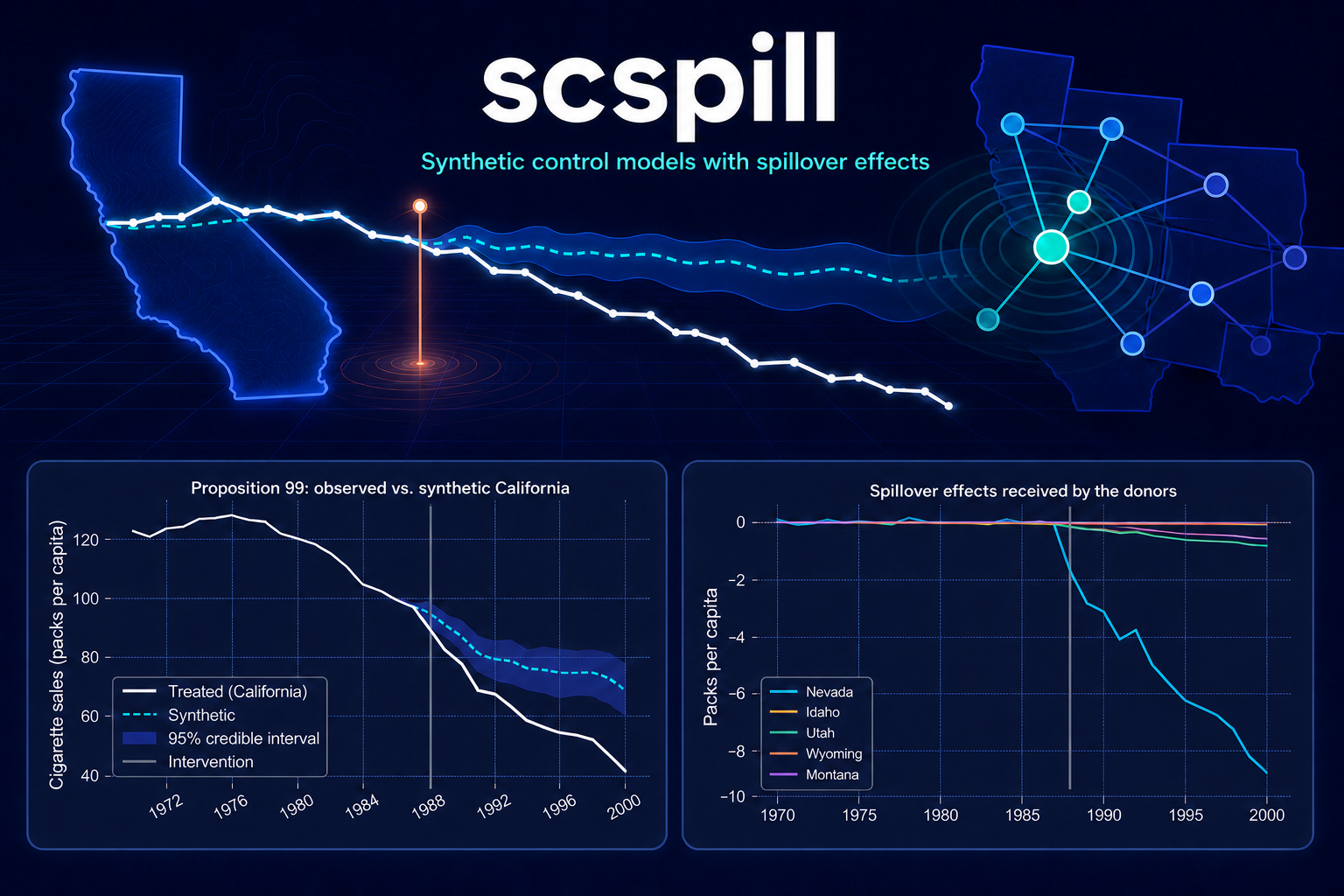
Synthetic control when the treatment leaks. scspill is a Python package of synthetic control models that drop SUTVA on the donor pool: the treatment is allowed to reach the controls, and every model reports two estimands — the effect on the treated unit, purged of the contamination, and the spillover effect received by each donor, which classical synthetic control cannot express at all.
Models
| Model | method |
Reference | Class | Docs |
|---|---|---|---|---|
| Bayesian spatial-autoregressive spillover SCM | "sar" |
Sakaguchi & Tagawa (2026), The Econometrics Journal | SCSPILL |
sar |
| Synthetic control under a known spillover structure | "cd" |
Cao & Dowd (arXiv:1902.07343v3) | SCSPILL |
cd |
Both models are selected through one configuration, SCSPILLConfig(method=...),
and return one result type.
sar(the default) routes spillovers through spatial weights you supply, scaled by a single intensity ρ that is estimated rather than assumed. It fits unconstrained horseshoe-shrunk synthetic weights and returns full Bayesian uncertainty for both estimands. At ρ = 0 it collapses exactly to the Bayesian horseshoe synthetic control.cdfits an intercept-adjusted simplex synthetic control for every unit. A known exposure structure then separates the direct effect from each spillover in every post-treatment period. The structure can be named units with free effects, one shared spillover, a spillover decaying with distance, or any exposure matrix. Andrews-type P tests give the inference for any linear hypothesis; the κ_A test checks the structure; a sensitivity analysis bounds the bias of missed spillovers. Its defaults are the paper's (v3) definitions.
The inclusive SCM of Di Stefano & Mellace and the partial-interference SCG of Grossi et al. remain on the roadmap.
The estimator architecture follows
mlsynth (a pydantic config in, a
standardized results object out), and the method names match its
SPILLSYNTH dispatcher, so the two libraries compose naturally; the
documentation site follows
geometrics.
Installation
pip install scspill              # NumPy/SciPy sampler backend
pip install "scspill[numba]"     # + JIT-compiled samplers (~10x faster)
pip install "scspill @ git+https://github.com/quarcs-lab/scspill.git"   # latest
Python 3.10+.
At a glance
from scspill import SCSPILL
from scspill.data import load_california

panel = load_california()        # Prop 99 panel + rook-contiguity weights
result = SCSPILL(
    {**panel.config_kwargs(), "m_iter": 20_000, "burn": 10_000, "seed": 42}
).fit()

result.att, result.att_ci          # treatment effect on California + 95% CrI
result.rho_hat, result.rho_ci      # spillover intensity posterior
result.spillover_panel["Nevada"]   # the effect received by Nevada, per year
result.diagnostics()               # ESS / R-hat / MCSE per chain
result.plot(kind="panel")          # counterfactual | effect | top spillovers
import numpy as np
from scspill.data import load_california_cd

cd = SCSPILL(load_california_cd(51).config_kwargs()).fit()   # method="cd"

cd.att                             # average direct effect on California
cd.effects_panel[["CA", "NV"]]     # direct effect and Nevada's spillover, by year
cd.effect_ci["NV"]                 # pointwise 95% intervals (P-test inversion)
no_spill = np.eye(len(cd.unit_labels))[1:]          # every unit but California
cd.test_hypothesis(no_spill, period=1990)         # "no spillover anywhere" in 1990
cd.kappa_test                      # is the assumed structure right?
cd.plot(kind="spillover")          # every exposed state's effect with intervals
Package layout
| Subpackage | What it does | Docs |
|---|---|---|
scspill |
The model layer. SCSPILL(config).fit() dispatches the Bayesian sar and Cao–Dowd cd estimators |
Models |
scspill.validation |
sar's sampler validation: the Geweke (2004) joint distribution test, prior-sensitivity grids, prior predictive checks |
Validation |
scspill.simulate |
sar's Monte Carlo engine: rook-lattice SAR DGP, SCM/BSCM/SCSPILL comparison, the Tables 1–2 grid |
Simulation study |
scspill.data |
The bundled case studies: California and Sudan (sar), and Cao & Dowd's 51/41-unit Proposition 99 panel (cd) |
Datasets |
Validated, not just implemented
The sar model is cross-validated against the authors' R replication
package (python benchmarks/run_benchmarks.py --all --report): California
and Sudan posteriors against the frozen R credible intervals, the Monte
Carlo grid against the paper's frozen Tables 1–2, prior predictive
statistics to three decimals, and the samplers against the Geweke joint
distribution test. The defaults are paper-correct: several documented bugs
of the reference implementation (a covariate memory-layout mismatch, a
missing horseshoe prior, alpha-frozen credible intervals, two incoherent
factor-block conditionals) are fixed here, each with an escape hatch or a
benchmark quantifying the difference — see the
sar model page.
The cd model is checked against three independent sources:
- the paper (v3): its statements on the Proposition 99 application, including Figure 3's sensitivity break-even points;
- the authors' replication code: every P value of their Proposition 99 output, and the statistics of their simulation code;
- mlsynth's
SPILLSYNTH(method="cd"): to solver tolerance, with identical P values.
Documentation
Full documentation, executed tutorials, and the API reference live at
https://quarcs-lab.github.io/scspill/. Machine-readable entry points
for AI agents: llms.txt
and llms-full.txt.
Development
git clone https://github.com/quarcs-lab/scspill && cd scspill
uv sync --all-extras --group dev --group docs
make test      # pytest (fast tier; `make test-slow` for the long tier)
make lint      # ruff check + format
make typecheck # mypy
make docs      # quartodoc build -> quarto render -> llms.txt
Citing
If you use scspill, please cite it as (machine-readable metadata lives in
CITATION.cff):
Mendez, C., Sakaguchi, S., & Tagawa, H. (2026). Synthetic Control Models with Spillovers in Python (version 0.3.0). https://github.com/quarcs-lab/scspill
Authors: Carlos Mendez · Shosei Sakaguchi · Hayato Tagawa
Acknowledgments
The library's design, syntax, and infrastructure are based on Jared
Greathouse's mlsynth, a larger and
more comprehensive package of synthetic control methods. The documentation
stack follows geometrics, from the
QuaRCS lab, where scspill is developed. The
sar model is cross-validated, every release, against the MIT-licensed
replication package for the article
it implements; that package's copyright notice is retained in LICENSE. The
cd model implements Jianfei Cao and Connor Dowd's method and is checked
against their replication repository;
its implementation was contributed by Hayato Tagawa.
License
MIT
1 maintainer

Metadata
1 maintainer
Release files for scspill 0.3.0
For a detailed explanation of source distributions (sdists) and built distributions (wheels), please see the package formats documentation.
Source distribution (sdist)
| File | Size | Uploaded | |
|---|---|---|---|
| scspill-0.3.0.tar.gz | 176.3 kB | Details |
Built distribution (wheel)
| File | Interpreter | ABI | Platform | Reset |
|---|---|---|---|---|
| scspill-0.3.0-py3-none-any.whl | Python 3 | none | any | Details |
Total release size: 373.2 kB
Release files / scspill-0.3.0.tar.gz
| Download URL | scspill-0.3.0.tar.gz |
|---|---|
| Size | 176.3 kB |
| Tags | Source |
|
SHA-256 checksum How to use checksums |
544b0c7d2878997d3d98ed53027365ed2dc84ea10c19356b314521b0fb64e97a
|
|
BLAKE2b-256 checksum How to use checksums |
bec37e341362364056f54760001892a8c39f18335fea5e26d39bb42e61190331
|
| Upload date | |
|
Uploaded using Trusted Publishing? What is trusted publishing? |
Yes |
| Uploaded via |
twine/7.0.0 CPython/3.13.14
|
Provenance
Provenance describes where a file came from. On PyPI, provenance is shared via attestations, which provide a verifiable record of the build or publishing details. View details, limitations and caveats.


PyPI Publish Attestation
PyPI verified that this artifact, at this checksum, originated from the publisher listed below.
Signed by GitHub Actions, verified by PyPI on Oct 16, 2026.
Transparency logRelease files / scspill-0.3.0-py3-none-any.whl
| Download URL | scspill-0.3.0-py3-none-any.whl |
|---|---|
| Size | 196.9 kB |
| Tags | Python 3 |
|
SHA-256 checksum How to use checksums |
8b2746d7c21c563e33932dc033393b5f5d123871156fcbf812d0777e3a2c3c58
|
|
BLAKE2b-256 checksum How to use checksums |
06cdb0811241be7c2d073b92228a079fe0d9b7663202cf6b54dabaaee7f35868
|
| Upload date | |
|
Uploaded using Trusted Publishing? What is trusted publishing? |
Yes |
| Uploaded via |
twine/7.0.0 CPython/3.13.14
|
Provenance
Provenance describes where a file came from. On PyPI, provenance is shared via attestations, which provide a verifiable record of the build or publishing details. View details, limitations and caveats.
PyPI Publish Attestation
PyPI verified that this artifact, at this checksum, originated from the publisher listed below.
Signed by GitHub Actions, verified by PyPI on Oct 16, 2026.
Transparency log













