
Deterministic, rule-based linter for Adobe Customer Journey Analytics and Adobe Analytics implementations.
Verified details
These details have been verified by PyPIProject links
GitHub Statistics
Maintainers

Project description
sdr-grader






A deterministic, rule-based linter for Adobe Customer Journey Analytics
(CJA) and Adobe Analytics (AA) implementations. It consumes JSON
snapshots from cja_auto_sdr
and aa_auto_sdr, evaluates
them against a versioned, pluggable YAML rubric, and produces a single
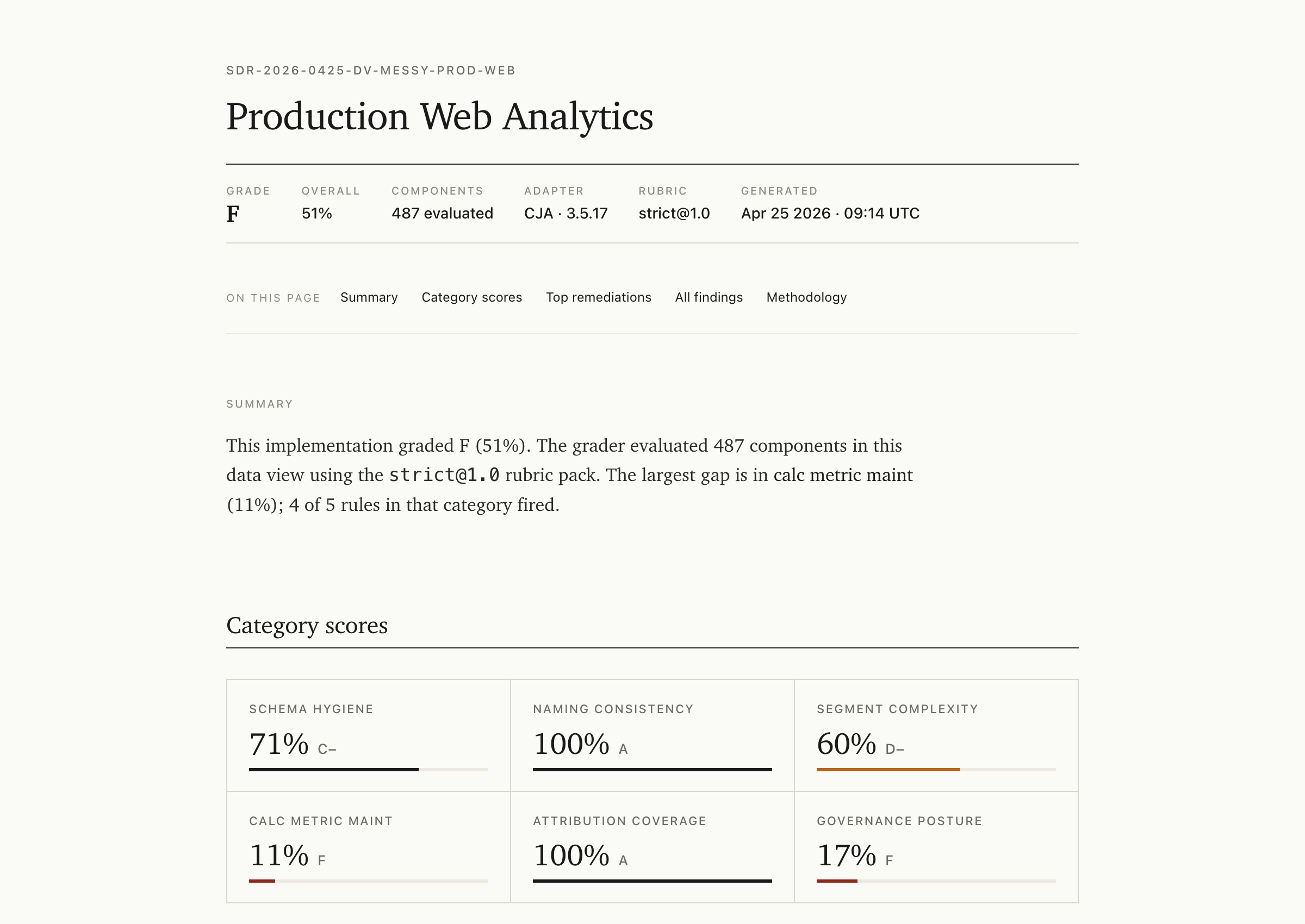
self-contained HTML report card plus a machine-readable JSON output. No
LLMs, no API calls — same input + same rubric always yields the same grade.
What it grades
sdr-grader ships two rubric packs:
strict— master-cert-grade opinion; tight thresholds. For teams who want every finding the rubric can produce.pragmatic— looser thresholds, same rule IDs. For teams who want a sanity check rather than an audit.
Both packs cover the same six categories — schema hygiene, naming
consistency, segment complexity, calculated metric maintainability,
attribution coverage, and governance posture — and share the same
rule IDs; pragmatic just loosens thresholds and demotes severities.
Every rule in the default packs grades against data the snapshot
itself carries, so out-of-the-box runs need no extra files. A few
additional check functions ship registered but unwired — they read
JSON the operator attaches at run time and are intended for forked
rubrics. See Supplementary inputs for the
attachment mechanism and docs/RUBRIC_FORMAT.md
for the pack format.
How it grades
A grade run is a one-way pipeline over typed data:
- Adapt — the platform adapter (
adapters/cja.pyoradapters/aa.py) normalizes the JSON snapshot into anImplementation(metrics, dimensions, segments, calculated metrics, governance signals). - Run rules — the engine loops over every rule in the active
rubric pack and calls its registered Python check function; each
check returns zero or more
Findings. - Score — for each non-zero-weight category the subtotal is
round((1 − fired_severity / total_severity) × 100), where the severity weights come from the pack's_meta.yaml. The overall score is the category-weighted average, rounded. - Letter — the score maps to a letter via the rubric's
descending
grade_scalebands.
Because the rubric (category weights, severity weights, grade bands,
rule list) is data, swapping packs swaps the opinion without changing
a line of grader code. The scoring algorithm itself is in
src/sdr_grader/core/grade_calc.py.
Quickstart
# 1. Install (uv tool, pipx, or any other Python installer).
uv tool install sdr-grader

# 2. Generate a snapshot of your data view (CJA) or report suite (AA).
cja_auto_sdr dv_prod_web --include-all-inventory --format json --output snapshot.json   # CJA
aa_auto_sdr  prod_us                              --format json --output snapshot.json   # AA

# 3. Grade it (platform auto-detected from the snapshot).
sdr-grader snapshot.json --output grade.html

# 4. Open the report.
open grade.html  # macOS; xdg-open on Linux
--include-all-inventory makes cja_auto_sdr ship calculated metrics
and segments alongside the dimensions/metrics SDR. Without it, the
calc-metric and segment rule packs grade against empty inputs and stay
silent. aa_auto_sdr includes both inventories by default, so no
equivalent flag is needed on the AA side. See the upstream
Component Inventory Overview
for the full set of --include-* switches.
Or pipe directly without writing a file to disk:
# CJA
cja_auto_sdr dv_prod_web --include-all-inventory --format json --output - | \
  sdr-grader - --output grade.html

# AA
aa_auto_sdr prod_us --format json --output - | \
  sdr-grader - --output grade.html
Input modes
| Mode | Invocation | When to use |
|---|---|---|
| File | sdr-grader path/to/snapshot.json |
One-off grade of a single snapshot you already have on disk. |
| Directory | sdr-grader path/to/snapshots/ |
Point at a folder of dated snapshots; picks the most recent by filename timestamp (falls back to mtime). |
sdr-grader path/to/snapshots/ --at 2026-04-01 |
Same folder, but grade the snapshot closest to (and not after) the given ISO-8601 date — useful for retro grading or reproducing a prior report. | |
| Trend | sdr-grader path/to/snapshots/ --trend |
Grade every dated snapshot in the folder and emit a single trend HTML with sparklines and findings churn. |
| Shell-out | sdr-grader --dataview dv_prod_web |
Pull a fresh CJA snapshot live via cja_auto_sdr and grade it in one shot — no intermediate file. Requires cja_auto_sdr on PATH; --include-all-inventory is passed automatically so calc-metric and segment rule packs grade against populated inputs. |
sdr-grader --rsid prod_us |
Same idea against AA via aa_auto_sdr. Requires aa_auto_sdr on PATH. |
|
| Stdin | … | sdr-grader - |
Stream JSON in from another tool without touching disk — pairs with cja_auto_sdr --include-all-inventory … --output - for ephemeral CI runs. |
One run grades one platform. CJA and AA snapshots are not mixed: the
platform is auto-detected per snapshot from its JSON shape, and the
normalized model holds exactly one platform. In single-file or
directory mode, only one snapshot is graded per invocation (siblings
in a directory are ignored). In --trend mode, the runner explicitly
errors out (snapshots in {dir} mix platforms …) on a mismatch — keep
CJA and AA snapshots in separate folders.
Output
- HTML report card at
--output PATH(defaultgrade-{timestamp}.html) — single self-contained file, no external CSS/JS, prints in black-and-white, screenshots cleanly into decks. - JSON output at
--json PATH— machine-readable representation of the same Report. Suitable for CI dashboards and leaderboards.
Sample report cards (rendered from the bundled fixtures):
| Clean (A) | Messy (F) | |
|---|---|---|
| CJA | examples/grade-cja-clean.html | examples/grade-cja-messy.html |
| AA | examples/grade-aa-clean.html | examples/grade-aa-messy.html |
Trend reports
Pointed at a directory of timestamped snapshots, --trend grades each
one chronologically and renders a single self-contained HTML with the
overall trajectory, per-category sparklines, and a findings-churn
summary. See docs/TREND_REPORTS.md for the
filename conventions and flag interactions, or
examples/trend-example.html for a rendered sample.
Supplementary inputs
Rules can optionally grade against data the snapshot doesn't carry
by reading from Implementation.supplementary_data. Operators feed
that map via --extra-input KEY=PATH (repeatable); rules whose key
is absent stay silent, so attaching extra inputs only matters for
rules that ask for them. See
docs/SUPPLEMENTARY_INPUTS.md.
Internal leaderboards
Teams grading many implementations can build their own percentile
reference from collected --json outputs and pass it back as
--distribution-data to render comparative context in the report. See
docs/LEADERBOARDS.md.
Customizing the rubric
Every layer is tunable: silence a single rule, fork a pack to shift
thresholds, write a new check function, or add a whole new platform.
The lightest mechanism that works is usually a .sdr-grader.yaml
suppression — but heavier moves (forking a pack, adding rules) are
supported and documented. See docs/CUSTOMIZATION.md
for the full customization spectrum and which mechanism fits which need.
Claude Code skill
The repo ships a Claude Code skill bundle at
skills/sdr-grader/ for asking follow-up
questions about a sdr-grader --json output without re-running the
grader — filter findings by severity / category / rule, pull up the
body and remediation for one rule, or diff two grades from different
snapshot dates. Install as a plugin (/plugin install brian-a-au/sdr-grader) or as a personal skill; the bundled helper
script also runs as plain Python with no extra dependencies. See
skills/sdr-grader/README.md for
install and usage details, or
skills/sdr-grader/SKILL.md for the
trigger phrases and helper command reference.
Develop
Requires Python 3.11+ and uv.
uv sync                # set up environment
uv run pytest          # run the test suite
uv run ruff check      # lint
uv run python scripts/generate_examples.py   # regenerate examples/
Documentation
Start here:
- docs/CUSTOMIZATION.md — picking the right customization mechanism
Customizing the rubric:
- docs/ADAPTER_GUIDE.md — adding a new platform
- docs/CHECK_FUNCTION_GUIDE.md — adding a new check
- docs/PROJECT_CONFIG.md —
.sdr-grader.yamlschema - docs/RUBRIC_FORMAT.md — YAML rubric schema
- docs/SUPPLEMENTARY_INPUTS.md —
--extra-inputmechanism
Calibration and audit:
- docs/PLATFORM_COVERAGE.md — CJA vs AA coverage, calibration corpus, and known AA gaps
- docs/CALIBRATION_CORPUS.md — how the 108-snapshot corpus behind the default thresholds is assembled
- docs/threshold_calibration.md — per-rule distributions + confidence ratings (auto-generated)
- docs/RUBRIC_AUDIT.md — premise audit of each rule against Adobe documentation; gaps Adobe carries but the rubric doesn't grade
Running and reporting:
- docs/CI_INTEGRATION.md — using
--fail-belowin CI - docs/LEADERBOARDS.md — building a distribution reference
- docs/TREND_REPORTS.md —
--trendusage and conventions
Tooling:
- skills/sdr-grader/README.md — Claude Code skill bundle for grade follow-up Q&A
Project details
Verified details
These details have been verified by PyPIProject links
GitHub Statistics
Maintainers


Download files
Download the file for your platform. If you're not sure which to choose, learn more about installing packages.
Source Distribution
Built Distribution
Filter files by name, interpreter, ABI, and platform.
If you're not sure about the file name format, learn more about wheel file names.
Copy a direct link to the current filters
File details
Details for the file sdr_grader-1.1.4.tar.gz.
File metadata
- Download URL: sdr_grader-1.1.4.tar.gz
- Upload date:
- Size: 275.6 kB
- Tags: Source
- Uploaded using Trusted Publishing? Yes
- Uploaded via: twine/6.1.0 CPython/3.13.12
File hashes
| Algorithm | Hash digest | |
|---|---|---|
| SHA256 |
97041c123c22a0f3ec22a96260cc2f8d077863beef44bfda0444d1a7a33ba5a3
|
|
| MD5 |
bbaec9158303b08fc5726223238a4812
|
|
| BLAKE2b-256 |
b24604bfec7f2c98d86df33e649593e00840a17c4248f34a41f42f16fe29dcc1
|
Provenance
The following attestation bundles were made for sdr_grader-1.1.4.tar.gz:
Publisher:
release.yml on brian-a-au/sdr-grader
-
Statement:
-
Statement type:
https://in-toto.io/Statement/v1 -
Predicate type:
https://docs.pypi.org/attestations/publish/v1 -
Subject name:
sdr_grader-1.1.4.tar.gz -
Subject digest:
97041c123c22a0f3ec22a96260cc2f8d077863beef44bfda0444d1a7a33ba5a3 - Sigstore transparency entry: 2194972903
- Sigstore integration time:
-
Permalink:
brian-a-au/sdr-grader@2282cb4d51327417795a63abebcbf5954bd4db66 -
Branch / Tag:
refs/tags/v1.1.4 - Owner: https://github.com/brian-a-au
-
Access:
public
-
Token Issuer:
https://token.actions.githubusercontent.com -
Runner Environment:
github-hosted -
Publication workflow:
release.yml@2282cb4d51327417795a63abebcbf5954bd4db66 -
Trigger Event:
push
-
Statement type:
File details
Details for the file sdr_grader-1.1.4-py3-none-any.whl.
File metadata
- Download URL: sdr_grader-1.1.4-py3-none-any.whl
- Upload date:
- Size: 111.4 kB
- Tags: Python 3
- Uploaded using Trusted Publishing? Yes
- Uploaded via: twine/6.1.0 CPython/3.13.12
File hashes
| Algorithm | Hash digest | |
|---|---|---|
| SHA256 |
7cd4c0cedab9ec205f933d6336f6f21f12f93be5df1a840c9c0a6b6ef9e6d93b
|
|
| MD5 |
722caceac08fec5c918a44fec79ef927
|
|
| BLAKE2b-256 |
f135885205df87eb07af1c1270d0d7b179c4735d937f1c41e3f3c80e7ad11ce3
|
Provenance
The following attestation bundles were made for sdr_grader-1.1.4-py3-none-any.whl:
Publisher:
release.yml on brian-a-au/sdr-grader
-
Statement:
-
Statement type:
https://in-toto.io/Statement/v1 -
Predicate type:
https://docs.pypi.org/attestations/publish/v1 -
Subject name:
sdr_grader-1.1.4-py3-none-any.whl -
Subject digest:
7cd4c0cedab9ec205f933d6336f6f21f12f93be5df1a840c9c0a6b6ef9e6d93b - Sigstore transparency entry: 2194972913
- Sigstore integration time:
-
Permalink:
brian-a-au/sdr-grader@2282cb4d51327417795a63abebcbf5954bd4db66 -
Branch / Tag:
refs/tags/v1.1.4 - Owner: https://github.com/brian-a-au
-
Access:
public
-
Token Issuer:
https://token.actions.githubusercontent.com -
Runner Environment:
github-hosted -
Publication workflow:
release.yml@2282cb4d51327417795a63abebcbf5954bd4db66 -
Trigger Event:
push
-
Statement type:






