
sdre - Stochastic Divison Rate Estimations
A lightweight tool for performing divison rate estimation of cellular populations based using the multi-stage birth process model proposed by David Kendall, 1948. Forward simulations of the stochastic model are performed using a C++-implemented $\tau$-leaping algorithm.
Installation
This package is available on PyPI, so you can just run
pip install sdre
Usage
import sdre
import matplotlib.pyplot as plt

# artifical data
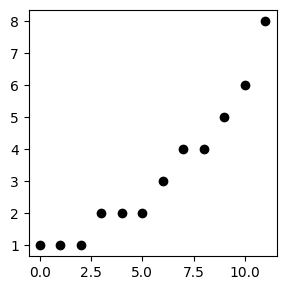
n_cells = [1, 1, 1, 2, 2, 2, 3, 4, 4, 5, 6, 8]
data = {i: [n] for i, n in enumerate(n_cells)}

# plot the data
plt.figure(figsize=(3.2, 3.2))
plt.scatter(data.keys(), data.values(), color='black')
plt.show()
# set up the model with the data from before
target = sdre.LikelihoodModel(data, n_samples=64)

fig, axs = plt.subplots(1, 2, figsize=(6.4, 3.2))

# we define two parameter combinations which by default are the cell cycle time,
# log number of stages, and initial population size
x0, x1 = [.9, 2, 1], [1.2, 1, 1]

for i, x in enumerate([x0, x1]):
    # we perform forward simulation by drawing 64 samples
    t, n = target.sample(x)

    # computes the synthetic log likelihood loss
    nll = target.compute_negative_log_likelihood(x)

    axs[i].set_title('NLL='+str(round(nll, 2)))

    axs[i].step(t, n.T, alpha=.2, color=plt.cm.tab10(i))
    axs[i].scatter(data.keys(), data.values(), color='black', zorder=10)

plt.show()
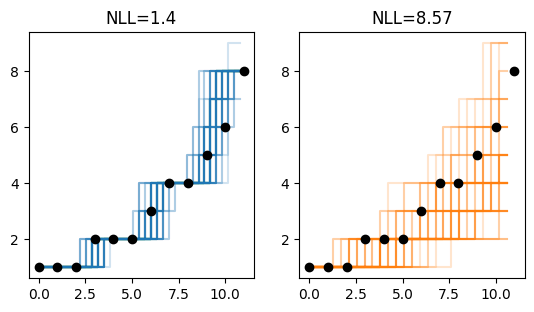
A lower negative log-likelihood (NLL) suggests a better fit, as we can confirm visually.
1 maintainer

Metadata
1 maintainer
Release files for sdre 0.0.4
For a detailed explanation of source distributions (sdists) and built distributions (wheels), please see the package formats documentation.
Built distribution (wheel)
| File | Interpreter | ABI | Platform | Actions Reset |
|---|---|---|---|---|
| sdre-0.0.4-py3-none-any.whl | Python 3 | none | any | Details for sdre-0.0.4-py3-none-any.whl |
Release files / sdre-0.0.4-py3-none-any.whl
| Download URL | sdre-0.0.4-py3-none-any.whl |
|---|---|
| Size | 7.2 kB |
| Tags | Python 3 |
|
SHA-256 checksum How to use checksums |
6e34911443cf911b44168565b8fdebc053ee89e3913dc0f10dc14a08b9e9db2b
|
|
BLAKE2b-256 checksum How to use checksums |
625b9146067af7b69fda8802d6d4a401a7fc571d843f28e6a0e473bea4ea6d06
|
| Upload date | |
|
Uploaded using Trusted Publishing? What is trusted publishing? |
No |
| Uploaded via |
twine/3.8.0 colorama/0.4.4 importlib-metadata/6.6.0 keyring/23.5.0 pkginfo/1.8.2 readme-renderer/34.0 requests-toolbelt/0.9.1 requests/2.28.2 rfc3986/1.5.0 tqdm/4.65.2 urllib3/1.26.13 CPython/3.10.12
|
Security for sdre 0.0.4
Provenance
Provenance describes where a file came from. On PyPI, provenance is shared via attestations, which provide a verifiable record of the build or publishing details. View details, limitations and caveats.
No provenance found
None of the files in this release were uploaded with provenance metadata.
A note on package security
PyPI is a repository for distributing packages, not a service for auditing them. While third-party security researchers and our staff do their best to detect and remove malicious packages, PyPI cannot guarantee the quality, security or suitability of any given package.
To learn more about protecting yourself from malicious actors, visit our package security documentation.













