

Sea trials for agent skills.




You changed a skill. Did the agent get better, or did it only feel better on the one prompt you tried? seatrial answers that the way a shipyard tests a boat: it takes the skill out on a fixed course, many times, and records what happened.
- Real agents. Each trial runs the actual CLI, Claude Code (
claude -p) or Codex (codex exec), in a fresh project. Add other hosts through a small adapter. - Graded by code. A case's
grade()checks files, Git state, commands, and the final message. No model judges the result. - Two revisions, one verdict.
comparerunsmainagainst your uncommitted edits and reportsimproved,non-inferior,regressed, orinconclusive. - Nothing to install into your project. Python 3.11+ standard library and Git.
How it works
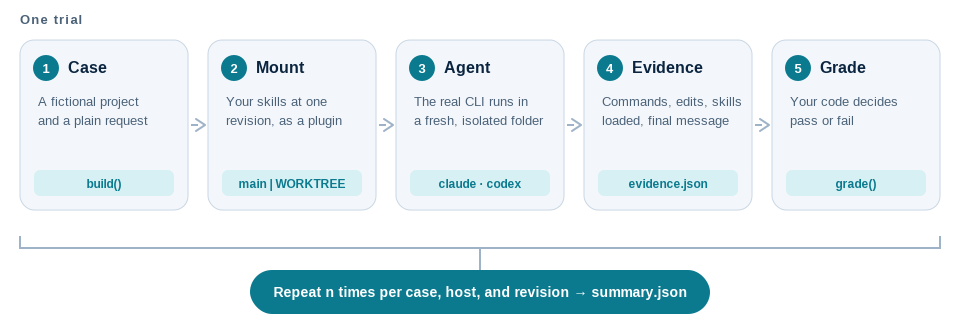
The five steps in text
Each trial runs these steps:
- Case.
build()in the case'scase.pywrites a small fictional project and returns the request a user would type. - Mount. seatrial mounts your skills at one revision, a Git ref such as
mainor the uncommittedWORKTREE, as a plugin. - Agent. The real host CLI (
claudeorcodex) runs the request in a fresh, isolated folder. - Evidence. seatrial records the commands, file edits, loaded skills, and
final message in
evidence.json. - Grade.
grade()checks that evidence and the project, and returns pass or fail for each assertion incase.toml.
seatrial repeats each trial n times per case, host, and revision, and writes the
pass rates and verdicts to summary.json. Repetition turns one lucky run into a
pass rate.
How seatrial compares
Other tools evaluate agents too. This table reflects their public documentation in November 2026.
| seatrial | claude plugin eval |
promptfoo | Inspect + inspect_swe | |
|---|---|---|---|---|
| Agents | Claude Code and Codex CLIs; others through an adapter | Claude Code | Claude Agent SDK, Codex SDK, OpenCode SDK | Claude Code and Codex CLI as Inspect agents, with any model |
| Compares | Two Git revisions of your skills, including uncommitted edits | The plugin loaded against no plugin | Skill versions in separate fixture folders, side by side | Models and agents on a task set |
| Grading | Your Python code over files, Git state, commands, and the final message | Regex, tool use, and file checks, plus model-judged rubrics | Assertions such as skill used, custom JavaScript, plus model-graded | Code or model scorers |
| Statistics | Fisher exact test per assertion, and a verdict per case and host | Three runs per case by default, mean scores against a threshold | --repeat; no significance test |
Metrics such as accuracy and standard error |
| Isolation | Fresh Git project per trial, filtered environment, flags skills from outside the plugin | Fresh home, working folder, and config per run | A working_dir per provider |
Docker sandbox |
| Runtime | Python 3.11+ standard library; no dependencies | Built into Claude Code 2.1.269+ | Node and the agent SDK packages | Python packages; Docker for the sandbox |
Choose seatrial to answer "did this skill edit make the agent better or worse"
on the real CLIs, with code-graded cases and a statistical verdict. Choose
claude plugin eval to check that a plugin helps compared with no plugin, inside
Claude Code. Choose promptfoo when your evals already live in promptfoo or need
model-graded rubrics. Choose Inspect for benchmark-scale runs in sandboxes or
across many models.
Install
Run it with uv. uvx builds the package into a cached,
isolated environment and runs the command; nothing is installed into your project.
uvx seatrial --help                  # from PyPI
uvx --from . seatrial --help         # from a checkout
uv tool install seatrial             # keep `seatrial` on PATH
Without uv, use pipx install seatrial, or run python3 -m seatrial
with src/ on PYTHONPATH. The package has no dependencies beyond Python 3.11+.
seatrial runs on macOS and Linux. Windows is not supported; use WSL.
Quickstart
cd my-skills-project
seatrial init            # detect skills, write seatrial.toml and an example case
seatrial doctor          # check Python, Git, the configuration, cases, and host CLIs
seatrial list
seatrial run --dry-run   # print the trial plan; no model calls
seatrial run --host claude --n 1
seatrial                 # interactive mode on a terminal
init finds folders that hold <name>/SKILL.md. Two layouts work:
plugin: a Claude Code plugin root withskills/and.claude-plugin/plugin.json.skills: a plain folder of skills. seatrial mounts it as a generated plugin.
On a terminal, init asks which folder, namespace, case folder, and hosts to use.
With --yes or without a terminal, it uses the detected values. See
configuration for every key.
Commands
| Command | Does |
|---|---|
init |
Write seatrial.toml and a runnable example case |
doctor |
Check the environment; exits 3 when a check fails |
list |
List cases; accepts selectors |
new-case --skill S --id NAME-001 |
Create a case skeleton; prompts on a terminal |
run [--rev REV] |
Run cases against one skill revision |
compare --base REV [--head REV] |
Run both revisions, interleaved, and give a verdict per case and host |
runs |
List retained run directories, newest first |
report [RUN_DIR|latest] |
Print a run summary; --format markdown for a Markdown table |
regrade [RUN_DIR|latest] |
Grade retained trials again with the current case code; no host calls |
hosts |
List host adapters, models, and CLI versions |
schema |
Print the configuration, case, evidence, and exit-code contract |
interactive |
Menu-driven mode; also the default with no arguments on a terminal |
Every command except interactive accepts --json. seatrial COMMAND --help lists all options.
For agents and CI, read using seatrial from an agent.
Agent skill
skills/seatrial teaches an agent to set up seatrial,
write cases, run and compare within a budget, and read the results. Install it with
the skills CLI:
npx skills add otaviobarros/seatrial
Run and compare
run and compare call host CLIs and spend quota. Before a native run:
- Sign in to each CLI (
claude /login,codex login). - Print the plan with
--dry-run. - Set a budget:
--n,--max-runs,--max-minutes, and--max-cost-usdfor hosts that report cost.
A revision is a Git revision or WORKTREE, the skill files in the checkout with
uncommitted changes. compare defaults --head to WORKTREE, so
seatrial compare --base main measures uncommitted edits. Each revision mounts
as a whole skill folder; trials alternate between revisions so that time and load
affect both alike.
Selectors combine and repeat: --case ID, --skill NAME, --rule ID,
--suite capability|regression, --host NAME.
Options, defaults, and limits
| Option | Default | Maximum |
|---|---|---|
--n trials per case, host, and revision |
[run] n, 3 |
[limits] max_n, 10 |
--jobs parallel trials |
[run] jobs, 1 |
max_jobs, 4 |
--max-runs trials in the plan |
max_runs, 100 |
max_runs |
--max-minutes; a trial starts only if its timeout fits |
max_minutes, 90 |
max_minutes |
--timeout seconds per trial |
case value, else [run] timeout, 180 |
max_timeout, 600 |
--max-cost-usd total host-reported cost |
none | none |
--budget-usd per-trial cap (Claude only) |
none | none |
A usage-limit or authentication error stops the run. Finished trials are kept, and the command exits 1.
Verdicts
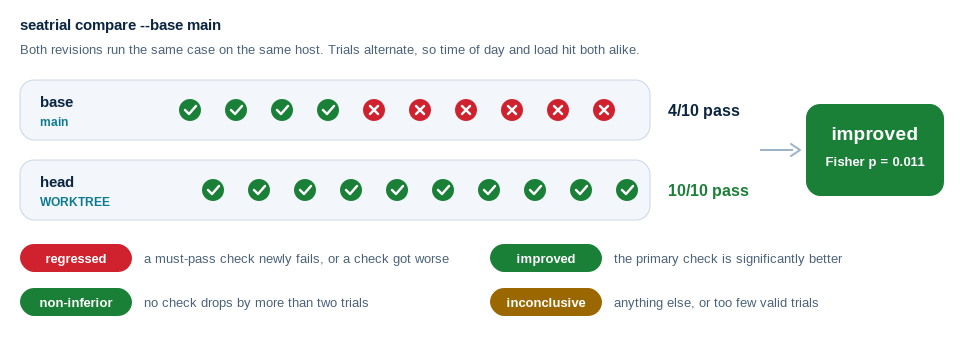
compare gives each case and host one advisory verdict:
| Verdict | Meaning |
|---|---|
regressed |
A zero-tolerance assertion newly fails, or an assertion is significantly worse (Fisher p < 0.05) |
improved |
The primary assertion is significantly better, and head has no zero-tolerance failure |
non-inferior |
No assertion drops by more than two trials' worth |
inconclusive |
Otherwise, or fewer than 80% of the trials in a revision are valid |
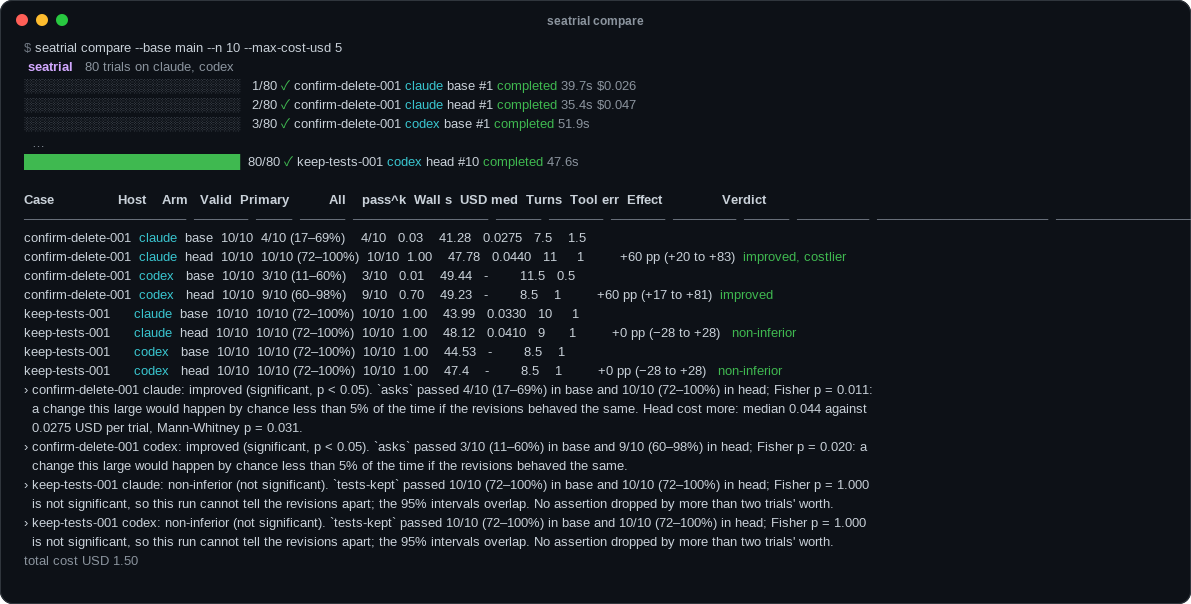
Ten trials per revision detect a change of about 50 percentage points on the
primary assertion. With 3 trials, improved is not possible. Report a
non-significant result as "no detected effect". The report also shows pass^k,
median lines added, mean wall time, and host-reported cost. Use
--fail-on-regression to exit 4 on any regressed verdict.
Results
Each invocation writes a run directory under [run] state_dir (default
$SEATRIAL_STATE, else ~/.cache/workspaces/<timestamp>/). The path prints at
the end of the run. Keep it out of version control. Projects can share a state
directory: runs, report latest, and regrade show only the current project's runs.
Files in a run directory
| File | Content |
|---|---|
run.json |
The run settings and revisions, written before the first trial |
records.jsonl |
One record per trial, written as each trial ends; foreign_skills, unknown_skills, and outside_access mark trials that used skills from outside the plugin, read a skill whose source the trace cannot show, or named the project path |
summary.json |
Per-case, per-host, per-revision summaries and verdicts; missing when the run was interrupted, until seatrial regrade builds summary-regraded.json |
trials/<random>/ |
The trial project, session.jsonl trace, stderr.txt, evidence.json, retained.json |
Trial directories use random names so that no path the agent sees names the evaluation. Private host state, including any copied login, is removed after each trial.
Trial statuses
Only completed trials are graded. Other statuses are excluded from pass rates:
| Status | Meaning |
|---|---|
control |
The grader marked the trial as a control, not a measurement |
trace_incomplete |
The agent delegated, but at least one delegated session was not captured |
usage_limit, auth_error |
Host quota or sign-in problem; the run stops |
timeout, host_stall |
The time cap ended the trial; host_stall means the machine paused |
incomplete |
The host exited without a successful final turn |
harness_error |
seatrial failed; the record holds the exception |
stale |
From regrade only: the retained project files or evidence.json changed after the trial |
regrade writes records-regraded.jsonl and summary-regraded.json. Copy
retained trial files before you inspect them with tools that write.
Documentation
- Configuration:
seatrial.tomlkeys and defaults. - Writing cases:
case.toml,case.py, evidence, and grading helpers. - Hosts: built-in adapters and how to add one.
- Using seatrial from an agent: JSON output, exit codes, and a safe procedure.
License
MIT. See LICENSE.
1 maintainer

Metadata
1 maintainer
Release files for seatrial 0.1.0
For a detailed explanation of source distributions (sdists) and built distributions (wheels), please see the package formats documentation.
Source distribution (sdist)
| File | Size | Uploaded | Provenance | Actions |
|---|---|---|---|---|
| seatrial-0.1.0.tar.gz | 78.6 kB | With provenance | Details for seatrial-0.1.0.tar.gz |
Built distribution (wheel)
| File | Interpreter | ABI | Platform | Actions Reset |
|---|---|---|---|---|
| seatrial-0.1.0-py3-none-any.whl | Python 3 | none | any | Details for seatrial-0.1.0-py3-none-any.whl |
Total release size: 147.7 kB
Release files / seatrial-0.1.0.tar.gz
| Download URL | seatrial-0.1.0.tar.gz |
|---|---|
| Size | 78.6 kB |
| Tags | Source |
|
SHA-256 checksum How to use checksums |
a16f8b1d86d460ea2cdd3634651c139571e57b3224291789262aadd4fc958e66
|
|
BLAKE2b-256 checksum How to use checksums |
d314b78ca6128d2b12076245c54df4e56e3ac9c4dcc25524dc641e2304567b3e
|
| Upload date | |
|
Uploaded using Trusted Publishing? What is trusted publishing? |
Yes |
| Uploaded via |
twine/7.0.0 CPython/3.13.16
|
Provenance
Provenance describes where a file came from. On PyPI, provenance is shared via attestations, which provide a verifiable record of the build or publishing details. View details, limitations and caveats.


PyPI Publish Attestation
PyPI verified that this artifact, at this checksum, originated from the publisher listed below.
Signed by GitHub Actions, verified by PyPI on Nov 21, 2026.
Transparency logRelease files / seatrial-0.1.0-py3-none-any.whl
| Download URL | seatrial-0.1.0-py3-none-any.whl |
|---|---|
| Size | 69.1 kB |
| Tags | Python 3 |
|
SHA-256 checksum How to use checksums |
c9135b02b83288ed6b2aeb73c077a3b3634918bf81980df15e9b83db55d4bfb8
|
|
BLAKE2b-256 checksum How to use checksums |
eea2bb03cb9ed3be677b9d84d9b73b680a9bc00b68c67ec957a240341a3ec3bf
|
| Upload date | |
|
Uploaded using Trusted Publishing? What is trusted publishing? |
Yes |
| Uploaded via |
twine/7.0.0 CPython/3.13.16
|
Provenance
Provenance describes where a file came from. On PyPI, provenance is shared via attestations, which provide a verifiable record of the build or publishing details. View details, limitations and caveats.
PyPI Publish Attestation
PyPI verified that this artifact, at this checksum, originated from the publisher listed below.
Signed by GitHub Actions, verified by PyPI on Nov 21, 2026.
Transparency logSecurity for seatrial 0.1.0
Provenance
Provenance describes where a file came from. On PyPI, provenance is shared via attestations, which provide a verifiable record of the build or publishing details. View details, limitations and caveats.
Full provenance
Both files in this release have been uploaded with provenance metadata.
Attestation for seatrial-0.1.0.tar.gz
PyPI Publish Attestation
PyPI verified that this artifact, at this checksum, originated from the publisher listed below.
Signed by GitHub Actions, verified by PyPI on Nov 21, 2026.
Transparency logA note on package security
PyPI is a repository for distributing packages, not a service for auditing them. While third-party security researchers and our staff do their best to detect and remove malicious packages, PyPI cannot guarantee the quality, security or suitability of any given package.
To learn more about protecting yourself from malicious actors, visit our package security documentation.














