
 |
secchiOpen Source Package Intelligence |




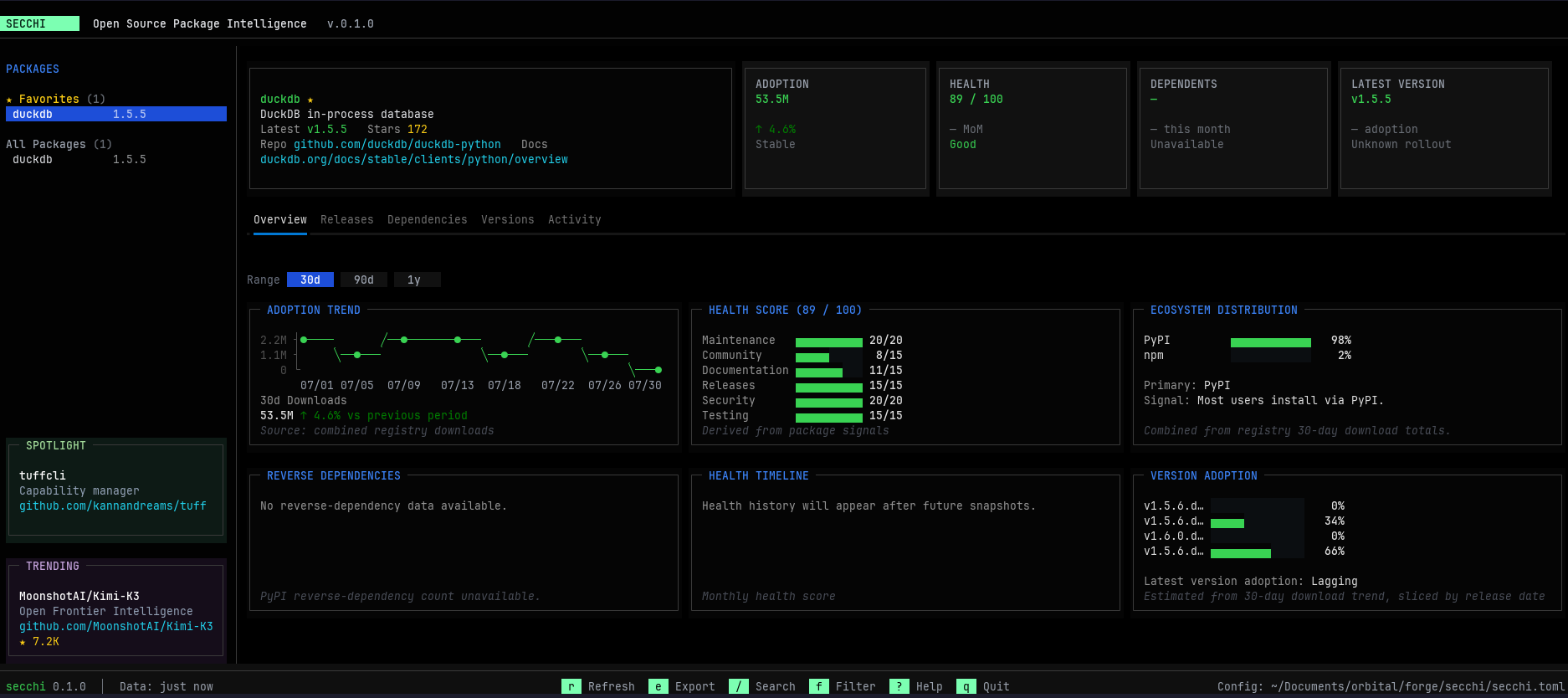
Secchi lets you explore, compare, monitor, and report on package health, adoption, dependencies, releases, and ecosystem signals from your terminal.
How to pronounce it: Secchi is pronounced “SEK-ee.” The name is inspired by the Secchi disk, an instrument used to measure water clarity—an apt metaphor for making package intelligence easier to see.
Try Secchi first
You can try the CLI and open the dashboard without installing Secchi as a
permanent command. This uses uvx,
which creates a temporary environment and removes it when you are done.
You only need uv installed:
# Print package intelligence in your terminal
uvx --from secchi secchi show duckdb

# Open the interactive dashboard
uvx --from secchi secchi dashboard duckdb
See the available commands before trying a package:
uvx --from secchi secchi --help
If you like what you see, install Secchi permanently with one of the options
below. You do not need to run secchi init for direct package exploration;
init is only needed when you want to create a workspace configuration for
your own projects.
Supported Ecosystems
 PyPI Python |
 npm JavaScript |
 crates.io Rust |
 Homebrew Formulae |
 Go Modules Go |
 CRAN R |
Capabilities
| Type | Capability | What it helps with | Status |
|---|---|---|---|
| Explore | Direct package lookup | Quickly inspect any package from the terminal | ✅ |
| Explore | Interactive dashboard | Explore health, adoption, releases, dependencies, and optional Web dashboard access | ✅ |
| Explore | Workspace monitoring | Monitor configured projects and registry sources | ✅ |
| Explore | Cross-registry search | Find packages across supported ecosystems | ✅ |
| Explore | Health and adoption signals | Understand project momentum and maintenance quality | ✅ |
| Explore | Security advisories | See OSV advisories affecting the latest package version | ✅ |
| Explore | Package comparison | Rank package choices with health, adoption, and confidence evidence | ✅ |
| Report | JSON reports | Use package intelligence in scripts and automation | ✅ |
| Report | Markdown reports | Share readable reports in GitHub, Notion, or documentation | ✅ |
| Report | HTML reports | Generate standalone reports for teams and stakeholders | ✅ |
| Report | Project-wide reports | Combine registry sources for one monitored project | ✅ |
| Automate | Package health checks | Fail workflows when package standards are not met | 🚧 |
| Automate | Workspace policy checks | Evaluate every configured project against policies | ⏳ |
| Automate | GitHub Actions integration | Run Secchi automatically in CI | ✅ |
| Integrate | Python SDK | Use Secchi from Python applications and scripts | ⏳ |
| Integrate | MCP Server | Let AI assistants query package intelligence | ✅ |
| Explore | Ecosystem adapters | Support PyPI, npm, crates.io, Homebrew, Go Modules, and CRAN | ✅ |
Install
For regular use, install Secchi as a command-line tool:
uv tool install secchi
pipx install secchi
pip install secchi
Quick Start
After installation, scaffold a config file interactively:
secchi init
Launch the dashboard for a project:
secchi -p duckdb
secchi --project opencode
Explore a package directly, without a configuration file:
secchi show duckdb
secchi dashboard duckdb
secchi search duckdb
secchi compare pypi:duckdb pypi:polars
secchi compare pypi:duckdb pypi:polars --format json
secchi report duckdb --format html --output duckdb-report.html
secchi report --config secchi.toml --project duckdb --format html
secchi check duckdb --min-health 80 --require-ci
Run the MCP server for local AI-agent integrations:
secchi mcp
# or
secchi-mcp
The server communicates over standard input/output and exposes tools for package inspection, cross-registry search, configured project reports, and health policy checks. It reuses the same cached intelligence pipeline as the CLI, dashboard, and report commands.
GitHub Actions
Secchi is available on the GitHub Marketplace as Secchi Package Intelligence. Use it to run package intelligence in CI and publish Markdown reports to the Actions job summary or a pull request comment.
- uses: kannandreams/secchi-action@v1
  with:
    package: pypi:duckdb
Use Secchi with MCP
Secchi can be added to an MCP-compatible coding agent or desktop client as a
local stdio server. If secchi is installed as a tool, use:
{
  "mcpServers": {
    "secchi": {
      "command": "secchi-mcp"
    }
  }
}
When running from a source checkout with uv, point the client at the project:
{
  "mcpServers": {
    "secchi": {
      "command": "uv",
      "args": [
        "run",
        "--project",
        "/path/to/secchi",
        "secchi-mcp"
      ]
    }
  }
}
The exact configuration file location depends on the MCP client. After the server is added, the agent can use these tools:
| MCP tool | Use it for |
|---|---|
inspect_package |
Inspect health, adoption, releases, dependencies, and repository signals |
search_packages |
Find matching packages across PyPI, npm, crates.io, Homebrew, Go Modules, and CRAN |
inspect_project |
Read a configured project from secchi.toml and summarize all its package sources |
check_package |
Evaluate minimum health and repository CI policies |
compare_packages |
Rank two or more package choices with recommendations, confidence, and evidence |
Package inspection uses Secchi's local cache by default. Ask the agent to refresh the data when current registry information is required. The MCP server is read-only: it does not modify packages, repositories, or configuration. Successful package results may include signal warnings when an optional source is unavailable; those warnings are preserved instead of turning the package into a failed result.
Reports are written to the current directory by default. Use --output to
choose a file path, or --output - to print the report to stdout.
Package inspection includes a Security tab in the dashboard and advisory data
in show, JSON, Markdown, HTML, and MCP results. Advisories are queried from
OSV.dev for the latest published version. A failed advisory lookup is reported
as a non-fatal signal warning; it does not change the health score or policy
check result. Homebrew does not currently have a stable OSV ecosystem mapping
in Secchi and is reported without advisory coverage.
Use --no-cache for a complete fresh fetch. It bypasses the local cache and
re-fetches package metadata, registry signals, GitHub signals, and OSV security
advisories.
Use --security-no-cache when only the OSV advisory data should be refreshed;
the package, registry, and GitHub caches are reused.
See DuckDB report examples for package and project exports in JSON, Markdown, and HTML.
JSON reports declare a schema and schema_version so automation can reject
or migrate incompatible output deliberately. Secchi's local package cache uses
the same versioned-envelope approach and continues to read legacy unversioned
cache entries while writing the current schema for new data.
The serialized boundaries are validated with Pydantic models while the internal application remains dataclass-based. This keeps the service and TUI lightweight while giving cache files, reports, and MCP responses explicit contracts. Future schema changes can be introduced as migrations instead of relying on every renderer and consumer to handle new fields independently.
search, show, dashboard, and report use the same data collection and scoring
pipeline. Add --registry with pypi, crates.io, npm, homebrew, go, or
cran when a package name needs an explicit ecosystem.
For registry troubleshooting, add --verbose to show readable SUCCESS,
WARN, and FAILURE events, including HTTP response statuses. Use
--log-file PATH to save the current run's diagnostics. In the dashboard,
press l for the process log; f remains the favorites-only filter.
compare is an advisory decision aid for agents and engineers choosing between
dependencies. It reports Recommended, Acceptable, Use with caution, or
Avoid, along with the evidence and unknown signals behind the result. Use
explicit registry:name references when comparing packages across ecosystems.
Secchi does not install, upgrade, remove, or approve a dependency automatically.
See the Dashboard metrics and health score guide for the meaning of the dashboard cards, overview panels, health categories, grades, and practical ways to improve a package's signals.
List available projects:
secchi --list
Config
Secchi looks for config in this order:
--config/-cpath./secchi.toml./.secchi.toml~/.config/secchi/config.toml
Example secchi.toml:
[projects.duckdb]
title = "DuckDB"
description = "DuckDB — embeddable analytical database"
favorite = true
repository = "https://github.com/duckdb/duckdb"
packages = [
    { name = "duckdb", registry = "pypi" },
    { name = "duckdb", registry = "npm" },
]
favorite belongs to the project, which makes workspace navigation clear when
one project contains several registry variants of the same package. Existing
package-level favorite entries remain supported for compatibility.
Optional Spotlight Feed
The dashboard can show a small, curated Spotlight card from Secchi's public feed. Spotlight is cached locally and can be disabled completely when you do not want Secchi to request the feed.
SECCHI_DISABLE_SPOTLIGHT=1 secchi dashboard duckdb
When this variable is set to 1, true, yes, or on, Secchi does not read
or fetch Spotlight data and removes the card from the dashboard.
CLI Options
secchi dashboard [package]              Launch the TUI (workspace when omitted)
secchi web [package]                    Serve the TUI dashboard in a browser
secchi show <package>                   Print a concise intelligence summary
secchi search <package>                 Search packages across supported registries
secchi report <package> --format <type> Generate json, html, or md output
secchi compare <package> <package>      Rank package choices; add --format json for agents
secchi check <package>                 Evaluate health and CI policies for automation
secchi --project <name>                 Backwards-compatible project dashboard
secchi --list                           List projects in config
secchi init                             Interactively create secchi.toml
Install Textual Web with pipx install textual-web to use secchi web.
Browser mode serves the existing Textual dashboard through that external CLI;
generated URLs should be treated as access to the live dashboard session.
Development
Live reload during development:
uv run textual run --dev src/secchi/dev.py -- -p duckdb
Press ctrl+r to manually reload the dashboard without exiting.
Coverage Reports
The latest main coverage report is published at
kannandreams.github.io/secchi/coverage/
after GitHub Pages is enabled for the repository.
Project Information
License
Apache 2.0
1 maintainer

Release files for secchi 0.1.5
For a detailed explanation of source distributions (sdists) and built distributions (wheels), please see the package formats documentation.
Source distribution (sdist)
| File | Size | Uploaded | |
|---|---|---|---|
| secchi-0.1.5.tar.gz | 9.4 MB | Details |
Built distribution (wheel)
| File | Interpreter | ABI | Platform | Reset |
|---|---|---|---|---|
| secchi-0.1.5-py3-none-any.whl | Python 3 | none | any | Details |
Total release size: 9.5 MB
Release files / secchi-0.1.5.tar.gz
| Download URL | secchi-0.1.5.tar.gz |
|---|---|
| Size | 9.4 MB |
| Tags | Source |
|
SHA-256 checksum How to use checksums |
28ae1a43deb0cf41add7db2ce38ff30eae631fc9986767dde72ec5b34ad98b1d
|
|
BLAKE2b-256 checksum How to use checksums |
9e21a4ebdb64ff7df365477accf413b0ecaaf8894d11af59ffa2010a83654e18
|
| Upload date | |
|
Uploaded using Trusted Publishing? What is trusted publishing? |
Yes |
| Uploaded via |
twine/7.0.0 CPython/3.13.14
|
Provenance
Provenance describes where a file came from. On PyPI, provenance is shared via attestations, which provide a verifiable record of the build or publishing details. View details, limitations and caveats.


PyPI Publish Attestation
PyPI verified that this artifact, at this checksum, originated from the publisher listed below.
Signed by GitHub Actions, verified by PyPI on Aug 13, 2026.
Transparency logRelease files / secchi-0.1.5-py3-none-any.whl
| Download URL | secchi-0.1.5-py3-none-any.whl |
|---|---|
| Size | 115.8 kB |
| Tags | Python 3 |
|
SHA-256 checksum How to use checksums |
dc18b670299591b1fde42531c9caadd237f5322a711989a9a75e49673a12351f
|
|
BLAKE2b-256 checksum How to use checksums |
7762a2d293062ba9a1ead5890dfda84188a38043e946e796e0308b6724db1946
|
| Upload date | |
|
Uploaded using Trusted Publishing? What is trusted publishing? |
Yes |
| Uploaded via |
twine/7.0.0 CPython/3.13.14
|
Provenance
Provenance describes where a file came from. On PyPI, provenance is shared via attestations, which provide a verifiable record of the build or publishing details. View details, limitations and caveats.
PyPI Publish Attestation
PyPI verified that this artifact, at this checksum, originated from the publisher listed below.
Signed by GitHub Actions, verified by PyPI on Aug 13, 2026.
Transparency log













