
see-your-agents
A local dashboard for Claude Code and Codex CLI sessions: who is working, who is waiting for you, which ticket a
session belongs to, what was done and where the agent is in its plan. It reads what the programs already keep on
disk, so it works with any session, including plain claude or codex in any terminal. From the page you can also
write to sessions, answer Claude Code's permission prompts, start new sessions and talk to a supervisor session that
watches all the others. The dashboard runs on your machine: a Python server on 127.0.0.1 and a page in your
browser.
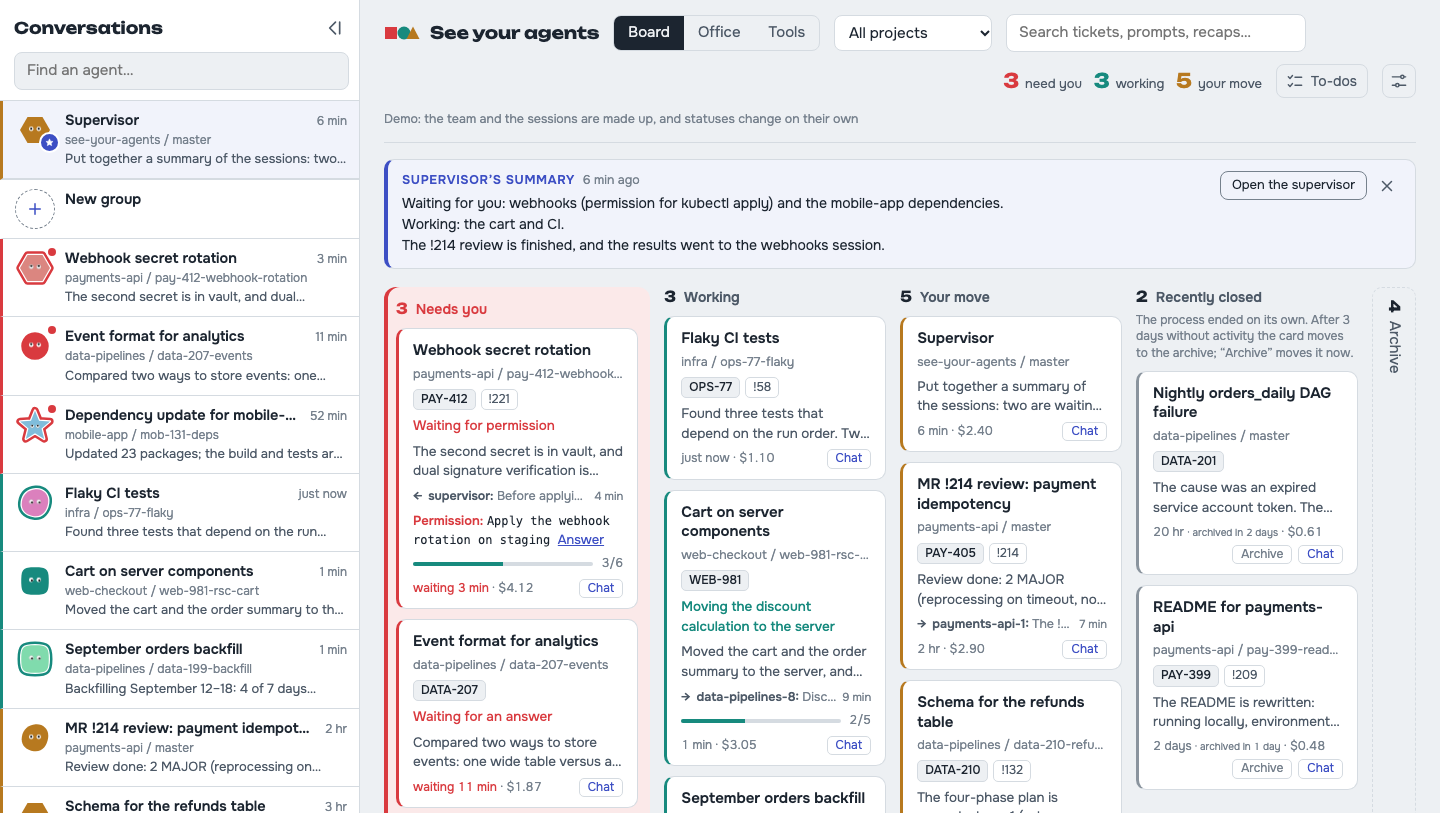
Try the demo in your browser: made-up sessions, nothing to install.
Features
- Board: sessions in columns by what is needed from you ("Needs you", "Working", "Your move"), with tickets, tasks, cost or tokens, context fill and MR state; the same sessions in an office view.
- Conversation: read any session as a chat and write to it, whether it runs in VS Code, tmux or the background, or is already closed; group chats with several agents at once.
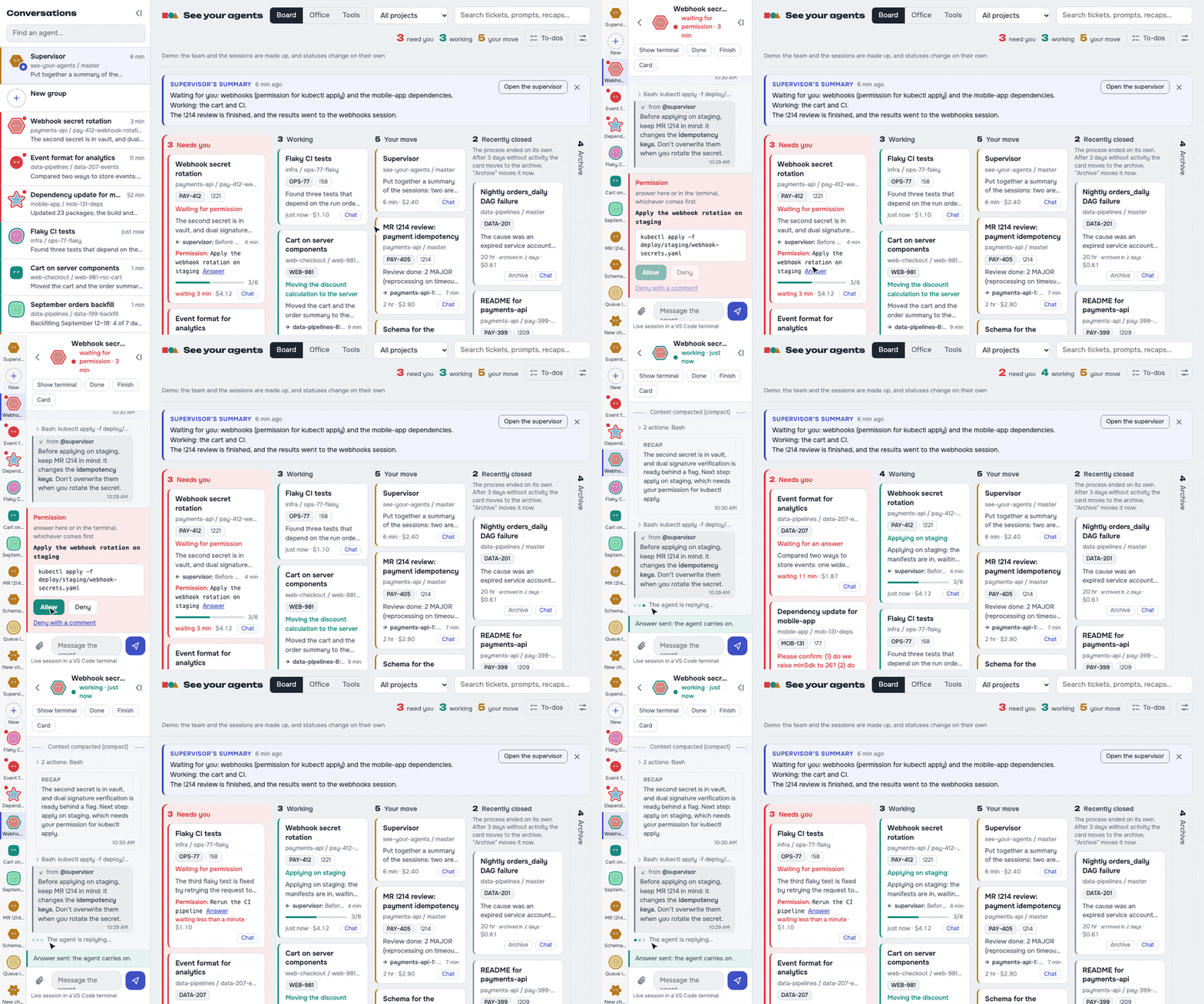
- Permissions: answer Claude Code's permission prompts, questions and plans from the page.
- New session and Fork: launch
claude --bgorcodex execin a project folder, or fork a session. - Supervisor: a Claude Code session that watches the others over the dashboard's MCP server and hands out tasks, with your confirmation.
- To-do, search, tools (skills, MCP servers, hooks and how often agents use them), keyboard shortcuts.
- Builder: ask the supervisor for a new module, and an agent builds it in a sandboxed branch for you to accept.
- Six UI languages: English, Russian, Spanish, German, French, Simplified Chinese. All UI text was written by Claude Opus 5.5; if a translation or a name could be better, suggestions are welcome.
A permission prompt answered from the board; the terminal's dialog stays open, and the first answer wins:
Quick start
uvx see-your-agents serve           # try it without installing

uv tool install see-your-agents     # or: pipx install see-your-agents
sya serve                           # http://127.0.0.1:8765, opens a browser tab
sya ls                              # the same board in the terminal (--all adds the archive)
From a checkout, for development or for the builder (it works on the dashboard's own git repository):
git clone https://github.com/vldplcd/see-your-agents.git && cd see-your-agents
uv run sya serve
The page is in English by default; Appearance → Language switches it. Optional one-time setup (the supervisor, the permission hook, the VS Code bridge) is in docs/configuration.md.
Requirements
uvand Python 3.11 or newer.- The Claude Code CLI (
claude) inPATH; the Codex CLI (codex) to see its sessions too. - macOS or Linux. Windows is not supported natively; under WSL it should work as on Linux (not tested yet).
- macOS only: the builder (its sandboxes use
sandbox-exec) and keeping the Mac awake. - Optional:
glabfor MR states, VS Code or tmux for typing into a live session's terminal,vplanfor visual plans.
The dashboard writes nothing to ~/.claude or ~/.codex itself, except through the setup commands you run. Details:
docs/configuration.md.
Documentation
- User guide: everything on screen and how to use it.
- Configuration: commands, ports, environment variables, data locations.
- Security: the threat model, guarantees and residual risks.
- Architecture, providers, languages, adding a feature.
- The full index: docs/README.md. What changed between versions: CHANGELOG.md.
Contributing
Contributions are welcome. Ways to help:
- Bug reports: an issue with your OS, Python, the CLI versions (
claude --version,codex --version), the steps and the logs. - Feature modules: a new view, panel, card line or MCP tool.
- Providers: support for another agent CLI next to Claude Code and Codex.
- Translations: a new UI language, or better wording in an existing one.
- Docs: corrections, clearer explanations, screenshots.
How a feature is added: a folder in src/see_your_agents/features/<id>/ and one line in
src/see_your_agents/features/__init__.py; the host and other features are not edited. Walkthrough:
docs/adding-a-feature.md. A provider is the same shape, a folder in
core/providers/<id>/ and one registry line: docs/providers.md.
The rules, in short:
- Work on a branch of your fork; one logical change per commit, subject
Area: what changed(todo,core,app,docs,ci…), the body says why. uv run ruff check src tests && uv run ruff format --check src tests && uv run pytest -qpasses before you open a pull request; CI runs it on Linux and macOS.- Every UI string is a catalog key with an English string; agent-facing text is English.
- UI changes come with screenshots in light and dark; security-sensitive changes come with tests.
Pull requests written with Claude Code, Codex or another agent are welcome; the repo carries rules for them (CLAUDE.md, AGENTS.md). The maintainers may decline any pull request without giving a reason.
Details: CONTRIBUTING.md. Keep it civil (code of conduct), and report vulnerabilities privately as SECURITY.md describes.
License
MIT, see LICENSE.
1 maintainer

Metadata
1 maintainer
Release files for see-your-agents 0.1.1
For a detailed explanation of source distributions (sdists) and built distributions (wheels), please see the package formats documentation.
Source distribution (sdist)
| File | Size | Uploaded | Provenance | Actions |
|---|---|---|---|---|
| see_your_agents-0.1.1.tar.gz | 647.6 kB | With provenance | Details for see_your_agents-0.1.1.tar.gz |
Built distribution (wheel)
| File | Interpreter | ABI | Platform | Actions Reset |
|---|---|---|---|---|
| see_your_agents-0.1.1-py3-none-any.whl | Python 3 | none | any | Details for see_your_agents-0.1.1-py3-none-any.whl |
Total release size: 1.1 MB
Release files / see_your_agents-0.1.1.tar.gz
| Download URL | see_your_agents-0.1.1.tar.gz |
|---|---|
| Size | 647.6 kB |
| Tags | Source |
|
SHA-256 checksum How to use checksums |
e9811143348d17753c78fcd87c02bdc98a2f8ad3261c273b419e878676fd88b2
|
|
BLAKE2b-256 checksum How to use checksums |
0d378a52be2db1dda494e266f6550dc659c06085484cecd25d2811ba69b90747
|
| Upload date | |
|
Uploaded using Trusted Publishing? What is trusted publishing? |
Yes |
| Uploaded via |
twine/7.0.0 CPython/3.13.16
|
Provenance
Provenance describes where a file came from. On PyPI, provenance is shared via attestations, which provide a verifiable record of the build or publishing details. View details, limitations and caveats.


PyPI Publish Attestation
PyPI verified that this artifact, at this checksum, originated from the publisher listed below.
Signed by GitHub Actions, verified by PyPI on Nov 4, 2026.
Transparency logRelease files / see_your_agents-0.1.1-py3-none-any.whl
| Download URL | see_your_agents-0.1.1-py3-none-any.whl |
|---|---|
| Size | 492.8 kB |
| Tags | Python 3 |
|
SHA-256 checksum How to use checksums |
3068bb827e8f4bcec97bb063c0e81790991ed277bbcd744e194fef759daa0b42
|
|
BLAKE2b-256 checksum How to use checksums |
4009a8090d438ff959de32d6dfadd79d661b7ce9c21c8a2e05d862e05abbdbd9
|
| Upload date | |
|
Uploaded using Trusted Publishing? What is trusted publishing? |
Yes |
| Uploaded via |
twine/7.0.0 CPython/3.13.16
|
Provenance
Provenance describes where a file came from. On PyPI, provenance is shared via attestations, which provide a verifiable record of the build or publishing details. View details, limitations and caveats.
PyPI Publish Attestation
PyPI verified that this artifact, at this checksum, originated from the publisher listed below.
Signed by GitHub Actions, verified by PyPI on Nov 4, 2026.
Transparency logSecurity for see-your-agents 0.1.1
Provenance
Provenance describes where a file came from. On PyPI, provenance is shared via attestations, which provide a verifiable record of the build or publishing details. View details, limitations and caveats.
Full provenance
All 2 files in this release have been uploaded with provenance metadata.
Attestation for see_your_agents-0.1.1.tar.gz
PyPI Publish Attestation
PyPI verified that this artifact, at this checksum, originated from the publisher listed below.
Signed by GitHub Actions, verified by PyPI on Nov 4, 2026.
Transparency logA note on package security
PyPI is a repository for distributing packages, not a service for auditing them. While third-party security researchers and our staff do their best to detect and remove malicious packages, PyPI cannot guarantee the quality, security or suitability of any given package.
To learn more about protecting yourself from malicious actors, visit our package security documentation.














