
Rare disease candidate variant diagnosis system — three-stage VCF-to-ranking with optional Genos model and AlphaFold3 structure prediction

Project description
SeekRare
Rare Disease Candidate Variant Diagnosis System — Three-Stage VCF-to-Ranking
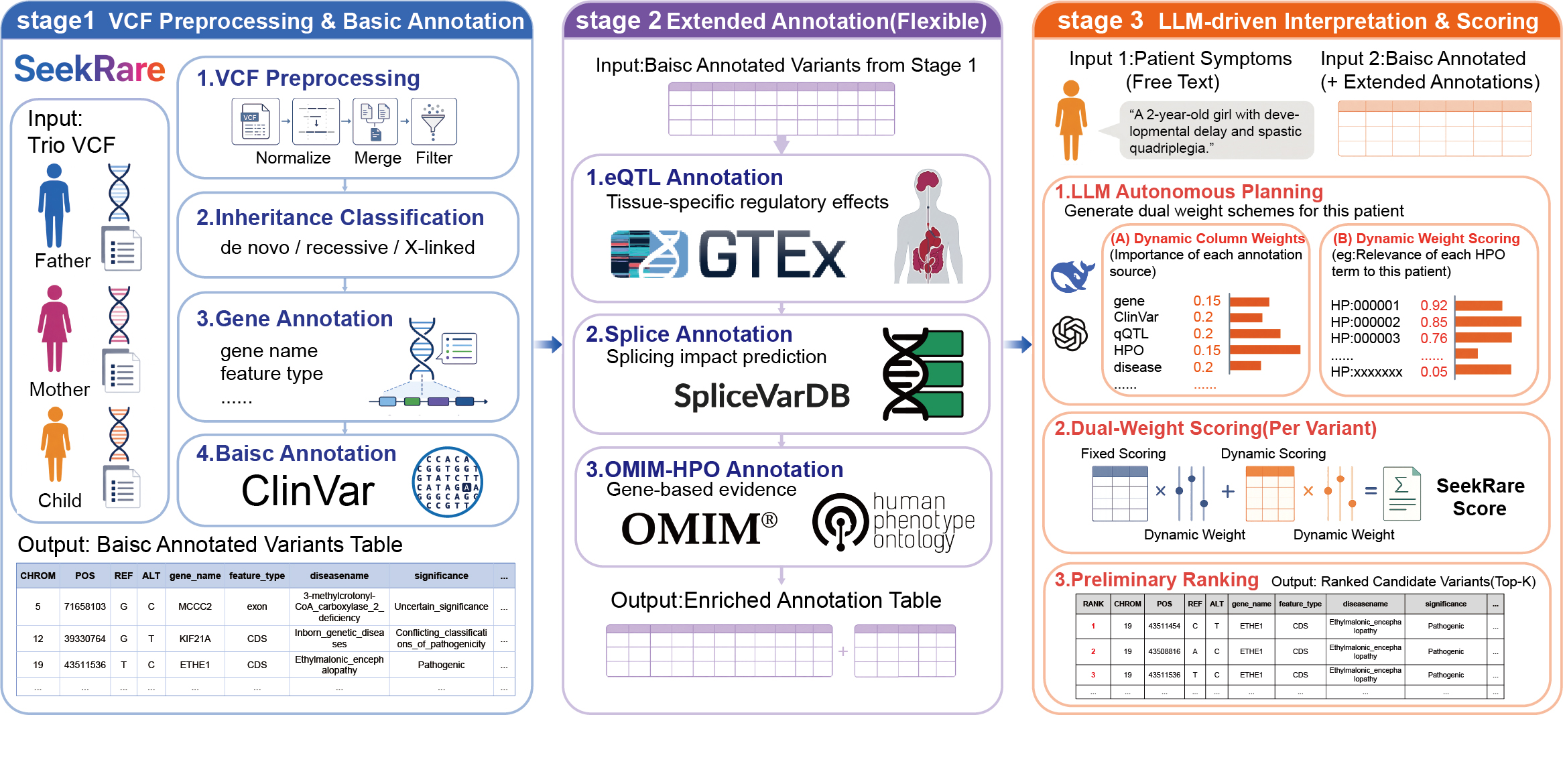
Table of Contents
- Installation
- Architecture Overview
- Stage 1 — VCF Preprocessing & Basic Annotation
- Stage 2 — Advanced Annotation (Optional, Multi-Step)
- Stage 3 — LLM Dynamic Scoring & Ranking
- Full Pipeline Usage
- Output File Reference
Installation
pip install seekrare
Reference files required for Stage 1 (user-provided):
| File | Description |
|---|---|
ref_fasta |
Reference genome FASTA |
gtf_file |
Gene annotation GTF file |
clinvar_vcf |
ClinVar VCF.gz/csv |
dbsnp_vcf |
dbSNP common all chr VCF.gz (optional; used for common variant filtering) |
# GRCh38 / hg38
# ref_fasta
wget https://ftp.ncbi.nlm.nih.gov/genomes/all/GCF/000/001/405/GCF_000001405.40_GRCh38.p14/GCF_000001405.40_GRCh38.p14_genomic.fna.gz
gunzip GCF_000001405.40_GRCh38.p14_genomic.fna.gz
mv GCF_000001405.40_GRCh38.p14_genomic.fna GRCh38.fa

# gtf_file
wget https://ftp.ncbi.nlm.nih.gov/genomes/all/GCF/000/001/405/GCF_000001405.40_GRCh38.p14/GCF_000001405.40_GRCh38.p14_genomic.gtf.gz
gunzip GCF_000001405.40_GRCh38.p14_genomic.gtf.gz
mv GCF_000001405.40_GRCh38.p14_genomic.gtf GRCh38.gtf

# clinvar_vcf
wget https://ftp.ncbi.nlm.nih.gov/pub/clinvar/vcf_GRCh38/clinvar.vcf.gz
wget https://ftp.ncbi.nlm.nih.gov/pub/clinvar/vcf_GRCh38/clinvar.vcf.gz.tbi

# dbsnp_vcf
wget https://ftp.ncbi.nih.gov/snp/organisms/human_9606_b151_GRCh38p7/VCF/00-common_all.vcf.gz
wget https://ftp.ncbi.nih.gov/snp/organisms/human_9606_b151_GRCh38p7/VCF/00-common_all.vcf.gz.tbi
Architecture Overview
Core Design Principles
- Stage 1 is required — VCF normalization + basic annotation
- Stage 2 is optional — advanced annotation on top of Stage 1 (eQTL / SpliceVARDB / OMIM-HPO)
- Stage 3 is required — LLM dynamic scoring + ranking
Mode Detection (Automatic)
| Parameters | Mode |
|---|---|
vcf_proband only |
Singleton mode |
vcf_proband + vcf_father + vcf_mother |
Family trio mode |
Stage 1 Usage
Option 1: via SeekRarePipeline (auto-detects singleton/family)
from seekrare import SeekRarePipeline

pipeline = SeekRarePipeline(
    vcf_proband="child.vcf.gz",
    vcf_father="father.vcf.gz",   # all three → family mode
    vcf_mother="mother.vcf.gz",
    ref_fasta="/path/to/GRCh38.fa",
    gtf_file="/path/to/genomic.gtf",
    clinvar_vcf="/path/to/clinvar.vcf.gz",
    dbsnp_vcf="/path/to/dbsnp.vcf.gz",   # optional
    work_dir="seekrare_output",
)
pipeline.stage1_preprocess()
# Output: seekrare_output/3_clinvar_annotated.csv
Option 2: standalone function run_family_preprocess
from seekrare.preprocess import run_family_preprocess

result = run_family_preprocess(
    work_dir="seekrare_output",
    child_vcf="child.vcf.gz",
    father_vcf="father.vcf.gz",
    mother_vcf="mother.vcf.gz",
    ref_fasta="/path/to/hg38.fa",
    gtf_file="/path/to/GRCh38.gtf",
    clinvar_vcf="/path/to/clinvar.vcf.gz",
    dbsnp_vcf="/path/to/00-common_all.vcf.gz",
)
# result = {"modes": {...}, "combined": DataFrame, "output_csv": str}
Option 3: individual step functions (each usable standalone)
from seekrare.preprocess import (
    stage1_vcf_to_gt_csv,       # VCF → GT CSV
    stage1_annotate_by_gtf,     # GT CSV → GTF annotation
    stage1_merge_filter_clinvar, # ClinVar annotation
    stage1_dbsnp_filter,        # dbSNP common filtering
    simplify_clinvar_csv,       # Column cleanup
)
Stage 2 — Advanced Annotation (Optional, Multi-Step)
Stage 2 consists of multiple optional steps. Each is a standalone function — use only what you need:
Stage 1 output (3_clinvar_annotated.csv)
       │
  ┌────┴────────────────────────────┐
  │  step 1: stage2_eqtl_annotation  │
  │  GTEx eQTL tissue annotation    │
  └────┬────────────────────────────┘
       │ (if tissue_dir provided)
  ┌────┴────────────────────────────┐
  │  step 2: stage2_splicevardb_..│
  │  SpliceVARDB splice annotation │
  └────┬────────────────────────────┘
       │ (if splicevardb_tsv provided)
  ┌────┴────────────────────────────┐
  │  step 3: stage2_omim_hpo_...  │
  │  OMIM + HPO secondary annot.  │
  └────┴────────────────────────────┘
         ↓
  6_omim_hpo_annotated.csv (example)
Step 1: GTEx eQTL Annotation (stage2_eqtl_annotation)
Purpose: LLM selects relevant tissues from GTEx based on symptoms; eQTL data merged from parquets.
from seekrare import stage2_eqtl_annotation

stage2_eqtl_annotation(
    stage1_csv="seekrare_output/3_clinvar_annotated.csv",
    tissue_dir="/path/to/GTEx_v11_eQTL_parquets",
    symptoms="thalassemia",
    output_csv="seekrare_output/4_eqtl_annotated.csv",
    llm_model="deepseek-v4-flash",
    api_key="sk-xxxxxxxx",
    base_url="https://api.deepseek.com",
)
New columns: eqtl_gene, eqtl_slope, eqtl_pval, eqtl_tissue, n_eqtl_tissues
Step 2: SpliceVARDB Annotation (stage2_splicevardb_annotation)
Purpose: Match variants by hg38 column (format chr-pos-ref-alt) to SpliceVARDB, annotate classification.
from seekrare import stage2_splicevardb_annotation

stage2_splicevardb_annotation(
    input_csv="seekrare_output/4_eqtl_annotated.csv",
    splicevardb_tsv="/path/to/splicevardb.download.tsv",
    output_csv="seekrare_output/5_splicevardb_annotated.csv",
)
New column: splicevardb (values: Splice-altering / Low-frequency / Normal / Conflicting)
Step 3: OMIM + HPO Secondary Annotation (stage2_omim_hpo_annotation)
Purpose:
OMIM: gene_name → MIM numbers fromgenemap2.txt(existing values preserved)HPO: append HPO tags fromphenotype.hpoaby OMIM (existing values preserved)diseasename: supplement fromphenotype.hpoadisease_name (existing values preserved)
from seekrare import stage2_omim_hpo_annotation

stage2_omim_hpo_annotation(
    input_csv="seekrare_output/5_splicevardb_annotated.csv",
    genemap2_path="/path/to/2022_05_05-genemap2.txt",
    mimtitles_path="/path/to/mimTitles.txt",
    phenotype_hpoa_path="/path/to/phenotype.hpoa",
    output_csv="seekrare_output/6_omim_hpo_annotated.csv",
)
Modified columns: OMIM (fills blanks), HPO (appends new tags), diseasename (fills blanks)
Via SeekRarePipeline
pipeline = SeekRarePipeline(
    vcf_proband="child.vcf.gz",
    work_dir="seekrare_output",
    gtex_tissue_dir="/path/to/GTEx_v11_eQTL_parquets",
    splicevardb_tsv="/path/to/splicevardb.download.tsv",
    genemap2_path="/path/to/genemap2.txt",
    mimtitles_path="/path/to/mimTitles.txt",
    phenotype_hpoa_path="/path/to/phenotype.hpoa",
)
pipeline.stage1_preprocess()

pipeline.stage2_eqtl_annotation(symptoms="thalassemia")
pipeline.stage2_splicevardb_annotation()
pipeline.stage2_omim_hpo_annotation()
Stage 3 — LLM Dynamic Scoring & Ranking
Scoring System
Static columns (built-in maps, no LLM needed):
| Column | Mapping Rule |
|---|---|
feature_type |
CDS=1.0, exon=0.9, gene=0.7, start_codon=0.8, stop_codon=0.8, transcript=0.5 |
significance |
Benign/Likely_benign → worst case (min) = -1.0; Pathogenic → 1.0; /-split takes worst end; empty → -0.5 |
clinvarstar |
0–5 directly mapped |
eqtl_tissue |
has content=0.5, empty=0 |
splicevardb |
Splice-altering=1.0, Low-frequency=0.6, Conflicting=0.5, Normal=0.2 |
Dynamic columns (LLM scores each unique value based on symptoms):
| Column | Description |
|---|---|
gene_name |
LLM scores each gene by relevance to symptoms |
diseasename |
LLM scores each disease name by relevance to symptoms |
HPO |
HP:xxxx tags scored by semantic relevance to symptoms |
OMIM |
OMIM:xxxxx scored by relevance to symptoms |
Orphanet |
Orphanet:xxxxx scored by relevance to symptoms |
inheritance_mode |
LLM decides which of de_novo / recessive / xlinked fits best given disease characteristics |
MC |
SO:xxxx tags scored by functional impact |
Consistency bonus: if both gene_name>0.6 AND diseasename>0.6 → extra +0.1. Rewards variants where the gene and disease name both strongly match the suspected diagnosis.
Default weight distribution (LLM may adjust based on symptoms):
{
  "gene_name": 0.15, "HPO": 0.15, "OMIM": 0.15,
  "Orphanet": 0.08, "diseasename": 0.12,
  "inheritance_mode": 0.10, "MC": 0.05,
  "feature_type": 0.10, "significance": 0.10,
  "clinvarstar": 0.025, "eqtl_tissue": 0.025, "splicevardb": 0.025
}
Usage
Option 1: standalone function
from seekrare import stage3_score_and_rank

top = stage3_score_and_rank(
    csv_path="seekrare_output/6_omim_hpo_annotated.csv",
    symptoms="thalassemia",
    top_k=50,
    output_csv="seekrare_output/stage3_ranked.csv",
    llm_model="deepseek-v4-flash",
    api_key="sk-xxxxxxxx",
    base_url="https://api.deepseek.com",
)
print(top[["CPRA", "gene_name", "seekrare_score", "rank"]].head(10))
Option 2: via SeekRarePipeline
pipeline.stage3_score_and_rank(symptoms="thalassemia")
Option 3: use Stage3Scorer directly
from seekrare.scoring import Stage3Scorer

scorer = Stage3Scorer(
    csv_path="seekrare_output/6_omim_hpo_annotated.csv",
    symptoms="thalassemia",
    top_k=50,
    llm_model="deepseek-v4-flash",
    api_key="sk-xxxxxxxx",
)
df = scorer.run()
scorer.save(df, "seekrare_output/stage3_ranked.csv")
Stage 3 Output Columns
All original columns + seekrare_score (weighted total) + rank (1-based)
Stage 4 — Genos / AlphaFold3 (Optional)
Stage 4A: Genos Model Analysis
Purpose: Run Genos model prediction on Stage 3 ranked top-K sites.
from seekrare import stage4_genos_analysis

stage4_genos_analysis(
    sites="top:10",    # take top 10 from stage3_ranked.csv
    stage3_csv="seekrare_output/stage3_ranked.csv",
    genome_fa="/path/to/hg38.fa",
    model_path="/path/to/Genos-1.2B",
    output_dir="seekrare_output/genos_result",
)
Note: Genos model weights must be pre-deployed at model_path.
Stage 4B: AlphaFold3 Structure Prediction
from seekrare import stage4_alphafold_prediction

stage4_alphafold_prediction(
    csv_path="seekrare_output/stage3_ranked.csv",
    ref_fasta="/path/to/hg38.fa",
    gtf_file="/path/to/genomic.gtf",
    top_n=5,
    output_dir="seekrare_output/alphafold_results",
)
Full Pipeline Usage
from seekrare import SeekRarePipeline

# ── Config ─────────────────────────────────────────────
pipeline = SeekRarePipeline(
    # Stage 1
    vcf_proband="/path/to/proband.vcf.gz",
    vcf_father="/path/to/father.vcf.gz",
    vcf_mother="/path/to/mother.vcf.gz",
    ref_fasta="/path/to/hg38.fa",
    gtf_file="/path/to/genomic.gtf",
    clinvar_vcf="/path/to/clinvar.vcf.gz",
    dbsnp_vcf="/path/to/dbsnp.vcf.gz",
    work_dir="seekrare_output",
    # Stage 2 (all optional)
    gtex_tissue_dir="/path/to/GTEx_v11_eQTL_parquets",
    splicevardb_tsv="/path/to/splicevardb.download.tsv",
    genemap2_path="/path/to/genemap2.txt",
    mimtitles_path="/path/to/mimTitles.txt",
    phenotype_hpoa_path="/path/to/phenotype.hpoa",
    # Stage 3 LLM
    llm_model="deepseek-v4-flash",
    api_key="sk-xxxxxxxx",
    base_url="https://api.deepseek.com",
)

# ── Stage 1 ─────────────────────────────────────────────
pipeline.stage1_preprocess()

# ── Stage 2 (multi-step optional) ───────────────────────
pipeline.stage2_eqtl_annotation(symptoms="thalassemia")
pipeline.stage2_splicevardb_annotation()
pipeline.stage2_omim_hpo_annotation()

# ── Stage 3 ─────────────────────────────────────────────
result = pipeline.stage3_score_and_rank(symptoms="thalassemia")
print(result[["CPRA", "gene_name", "seekrare_score", "rank"]].head(20))

# ── Stage 4 (optional) ───────────────────────────────────
pipeline.stage4_genos_analysis(
    sites="top:10",
    genome_fa="/path/to/hg38.fa",
    model_path="/path/to/Genos-1.2B",
    output_dir="seekrare_output/genos_result",
)
Output File Reference
| File | Stage | Description |
|---|---|---|
3_clinvar_annotated.csv |
End of Stage 1 | Family/singleton merged result with inheritance_mode |
4_eqtl_annotated.csv |
End of Stage 2 Step 1 | After GTEx eQTL annotation |
5_splicevardb_annotated.csv |
End of Stage 2 Step 2 | After SpliceVARDB annotation |
6_omim_hpo_annotated.csv |
End of Stage 2 Step 3 | After OMIM + HPO secondary annotation |
stage3_ranked.csv |
End of Stage 3 | Sorted results with seekrare_score and rank |
genos_result/ |
Stage 4A | Genos model prediction output directory |
alphafold_results/ |
Stage 4B | AlphaFold3 structure prediction output directory |
Dependencies
Core (pip install seekrare):
- pandas, numpy, pyarrow, pyyaml
- openai, anthropic
- tqdm, loguru, requests
Optional groups:
[alphafold]— alphafold3[genomodel]— torch, transformers, pygromaix[dev]— pytest, black, ruff
Project details
Release history Release notifications | RSS feed


Download files
Download the file for your platform. If you're not sure which to choose, learn more about installing packages.
Source Distribution
Built Distribution
Filter files by name, interpreter, ABI, and platform.
If you're not sure about the file name format, learn more about wheel file names.
Copy a direct link to the current filters
File details
Details for the file seekrare-0.9.4.tar.gz.
File metadata
- Download URL: seekrare-0.9.4.tar.gz
- Upload date:
- Size: 101.3 kB
- Tags: Source
- Uploaded using Trusted Publishing? No
- Uploaded via: twine/6.1.0 CPython/3.9.6
File hashes
| Algorithm | Hash digest | |
|---|---|---|
| SHA256 |
eae78d4f038b15830c2ceb60795d1b923066a878ca0b72b4cffb572e5d21ba17
|
|
| MD5 |
0cdece79a884c9d726d133ba1c18d90e
|
|
| BLAKE2b-256 |
bee616880ce76ebae8623a2d3052e4d4440b5e97e37db58942a65bbe0e85582a
|
File details
Details for the file seekrare-0.9.4-py3-none-any.whl.
File metadata
- Download URL: seekrare-0.9.4-py3-none-any.whl
- Upload date:
- Size: 89.9 kB
- Tags: Python 3
- Uploaded using Trusted Publishing? No
- Uploaded via: twine/6.1.0 CPython/3.9.6
File hashes
| Algorithm | Hash digest | |
|---|---|---|
| SHA256 |
1a7b8f06f7d2e58522da83bf0103d52153997b4955d9ef309f524c7c072d668e
|
|
| MD5 |
0d199792e05d282d833e84ed8bc05f32
|
|
| BLAKE2b-256 |
afe531b16b5fdcfffa26e08cedd81c1385f7b4ffa7688a6e89d6620fd0964acf
|






