
This release is a pre-release and may not be stable for production use.
SeetaPsych Attributes
Face and body based psychology analysis
SeetaPsych Lib is a Python library for face- and body-based psychology analysis. It provides a modular Pipeline/Runner runtime and an optional Streamlit WebUI.
This project is used to manage the specifications for various attribute outputs, providing a unified standard so that different algorithm implementations can produce interchangeable and reusable module outputs.
TypedDict Type Hints
Alongside the JSON schemas documented below, this project ships a set of ready-to-use
TypedDict declarations under seetapsych_attributes.types so that your IDE can
provide auto-completions and static type checks directly on the runner's report dict:
# -*- coding: utf-8 -*-
import json

import cv2

from seetapsych_lib.runtime.factory import Factory
from seetapsych_lib.runtime.pipeline import Pipeline
from seetapsych_lib.runtime.runner import Runner

from seetapsych_attributes.types import Report, BBox, FaceDetection


def main():
    factory = Factory()
    factory.load_builtin_modules()

    pipeline = Pipeline(factory, attributes=["face/detection"])
    pipeline.solve()
    pipeline.install_requirements()
    pipeline.cache_models()

    runner = Runner(pipeline)

    report: Report = runner.run(data={"default": cv2.imread("data/a.jpg")})

    # IDE autocompletion + type inference for every attribute key:
    detections: FaceDetection | None = report.get("face_detection")
    if detections:
        first: BBox = detections[0]
        x1, y1, x2, y2 = first["xyxy"]
        score: float = first["score"]
        print(f"face at ({x1},{y1})-({x2},{y2}), score = {score:.3f}")

    print(json.dumps(report, indent=2, ensure_ascii=False))


if __name__ == "__main__":
    main()
The top-level Report TypedDict includes every attribute key defined in the
catalog (all fields are optional, because a pipeline may only request a subset).
Per-attribute element types such as BBox, Landmarks, Selection,
ActionUnits, Expression, HeartRate, HeadSocialGaze, etc. are also
exported individually.
Catalog
- face/detection Face detection results as rectangular bounding boxes.
- face/landmarks Facial landmarks for basic alignment: L-eye, R-eye, nose, L-mouth, R-mouth (10 interleaved floats).
- face/selection Selected face PID. Selected face order is reflected in face/detection and face/landmarks.
- face/action_units Indicate the confidence level of each Action Unit. Not all Action Units' results may be output.
- face/expression Indicate the confidence level of each expression.
- face/dense_landmarks 280-point dense facial landmarks (560 interleaved [x,y] floats).
- face/mesh 468-point 3D face mesh landmarks in normalized coordinates.
- face/gaze_screen Per-eye screen-space point-of-gaze coordinates in pixels and camera-space point-of-gaze coordinates in millimeters. Camera-space coordinates may be 2D or 3D depending on the algorithm; origin is at the camera center.
- face/heart_rate Heart rate (BPM) estimated from buffered face video frames.
- face/dimensional_affect Continuous valence-arousal affect dimensions alongside discrete expressions and Action Units.
- head/detection Multi-person head bounding box detection results.
- head/selection Top-N head selection result (count + original indices), reordering head_detection.
- head/gaze_point Per-head 2D scene gaze target point with associated likelihood heatmap.
- head/social_gaze Dyadic social gaze relations between two detected people. Class set: share, mutual, single, miss, void.
face/detection
Face detection results as rectangular bounding boxes.
Properties
face_detection(array, required)- Items: Refer to BBox.
Definitions
Examples
{
    "face_detection": [
        {
            "score": 0.5,
            "xyxy": [
                100,
                200,
                300,
                400
            ]
        }
    ]
}
face/landmarks
Facial landmarks for basic alignment: L-eye, R-eye, nose, L-mouth, R-mouth (10 interleaved floats).
Properties
face_landmarks(array, required)- Items: Refer to Landmarks.
Definitions
Examples
{
    "face_landmarks": [
        {
            "landmarks": [
                100,
                100,
                200,
                200,
                300,
                300,
                400,
                400,
                500,
                500
            ]
        }
    ]
}
face/selection
Selected face PID. Selected face order is reflected in face/detection and face/landmarks.
Properties
face_selection(required): Refer to Selection.
Definitions
Examples
{
    "face_detection": [
        {
            "score": 0.5,
            "xyxy": [
                100,
                200,
                300,
                400
            ]
        }
    ],
    "face_selection": {
        "pid": 1
    }
}
face/action_units
Indicate the confidence level of each Action Unit. Not all Action Units' results may be output.
Properties
face_action_units(array, required)- Items: Refer to ActionUnits.
Definitions
ActionUnits(object)AU1:[0, 1]. Inner Brow Raiser. Default:null.AU2:[0, 1]. Outer Brow Raiser. Default:null.AU4:[0, 1]. Brow Lowerer. Default:null.AU5:[0, 1]. Upper Lid Raiser. Default:null.AU6:[0, 1]. Cheek Raiser. Default:null.AU7:[0, 1]. Lid Tightener. Default:null.AU9:[0, 1]. Nose Wrinkler. Default:null.AU10:[0, 1]. Upper Lip Raiser. Default:null.AU12:[0, 1]. Lip Corner Puller. Default:null.AU15:[0, 1]. Lip Corner Depressor. Default:null.AU17:[0, 1]. Chin Raiser. Default:null.AU20:[0, 1]. Lip Stretcher. Default:null.AU23:[0, 1]. Lip Tightener. Default:null.AU24:[0, 1]. Lip Pressor. Default:null.AU25:[0, 1]. Lips Part. Default:null.AU26:[0, 1]. Jaw Drop. Default:null.
Examples
{
    "face_action_units": [
        {
            "AU1": 0.5,
            "AU10": 0.5,
            "AU12": 0.5,
            "AU15": 0.5,
            "AU17": 0.5,
            "AU2": 0.5,
            "AU20": 0.5,
            "AU23": 0.5,
            "AU24": 0.5,
            "AU25": 0.5,
            "AU26": 0.5,
            "AU4": 0.5,
            "AU5": 0.5,
            "AU6": 0.5,
            "AU7": 0.5,
            "AU9": 0.5
        }
    ]
}
face/expression
Indicate the confidence level of each expression.
Properties
face_expression(array, required)- Items: Refer to Expression.
Definitions
Expression(object)neutral: Confidence in[0, 1]. Default:null.anger: Confidence in[0, 1]. Default:null.disgust: Confidence in[0, 1]. Default:null.fear: Confidence in[0, 1]. Default:null.happy: Confidence in[0, 1]. Default:null.sad: Confidence in[0, 1]. Default:null.surprise: Confidence in[0, 1]. Default:null.
Examples
{
    "face_expression": [
        {
            "anger": 0.01,
            "disgust": 0.01,
            "fear": 0.01,
            "happy": 0.94,
            "neutral": 0.01,
            "sad": 0.01,
            "surprise": 0.01
        }
    ]
}
face/dense_landmarks
280-point dense facial landmarks (560 interleaved [x,y] floats).
Properties
face_dense_landmarks(array, required)- Items: Refer to DenseLandmarks.
Definitions
Examples
{
    "face_dense_landmarks": [
        {
            "landmarks": "[100.0] * 560"
        }
    ]
}
face/mesh
468-point 3D face mesh landmarks in normalized coordinates.
Properties
face_mesh(array, required)- Items: Refer to MeshLandmarks.
Definitions
Examples
{
    "face_mesh": [
        {
            "normalized_3d_landmarks": "[0.5] * 1404"
        }
    ]
}
face/gaze_screen
Per-eye screen-space point-of-gaze coordinates in pixels and camera-space point-of-gaze coordinates in millimeters. Camera-space coordinates may be 2D or 3D depending on the algorithm; origin is at the camera center.
Properties
face_gaze_screen(array, required)- Items: Refer to GazeScreen.
Definitions
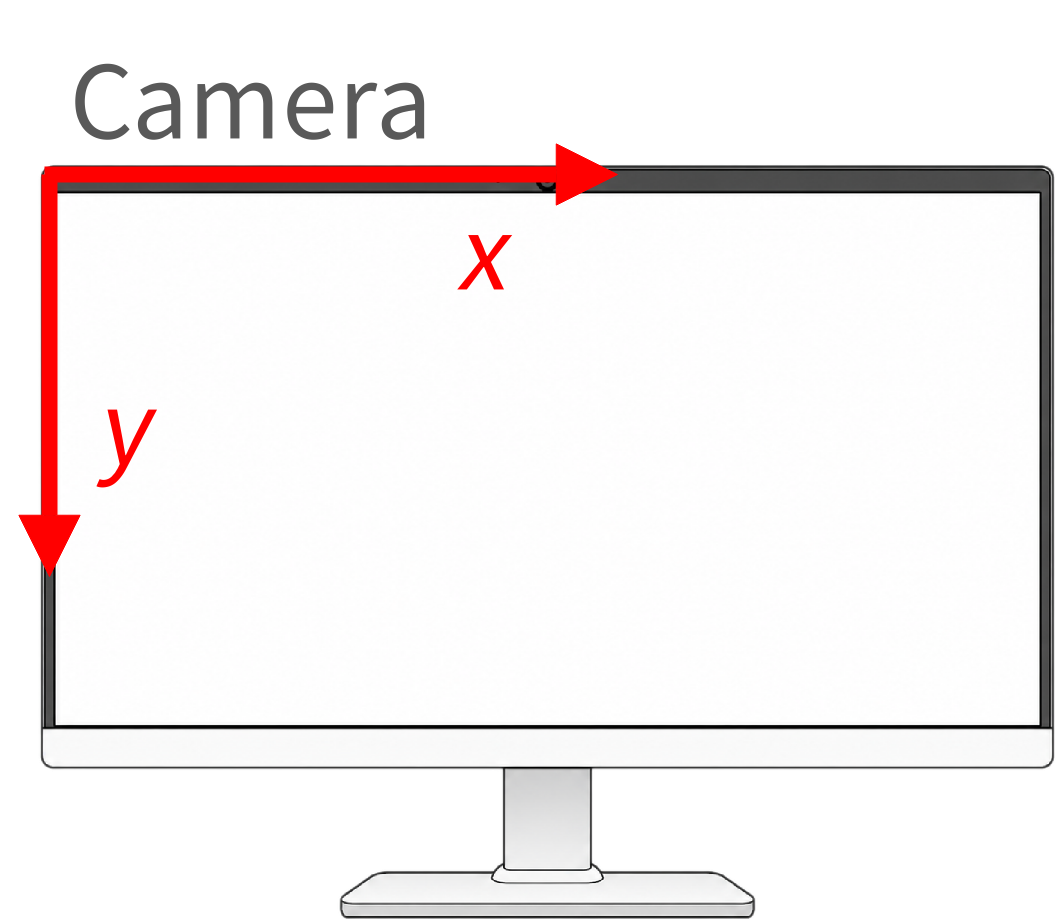
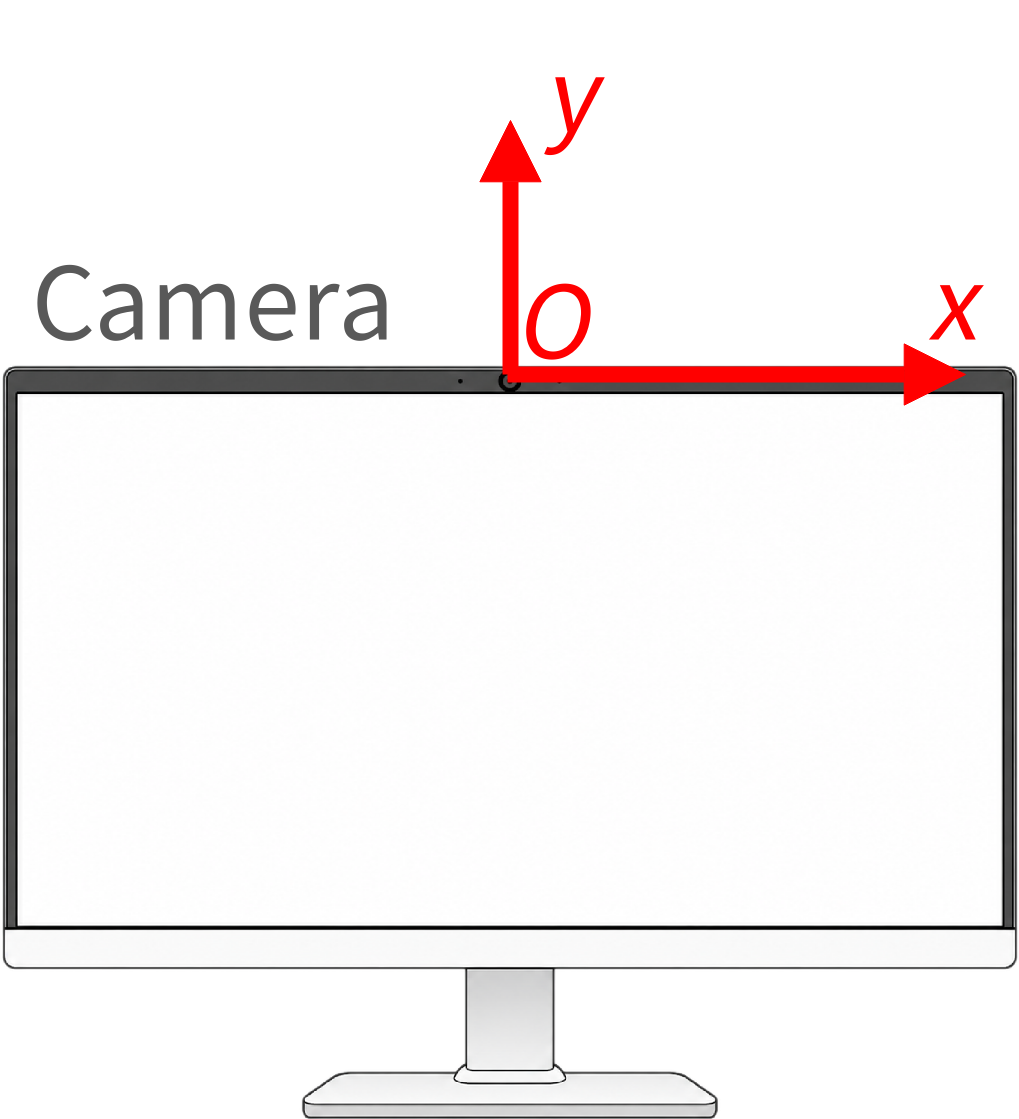
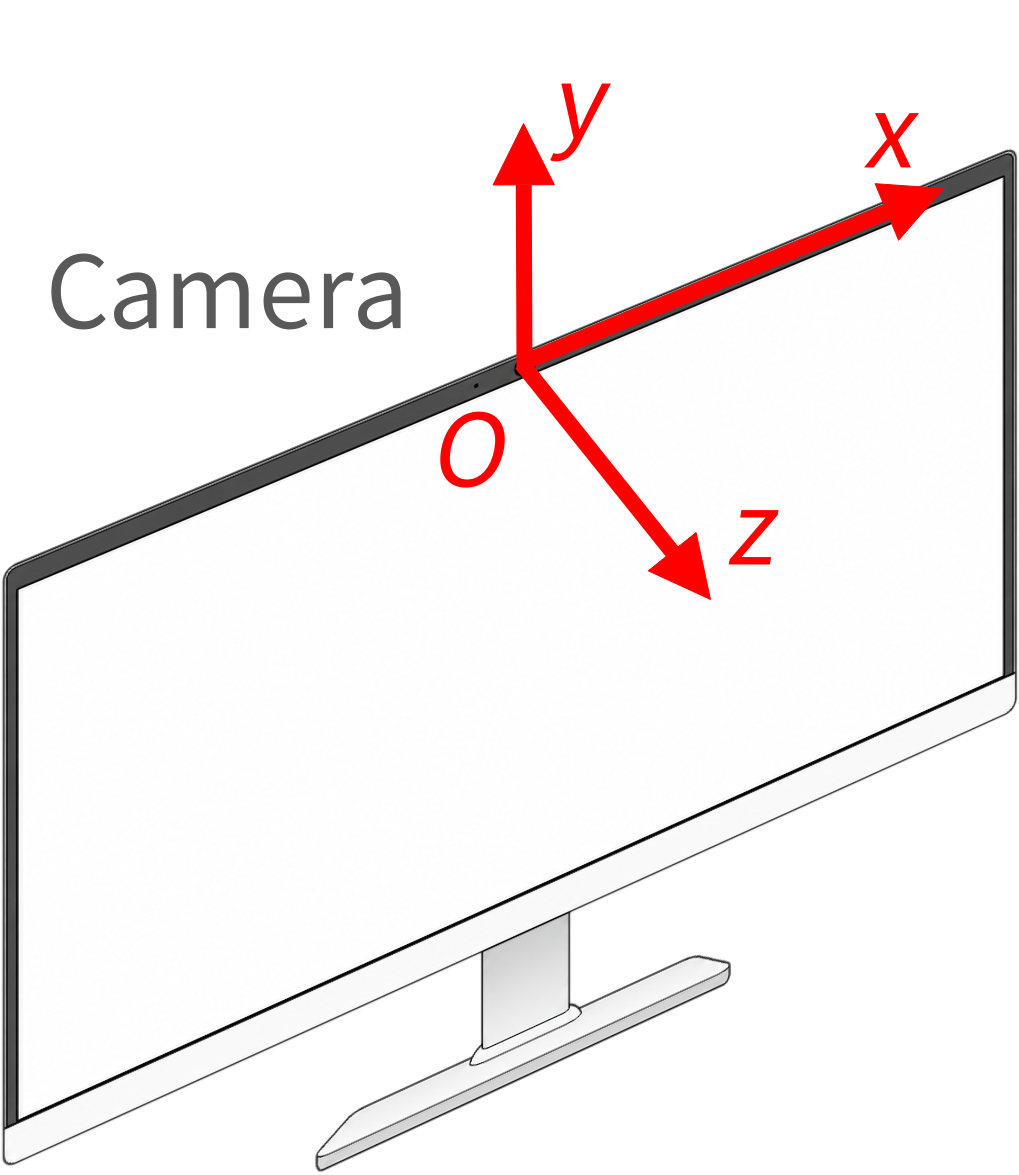
GazeData(object): Gaze estimation result for a single face.success(boolean, required): Whether gaze estimation succeeded for this face.gaze_screen_px(required): Per-eye point-of-gaze coordinates in screen-space pixels. The origin is at the left top corner of the screen. The coordinate system is shown as Fig. 1. Refer to GazePoint.gaze_camera_mm(required): Per-eye point-of-gaze coordinates in the camera coordinate system, measured in millimeters. The coordinate origin is located at the camera optical center. Depending on the gaze estimation algorithm, the point-of-gaze can be represented either as a 2D coordinate on the camera image plane or as a 3D point in camera space. The coordinate definitions for 2D and 3D gaze_camera_mm are illustrated in Fig. 2 and Fig. 3, respectively. Different algorithms may natively output in different coordinate frames; all values are normalized to the conventions documented here before being returned. Refer to GazePoint.
GazePoint(object): Point-of-gaze coordinates for two eyes in either screen-pixel or camera-millimeter space.left_eye(array, required): Gaze-screen-px [x,y] or gaze-camera-mm [x,y(,z)]; 2D or 3D depending on algorithm; empty list if unavailable. Length must be between 0 and 3 (inclusive).right_eye(array, required): Screen-px [x,y] or camera-mm [x,y(,z)]; 2D or 3D depending on algorithm; empty list if unavailable. Length must be between 0 and 3 (inclusive).
GazeScreen(object): Wrapper for per-face gaze data in face/gaze_screen schema.gaze(required): Refer to GazeData.
Examples
{
    "face_gaze_screen": [
        {
            "gaze": {
                "gaze_camera_mm": {
                    "left_eye": [
                        155.0,
                        50.0,
                        25.0
                    ],
                    "right_eye": [
                        155.0,
                        50.0,
                        25.0
                    ]
                },
                "gaze_screen_px": {
                    "left_eye": [
                        960.0,
                        540.0
                    ],
                    "right_eye": [
                        960.0,
                        540.0
                    ]
                },
                "success": true
            }
        }
    ]
}
face/heart_rate
Heart rate (BPM) estimated from buffered face video frames.
Properties
face_heart_rate(required): Refer to HeartRate.
Definitions
Examples
{
    "face_heart_rate": {
        "fps": 30.0,
        "hr_bpm": 72.5,
        "wait_seconds": 0.0
    }
}
{
    "face_heart_rate": {
        "fps": 30.0,
        "wait_seconds": 5.2
    }
}
face/dimensional_affect
Continuous valence-arousal affect dimensions alongside discrete expressions and Action Units.
Properties
face_dimensional_affect(array, required)- Items: Refer to DimensionalAffect.
Definitions
Examples
{
    "face_dimensional_affect": [
        {
            "arousal": 0.32,
            "valence": 0.85
        }
    ]
}
head/detection
Multi-person head bounding box detection results.
Properties
head_detection(array, required)- Items: Refer to HeadBBox.
Definitions
Examples
{
    "head_detection": [
        {
            "score": 0.85,
            "xyxy": [
                100,
                200,
                300,
                400
            ]
        }
    ]
}
head/selection
Top-N head selection result (count + original indices), reordering head_detection.
Properties
head_selection(required): Refer to HeadSelection.
Definitions
Examples
{
    "head_detection": [
        {
            "score": 0.85,
            "xyxy": [
                100,
                200,
                300,
                400
            ]
        }
    ],
    "head_selection": {
        "count": 1,
        "selected_indices": [
            0
        ]
    }
}
head/gaze_point
Per-head 2D scene gaze target point with associated likelihood heatmap.
Properties
head_gaze_point(array, required)- Items: Refer to HeadGazePoint.
Definitions
HeadGazePoint(object)head_location_xyxy(array, required): Length must be equal to 4.gaze_point_px(array, required): Length must be equal to 2.heatmap(array, required): 2D gaze likelihood heatmap over the scene. Runtime type: numpy.ndarray of float32, shape [image_height, image_width], values in [0, 1] probability range.
Examples
{
    "head_gaze_point": [
        {
            "gaze_point_px": [
                640.0,
                360.0
            ],
            "head_location_xyxy": [
                100,
                200,
                300,
                400
            ],
            "heatmap": "numpy.ndarray(shape=[H, W], dtype=float32) -- 2D [0,1] gaze likelihood heatmap"
        }
    ]
}
head/social_gaze
Dyadic social gaze relations between two detected people. Class set: share, mutual, single, miss, void.
Properties
head_social_gaze(required): Refer to HeadSocialGaze.
Definitions
HeadSocialGaze(object)principal: Left-side / primary person in dyadic interaction. Default:null.- Any of
- : Refer to SocialGazePerson.
- null
- Any of
associate: Right-side / secondary person in dyadic interaction. Default:null.- Any of
- : Refer to SocialGazePerson.
- null
- Any of
success(boolean): Whether at least two heads were detected for social gaze inference. Default:true.
SocialGazePerson(object)head_location_xyxy(array, required): Length must be equal to 4.gaze_point_px(array, required): Length must be equal to 2.heatmap(array, required): 2D gaze likelihood heatmap. Runtime type: numpy.ndarray of float32, shape [image_height, image_width], values in [0, 1] probability range.social_gaze_id(integer, required): Integer class ID of the social gaze relation. Ordered mapping: 0=share, 1=mutual, 2=single, 3=miss, 4=void.social_gaze_label(string, required): Human-readable social gaze relation label. Possible values: share, mutual, single, miss, void. Index of the value matches social_gaze_id.
Examples
{
    "head_social_gaze": {
        "associate": {
            "gaze_point_px": [
                200.0,
                300.0
            ],
            "head_location_xyxy": [
                600,
                200,
                800,
                400
            ],
            "heatmap": "numpy.ndarray(shape=[H, W], dtype=float32) -- 2D [0,1] gaze likelihood heatmap",
            "social_gaze_id": 1,
            "social_gaze_label": "mutual"
        },
        "principal": {
            "gaze_point_px": [
                800.0,
                300.0
            ],
            "head_location_xyxy": [
                100,
                200,
                300,
                400
            ],
            "heatmap": "numpy.ndarray(shape=[H, W], dtype=float32) -- 2D [0,1] gaze likelihood heatmap",
            "social_gaze_id": 1,
            "social_gaze_label": "mutual"
        },
        "success": true
    }
}
{
    "head_social_gaze": {
        "success": false
    }
}
1 maintainer

Download files
Download the file for your platform. If you're not sure which to choose, learn more about installing packages.
Source Distribution
Built Distribution
Filter files by name, interpreter, ABI, and platform.
If you're not sure about the file name format, learn more about wheel file names.
Copy a direct link to the current filters
File details
Details for the file seetapsych_attributes-0.0.3rc3.tar.gz.
File metadata
- Download URL: seetapsych_attributes-0.0.3rc3.tar.gz
- Upload date:
- Size: 1.3 MB
- Tags: Source
- Uploaded using Trusted Publishing? Yes
- Uploaded via:
twine/7.0.0 CPython/3.13.14
File hashes
| Algorithm | Hash digest | |
|---|---|---|
| SHA256 |
e7e4250fbcce580337a5e20e1fa568c572603b55db35c4f10c4eed38172d409b
|
|
| MD5 |
dbc75804e983bf1138906d949f238d41
|
|
| BLAKE2b-256 |
e06222215122e1e3ff2e8bc6dea235089d0f9738c45cda4ba9c83c8e70903575
|
Provenance
The following attestation bundles were made for seetapsych_attributes-0.0.3rc3.tar.gz:
Publisher:
publish.yml on seetapsych/seetapsych-attributes
-
Statement:
-
Statement type:
https://in-toto.io/Statement/v1 -
Predicate type:
https://docs.pypi.org/attestations/publish/v1 -
Subject name:
seetapsych_attributes-0.0.3rc3.tar.gz -
Subject digest:
e7e4250fbcce580337a5e20e1fa568c572603b55db35c4f10c4eed38172d409b - Sigstore transparency entry: 2677607410
- Sigstore integration time:
-
Permalink:
seetapsych/seetapsych-attributes@721929a4007de840700a7f1c36fc177455d4afa4 -
Branch / Tag:
refs/tags/r0.0.3rc3 - Owner: https://github.com/seetapsych
-
Access:
public
-
Token Issuer:
https://token.actions.githubusercontent.com -
Runner Environment:
github-hosted -
Publication workflow:
publish.yml@721929a4007de840700a7f1c36fc177455d4afa4 -
Trigger Event:
push
-
Statement type:
File details
Details for the file seetapsych_attributes-0.0.3rc3-py3-none-any.whl.
File metadata
- Download URL: seetapsych_attributes-0.0.3rc3-py3-none-any.whl
- Upload date:
- Size: 25.4 kB
- Tags: Python 3
- Uploaded using Trusted Publishing? Yes
- Uploaded via:
twine/7.0.0 CPython/3.13.14
File hashes
| Algorithm | Hash digest | |
|---|---|---|
| SHA256 |
606bbfdbc6dd01c5647f5be0ef4551cf103e6a464e8059bcebaef9dcc56b183c
|
|
| MD5 |
21e42e23a46c8d2a02ddaf464104c535
|
|
| BLAKE2b-256 |
ef52d553c7efb043e9052a11ecde569ed68e0bc506f10fa262e231c2c6fa1a98
|
Provenance
The following attestation bundles were made for seetapsych_attributes-0.0.3rc3-py3-none-any.whl:
Publisher:
publish.yml on seetapsych/seetapsych-attributes
-
Statement:
-
Statement type:
https://in-toto.io/Statement/v1 -
Predicate type:
https://docs.pypi.org/attestations/publish/v1 -
Subject name:
seetapsych_attributes-0.0.3rc3-py3-none-any.whl -
Subject digest:
606bbfdbc6dd01c5647f5be0ef4551cf103e6a464e8059bcebaef9dcc56b183c - Sigstore transparency entry: 2677607445
- Sigstore integration time:
-
Permalink:
seetapsych/seetapsych-attributes@721929a4007de840700a7f1c36fc177455d4afa4 -
Branch / Tag:
refs/tags/r0.0.3rc3 - Owner: https://github.com/seetapsych
-
Access:
public
-
Token Issuer:
https://token.actions.githubusercontent.com -
Runner Environment:
github-hosted -
Publication workflow:
publish.yml@721929a4007de840700a7f1c36fc177455d4afa4 -
Trigger Event:
push
-
Statement type:














