
HERTZ

Open-source heart-rate estimation from facial video
HERTZ brings complementary heart-rate estimators into one extensible open-source collection. TinyHR learns pulse waveforms from facial video, while AdaChrom recovers pulse signals through an interpretable, training-free chrominance pipeline. The collection follows a modular organization that supports the incorporation, independent documentation, and comparison of additional rPPG estimators.
Introduction · Estimator collection · Installation · Module zoo · Resources


Introduction
HERTZ provides heart-rate estimation modules for the SeetaPsych ecosystem. It includes two open-source remote photoplethysmography (rPPG) estimators: TinyHR, a lightweight convolutional model that predicts a pulse waveform from facial video, and AdaChrom, an unsupervised signal-processing method based on adaptive skin-region selection, chrominance projection, and frequency analysis.
HERTZ Estimator Collection
TinyHR: lightweight learning-based rPPG
TinyHR is a compact learning-based estimator that predicts an rPPG waveform from facial video and obtains heart rate through spectral post-processing.
Overview
The exported ONNX model contains 82,177 parameter elements and occupies approximately 381 KiB. TinyHR uses a 160-frame facial-video input window and a default 1.0 s rolling update interval after sufficient valid face frames have been collected.
Demonstration
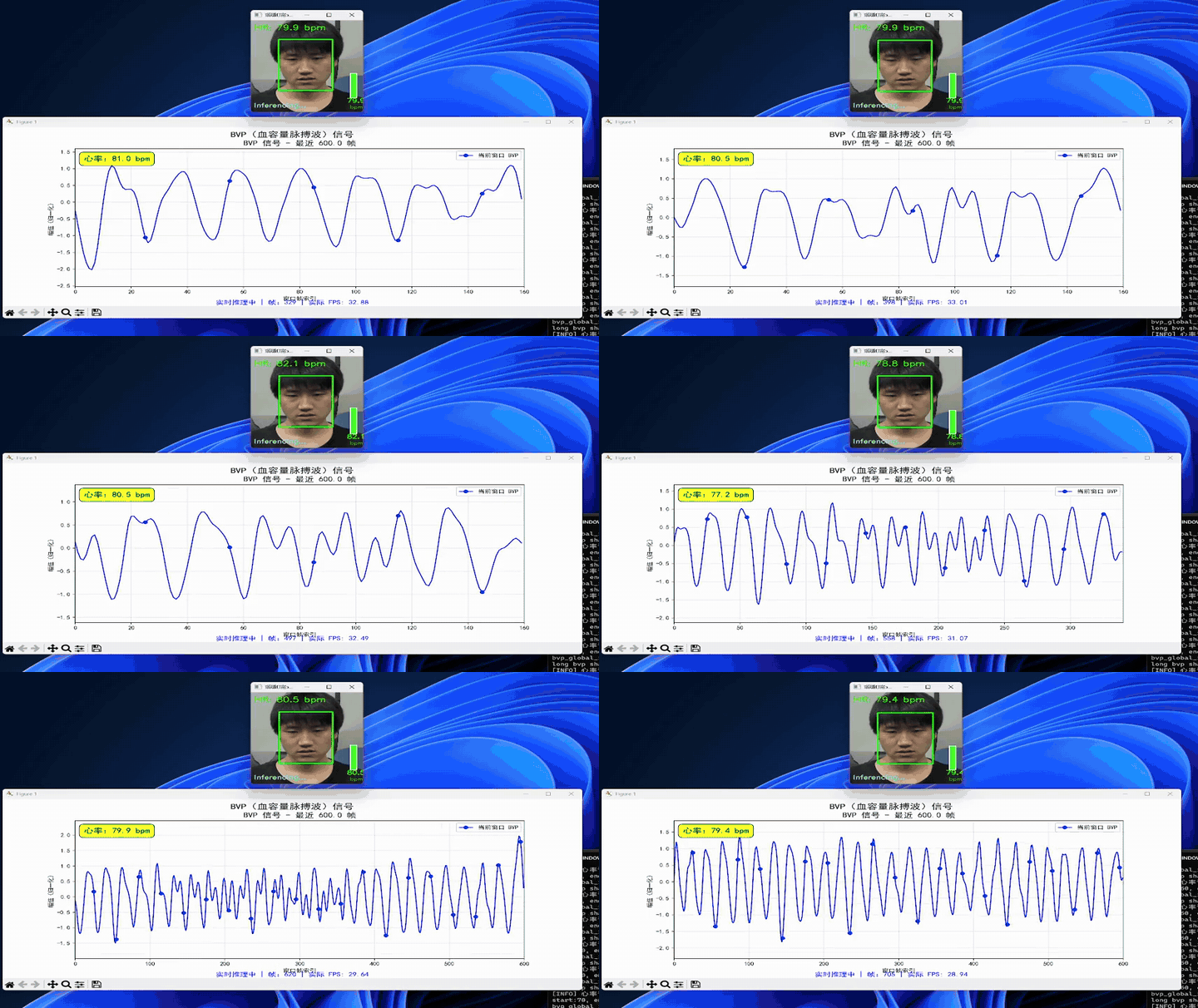
The demonstration presents the detected face, predicted rPPG waveform, and heart-rate estimate together.
Training Data
TinyHR was trained on subsets of four rPPG datasets. The counts below describe the training data reported in the technical report; they are not the full sizes of the source datasets.
| Dataset | Training subjects | Training videos | Usage |
|---|---|---|---|
| VIPL-HR V1 | 85 | 1,883 | Training |
| VIPL-HR V2 | 500 | 2,498 | Training |
| V4V | 103 | 726 | Training |
| MCD-rPPG | 600 | 1,200 | Training; front-facing videos only |
| Total | 1,288 | 6,307 | Four-source training corpus |
| Training configuration | Setting |
|---|---|
| Batch size | 4 |
| Initial learning rate | 0.005 |
| Learning-rate scheduler | OneCycleLR |
| Input clip | 160 RGB face crops, each resized to 128 × 128 pixels |
Source: TinyHR technical report, page 1 (input) and pages 6–7 (training data and configuration).
Model Size and Reference Inference Time
| Measurement | Result | Interpretation |
|---|---|---|
| Exported ONNX parameters | 82,177 | Initializer-element count after export and convolution/normalization fusion; not the pre-export trainable-parameter count |
| ONNX file size | ≈ 381 KiB | 390,150 bytes; SHA-256 matches the checksum declared in tiny-hr.yml |
| CPU inference time | 80 ms mean | 100 inference runs on an Intel Core i9-13900KF CPU at 3.00 GHz |
| GPU inference time | 6 ms mean | 100 inference runs on an NVIDIA H20 GPU in a server environment |
| Input observation duration | ≈ 5.3 s at 30 FPS | Time to collect 160 valid face frames; the first result also depends on update scheduling and computation |
| Rolling update interval | 1.0 s default | Timestamp-based update requests; approximately 30 frames per interval at 30 FPS |
The measurements exclude video acquisition, face detection, input-window collection, and update scheduling. They are hardware- and environment-dependent and are separate from accuracy evaluation.
Architecture and Inference
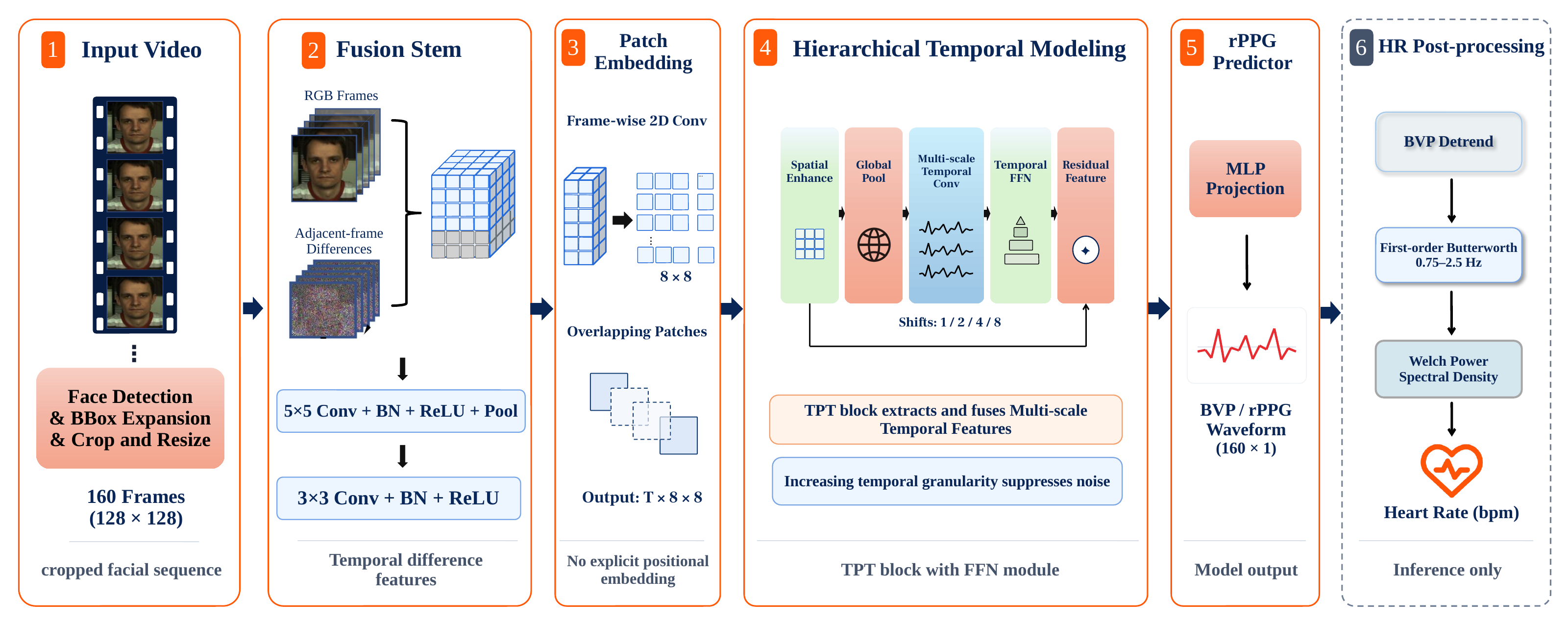
| Stage | Module | Function |
|---|---|---|
| 01 | Frame Difference Fusion Stem | Concatenates four neighboring-frame RGB differences into 12 channels and extracts features through the difference branch. |
| 02 | Spatial Patch Embedding | A frame-wise 4 × 4 convolution with stride 4 maps 32 × 32 features to a non-overlapping 8 × 8 grid with 32 channels. |
| 03 | Multi-scale Temporal Feature block | Parallel temporal-shift branches, pointwise convolutions, a temporal feed-forward network, and residual fusion integrate temporal features. |
| 04 | Waveform Predictor | Spatial pooling and two pointwise convolutions produce one rPPG sample per input frame. |
| 05 | Signal Processing | Detrending, band-pass filtering, and the dominant Welch PSD peak yield the heart-rate estimate. |
Inference uses a Butterworth band-pass filter with cutoff frequencies of 0.75 and 2.5 Hz (45–150 BPM). Within this search band, the frequency of the largest Welch PSD peak is converted to heart rate:
Heart rate (BPM) = 60 × dominant frequency (Hz)
Training Objectives
The technical report defines negative Pearson correlation for temporal waveform agreement, cross-entropy over 45–149 BPM frequency bins, and KL divergence between spectral-peak distributions. Their weights are 0.2, 1.0, and 1.0:
L = 0.2 L_time + L_CE + L_KL
Evaluation
Results on the fifth fold of the VIPL-HR dataset:
| Label | MAE ↓ | RMSE ↓ | Pearson ↑ |
|---|---|---|---|
| gt | 5.223 | 8.675 | 0.679 |
| wave | 3.880 | 6.893 | 0.772 |
Module Configuration and Usage
Module configuration: tiny-hr.yml
| Name | Type | Default | Description |
|---|---|---|---|
| fps | number | 30 | Sampling rate used for waveform buffering and spectral analysis; it must match the effective input frame rate. |
| interval | number | 1 | Timestamp-based interval between update requests, in seconds; distinct from observation duration and computation time. |
seetapsych-webui --files seetapsych_hertz/modules/tiny-hr.yml
from seetapsych_lib.runtime.factory import Factory
from seetapsych_lib.runtime.pipeline import Pipeline

factory = Factory()
factory.load_file_modules("seetapsych_hertz/modules/tiny-hr.yml")
pipeline = Pipeline(factory, ...)
pipeline.add_attributes("face/heart_rate")
For a complete end-to-end example with visualization, see examples/camera_heart_rate.py.
TinyHR Resources
AdaChrom: unsupervised chrominance-based rPPG
AdaChrom is an unsupervised remote photoplethysmography method for heart-rate estimation from facial videos. Instead of relying on labeled training data, AdaChrom estimates pulse-related blood volume pulse (BVP) signals from subtle temporal color variations in facial skin regions, providing an interpretable solution for contactless heart-rate estimation. Given a facial video sequence, AdaChrom follows a three-stage pipeline. In the pre-processing stage, face alignment is performed and ROI masks are generated. In the BVP extraction stage, mean BGR color signals are extracted from valid facial regions over a sliding temporal window, and the BVP signal is recovered from these temporal color signals. In the post-processing stage, heart rate is estimated from the recovered BVP signal through frequency-domain analysis and peak selection.
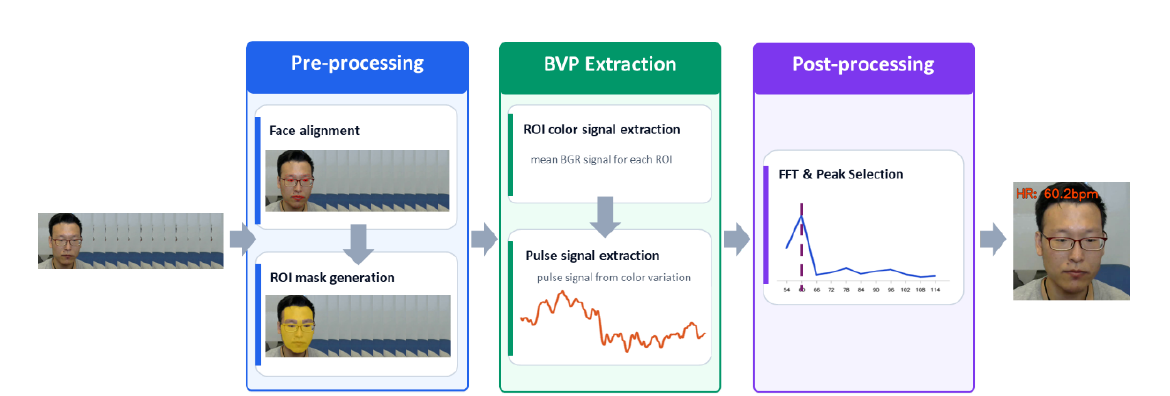
AdaChrom signal-processing pipeline.
A. Pre-processing
In the pre-processing stage, AdaChrom establishes reliable spatial support for ROI-based signal extraction. Specifically, facial landmarks are aligned to reduce motion-induced ROI shifts, while valid facial skin regions are defined through ROI mask generation for subsequent BVP extraction.
i) Face Alignment
Face Alignment provides the geometric basis for all subsequent ROI operations. The aligned landmarks also provide a validity check for each frame, and frames with missing, zero, or non-finite landmark coordinates are excluded from the current estimation window. The details of face alignment can be found in SeetaPsych Face Hub.
ii) ROI Mask Generation
After alignment, landmarks-defined polygon regions are used to construct facial ROI masks that isolate skin-dominant facial areas. A skin-color constraint is further applied in YCrCb color space. The final ROI mask is obtained by intersecting the geometric face mask with the detected skin mask. For each valid ROI, the algorithm records both the mean BGR value and the number of effective pixels, so empty or unreliable ROIs can be rejected before signal estimation. Four ROI strategies are supported in this implementation.
Legacy YCrCb Skin ROI (AdaChrom-v1): The legacy skin ROI first constructs a full-face mask from the facial landmarks and then applies a fixed YCrCb skin-color rule to identify skin pixels within the face region.
Fixed Forehead-seeded Skin ROI (AdaChrom-v2): The fixed forehead strategy uses a predefined landmark-based forehead region as the seed area for skin-color modeling. A two-dimensional Gaussian model is fitted in the Cr/Cb color space using the seed pixels, and pixels within the face region are retained when their color distribution is sufficiently close to the learned forehead skin model.
Adaptive Forehead-seeded Skin ROI (AdaChrom-v3): The adaptive forehead strategy extends the seed region around the forehead before estimating the Cr/Cb skin-color model. Compared with the fixed forehead seed, this strategy is designed to include more reliable forehead skin pixels and improve robustness when the fixed seed area is too small or partially affected by local landmark variation.
Connected-component-filtered Skin ROI (AdaChrom-v4): In addition to the adaptive forehead strategy, the connected-component strategy further filters the candidate skin regions according to spatial connectivity. Isolated false-positive regions are removed, while larger connected components that are spatially consistent with the face skin area are preserved for subsequent BGR signal extraction.
B. BVP Extraction
In the BVP extraction stage, AdaChrom converts spatial color observations from facial ROIs into temporal color traces and recovers the pulse-related BVP signal from these traces. This stage aggregates valid ROI measurements over a sliding temporal window, providing the signal representation used for subsequent heart-rate estimation.
i) ROI Color Signal Extraction
For every valid frame and ROI, the algorithm computes the spatial mean of the BGR pixel values inside the ROI mask:
$$ c_t = [\overline{B_t}, \overline{G_t}, \overline{R_t}] $$
This produces a temporal color trace for each ROI. Because remote photoplethysmography relies on subtle skin-color variations caused by blood volume changes, spatial averaging is used to suppress pixel-level noise and preserve the dominant temporal variation.
Before pulse extraction, the irregularly sampled color observations are regularized onto an evenly spaced time grid using the frame timestamps. The signal is then smoothed to reduce high-frequency noise and normalized by each channel's temporal mean to reduce illumination-scale effects.
ii) Pulse Signal Extraction
The core BVP extraction model follows a CHROM-style chrominance projection. The normalized RGB traces are transformed into two chrominance components:
$$ X = 3R - 2G $$
$$ Y = 1.5R + G - 1.5B $$
The pulse signal is then computed by balancing the two components according to their temporal standard deviations:
$$ \alpha = \frac{std(X)}{std(Y)} $$
$$ s(t) = X - \alpha Y $$
This projection emphasizes color changes associated with blood volume pulse while suppressing illumination variation and motion-related intensity changes. The projected BVP signal is then mean-centered, scaled, and smoothed before spectral analysis.
C. Post-processing
The post-processing stage converts the extracted BVP signal into the final heart-rate estimate through FFT-based spectral analysis and peak selection. A Hamming window is applied before the real-valued FFT to reduce spectral leakage. The magnitude spectrum is searched within the estimator's valid heart-rate range, approximately 50-120 bpm. The dominant spectral peak is selected as the heart-rate frequency and converted to beats per minute.
$$ f_{peak} = \underset{f}{\arg\max}, |FFT(s(t))| $$
$$ HR = 60 f_{peak} $$
Evaluation
Results for AdaChrom-v4 on the fifth fold of the VIPL-HR dataset:
| Label | MAE ↓ | RMSE ↓ | Pearson ↑ |
|---|---|---|---|
| gt | 8.60 | 13.00 | 0.42 |
| wave | 6.63 | 9.84 | 0.47 |
Installation
This project is included in the default SeetaPsych configuration. Download its modules with:
seetapsych-manager download
For the complete framework workflow, see SeetaPsych.
Module Zoo
| Module | Description | Input modes |
|---|---|---|
| AdaChrom | Chrominance-based rPPG on adaptive skin ROIs, without a learned pulse estimator | Video stream · video file |
| TinyHR | Convolutional rPPG waveform estimation with Welch PSD-based heart-rate post-processing | Video stream · video file |
AdaChrom
Model-free rPPG heart rate estimation using adaptive chrominance analysis on skin ROI.
Module config: ada-chrom.yml
| Package | Provides | Requires |
|---|---|---|
| HeartRate-AdaChrom | face/heart_rate |
face/dense_landmarks |
Description
Adaptive chrominance rPPG heart rate estimator from adaptive forehead ROI, no neural model required.
Usage Notes
- Supports both video streams and video files.
- For video stream mode, best results are achieved at 30 FPS or higher, which requires optimized processing logic and better hardware (with GPU).
- For stable analysis results, it is recommended to use video files with a stable frame rate of 30 FPS or higher.
Parameters
| Name | Type | Default | Description & Tuning |
|---|---|---|---|
window_samples |
integer | 300 |
Sliding window frame count for HR estimation. Larger values reduce noise but increase latency; adjust based on real-time demand. |
roi_regions |
selection[] |
["skin_b_adaptive_forehead"] |
List of regions to use for HR estimation. Defaults to ["skin_b_adaptive_forehead"]. Multiple selectors are evaluated independently, with valid results merged into the fused hr_bpm and the per-region roi_hr_bpm map. |
Models
(None)
Output Attributes
face/heart_rate— spec.
The per-region results requested via roi_regions are returned inside roi_hr_bpm: each key corresponds to one selected ROI and the value is that region's heart rate in BPM for the current window.
Resources
- TinyHR technical report
- TinyHR architecture diagram
- HERTZ Project Website
- Interactive project page source
- Hugging Face model distribution and interactive demos are planned.
License
This project is released under the BSD 3-Clause License.
Affiliations


1 maintainer

Metadata
1 maintainer
Release files for seetapsych-hertz 0.0.4
For a detailed explanation of source distributions (sdists) and built distributions (wheels), please see the package formats documentation.
Source distribution (sdist)
| File | Size | Uploaded | |
|---|---|---|---|
| seetapsych_hertz-0.0.4.tar.gz | 232.1 kB | Details |
Built distribution (wheel)
| File | Interpreter | ABI | Platform | Reset |
|---|---|---|---|---|
| seetapsych_hertz-0.0.4-py3-none-any.whl | Python 3 | none | any | Details |
Total release size: 321.2 kB
Release files / seetapsych_hertz-0.0.4.tar.gz
| Download URL | seetapsych_hertz-0.0.4.tar.gz |
|---|---|
| Size | 232.1 kB |
| Tags | Source |
|
SHA-256 checksum How to use checksums |
4b37a440eb5bd2ec9c0b65c925f8af6bd828281d00e36800a1b01ecf6ffb3fb0
|
|
BLAKE2b-256 checksum How to use checksums |
473d3e0d63283db002052ee83620b1c71340680c6b3281216d4d0502a806ea07
|
| Upload date | |
|
Uploaded using Trusted Publishing? What is trusted publishing? |
Yes |
| Uploaded via |
twine/7.0.0 CPython/3.13.14
|
Provenance
Provenance describes where a file came from. On PyPI, provenance is shared via attestations, which provide a verifiable record of the build or publishing details. View details, limitations and caveats.


PyPI Publish Attestation
PyPI verified that this artifact, at this checksum, originated from the publisher listed below.
Signed by GitHub Actions, verified by PyPI on Sep 17, 2026.
Transparency logRelease files / seetapsych_hertz-0.0.4-py3-none-any.whl
| Download URL | seetapsych_hertz-0.0.4-py3-none-any.whl |
|---|---|
| Size | 89.1 kB |
| Tags | Python 3 |
|
SHA-256 checksum How to use checksums |
4b9c7363157cdca6fbd24b0a3971aeff64a25998358aecf55038e0c9bbce3fbb
|
|
BLAKE2b-256 checksum How to use checksums |
f3f05db66626d6453ac18087b975f6508012dd3b20b7440300a7736f469e5e43
|
| Upload date | |
|
Uploaded using Trusted Publishing? What is trusted publishing? |
Yes |
| Uploaded via |
twine/7.0.0 CPython/3.13.14
|
Provenance
Provenance describes where a file came from. On PyPI, provenance is shared via attestations, which provide a verifiable record of the build or publishing details. View details, limitations and caveats.
PyPI Publish Attestation
PyPI verified that this artifact, at this checksum, originated from the publisher listed below.
Signed by GitHub Actions, verified by PyPI on Sep 17, 2026.
Transparency log













