
Generic Segment Tree


A generic python3 implementation of segment tree and dual segment tree data structures. The implementation is not only supporting generic inputs but also supports non-commutative functions and non-commutative composition of functions.
A segment tree is a data structure useful for storing items in a way which makes it easy to update individual elements and query for the cumulative value of applying a certain function to items' segments/intervals.
A dual segment tree is a data structure useful for applying a series of functions on all items in a segment/interval individually, while also allowing to query for specific items.
How to use?
Installation
Install using pip from the command line:
pip install seg-tree
Segment Tree
As seen below you can use arrays of any type and any binary-associative functions (even non-commutative like chars concatenation)
from segment_tree import SegmentTree

# ints with multiplication function
arr = [1, 2, 3, 4, 5, 6, 7, 8]
st = SegmentTree(items=arr, func=lambda x, y: x * y)
st.update(item_id=3, new_val=9) # items' values after: [1, 2, 3, 9, 5, 6, 7, 8]
st.query(left=0, right=2) # 6 (= 1 * 2 * 3)
st.query(left=2, right=5) # 810 (= 3 * 9 * 5 * 6)

# chars with concatenation function
arr = ['a', 'b', 'c', 'd', 'e', 'f', 'g']
st = SegmentTree(items=arr, func=lambda x, y: x + y)
st.update(item_id=3, new_val='r')  # items' values after: ['a', 'b', 'c', 'r', 'e', 'f', 'g']
st.query(left=0, right=2)  # "abc"
st.query(left=2, right=5)  # "cref"
Dual Segment Tree
As seen below you can compose any associative series of unary functions and use arrays of any type
from segment_tree import DualSegmentTree

# Example with ints array
arr = [1, 2, 3, 4, 5, 6, 7, 8]
st = DualSegmentTree(arr)
st.update(left=1, right=3, func=lambda x: x + 5) # items' values after: [1, 7, 8, 9, 5, 6, 7, 8]
st.update(left=2, right=4, func=lambda x: -x) # items' values after: [1, 7, -8, -9, -5, 6, 7, 8]
st.query(item_id=0) # 1
st.query(item_id=3) # -9

# Example with chars array
arr = ['a', 'b', 'c', 'd', 'e', 'f', 'g']
def concat_r(x): return x + 'r'
st = DualSegmentTree(items=arr)
st.update(left=3, right=5, func=concat_r) # items' values after: ['a', 'b', 'c', 'dr', 'er', 'fr', 'g']
st.query(item_id=1) # "b"
st.query(item_id=4) # "er"
API and Time Complexity
Denote n as the total number of elements in the array.
Segment Tree
| Function | Description | Time Complexity |
|---|---|---|
SegmentTree(items, func) |
Builds a segment tree from items with func as cumulative function |
O(n) |
update(item_id, new_val) |
Updates an the content of item in item_id to new_val |
O(log n) |
query(left, right) |
Returns the cumulative value of applying func to[left, right] |
O(log n) |
Dual Segment Tree
| Function | Description | Time Complexity |
|---|---|---|
DualSegmentTree(items) |
Builds a dual segment tree from items |
O(n) |
update(left, right, func) |
Apply func to each of the items in [left, right] individually |
O(log n) Amortized |
query(item_id) |
Get the value of item with id=item_id |
O(log n) |
Further Explanation On The Algorithms
The segment tree creates an array that simulates a complete binary tree
in which the leaves are the items of the input array. This tree is composed of
roughly 2 * n - 1 nodes (in the case where n is not a power of 2, additional dummy
leaves are added to maintain the complete binary tree structure).
The tree is taking advantage of the non-leaves nodes to store there values which will help it to perform actions on segments of the items without going all the way down to all of the items.
(Regular) Segment Tree
build - Fill the leaves with the values from the input array and fill the
rest of the tree applying the provided function on (left_child, right_child).
update - The tree updates the relevant leaf and its ancestors all the way up to the root.
query - Here the idea is to start at the root of the tree and go down
looking for the split_node. The split_node is the lowest node in the tree
that all the requested query segment is contained in its dominating segment of leaves.
An example of a split_node is shown below, where the blue node is the split
node for the segment marked in black.
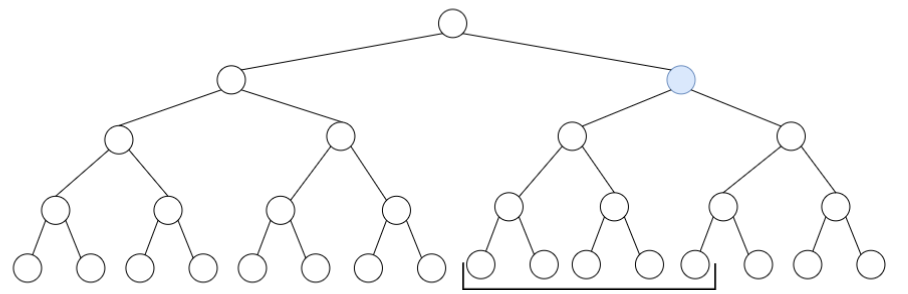
From the split_node the algorithm takes 2 tours - one to each of the children of split_node.
Taking the left tour it goes to the left child of split_node. Looking at the
left child of split_node there are 3 options:
- The dominating segment of
split_node.leftis contained within the requested query segment. In this, case the tour is ending withsplit_node.left.val.
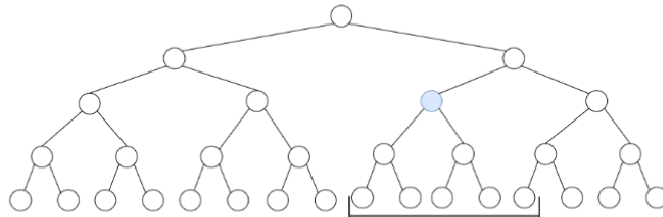
- The dominating segment of
split_node.left.leftintersects with the requested query segment. This means that the whole dominating segment ofsplit_node.left.rightis contained within the query segment, so all of its leaves descendants are relevant. Thereforesplit_node.left.right.valis memorized aside and the tour continues tosplit_node.left.leftwhich will result in some arbitrary valueleft_val. The algorihm than returnsfunc(left_val, split_node.left.right.val)as the left tour's result.
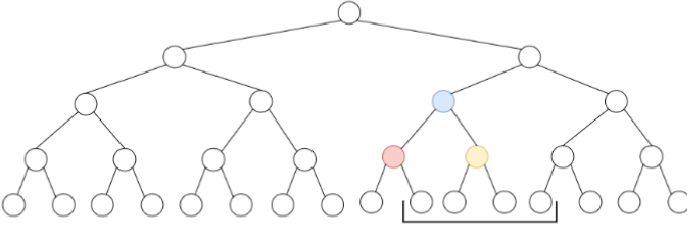
- The dominating segment of
split_node.left.leftdoesn't intersects with the requested query segment. This means the tour can be continued tosplit_node.left.rightand return the result of it as the result of the whole left tour.
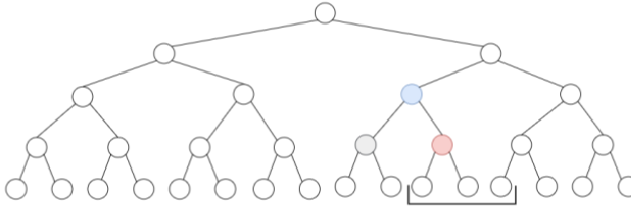
The right tour is done similarly and it returns func(left_tour_result, right_tour_result)
This whole method maintains narrow routes, not spreading to many allies, which helps keep the time complexity low.
Dual Segment Tree
build - Fill the leaves with the values from the input array and fill the rest of the tree with the identity function.
query - Start from the relevant leaf and go up to the root composing the functions on the way one over the others.
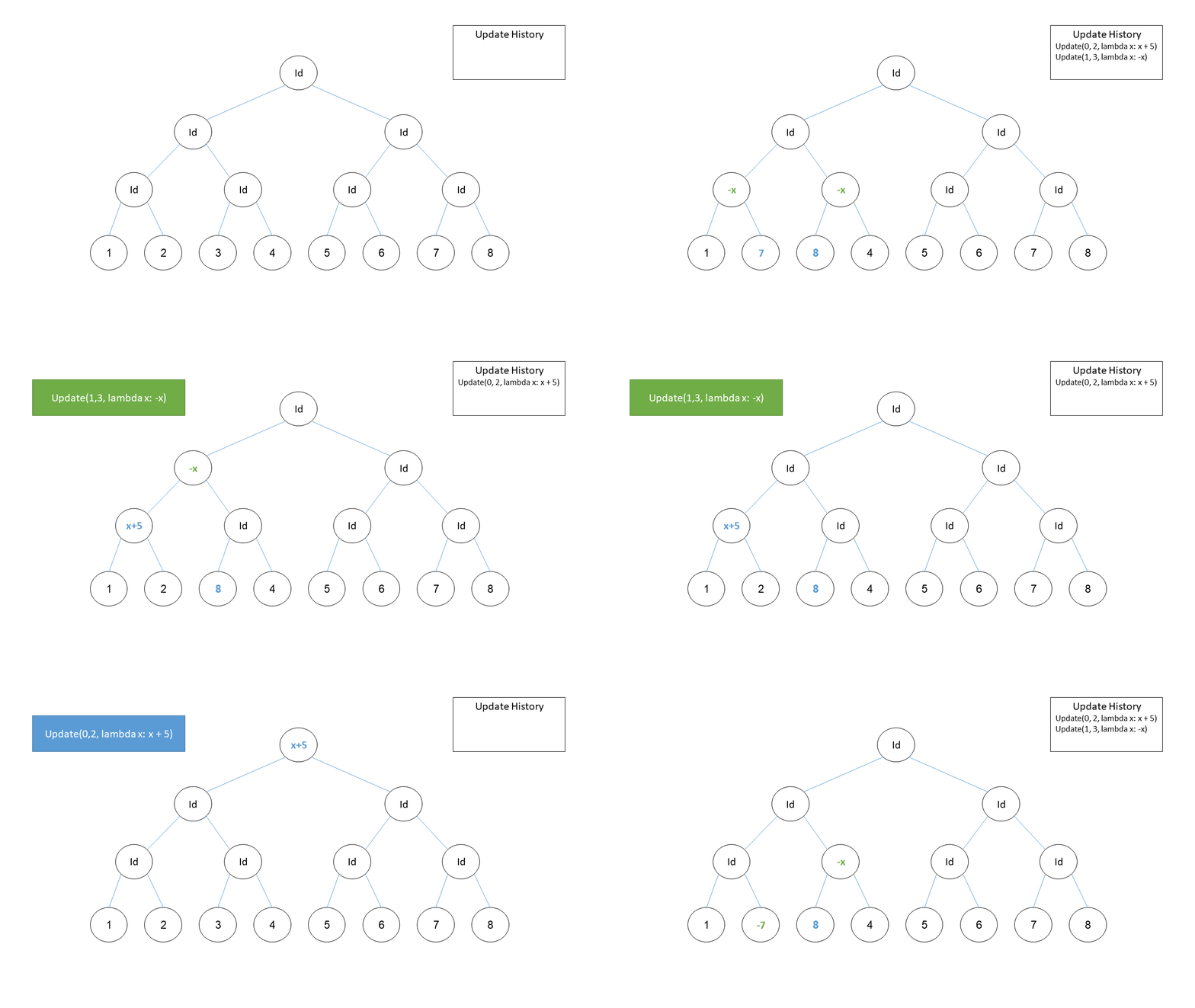
update - Works similarly to the SegmentTree's query. There is an additional
tweak here to allow non-commutative series of functions composition (cases where
f(g(x)) != g(f(x))). To achieve this it does as follows: during the update,
on the way down from the root the non-identity it functions it meets on the way are pushed
downwards to their children. An illustration of this in a simple case is shown below.
1 maintainer

Metadata
1 maintainer
Release files for seg-tree 0.1
For a detailed explanation of source distributions (sdists) and built distributions (wheels), please see the package formats documentation.
Source distribution (sdist)
| File | Size | Uploaded | |
|---|---|---|---|
| seg-tree-0.1.tar.gz | 7.6 kB | Details |
Built distribution (wheel)
| File | Interpreter | ABI | Platform | Reset |
|---|---|---|---|---|
| seg_tree-0.1-py3-none-any.whl | Python 3 | none | any | Details |
Total release size: 16.8 kB
Release files / seg-tree-0.1.tar.gz
| Download URL | seg-tree-0.1.tar.gz |
|---|---|
| Size | 7.6 kB |
| Tags | Source |
|
SHA-256 checksum How to use checksums |
f2d6841e9129b56cf025851a11c9c8ff4285b3c03edb373d03102eed07d870f4
|
|
BLAKE2b-256 checksum How to use checksums |
a7d6c9fcb5395eb2356eadbc4d11a840f15100122c5756bbee9a5f73cacc500d
|
| Upload date | |
|
Uploaded using Trusted Publishing? What is trusted publishing? |
No |
| Uploaded via |
twine/4.0.1 CPython/3.8.3
|
Release files / seg_tree-0.1-py3-none-any.whl
| Download URL | seg_tree-0.1-py3-none-any.whl |
|---|---|
| Size | 9.3 kB |
| Tags | Python 3 |
|
SHA-256 checksum How to use checksums |
d7a70f27e5aa6df674de74f2bd1bb1d5cb3fadf0f1fbc265176cf11364454d79
|
|
BLAKE2b-256 checksum How to use checksums |
5df08331c28ff1eb00f57abcadd76e3c9b0d73c6d4d3df36654aef3924d626d0
|
| Upload date | |
|
Uploaded using Trusted Publishing? What is trusted publishing? |
No |
| Uploaded via |
twine/4.0.1 CPython/3.8.3
|













