

SegCraft
Train, evaluate, and run semantic segmentation on images and video from one YAML config.


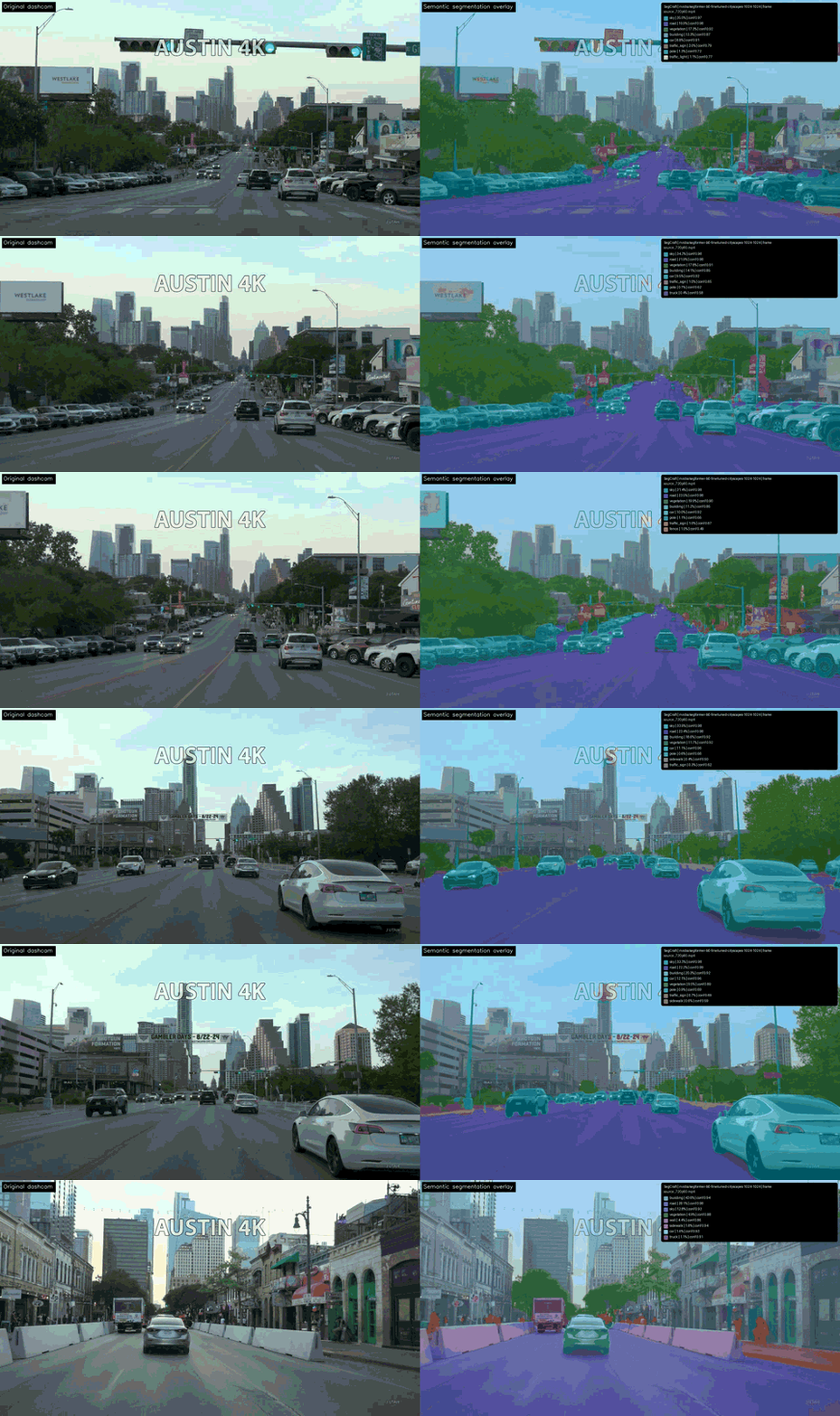
SegCraft is a config-first semantic segmentation toolkit for training, evaluating, and running image/video prediction from the same YAML setup. It is alpha software, so the Python API and config schema can still change.
Quick start
pip install "segcraft[web]"
segcraft-web          # then open http://127.0.0.1:8000
Upload a video or paste a YouTube URL, choose a preset, and download the
original, overlay, and side-by-side comparison videos. On an NVIDIA GPU, install
the CUDA build of PyTorch first (see Install). With the default
runtime.device: auto, SegCraft falls back to the CPU when it finds no GPU.
From a checkout, .\run.bat (Windows), ./run.command (macOS), or ./run.sh
(Linux) sets up a pinned uv, builds the environment, and opens the app in your
browser.
Why SegCraft
- One config for the whole workflow. Training, evaluation, and prediction read the same YAML, and configs merge in a fixed order: base, optional preset, optional local overrides.
- Three model backends behind one interface. Choose TorchVision, segmentation-models-pytorch, or Hugging Face SegFormer models by name in the config, with presets for Cityscapes, ADE20K, and PASCAL VOC.
- Video in, video out. Prediction writes
original.mp4,overlay.mp4, and a side-by-sidecomparison.mp4, plus asummary.json. - Three ways to drive it. Preset names work the same in the CLI, the Python
API, and the web app, and
segcraft doctorreports what Torch and CUDA can see.
Install
From a checkout, use the same entry point on every platform. It installs a
pinned uv, creates the local environment, starts the web app, waits until it
is ready, and then opens it in your browser.
.\run.bat
./run.command  # macOS
./run.sh       # Linux
Run doctor, intentionally rebuild the environment with repair, or use the
Docker path with the same launcher:
./run.sh doctor
./run.sh repair
./run.sh docker
./run.sh logs
./run.sh stop
Setup checks available disk space, prevents two installs from changing the
environment at the same time, and retries transient network failures up to
three times. A failed setup leaves details in .setup/install.log.
The PowerShell equivalents are .\run.ps1 doctor and .\run.ps1 docker.
Docker binds the UI only to 127.0.0.1:8000 and keeps outputs and model caches
in named volumes. An NVIDIA host can opt into GPU access with:
docker compose -f compose.yaml -f compose.nvidia.yaml up --build
For package-only use, install just the extras you need:
pip install "segcraft[torch]"                    # prediction/training with TorchVision
pip install "segcraft[torch,smp]"                # segmentation-models-pytorch
pip install "segcraft[torch,transformers]"       # Hugging Face segmentation models
pip install "segcraft[torch,transformers,video]" # video files and YouTube helpers
pip install "segcraft[web]"                      # FastAPI UI with video + default model backends
For development from a checkout:
uv sync --frozen --extra web --extra dev
For NVIDIA GPUs, install the CUDA-enabled PyTorch wheel that matches your system from the PyTorch install page, then run:
segcraft doctor
segcraft doctor reports the Python executable, Torch version, CUDA build,
CUDA availability, and visible GPU names. If it reports CUDA available: False,
launch SegCraft from the environment where Torch can see CUDA, or keep
runtime.device: auto so SegCraft falls back to CPU instead of failing.
CLI
segcraft validate
segcraft predict --preset cityscapes_video --local configs/local.yaml
segcraft train --preset fast_dev --local configs/local.yaml
segcraft evaluate --preset quality --local configs/local.yaml
configs/local.yaml is for machine-specific paths and is ignored by git.
Start from configs/local.example.yaml.
Web App
segcraft-web
Open http://127.0.0.1:8000. The UI accepts either a video upload or a
YouTube URL, lets you choose a preset or type a custom preset path/name, shows
job progress, shows the active Torch/CUDA runtime, and exposes downloads for
the generated outputs.
Notebooks
notebooks/01_quickstart.ipynb: video prediction demo.notebooks/02_config_and_api.ipynb: config and API basics.notebooks/03_web_app.ipynb: launching the optional FastAPI app.
Presets
SegCraft merges configs in this order:
configs/base.yaml- optional preset
- optional local config
Preset names work in the CLI, Python API, and web app:
fast_dev: tiny CPU training run.quality: longer training settings with scheduler and metrics.binary_quickstart: binary foreground/background setup.pascal_video: TorchVision PASCAL/VOC video prediction.cityscapes_video: SegFormer Cityscapes video prediction.cpu_video_demo: short Cityscapes CPU demo settings.ade20k_video: SegFormer ADE20K video prediction.smp_unet_resnet34: SMP Unet training setup.
task.num_classes controls trainable model heads. task.class_names only
controls display names; if labels are missing or do not match the model,
SegCraft falls back to class_<id> names during prediction.
Python API
from segcraft import load_config, load_config_object, list_available_presets
from segcraft.prediction import run_prediction

print(list_available_presets())

config = load_config("configs/base.yaml", preset_path="cityscapes_video")
typed = load_config_object("configs/base.yaml", preset_path="cityscapes_video")

events = []
summary = run_prediction(config, progress_callback=events.append)
Outputs
Video prediction writes:
original.mp4overlay.mp4comparison.mp4summary.json
Image-folder prediction writes masks, overlays, an optional overlay video, and the same summary metadata.
Development
pip install -e ".[web,dev]"
pytest
python -m build
twine check dist/*
Publishing uses .github/workflows/release.yml with GitHub trusted publishing.
Configure the PyPI/TestPyPI publisher for owner oney-erge, repository
SegCraft-Semantic-Segmentation, workflow release.yml, and environment
pypi. A v* tag publishes the package, container image, distribution files,
and GitHub release. A manual run can publish to TestPyPI without making a
release.
1 maintainer

Metadata
1 maintainer
Release files for segcraft 0.1.6
For a detailed explanation of source distributions (sdists) and built distributions (wheels), please see the package formats documentation.
Source distribution (sdist)
| File | Size | Uploaded | |
|---|---|---|---|
| segcraft-0.1.6.tar.gz | 53.8 kB | Details |
Built distribution (wheel)
| File | Interpreter | ABI | Platform | Reset |
|---|---|---|---|---|
| segcraft-0.1.6-py3-none-any.whl | Python 3 | none | any | Details |
Total release size: 109.4 kB
Release files / segcraft-0.1.6.tar.gz
| Download URL | segcraft-0.1.6.tar.gz |
|---|---|
| Size | 53.8 kB |
| Tags | Source |
|
SHA-256 checksum How to use checksums |
c489a9d891f8a4f471578c75f0650326f48bd1cfc437ba231444fdaa7028a4d7
|
|
BLAKE2b-256 checksum How to use checksums |
1348c4f8e74c66ec91902157085f7babeb791ddc71184e194811e5d48d20b7d4
|
| Upload date | |
|
Uploaded using Trusted Publishing? What is trusted publishing? |
Yes |
| Uploaded via |
twine/7.0.0 CPython/3.13.14
|
Provenance
Provenance describes where a file came from. On PyPI, provenance is shared via attestations, which provide a verifiable record of the build or publishing details. View details, limitations and caveats.


PyPI Publish Attestation
PyPI verified that this artifact, at this checksum, originated from the publisher listed below.
Signed by GitHub Actions, verified by PyPI on Oct 3, 2026.
Transparency logRelease files / segcraft-0.1.6-py3-none-any.whl
| Download URL | segcraft-0.1.6-py3-none-any.whl |
|---|---|
| Size | 55.6 kB |
| Tags | Python 3 |
|
SHA-256 checksum How to use checksums |
5a2c5d6c9726ef80a58f8ba0254734df14ed13f6fae7ba481d9321b3ef210dbc
|
|
BLAKE2b-256 checksum How to use checksums |
7c071502350ebefe169d7fee7bc99274a6d32dac186e9053c756eac424e5ac9e
|
| Upload date | |
|
Uploaded using Trusted Publishing? What is trusted publishing? |
Yes |
| Uploaded via |
twine/7.0.0 CPython/3.13.14
|
Provenance
Provenance describes where a file came from. On PyPI, provenance is shared via attestations, which provide a verifiable record of the build or publishing details. View details, limitations and caveats.
PyPI Publish Attestation
PyPI verified that this artifact, at this checksum, originated from the publisher listed below.
Signed by GitHub Actions, verified by PyPI on Oct 3, 2026.
Transparency log













