
segger






Cell segmentation for imaging-based spatial transcriptomics as graph-based transcript–cell assignment.
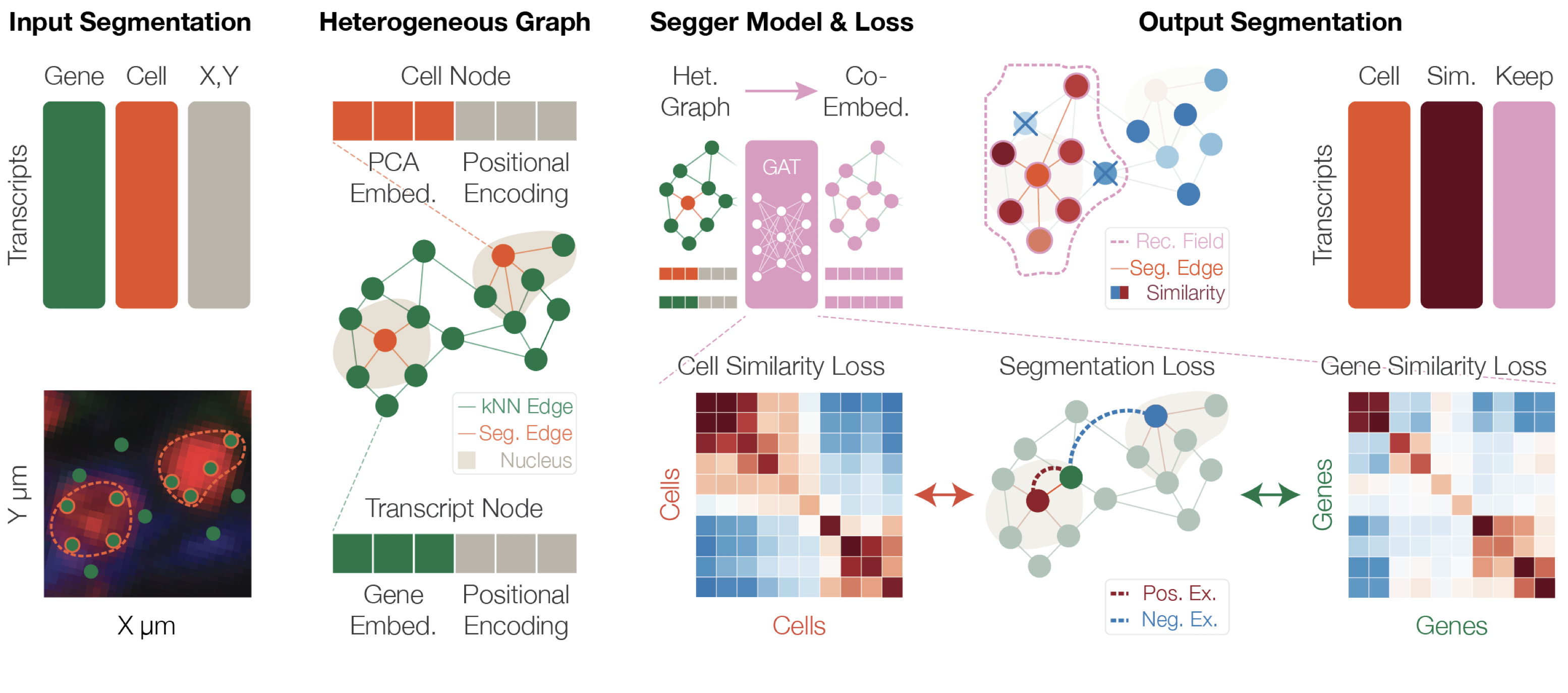
Segger is a graph neural network (GNN)-based method that formulates cell segmentation in imaging-based spatial transcriptomics (iST) as a problem of transcript–cell assignment. Rather than relying solely on geometric proximity, Segger assumes that a transcript belongs to a cell if it is consistent both with its local spatial context and with the gene expression programs that define cell identity, as captured in a shared latent representation.
Full documentation - installation, quickstart, outputs, API reference, etc.: segger-segmentation.readthedocs.io
Installation
segger requires CUDA 13 and Python 3.13.
uv pip install segger
For conda, pixi, installing from source and older CUDA versions, see the installation docs.
Container
On HPC clusters, run the Docker image with Apptainer/Singularity. Pull it once (about 10-20 minutes), then run on a GPU node with --nv:
export APPTAINER_CACHEDIR=/path/to/cachedir
apptainer pull segger.sif docker://sailmskcc/segger:latest
apptainer exec --nv segger.sif segger --help
For Docker, see Use a container.
Usage
segger segment \
  -i /path/to/your/ist/data/ \
  -o /path/to/save/outputs/ \
  --export anndata boundaries  # optional (e.g. anndata, boundaries, xeniumranger, ...)
See notebooks/quickstart.ipynb for an end-to-end walkthrough.
If you run into a problem, first check the GitHub issues and the known issues in the docs.
Contributing
See CONTRIBUTING.md.
Methods description
Citation
If you use segger in your research, please cite:
@misc{heidari2026segger,
  title={Segger: Fast and accurate cell segmentation of imaging-based spatial transcriptomics data},
  author={Heidari, Elyas and Moorman, Andrew and others},
  note={Methods description},
  year={2026},
  howpublished={\url{https://github.com/dpeerlab/segger/blob/main/segger_methods.pdf}}
}
1 maintainer

Metadata
1 maintainer
Release files for segger 1.0.0
For a detailed explanation of source distributions (sdists) and built distributions (wheels), please see the package formats documentation.
Source distribution (sdist)
| File | Size | Uploaded | Provenance | Actions |
|---|---|---|---|---|
| segger-1.0.0.tar.gz | 93.3 kB | With provenance | Details for segger-1.0.0.tar.gz |
Built distribution (wheel)
| File | Interpreter | ABI | Platform | Actions Reset |
|---|---|---|---|---|
| segger-1.0.0-py3-none-any.whl | Python 3 | none | any | Details for segger-1.0.0-py3-none-any.whl |
Total release size: 200.4 kB
Release files / segger-1.0.0.tar.gz
| Download URL | segger-1.0.0.tar.gz |
|---|---|
| Size | 93.3 kB |
| Tags | Source |
|
SHA-256 checksum How to use checksums |
d242acc9ee4b5ec9968c1e8b3084b264c668c9c8ddd9b5c3eb4fd86b642c8253
|
|
BLAKE2b-256 checksum How to use checksums |
69cfff20308e70ced06ef4ceafba5a268846da3c17b156757467f79878e9cf3b
|
| Upload date | |
|
Uploaded using Trusted Publishing? What is trusted publishing? |
Yes |
| Uploaded via |
twine/7.0.0 CPython/3.13.16
|
Provenance
Provenance describes where a file came from. On PyPI, provenance is shared via attestations, which provide a verifiable record of the build or publishing details. View details, limitations and caveats.


PyPI Publish Attestation
PyPI verified that this artifact, at this checksum, originated from the publisher listed below.
Signed by GitHub Actions, verified by PyPI on Nov 20, 2026.
Transparency logRelease files / segger-1.0.0-py3-none-any.whl
| Download URL | segger-1.0.0-py3-none-any.whl |
|---|---|
| Size | 107.0 kB |
| Tags | Python 3 |
|
SHA-256 checksum How to use checksums |
69941b408462191c472c530aa538b4f43a39a936d301eeb9ea9181e6c3d65006
|
|
BLAKE2b-256 checksum How to use checksums |
d3c1f8b2aaf7f2402930b668079c0774f1fa3a25e2cf3f514a153edcc76f19e2
|
| Upload date | |
|
Uploaded using Trusted Publishing? What is trusted publishing? |
Yes |
| Uploaded via |
twine/7.0.0 CPython/3.13.16
|
Provenance
Provenance describes where a file came from. On PyPI, provenance is shared via attestations, which provide a verifiable record of the build or publishing details. View details, limitations and caveats.
PyPI Publish Attestation
PyPI verified that this artifact, at this checksum, originated from the publisher listed below.
Signed by GitHub Actions, verified by PyPI on Nov 20, 2026.
Transparency logSecurity for segger 1.0.0
Provenance
Provenance describes where a file came from. On PyPI, provenance is shared via attestations, which provide a verifiable record of the build or publishing details. View details, limitations and caveats.
Full provenance
Both files in this release have been uploaded with provenance metadata.
Attestation for segger-1.0.0.tar.gz
PyPI Publish Attestation
PyPI verified that this artifact, at this checksum, originated from the publisher listed below.
Signed by GitHub Actions, verified by PyPI on Nov 20, 2026.
Transparency logA note on package security
PyPI is a repository for distributing packages, not a service for auditing them. While third-party security researchers and our staff do their best to detect and remove malicious packages, PyPI cannot guarantee the quality, security or suitability of any given package.
To learn more about protecting yourself from malicious actors, visit our package security documentation.














