
SEKMET FHIR R4 Tester
A micro hospital information system (HIS) that you can point at a real HIS, EHR, LIS, RIS or payer system to test its FHIR R4 integration end to end. SEKMET plays the other side of real hospital workflows: it acts as a FHIR server that the system calls, as a FHIR client that drives it, and as a lab, radiology, pharmacy or payer counterpart. It records every exchange and tells you exactly where the integration breaks.





pip install sekmet-fhir
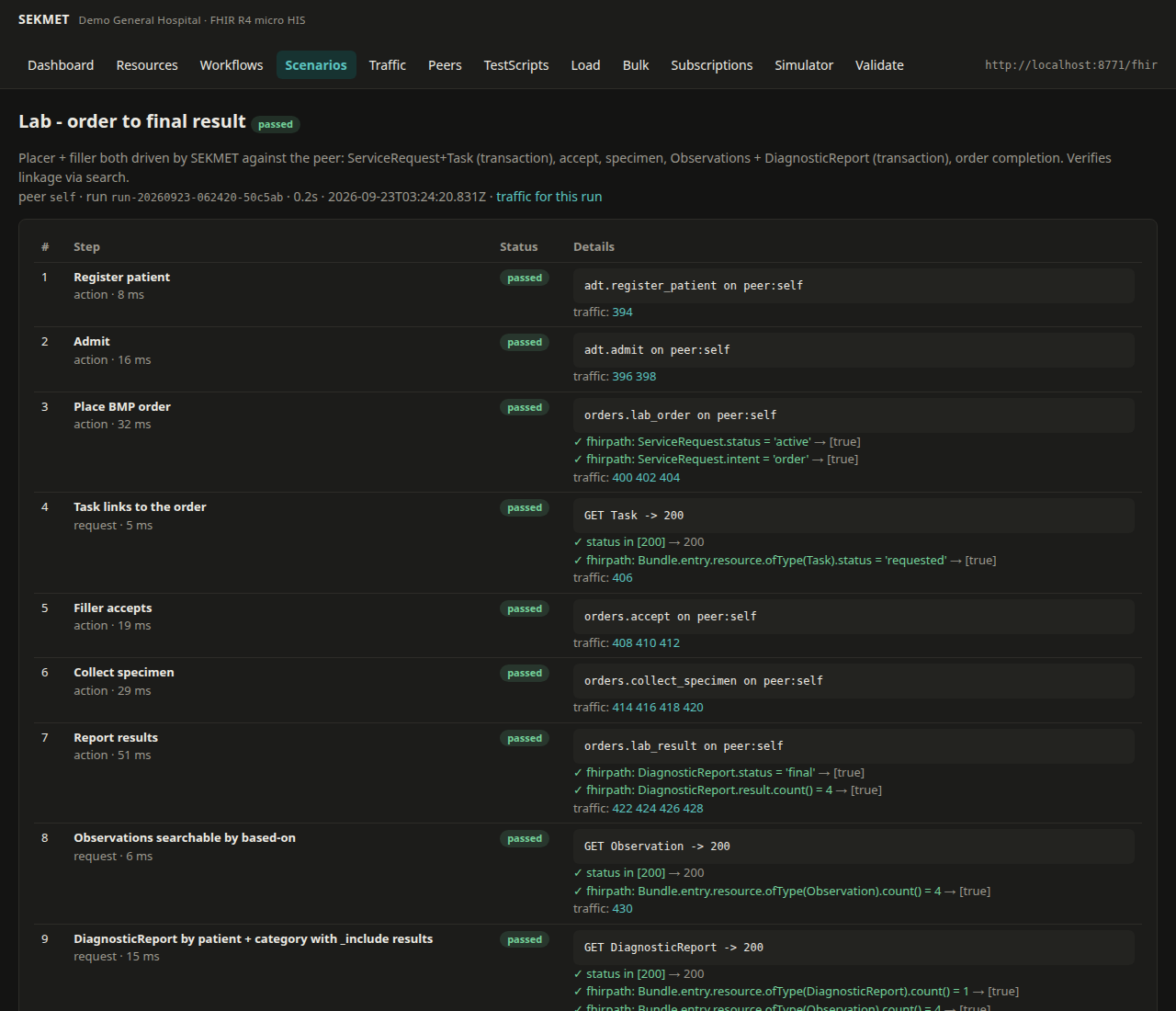
sekmet scenario run all --peer self      # 14 hospital scenarios against its own FHIR server, ~20 s
The problem
You're integrating with a hospital system over FHIR: registration and ADT feeds, lab orders and results, radiology, scheduling, pharmacy, claims, notifications. To test it properly you need another hospital system that behaves realistically:
- it places orders and reports results,
- it books and cancels appointments,
- it subscribes to changes,
- it sends FHIR messages,
- it handles SMART Backend Services auth,
- and it survives concurrent load.
The usual options are poor:
- Generic FHIR servers (HAPI, Firely…) store resources, but they don't act: nothing fulfils your order or pays your claim.
- Conformance suites (Inferno, Touchstone) check the API against specifications, but not your hospital workflows.
- Testing against a production partner is slow, risky, and can't reproduce edge cases on demand.
SEKMET fills that gap. It's a small, scriptable, observable hospital system built only for testing FHIR integrations.
Who it's for
- HIS/EHR vendors and integration teams preparing an interface (ADT, orders/results, scheduling, pharmacy, billing) or a go-live.
- Lab (LIS), radiology (RIS/PACS), pharmacy and payer system developers who need a realistic placer or counterpart.
- QA teams who want repeatable FHIR regression tests in CI (JUnit output, exit codes, gates).
- Implementers of FHIR features (Subscriptions, Bulk Data, messaging, SMART) who want to test both the client and the server side.
- Anyone evaluating a FHIR server: "Does it really do what its CapabilityStatement says?"
Use cases
| You want to… | SEKMET does… |
|---|---|
| Check a HIS can register, admit, transfer and discharge patients over FHIR | runs the ADT workflows against it and verifies Encounter status, location history, discharge disposition and searches |
| Test a lab or radiology interface | places ServiceRequest + Task, then either fulfils it itself (Specimen, Observations, DiagnosticReport, ImagingStudy) or waits for your system to result it |
| Test the HIS as a filler | your system sends orders to SEKMET, and the built-in simulator answers as lab, RIS, scheduler, pharmacy or payer |
| Validate appointment booking, e-prescribing or claims | Schedule/Slot/Appointment, MedicationRequest/Dispense/Administration, Coverage/ChargeItem/Claim/ClaimResponse flows |
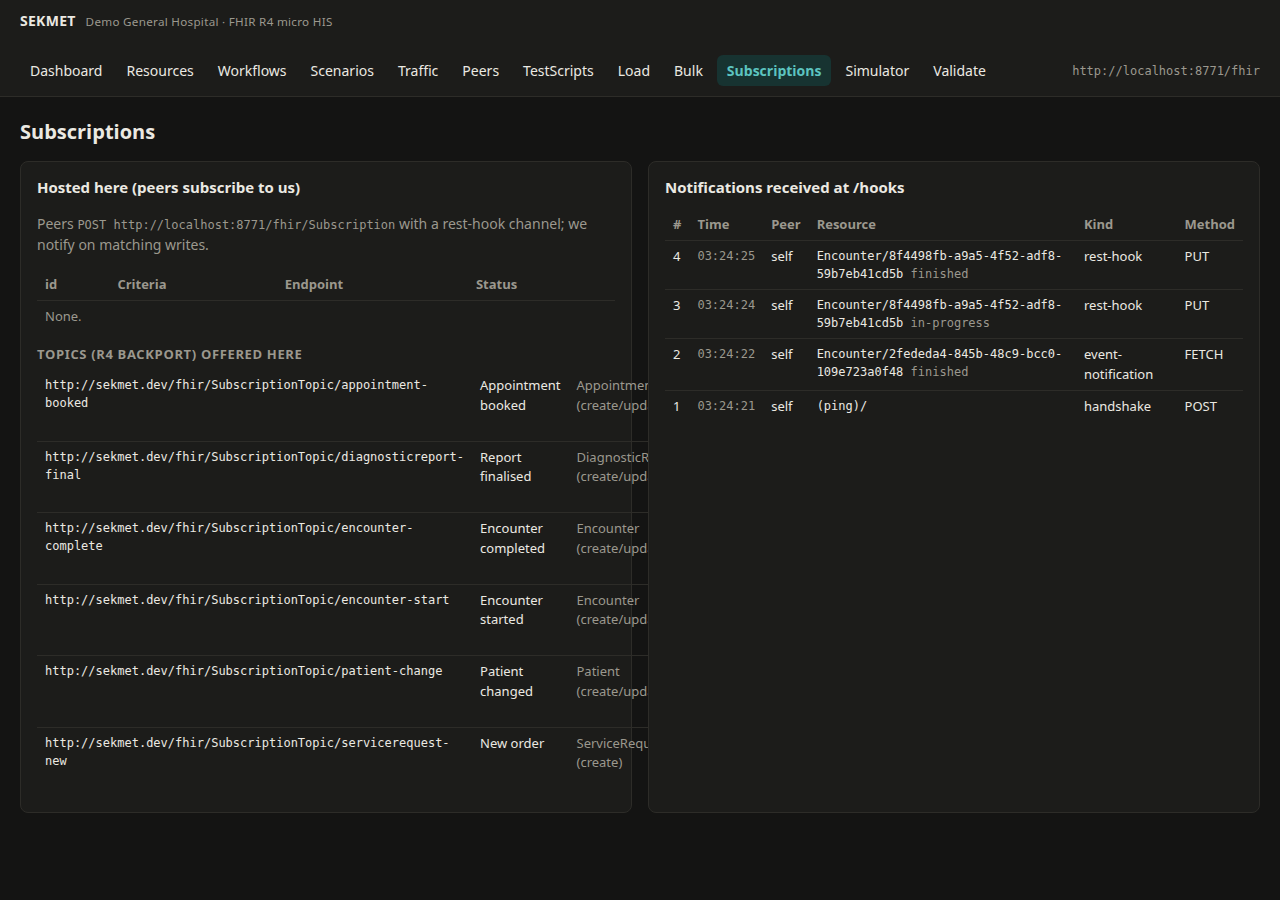
| Test notifications | classic R4 rest-hook and topic-based Subscriptions (R4 Backport IG), as publisher and as subscriber |
| Test FHIR messaging | ADT/order/result message Bundles to $process-message, with acknowledgements checked |
| Test SMART Backend Services / OAuth2 | acts as the SMART client (signed JWT, or client secret for e.g. Keycloak) and as a SMART token server |
Test Bulk Data $export |
runs the async export end to end and validates every NDJSON line; also serves $export itself |
| Check XML as well as JSON | the whole scenario library can run over application/fhir+xml |
| Run existing FHIR TestScripts or produce TestReports | built-in TestScript engine; any run can be exported as a replayable TestScript |
| Load test before go-live | N parallel users run hospital journeys, with per-endpoint p95/p99, error rates and correctness under concurrency, gated for CI |
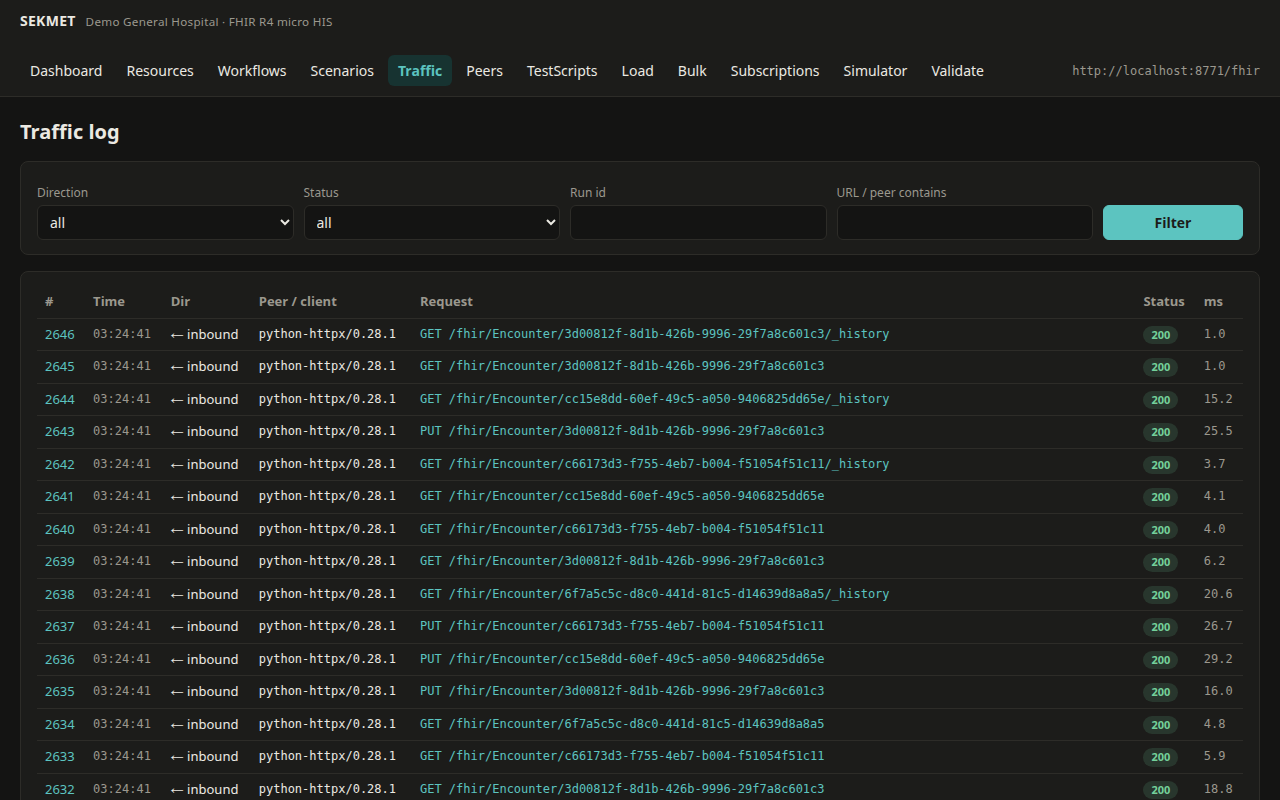
| See exactly what went over the wire | every request/response in both directions, correlated per test step, with secrets redacted |
What's inside
- FHIR R4 server: CRUD, versioning, conditional operations, transactions with rollback, rich search
(chaining,
_has,_include/_revinclude, modifiers, prefixes, paging), JSON and XML,$everything,$validate,$process-message,Claim/$submit,$export, Subscriptions (rest-hook and Backport topics with$status). Auth: none, Basic, bearer, or SMART Backend Services with scopes, over HTTPS. - FHIR client and workflows: about 40 hospital workflows (ADT, lab and imaging orders/results, scheduling, medications, clinical documentation, billing), with standard terminology (LOINC, SNOMED CT, RxNorm, HL7 v2 event codes). They target the local store, a peer over REST, or a peer via FHIR messaging.
- Scenario runner: readable YAML with FHIRPath assertions. It skips steps a peer doesn't advertise (CapabilityStatement-aware), grades SHALL vs SHOULD, and reports to HTML, JSON and JUnit.
- TestScript engine: runs standard FHIR TestScripts (fixtures, variables, XPath/FHIRPath asserts, multi-server) and writes TestReports.
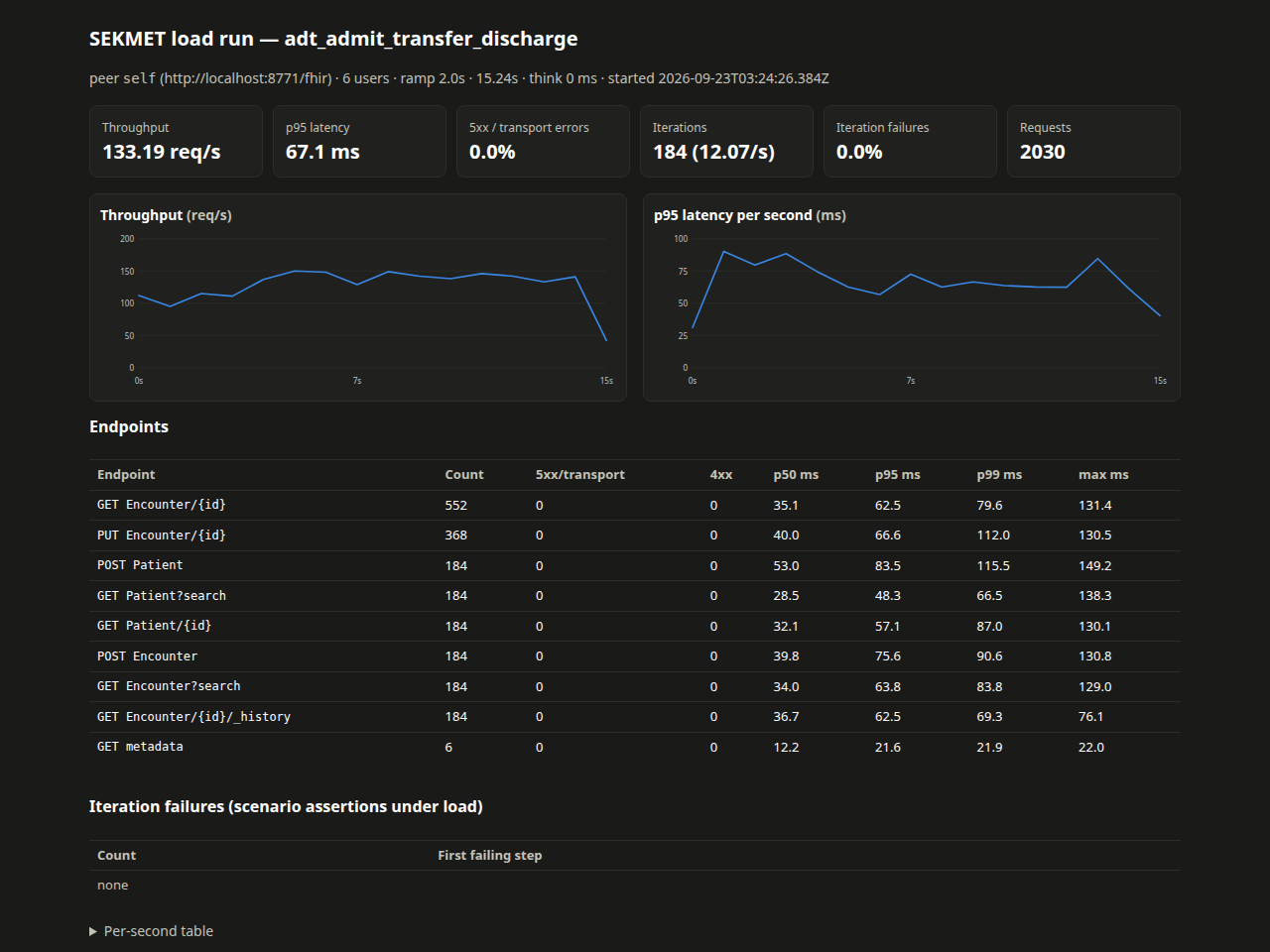
- Load mode: scenarios as user journeys, a guard against loading systems you don't own, and CI gates.
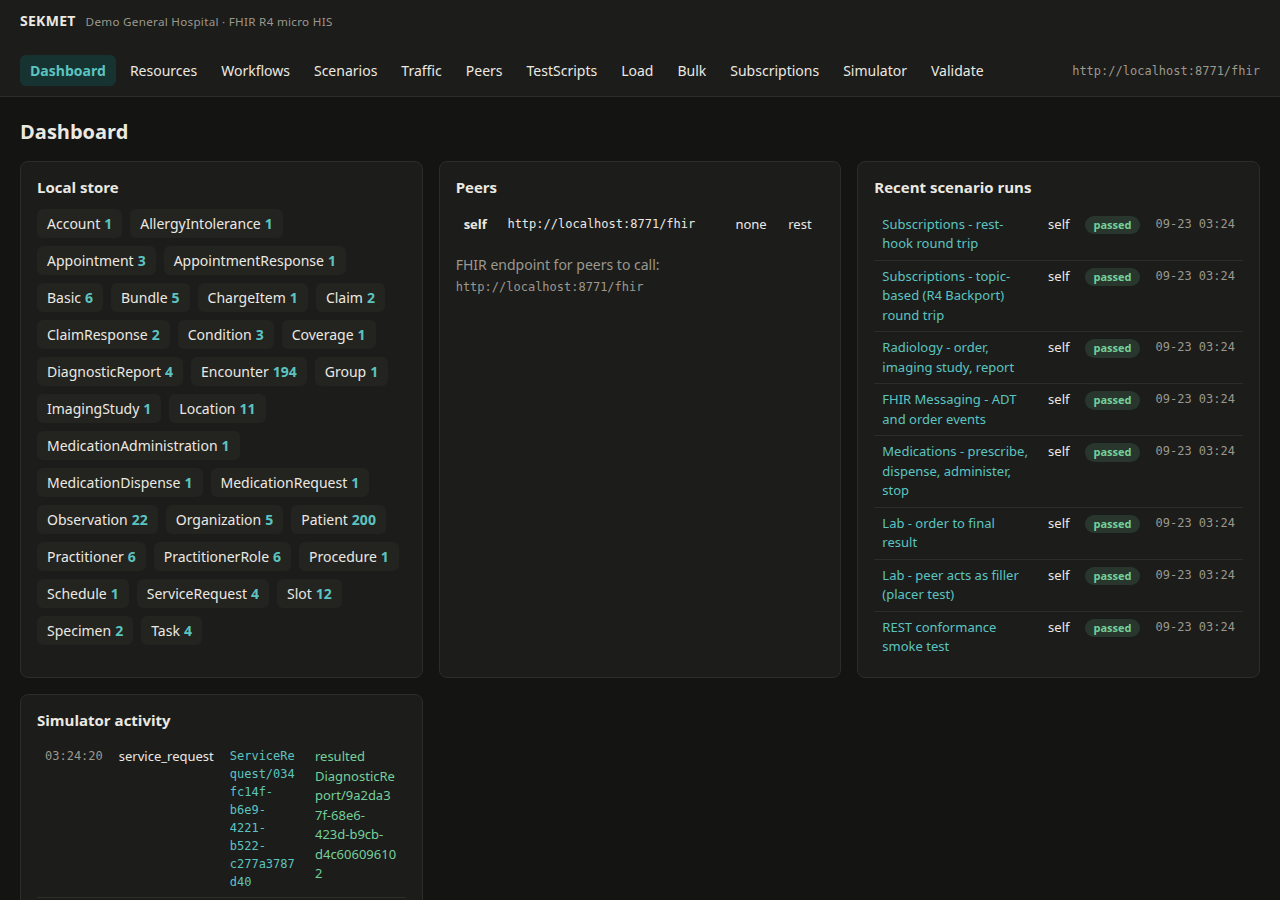
- Web console: dashboard, resources, workflow forms, scenarios, traffic inspector, peers, TestScripts, load, bulk, subscriptions, simulator, validator.
 |
 |
 |
 |
Quick start
pip install sekmet-fhir                       # Python 3.11+
sekmet serve                                  # FHIR: http://localhost:8090/fhir   console: http://localhost:8090/ui
Point it at the system you want to test by adding a peer to settings.yaml (see
config/settings.example.yaml):
peers:
  my-his:
    base_url: https://his.example.org/fhir/r4
    auth: {type: client_credentials, client_id: sekmet, client_secret_file: keys/my-his.secret,
           token_url: https://auth.example.org/realms/x/protocol/openid-connect/token}
sekmet peers test my-his                               # read-only: token + CapabilityStatement + gaps
sekmet scenario run conformance_smoke --peer my-his    # core REST behaviour
sekmet scenario run all --peer my-his                  # every hospital flow; reports in ./reports/
sekmet load run adt_admit_transfer_discharge --peer my-his -u 10 -d 60 --i-own-this-system --max-p95 1000
Write your own scenario:
name: Admitted patient appears in the ward census
steps:
  - {action: adt.register_patient, save: reg}
  - {action: adt.admit, args: {patient: "${reg.patient.id}", bed: bed-401-1}, save: adm}
  - name: Census search
    request: {method: GET, path: Encounter, params: {status: in-progress, patient: "Patient/${reg.patient.id}"}}
    expect: {status: 200, fhirpath: ["Bundle.entry.resource.ofType(Encounter).id contains '${adm.encounter.id}'"]}
How it compares
| Plays hospital workflows | Acts as a counterpart system | Server under test | Client under test | Load / concurrency | Traffic inspector | |
|---|---|---|---|---|---|---|
| SEKMET | ✓ ADT, orders, scheduling, meds, billing | ✓ lab/RIS/pharmacy/payer simulator | ✓ | ✓ (its server + simulator) | ✓ | ✓ |
| Inferno test kits | – (conformance to IGs) | – | ✓ | partly (proxy) | – | per test |
| Touchstone | – (TestScripts) | – | ✓ | ✓ | – | ✓ |
| HAPI / Firely servers | – (resource stores) | – | – | ✓ (as a target) | – | – |
| Synthea | synthetic records, not live exchange | – | – | – | – | – |
They complement each other: use Inferno or Touchstone for IG certification, and SEKMET for "does our integration actually work, end to end, under load". SEKMET runs standard TestScripts too, so scripts move between tools.
Tested against
The scenario library has run against HAPI FHIR 8.x, Firely Server 6.x, Spark, WildFHIR, fhir-candle (JSON and XML) and the Inferno SMART App Launch kit (Backend Services). Every round found and fixed real issues, in SEKMET and elsewhere. See the testing log and its peer behaviour matrix.
Architecture
flowchart LR
  subgraph SEKMET[SEKMET micro HIS]
    UI[Web console / CLI] --> RUN[Scenario, TestScript & load runners]
    RUN --> WF[Hospital workflows<br/>ADT · orders · scheduling · meds · billing]
    WF -->|local / REST / messaging| CLI[FHIR client<br/>JSON·XML · SMART · OAuth2]
    SRV[FHIR R4 server<br/>search · transactions · $export<br/>Subscriptions · messaging · SMART] --> STORE[(SQLite store<br/>+ traffic log)]
    SRV --> SIM[Simulator<br/>lab · RIS · pharmacy · payer]
    SIM --> STORE
  end
  CLI -->|drives| HIS[(System under test<br/>HIS / EHR / LIS / payer)]
  HIS -->|calls, subscribes, messages| SRV
  SRV -->|rest-hook / backport notifications| HIS
Documentation
- Operations guide: installation, commands, configuration reference, auth, formats, Subscriptions, Bulk Data, TestScript, load testing, troubleshooting.
- Scenarios: scenario catalogue, authoring reference, portability rules learned from real servers.
- Testing log: what each test round against real servers found.
Safety
SEKMET generates synthetic data only. Don't point write scenarios or load tests at production systems or at
systems holding real patient data. Load mode refuses non-local targets unless you pass --i-own-this-system. See
SECURITY.md.
Contributing
Issues and pull requests are welcome, especially new scenarios, workflows, and findings from real systems (without customer data). See CONTRIBUTING.md.
License
Keywords: FHIR R4 test harness · HL7 FHIR integration testing · HIS / EHR interoperability testing · FHIR mock server · FHIR simulator · lab / radiology interface testing · FHIR Subscriptions backport · SMART Backend Services testing · Bulk Data $export testing · FHIR TestScript runner · FHIR load testing
1 maintainer

Metadata
1 maintainer
Release files for sekmet-fhir 0.1.1
For a detailed explanation of source distributions (sdists) and built distributions (wheels), please see the package formats documentation.
Source distribution (sdist)
| File | Size | Uploaded | |
|---|---|---|---|
| sekmet_fhir-0.1.1.tar.gz | 172.0 kB | Details |
Built distribution (wheel)
| File | Interpreter | ABI | Platform | Reset |
|---|---|---|---|---|
| sekmet_fhir-0.1.1-py3-none-any.whl | Python 3 | none | any | Details |
Total release size: 363.7 kB
Release files / sekmet_fhir-0.1.1.tar.gz
| Download URL | sekmet_fhir-0.1.1.tar.gz |
|---|---|
| Size | 172.0 kB |
| Tags | Source |
|
SHA-256 checksum How to use checksums |
3681b04dafc44de8d83d812fc75b2c391223659966e39797b232d6371d17edab
|
|
BLAKE2b-256 checksum How to use checksums |
c9faf05bb6fbf839438515df5e3ec4a7f3eb0f8cf4e4776e0a095f2e04ba37db
|
| Upload date | |
|
Uploaded using Trusted Publishing? What is trusted publishing? |
Yes |
| Uploaded via |
twine/7.0.0 CPython/3.13.14
|
Provenance
Provenance describes where a file came from. On PyPI, provenance is shared via attestations, which provide a verifiable record of the build or publishing details. View details, limitations and caveats.


PyPI Publish Attestation
PyPI verified that this artifact, at this checksum, originated from the publisher listed below.
Signed by GitHub Actions, verified by PyPI on Sep 23, 2026.
Transparency logRelease files / sekmet_fhir-0.1.1-py3-none-any.whl
| Download URL | sekmet_fhir-0.1.1-py3-none-any.whl |
|---|---|
| Size | 191.7 kB |
| Tags | Python 3 |
|
SHA-256 checksum How to use checksums |
602284a347c26070fbc0ac5e373e9f86c162c0922ae5b23d66ed4e1ea405a409
|
|
BLAKE2b-256 checksum How to use checksums |
cfde7b2c08c0dfd64e8cb2dcc9467bb967b9ff0bcdfe1aff366bb2b555137e9f
|
| Upload date | |
|
Uploaded using Trusted Publishing? What is trusted publishing? |
Yes |
| Uploaded via |
twine/7.0.0 CPython/3.13.14
|
Provenance
Provenance describes where a file came from. On PyPI, provenance is shared via attestations, which provide a verifiable record of the build or publishing details. View details, limitations and caveats.
PyPI Publish Attestation
PyPI verified that this artifact, at this checksum, originated from the publisher listed below.
Signed by GitHub Actions, verified by PyPI on Sep 23, 2026.
Transparency log













